How to prepare for machine learning coding interview questions
This blog breaks down what to expect in a machine-learning coding interview — from take-home data-science assignments and live coding rounds to classic data-structure/algorithm challenges and statistical reasoning questions.
Machine learning coding interviews evaluate engineering judgment, not just model accuracy or algorithmic recall. Interviewers are assessing whether you can reason about data, communicate trade-offs, and anticipate how a solution holds up beyond the notebook.
Key takeaways
- Judgment over trivia: Interviewers care more about why you made a decision than whether you landed on the textbook-correct algorithm.
- Verbalize your reasoning: In live coding sessions, narrating your thought process, including shortcuts and assumptions, carries more weight than producing a polished but silent solution.
- Avoid common failure modes: Data leakage, metric misuse, and overengineering are the most frequent ways candidates undermine technically sound work.
- DS&A fundamentals still apply: Efficient data access, complexity analysis, and memory awareness matter in ML pipelines just as much as in general software engineering roles.
- Production awareness signals seniority: Acknowledging constraints like model drift, experiment reproducibility, and feature distribution monitoring shows interviewers you think beyond training time.
Machine learning coding interviews feel different from standard software interviews for a reason. You are not just being evaluated on whether your code runs or whether your model converges. Interviewers are trying to understand how you reason about data, how you make trade-offs under uncertainty, and whether you can turn a messy real-world problem into a robust, maintainable solution.
Strong candidates quickly realize that ML interviews are less about recalling the “right” algorithm and more about demonstrating judgment. Why did you choose this approach? What assumptions are you making about the data? How would your solution break at scale—and how would you notice when it does?
This blog reframes machine learning coding interview questions as decision-making exercises, not trivia contests. It walks through the structure of ML interviews, explains what interviewers care about at each stage, and shows how to communicate your thinking clearly, even when the problem is underspecified or time is tight.
What interviewers are really testing: Can you think like an engineer who builds, evaluates, and maintains ML systems—not just someone who trains models in a notebook?

I created Grokking the Coding Interview because I watched too many talented engineers fail interviews they should have passed. At Microsoft and Meta, I saw firsthand what separated the candidates who succeeded from the ones who didn't. It wasn't how many LeetCode problems they'd solved. It was whether they could look at an unfamiliar problem and know how to approach it the right way. That's what this course teaches. Rather than throwing hundreds of disconnected problems at you, we organize the entire coding interview around 28 fundamental patterns. Each pattern is a reusable strategy. Once you understand two pointers, for example, you can apply them to dozens of problems you've never seen before. The course walks you through each pattern step by step, starting with the intuition behind it, then building through increasingly complex applications. As with every course on Educative, you will practice in a hands-on way with 500+ challenges, 17 mock interviews, and detailed explanations for every solution. The course is available in Python, Java, JavaScript, Go, C++, and C#, so you can prep in the language you'll actually use in your interview. Whether you're preparing for your first FAANG loop or brushing up after a few years away from interviewing, this course will give you a repeatable framework for cracking the coding interview.
The structure of machine learning coding interviews#
Most machine learning interview loops are intentionally multi-modal. Companies know that no single round can capture the full scope of ML work, so they combine formats that reveal different dimensions of your skill set.
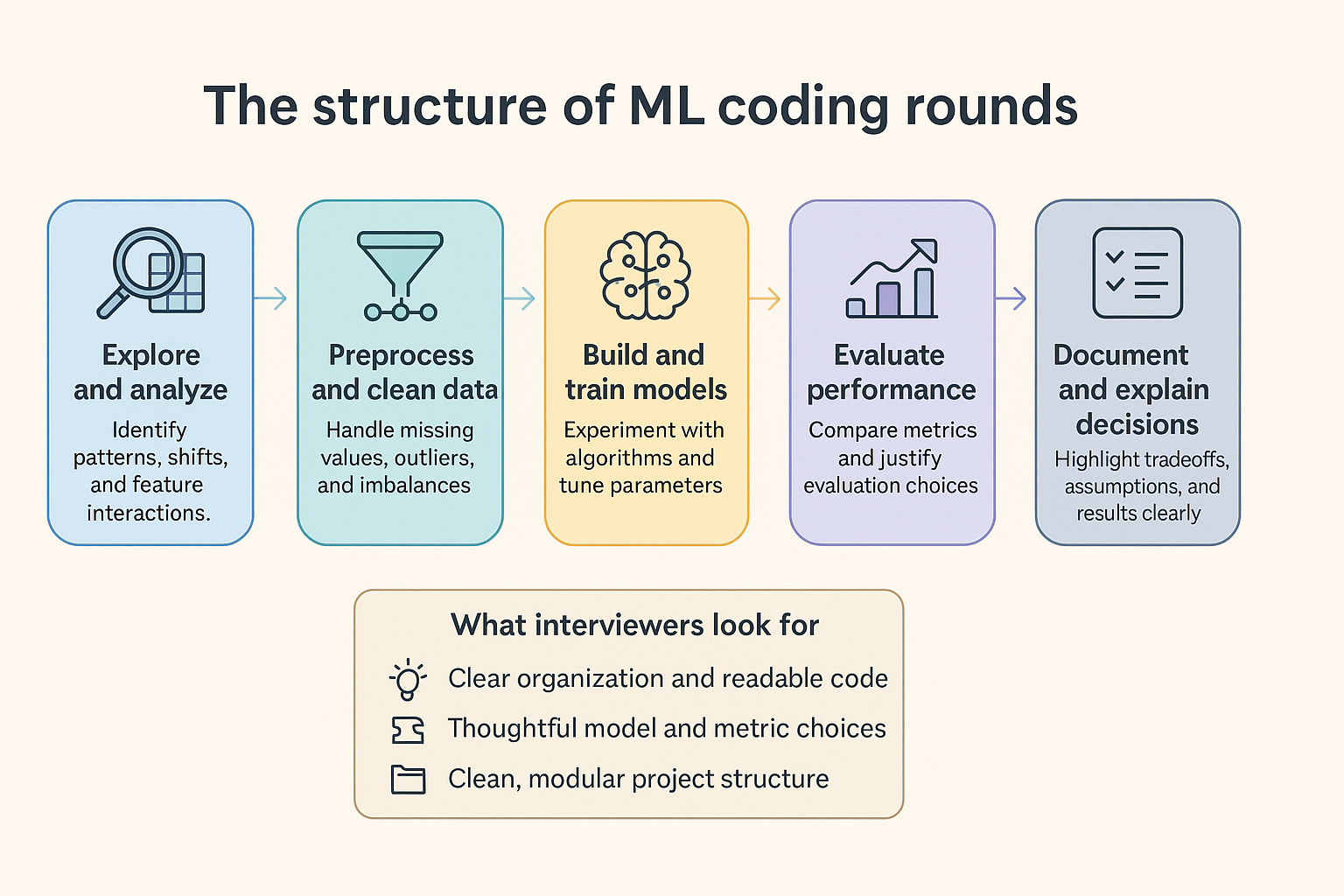
At a high level, interview loops blend take-home assignments, live coding sessions, and foundational algorithmic rounds. Each exists for a reason. Take-homes reveal how you work independently. Live coding shows how you reason under pressure. Algorithms and statistics rounds confirm that you have the technical foundation to build scalable systems.
How different rounds evaluate different skills#
Interview round | Primary signal | What interviewers evaluate |
Take-home project | End-to-end thinking | Structure, assumptions, communication |
Live ML coding | Real-time reasoning | Trade-offs, debugging, clarity |
DS&A round | Engineering fundamentals | Efficiency, correctness |
Stats / theory | Modeling intuition | Sound decision-making |
Understanding why each round exists helps you tailor both your preparation and your answers.
Take-home ML assignments: clarity under ambiguity#
Take-home assignments are often the most revealing part of an ML interview. They deliberately resemble real work: ambiguous problem statements, imperfect data, and limited guidance. Interviewers are not looking for a perfect model. They are looking for how you approach uncertainty.
A strong submission tells a coherent story. It starts with exploratory analysis that demonstrates you understand the data’s distributions, quirks, and limitations. Preprocessing decisions are explained rather than applied mechanically. If you handle missing values, outliers, or class imbalance, you explain why those steps matter for this specific problem.
Modeling choices should feel intentional. Interviewers are far more impressed by one well-justified model than by a shallow comparison of many algorithms. Evaluation metrics are selected based on the real objective, not habit.
A strong answer sounds like this: “I chose precision–recall AUC instead of accuracy because the dataset is highly imbalanced and false positives carry a real downstream cost.”
Beyond modeling, interviewers also assess how you package your work. Clean repository structure, modular code, readable notebooks, and concise documentation signal that you can operate in a production ML environment—not just complete an assignment.
Live ML coding sessions: thinking out loud matters#
Live coding interviews test a different skill: your ability to reason while writing code. These sessions often combine algorithmic thinking with practical ML implementation, but the strongest signal comes from how you communicate.

Interviewers expect you to narrate your thought process. Silence works against you because they cannot see your reasoning. Explaining what you are doing, why you are doing it, and what trade-offs you are making builds confidence—even if the solution is incomplete.
You might be asked to implement a simplified algorithm, debug a broken training loop, or reason through why a model behaves poorly. The goal is not production-ready code; it is structured thinking.
What interviewers are really testing: Can you translate conceptual understanding into working code while adapting when things go wrong?
Strong candidates also acknowledge shortcuts. Saying “I’m skipping regularization for now due to time” signals awareness, not weakness.
Core data structures and algorithms still matter#
Even for ML-focused roles, software engineering fundamentals remain essential. Machine learning systems are still systems. Inefficient logic, poor memory usage, or unscalable data handling can derail ML projects long before model quality becomes the issue.
Interviewers use DS&A questions to confirm that you can reason about performance and correctness. These skills show up everywhere in ML work: feature pipelines, batch inference, data joins, and real-time serving.
Common pitfall: Treating DS&A questions as irrelevant because “this is an ML role.”
After explaining your reasoning, a short recap is enough:
Efficient iteration and data access
Comfort with trees, graphs, and arrays
Clear time and space complexity analysis
Probability and statistics: grounding your decisions#
Statistics is the bridge between data and decisions. In ML interviews, statistical questions are rarely abstract. They are tied directly to modeling choices.
When an interviewer asks about regularization, they want to know how it affects generalization. When they ask about metrics, they want to see whether you can align evaluation with business impact.
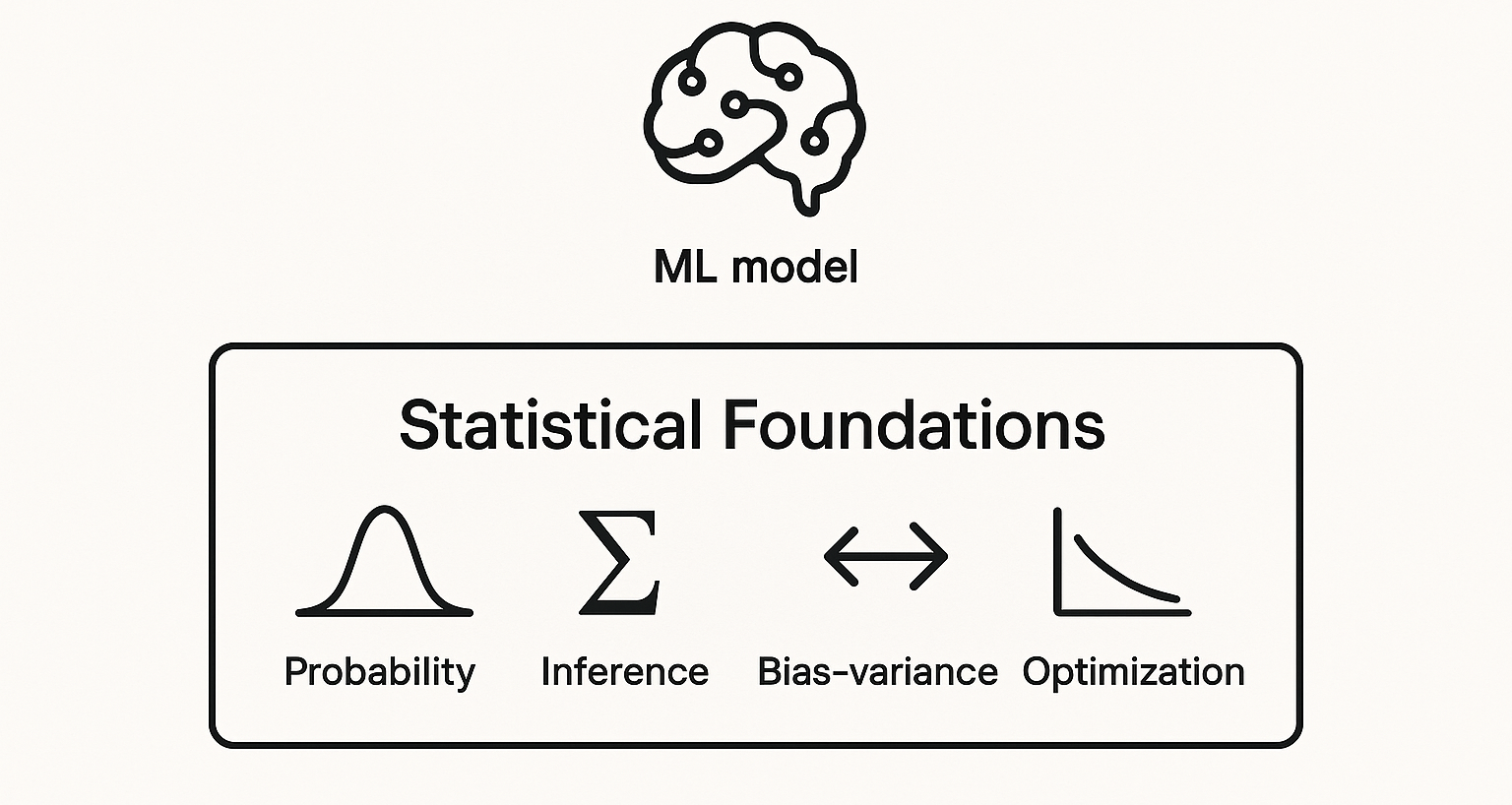
Strong candidates explain intuition before formulas. They describe why a metric is appropriate before defining it mathematically.
A strong answer sounds like this: “Accuracy hides the failure modes here, so I’d prioritize recall even if it increases false positives.”
Common evaluation considerations#
Scenario | Preferred metric | Why |
Class imbalance | Precision / recall | Accuracy is misleading |
Ranking tasks | AUC / NDCG | Order matters |
Regression with outliers | MAE | Robust to extremes |
How interviewers evaluate your thinking process (not just your code)#
One of the most overlooked aspects of ML interviews is that interviewers continuously evaluate how you think. They listen for assumptions, mental models, and your ability to course-correct.
Strong candidates verbalize uncertainty. They state assumptions explicitly and ask clarifying questions when requirements are ambiguous. When new information invalidates an approach, they adapt calmly instead of defending a flawed solution.
What interviewers are really testing: Can this person reason clearly when the problem is underspecified or changes midstream?
Common ML coding interview failure modes—and how to avoid them#
Many candidates fail ML interviews not because they lack knowledge, but because they fall into predictable traps.
Data leakage is one of the most common. Using information during training that would not be available at inference invalidates results. Metric misuse is another frequent issue, such as optimizing accuracy in settings where it does not reflect real success.
Overengineering also hurts candidates. Complex models applied to simple problems often obscure reasoning rather than improve outcomes. Finally, poor communication can undermine even strong technical solutions.
Frequent failure modes#
Failure | Why it hurts | How to avoid it |
Data leakage | Inflated performance | Strict train/test boundaries |
Metric misuse | Misaligned goals | Tie metrics to problem context |
Overengineering | Low signal | Start simple, justify complexity |
Poor communication | Lost confidence | Narrate decisions clearly |
From notebook to production: what interviewers expect you to anticipate#
Even when interviews focus on modeling, interviewers listen for production awareness. They want to know whether you understand that real ML systems must be reproducible, monitorable, and maintainable.
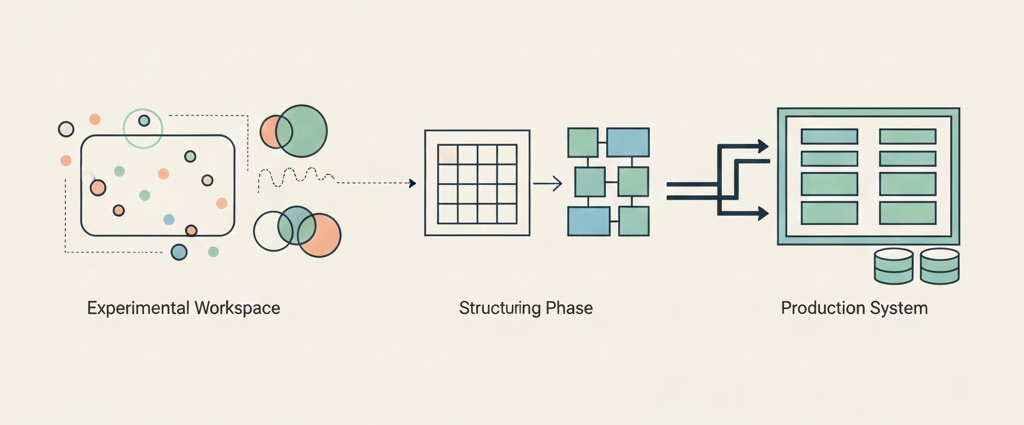
This does not mean designing a full deployment pipeline in an interview. It means acknowledging constraints such as data versioning, experiment reproducibility, model drift, and monitoring.
A strong answer sounds like this: “In production, I’d monitor feature distributions to detect drift and trigger retraining.”
Final thoughts#
Machine learning coding interview questions are not about perfection. They are about judgment, clarity, and adaptability. Interviewers want engineers who can reason about data, write maintainable code, and communicate decisions under uncertainty.
If you focus on explaining your thinking, grounding your choices in principles, and anticipating real-world constraints, you will be prepared for the full range of machine learning coding interview questions companies use to identify strong ML engineers.
Happy learning!