Mobile System Design Explained
Design mobile systems that survive real-world conditions. Learn how offline support, efficient APIs, secure authentication, and scalable backends come together to create fast, reliable mobile experiences users trust, even on unreliable networks.
Mobile applications are often the primary interface between users and a product. Whether it’s a banking app, a social platform, a ride-hailing service, or a productivity tool, users expect mobile experiences to feel fast, reliable, and intuitive. What they interact with on screen, however, is only the visible layer of a much deeper System Design challenge.
Mobile System Design focuses on building resilient client–server systems that continue to work under unstable networks, constrained devices, and unpredictable user behavior. Unlike traditional web systems, mobile applications must assume that clients can disconnect at any moment, lose power, or be terminated by the operating system without warning.
This reality is why mobile is a common System Design interview question. Interviewers are not testing UI knowledge or platform-specific APIs. They are evaluating whether you understand how real-world constraints influence architectural decisions and long-term system behavior.
System Design Deep Dive: Real-World Distributed Systems
This course deep dives into how large, real-world systems are built and operated to meet strict service-level agreements. You’ll learn the building blocks of a modern system design by picking and combining the right pieces and understanding their trade-offs. You’ll learn about some great systems from hyperscalers such as Google, Facebook, and Amazon. This course has hand-picked seminal work in system design that has stood the test of time and is grounded on strong principles. You will learn all these principles and see them in action in real-world systems. After taking this course, you will be able to solve various system design interview problems. You will have a deeper knowledge of an outage of your favorite app and will be able to understand their event post-mortem reports. This course will set your system design standards so that you can emulate similar success in your endeavors.
The core challenge of mobile System Design#
At its core, mobile System Design is about building distributed systems with unreliable clients. Mobile devices differ widely in hardware capabilities, operating system behavior, and network quality. A well-designed system must continue functioning even when ideal conditions are absent.
Instead of fighting these constraints, strong mobile System Design embraces them. The system assumes intermittent connectivity, limited resources, and frequent interruptions, then designs around those realities.
The table below highlights why mobile environments demand different design choices than traditional web systems.
Constraint area | Mobile reality | Design implication |
Network | Intermittent or unavailable | Offline support and retries are required |
Device resources | Limited CPU, memory, and battery | Efficient computation and network usage |
App lifecycle | Apps are frequently paused or killed | State persistence is essential |
User expectations | Immediate feedback | Low perceived latency matters |
Accepting these constraints early leads to more robust designs.
Functional requirements in mobile systems#
Functional requirements define what a mobile system allows users to do. Conceptually, these requirements resemble those of web systems, but their implementation differs significantly due to mobile limitations.
Most mobile applications need to authenticate users, fetch data, allow users to create or update content, and react to events such as messages or status changes. Push notifications are often part of this experience, enabling interaction even when the app is inactive.
When grokking System Design, it helps to anchor these requirements to a concrete example, such as a social feed or an e-commerce app, before generalizing. This demonstrates clarity of thinking and practical understanding of mobile workflows.
Non-functional requirements that shape mobile System Design#
Non-functional requirements often influence mobile System Design more than functional needs. Performance, reliability, and efficiency directly affect user retention and trust.
Mobile users quickly abandon apps that feel slow, drain battery, or behave unpredictably. Security is also critical, as mobile devices frequently store sensitive personal data and are easily lost or compromised.
The table below summarizes key non-functional concerns and why they matter specifically in mobile systems.
Requirement | Why it matters |
Low latency | Slow apps lose users quickly |
Availability | Clients fail often; servers must not |
Offline support | Network access cannot be assumed |
Resource efficiency | Battery and data usage affect retention |
Security | Devices are personal and exposed |
Scalability | Mobile traffic is bursty and uneven |
Addressing these constraints explicitly signals production-level System Design thinking.
Scalability & System Design for Developers
As you progress in your career as a developer, you'll be increasingly expected to think about software architecture. Can you design systems and make trade-offs at scale? Developing that skill is a great way to set yourself apart from the pack. In this Skill Path, you'll cover everything you need to know to design scalable systems for enterprise-level software.
High-level architecture of a mobile system#
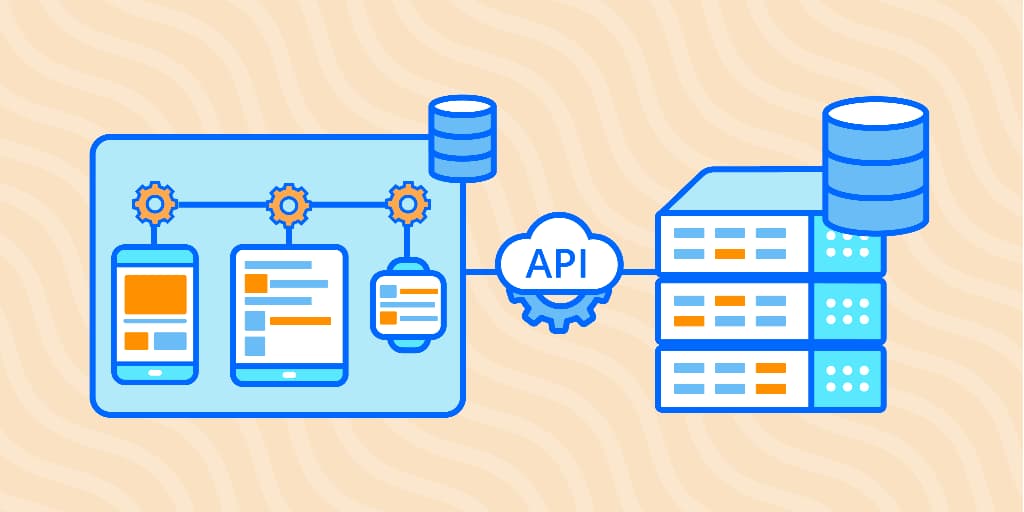
Most mobile systems follow a client–server architecture with clear separation of responsibilities. The mobile client focuses on presentation and local state, while backend services handle business logic, persistence, and coordination.
At a high level, the mobile client is responsible for rendering the user interface, managing local storage, and orchestrating network requests. Backend services manage authentication, data access, and long-running operations, while notification services handle asynchronous updates.
This separation allows both the client and backend to evolve independently, which is essential for long-lived mobile systems.
Designing the mobile client#
The mobile client is not just a UI layer. It plays a critical role in system reliability, performance, and user experience. A well-designed client carefully manages local state, minimizes unnecessary network calls, and handles interruptions gracefully.
Local caching reduces perceived latency and improves offline usability. Persistent storage ensures the app can recover state after restarts. Network orchestration avoids redundant requests, and thoughtful error handling prevents user frustration during failures.
Strong mobile System Design minimizes reliance on continuous connectivity and treats the client as an intelligent participant in the system.
Backend API design for mobile systems#
APIs built for mobile clients differ from traditional web APIs. Mobile apps are sensitive to both latency and payload size, which makes efficiency a top priority.
Rather than exposing many fine-grained endpoints, mobile-friendly APIs often aggregate related data into fewer calls. Payloads are carefully shaped to return only what the client needs. API versioning allows backend systems to evolve without breaking older app versions that users may not update immediately.
Designing APIs this way enables teams to improve backend functionality while maintaining a stable mobile experience.
Data synchronization and offline behavior#
Offline support is one of the most complex aspects of mobile System Design. Many mobile apps must continue functioning when the device is offline, then reconcile changes once connectivity returns.
This typically involves storing data locally, queueing write operations while offline, and running background synchronization when the network becomes available. Conflict resolution is often required when multiple updates occur on different clients.
Synchronization logic must be resilient to partial failures, retries, and inconsistent states, making it one of the most challenging parts of mobile systems.
Caching strategies in mobile systems#
Caching improves performance and reduces backend load, but it introduces the risk of stale data. Mobile systems often use multiple caching layers to balance freshness and responsiveness.
In-memory caches support fast access during active sessions. Persistent storage enables offline access and faster app startup. Backend caches reduce database pressure during traffic spikes.
A strong mobile System Design clearly defines when cached data is acceptable and when fresh data must be fetched to preserve correctness.
Authentication and security in mobile System Design#
Security is especially important in mobile systems because devices can be lost, stolen, or compromised. Token-based authentication is commonly used to limit exposure and control session lifetimes.
Secure storage mechanisms protect credentials on the device. Short-lived tokens reduce the impact of leaks, while encrypted communication prevents interception. Protecting against replay attacks and unauthorized access is essential for maintaining trust.
Addressing security early reflects responsible System Design thinking.
Push notifications and asynchronous updates#
Push notifications allow backend systems to re-engage users even when the app is not running. They are asynchronous by nature and operate independently from core request flows.
Designing notifications involves balancing reliability with user experience. Notifications may be delayed or dropped, so systems must handle uncertainty gracefully. Overuse can annoy users, while well-designed deep links guide them to the right context when they return.
When done well, notifications enhance engagement without disrupting usability.
Handling network failures gracefully#
Network failures are normal in mobile environments. Systems must recover without draining the battery or overwhelming backend services.
Retries should be controlled using techniques like exponential backoff. APIs should be idempotent to avoid duplicate actions. Clear user feedback during extended outages helps maintain trust.
Graceful failure handling is a hallmark of strong mobile System Design.
Performance optimization in mobile systems#
Performance directly influences retention. Users expect apps to feel fast, even on slow networks or older devices.
Reducing startup time improves first impressions. Minimizing payload sizes speeds up interactions. Background prefetching prepares data without blocking the user interface.
Every performance optimization should be tied back to perceived user experience, not just raw metrics.
Designing for scalability#
Mobile traffic often arrives in bursts, driven by notifications, events, or time-zone patterns. Backend systems must absorb these spikes without degrading performance.
Horizontal scaling, aggressive caching, and asynchronous processing help systems remain responsive as usage grows. Designing for scale ensures that the system continues to perform well as adoption increases.
Observability and monitoring in production#
Operating mobile systems requires visibility into both client-side and server-side behavior. Many issues only appear on specific devices, operating systems, or network conditions.
Monitoring API latency, crash rates, synchronization failures, and notification delivery success allows teams to detect problems early and respond quickly. Strong observability shortens recovery time and improves reliability.
What interviewers look for in mobile System Design#
Interviewers are not evaluating knowledge of mobile frameworks. They want to see how you reason about unreliable clients, constrained environments, and long-lived systems. Clear trade-off analysis, structured thinking, and the ability to explain failure scenarios matter far more than implementation details.
Final thoughts#
Mobile System Design is about building systems that succeed under imperfect conditions. Strong designs assume unreliable networks, limited devices, and high user expectations from the start. When you can clearly explain how your system behaves when things go wrong, you demonstrate real-world engineering maturity and sound System Design judgment.