OpenAI software engineer interview: 2026 preparation guide
Preparing for the OpenAI software engineer interview takes more than solving coding problems. Master practical engineering, System Design, communication, and interview strategy with structured learning and realistic practice to stand out in every round.
Landing an OpenAI software engineer interview is different from interviewing at most technology companies. While strong computer science fundamentals still matter, OpenAI places equal emphasis on engineering judgment, collaboration, practical problem-solving, and the ability to build reliable software under real-world constraints. According to OpenAI's official interview guide, candidates are evaluated not only on technical excellence but also on communication, adaptability, and alignment with the company's mission of building safe AI that benefits humanity.
If you've been preparing with hundreds of LeetCode questions alone, you're probably missing an important part of the interview. The OpenAI interview process often goes beyond isolated algorithms and instead explores how you reason through ambiguity, improve existing systems, explain trade-offs, and write production-quality code. Recent candidate reports also suggest a growing focus on practical engineering problems, distributed systems, infrastructure, and AI-powered products.
This blog breaks down everything you should know about the OpenAI software engineer interview, including the hiring process, common interview stages, coding expectations, System Design preparation, behavioral questions, and a practical roadmap to maximize your chances of success.
Why the OpenAI software engineer interview is different#
Most software engineering interviews primarily evaluate whether you can solve algorithmic problems quickly.
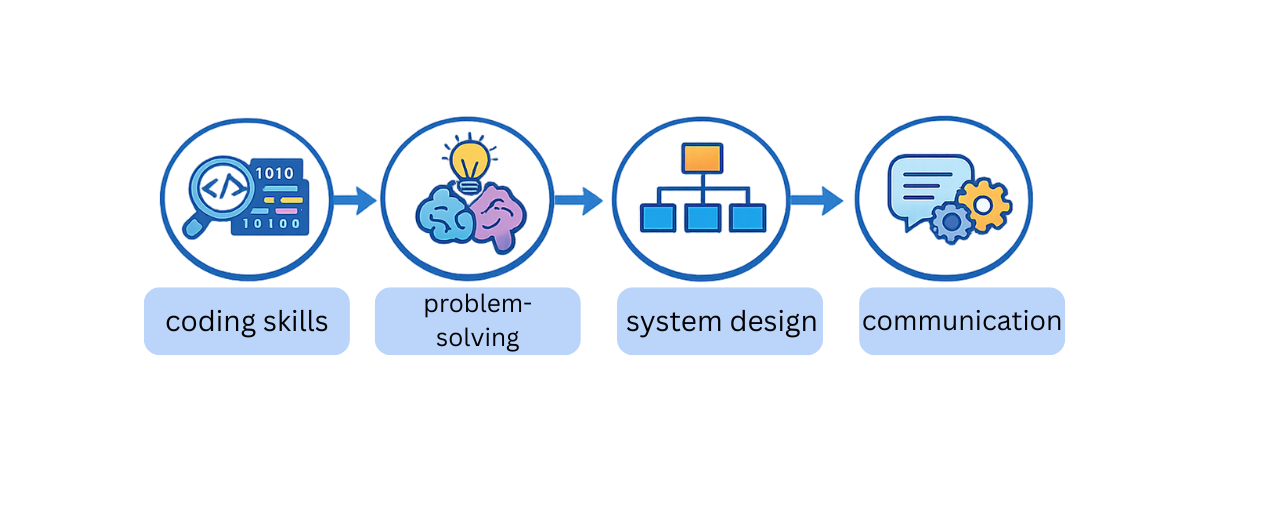
OpenAI certainly expects excellent coding ability, but interviewers also want to understand how you think as an engineer. They care about your reasoning process, communication, engineering maturity, and how your solutions evolve when new constraints are introduced.
Candidates are frequently expected to explain why they chose one architecture over another, how they would improve maintainability, and how their design changes as requirements evolve.
Some of the areas interviewers commonly evaluate include:
Clean, maintainable code
Strong computer science fundamentals
Distributed systems knowledge
Performance optimization
Reliability and testing
Communication during problem solving
Collaboration and feedback
Interest in AI and OpenAI's mission
Instead of memorizing solutions, successful candidates demonstrate strong engineering judgment throughout the discussion.
Typical OpenAI software engineer interview process#
Although the exact process varies by team, OpenAI's official hiring guide outlines a consistent structure that most engineering candidates experience.
Stage | What to expect |
Resume review | Recruiter evaluates background and experience |
Recruiter screen | Career discussion, motivation, previous projects |
Technical assessment | Live coding, take-home assignment, or pair programming |
System Design | Large-scale architecture discussion |
Final interview loop | Multiple engineering and behavioral interviews |
Hiring decision | References and final offer |
For many software engineering positions, candidates spend four to six hours in final interviews across several interviewers. Engineering interviews emphasize solution quality, performance, testing, and communication.
Resume screening tips#
Your interview begins long before the first coding problem.
OpenAI receives applications from exceptional engineers around the world, so your resume should demonstrate measurable engineering impact instead of simply listing technologies.
Strong resumes usually emphasize:
Systems built at scale
Performance improvements
Infrastructure ownership
Reliability work
Developer productivity improvements
AI or machine learning projects
Open-source contributions
Technical leadership
Quantifying impact makes your experience significantly stronger than simply listing responsibilities.
What happens during the coding interview#
OpenAI coding interviews often resemble engineering tasks rather than competitive programming contests.
Interviewers want to see clean implementation, thoughtful design, readable code, and excellent communication while solving the problem.
Recent interview reports suggest candidates encounter practical problems involving data structures, caching, rate limiting, serialization, state management, and API behavior instead of obscure algorithm puzzles.
While preparing, focus on:
Arrays and strings
Hash maps
Trees and graphs
Queues and heaps
Dynamic programming
Concurrency basics
Object-oriented design
Testing edge cases
Just as importantly, explain your thought process while coding instead of silently writing the solution.
Grokking the Coding Interview Patterns

I created Grokking the Coding Interview because I watched too many talented engineers fail interviews they should have passed. At Microsoft and Meta, I saw firsthand what separated the candidates who succeeded from the ones who didn't. It wasn't how many LeetCode problems they'd solved. It was whether they could look at an unfamiliar problem and know how to approach it the right way. That's what this course teaches. Rather than throwing hundreds of disconnected problems at you, we organize the entire coding interview around 28 fundamental patterns. Each pattern is a reusable strategy. Once you understand two pointers, for example, you can apply them to dozens of problems you've never seen before. The course walks you through each pattern step by step, starting with the intuition behind it, then building through increasingly complex applications. As with every course on Educative, you will practice in a hands-on way with 500+ challenges, 17 mock interviews, and detailed explanations for every solution. The course is available in Python, Java, JavaScript, Go, C++, and C#, so you can prep in the language you'll actually use in your interview. Whether you're preparing for your first FAANG loop or brushing up after a few years away from interviewing, this course will give you a repeatable framework for cracking the coding interview.
System Design carries enormous weight#
For experienced engineers, the System Design interview is often one of the most important stages.
Unlike traditional System Design interviews that focus only on familiar products like Twitter or Dropbox, OpenAI interviewers increasingly explore infrastructure related to AI systems, APIs, distributed services, and high-scale platforms.
Topics you should comfortably discuss include:
Load balancing
Distributed caching
Database replication
Event-driven architecture
API gateways
Rate limiting
Streaming systems
Fault tolerance
Observability
Horizontal scaling
Many candidates report that interviewers continually introduce new constraints during the conversation to evaluate how well your design adapts.
Grokking Modern System Design Interview

For a decade, when developers talked about how to prepare for System Design Interviews, the answer was always Grokking System Design. This is that course — updated for the current tech landscape. As AI handles more of the routine work, engineers at every level are expected to operate with the architectural fluency that used to belong to Staff engineers. That's why System Design Interviews still determine starting level and compensation, and the bar keeps rising. I built this course from my experience building global-scale distributed systems at Microsoft and Meta — and from interviewing hundreds of candidates at both companies. The failure pattern I kept seeing wasn't a lack of technical knowledge. Even strong coders would hit a wall, because System Design Interviews don't test what you can build; they test whether you can reason through an ambiguous problem, communicate ideas clearly, and defend trade-offs in real time (all skills that matter more than ever now in the AI era). RESHADED is the framework I developed to fix that: a repeatable 45-minute roadmap through any open-ended System Design problem. The course covers the distributed systems fundamentals that appear in every interview – databases, caches, load balancers, CDNs, messaging queues, and more – then applies them across 13+ real-world case studies: YouTube, WhatsApp, Uber, Twitter, Google Maps, and modern systems like ChatGPT and AI/ML infrastructure. Then put your knowledge to the test with AI Mock Interviews designed to simulate the real interview experience. Hundreds of thousands of candidates have already used this course to land SWE, TPM, and EM roles at top companies. If you're serious about acing your next System Design Interview, this is the best place to start.
Behavioral interviews matter more than many candidates expect#
OpenAI repeatedly emphasizes collaboration, feedback, curiosity, and mission alignment throughout its hiring process.
Expect questions such as:
Tell me about a difficult engineering project.
Describe a disagreement with another engineer.
How do you handle technical feedback?
What's the hardest production issue you've solved?
Why OpenAI?
What excites you about AI?
Good behavioral answers include:
Clear context
Your individual contribution
Technical decisions
Measurable results
Lessons learned
Interviewers generally prefer authentic stories over rehearsed responses.
Grokking the Behavioral Interview

Behavioral interviews have become a decisive part of the hiring process across roles. Whether you’re a software engineer, product manager, or engineering leader, strong technical skills alone are no longer enough. Companies are evaluating how you think, communicate, and operate in real-world situations. That’s why preparing specifically for behavioral interviews is critical. This is why I built this course around a common gap: candidates often underestimate behavioral interviews or prepare for them too late. As a result, even strong candidates struggle to clearly articulate their experiences, decisions, and impact. The goal here is to give you a structured way to approach behavioral questions with clarity and confidence. You’ll learn how to break down common behavioral interview questions, structure your answers, and communicate your experiences effectively. The course also includes a video recording feature, allowing you to practice your responses, review them, and improve over time. By the end, you’ll have a repeatable approach to behavioral interviews, one that helps you present your experiences clearly and perform with confidence in any interview setting.
Common technical topics to study#
Preparing broadly instead of narrowly gives you the highest probability of success.
Topic | Importance |
Data structures | High |
Algorithms | High |
System Design | Very High |
Distributed systems | Very High |
Networking | High |
Databases | High |
Concurrency | High |
Operating systems | Medium |
API design | Very High |
Testing | High |
You don't need to become an expert in every domain, but you should understand how these concepts work together in production systems.
How to prepare for the OpenAI software engineer interview#
Many candidates spend months solving coding questions but relatively little time practicing engineering discussions.
A more balanced preparation strategy typically produces better results.
A structured study plan could look like this:
Weeks 1-2#
Refresh algorithms
Practice coding daily
Review data structures
Weeks 3-4#
Study distributed systems
Practice API design
Review networking fundamentals
Weeks 5-6#
Complete mock interviews
Practice behavioral responses
Review previous engineering projects
Final week#
Read recent OpenAI research
Review company blog posts
Practice explaining architecture aloud
Focus on communication instead of memorization
OpenAI itself recommends becoming familiar with its latest work, blog posts, and research before interviewing.
Mistakes candidates commonly make#
Many technically strong engineers fail interviews for reasons unrelated to coding ability.
Some of the most common mistakes include:
Jumping into coding too quickly
Ignoring edge cases
Poor communication
Weak testing strategy
Overcomplicated solutions
Memorized System Designs
Limited understanding of trade-offs
The strongest candidates continually explain their reasoning, verify assumptions, and improve their solutions as the interview progresses.
Resources that help the most#
Preparing effectively means combining multiple learning resources instead of relying on a single platform.
Consider studying:
LeetCode problems for coding practice
System Design interview courses
Distributed systems books
Networking fundamentals
Mock interviews
OpenAI research publications
OpenAI engineering blog posts
Real interview simulations often provide more value than solving dozens of isolated problems because they improve communication alongside technical ability.
Final thoughts#
The OpenAI software engineer interview is challenging because it evaluates far more than programming knowledge. The interview measures how you think through ambiguity, collaborate with others, communicate technical decisions, and build reliable systems that can operate at enormous scale.
Rather than trying to memorize every possible interview question, focus on becoming a stronger engineer. Write clean code, understand distributed systems, practice explaining trade-offs, and build real projects that demonstrate engineering depth. Those are the qualities that consistently appear throughout OpenAI's own hiring guidance and recent candidate experiences.
Frequently asked questions#
How difficult is the OpenAI software engineer interview?#
It is generally considered one of the most challenging software engineering interview processes because it combines coding, System Design, behavioral interviews, and deep technical discussions focused on real-world engineering.
Does OpenAI ask LeetCode questions?#
Yes, but interviews often emphasize practical engineering problems rather than obscure algorithm puzzles. Clean code, testing, and communication are equally important.
How many interview rounds does OpenAI have?#
Most candidates go through several stages, including recruiter screening, technical assessment, System Design, behavioral interviews, and a final interview loop, although the exact process varies by role and team.
Is System Design required?#
Yes. Mid-level and senior software engineering candidates should expect a System Design interview focused on scalability, reliability, and engineering trade-offs.
Should I study AI before interviewing?#
You don't necessarily need to be an AI researcher, but understanding OpenAI's products, recent research, and the company's mission will help throughout the interview process.