What is Keras? A beginner-friendly guide to the Deep Learning API
Discover how Keras makes deep learning simple. Learn to build, train, and experiment with neural networks using an intuitive Python API. Start your journey into AI with one of the most beginner-friendly tools used by developers today.

Developers who begin learning deep learning often encounter many frameworks and tools used to build neural networks. At this stage, it is common for beginners to ask what is Keras when they see it referenced in tutorials, machine learning notebooks, or artificial intelligence projects.
Deep learning frameworks have dramatically simplified the development of machine learning models. In the early days of neural network development, implementing models required extensive mathematical coding and complex numerical computations. Modern frameworks abstract much of this complexity, allowing developers to focus on designing models rather than implementing low-level operations.
Keras has played an important role in making deep learning accessible to a broader audience. By providing a high-level interface for building neural networks, it allows developers to create, train, and evaluate machine learning models with relatively concise and readable code.
An Introductory Guide to Data Science and Machine Learning

There is a lot of dispersed and somewhat conflicting information on the internet when it comes to data science, making it tough to know where to start. Don't worry. This course will get you familiar with the state of data science and the related fields such as machine learning and big data. You'll learn the fundamental concepts and libraries that are essential to solve any problem in this field. You will work on real-time projects from Kaggle while also honing your mathematical skills, which will be used extensively in most problems you face. You'll go through a systematic approach to learning about data acquisition to data wrangling and everything in between. This is your all-in-one guide to becoming a confident data scientist.
This guide explains how Keras works, how it integrates with the broader Python machine learning ecosystem, and how developers use it to build neural networks.
What is Keras?#
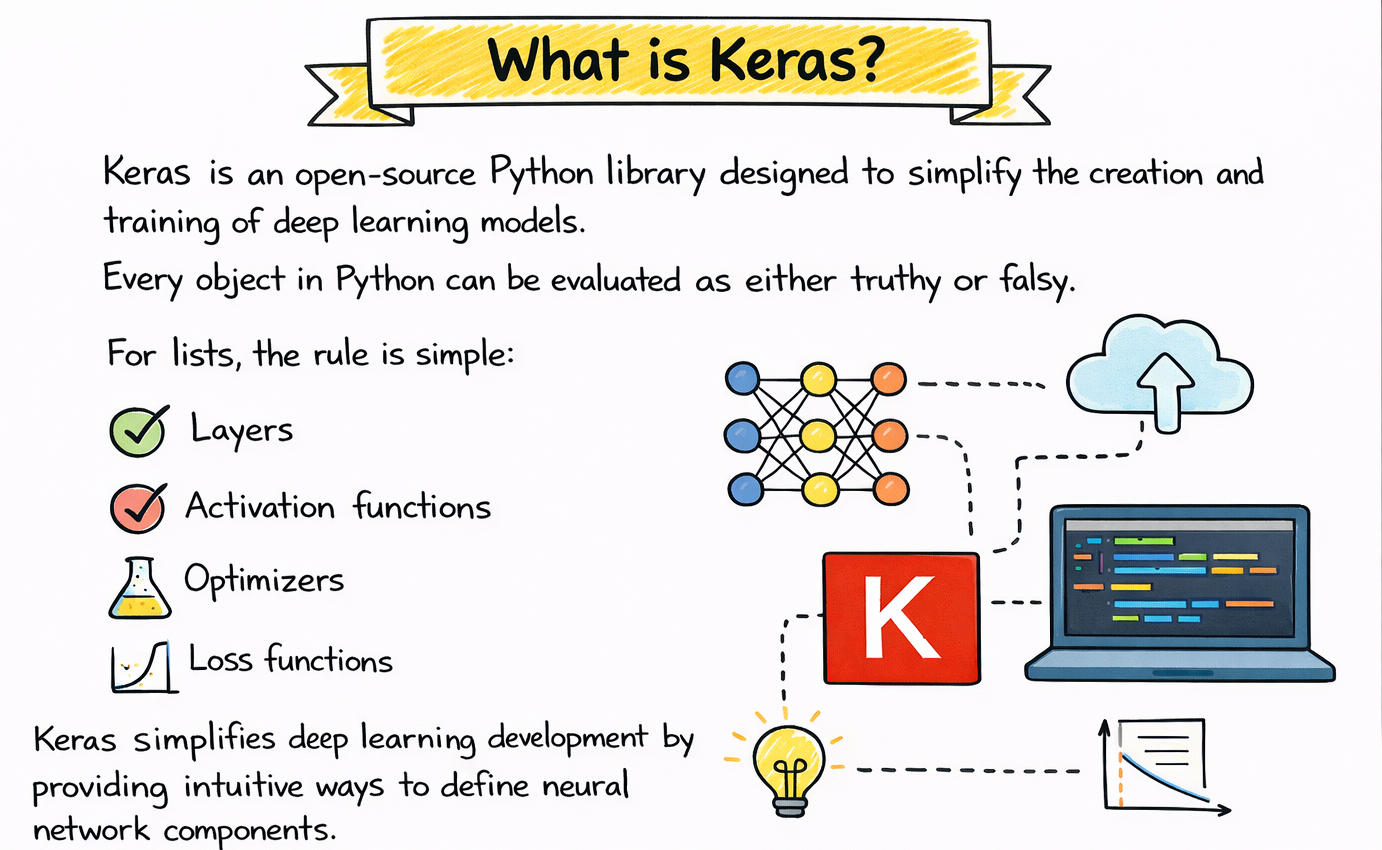
Keras is an open-source Python library designed to simplify the creation and training of deep learning models. It provides a high-level application programming interface that allows developers to define neural networks without needing to interact directly with the low-level numerical operations required by deep learning algorithms.
In traditional machine learning frameworks, developers often had to manually manage tensors, gradients, and complex optimization routines. Keras simplifies this process by providing intuitive abstractions for common neural network components such as layers, activation functions, optimizers, and loss functions.
Because of its simplicity and readability, Keras has become one of the most approachable tools for developers who want to begin building deep learning models. When learners ask what is Keras, they are usually trying to understand how it simplifies the development of neural networks within Python-based machine learning workflows.
Fundamentals of Machine Learning for Software Engineers
Machine learning is the future for the next generation of software professionals. This course serves as a guide to machine learning for software engineers. You’ll be introduced to three of the most relevant components of the AI/ML discipline; supervised learning, neural networks, and deep learning. You’ll grasp the differences between traditional programming and machine learning by hands-on development in supervised learning before building out complex distributed applications with neural networks. You’ll go even further by layering networks to create deep learning systems. You’ll work with complex real-world datasets to explore machine behavior from scratch at each phase. By the end of this course, you’ll have a working knowledge of modern machine learning techniques. Using software engineering, you’ll be prepared to build complex neural networks and wrangle real-world data challenges.
Keras overview#
Feature | Description |
Library name | Keras |
Programming language | Python |
Primary purpose | Deep learning model development |
Backend support | TensorFlow (most common) |
Typical users | Machine learning engineers, data scientists |
Each feature helps illustrate how Keras fits into the machine learning ecosystem.
The library name Keras refers to the high-level interface used to design neural networks. The tool focuses on simplifying deep learning development. The programming language used is Python, which allows Keras to integrate easily with other machine learning libraries such as NumPy, Pandas, and TensorFlow.
The primary purpose of Keras is deep learning model development. It provides tools for defining model architectures, training neural networks, and evaluating model performance. Backend support typically comes from TensorFlow, which performs the underlying numerical computations required during training.
Typical users include machine learning engineers and data scientists who build and deploy neural network models for various applications.
Key features of Keras#
Several features have contributed to Keras becoming a widely adopted tool for deep learning development.
User-friendly API design: Keras provides a clear and intuitive interface for building neural networks. Developers can define complex models using concise Python code, which reduces the learning curve for beginners and improves code readability.
Modular neural network components: Keras organizes neural networks using modular building blocks such as layers, activation functions, optimizers, and loss functions. This modular structure allows developers to combine components in flexible ways when designing models.
Integration with TensorFlow: Modern versions of Keras are tightly integrated with TensorFlow. This integration allows developers to benefit from TensorFlow’s powerful computational engine while maintaining the simplicity of the Keras interface.
Support for rapid experimentation: Deep learning development often involves testing different model architectures and hyperparameters. Keras makes experimentation easier by allowing developers to quickly modify models and retrain them.
Easy model building and training: Keras provides built-in methods for compiling, training, and evaluating models. Developers can train neural networks using a few simple commands rather than writing complex training loops manually.
These features help explain why Keras is frequently recommended for developers beginning their journey into deep learning.
How Keras works with TensorFlow#
Modern versions of Keras are integrated directly into TensorFlow as TensorFlow Keras, commonly accessed through the tf.keras module. This integration allows developers to define neural networks using Keras while relying on TensorFlow for the underlying numerical computations.
TensorFlow acts as the computational engine that performs tensor operations, gradient calculations, and optimization processes during model training. Keras provides a simpler interface that allows developers to describe neural network architectures in an intuitive way.
For example, developers can define layers, activation functions, and training configurations using Keras syntax, while TensorFlow handles the heavy computational workload behind the scenes.
Understanding this relationship helps clarify what is Keras within the modern machine learning ecosystem, since it functions as a high-level interface built on top of a powerful deep learning framework.
Simple Keras example#
The following example demonstrates how a simple neural network can be defined using Keras.
from tensorflow import kerasfrom tensorflow.keras import layersmodel = keras.Sequential([layers.Dense(64, activation="relu"),layers.Dense(10, activation="softmax")])
This example defines a neural network using the Sequential model type. The Sequential model allows layers to be stacked in a linear order.
The first layer is a dense layer with sixty-four neurons and a ReLU activation function. This layer processes the input data and learns intermediate representations. The second layer contains ten neurons with a softmax activation function, which is commonly used for classification problems where the model must predict one of several possible categories.
Although this example defines only a simple architecture, it illustrates how Keras allows developers to describe neural networks clearly and concisely.
Keras vs other deep learning frameworks#
Different deep learning frameworks provide different strengths depending on the needs of developers and researchers.
Framework | Strengths | Typical Use Case |
Keras | Beginner-friendly API | Rapid model development |
TensorFlow | Scalable deep learning platform | Production systems |
PyTorch | Flexible experimentation | Research and prototyping |
Keras focuses on simplicity and ease of use, which makes it a popular choice for developers who want to build neural networks quickly. TensorFlow provides a more comprehensive ecosystem for large-scale machine learning systems and production deployment.
PyTorch offers flexible model design and dynamic computation graphs, which are often preferred in research environments. Understanding the strengths of these frameworks helps developers choose the most appropriate tool for their projects.
Common use cases of Keras#
Keras is used in many real-world machine learning applications.
One common application involves image classification systems, where neural networks analyze images and identify objects or patterns. Another important use case involves natural language processing models, where neural networks process text data for tasks such as sentiment analysis or language translation.
Keras is also used in recommendation engines that analyze user behavior and suggest products, movies, or other content. Finally, many organizations use Keras for predictive analytics systems, where machine learning models analyze historical data to forecast future outcomes.
These applications demonstrate how Keras helps developers quickly build and experiment with neural network models.
FAQ#
Is Keras a library or a framework?#
Keras is typically described as a high-level deep learning library that operates on top of other frameworks, most commonly TensorFlow. It simplifies model development by providing a user-friendly interface for defining and training neural networks.
Do beginners need to learn TensorFlow before Keras?#
Beginners can start learning Keras without fully understanding TensorFlow because Keras abstracts many of the underlying complexities. However, gaining familiarity with TensorFlow concepts can be beneficial when building more advanced machine learning systems.
Is Keras still widely used?#
Yes, Keras remains widely used, especially because it is integrated into TensorFlow as the tf.keras module. Many machine learning practitioners use it to build models efficiently while leveraging TensorFlow’s powerful backend.
How does Keras compare with PyTorch?#
Keras focuses on simplicity and ease of use, which makes it appealing for rapid model development. PyTorch provides greater flexibility and is often preferred in research environments where developers need more control over model architecture and training processes.
Final words#
Keras has become an important tool in the modern machine learning ecosystem by simplifying the development of deep learning models. Its intuitive API allows developers to design neural networks, train models, and evaluate results using clear and concise Python code.
Understanding what is Keras helps developers begin working with neural networks and deep learning systems without needing to master low-level implementation details. By combining ease of use with integration into powerful frameworks such as TensorFlow, Keras provides a practical starting point for developers who want to build machine learning models and experiment with deep learning techniques.
