Partitioning
Explore the concept of partitioning in distributed systems to achieve scalability by dividing datasets across nodes. Understand the differences between vertical and horizontal partitioning, their benefits, limitations, and impact on transactional operations. This lesson helps you grasp key data distribution methods essential for designing scalable distributed systems.
One of the major benefits of distributed systems is scalability.
Scalability
Scalability lets us store and process datasets much larger than what we could with a single machine.

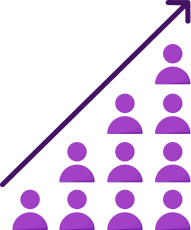
Mechanism to achieve scalability
One of the primary mechanisms of achieving scalability is partitioning.
Partitioning
Partitioning is the process of splitting a dataset into multiple, smaller datasets, and then assigning the responsibility of storing and processing them to different nodes of a distributed system. This allows us to add more nodes to our system and increase the size of the data it can handle.
There are two different variations of partitioning:
- Vertical partitioning
- Horizontal partitioning (or