Mini Map
Log In
C++ Standard Library including C++ 14 & C++ 17
0%
1.
Introduction
About this course
Conventions
Source Examples
Further Information
C++ versus C++11
2.
The Standard Library
History
Utilities
Components
3.
Overview
Numeric Functions
Text Processing
Input, Output and Filesystems
Multithreading
4.
Application of Libraries
Introduction
Including Header Files
Using Namespaces
Building an Executable
5.
Utilities
Utilities in C++ Standard Library
6.
Useful Functions
The min, max and minmax functions
Move vs. Copy
Forward
Swap
7.
Adaptors for Functions
std::bind and std::function
Behavior of std::bind and std::function
8.
Pairs and Tuples
Pairs
Tuples
9.
Reference Wrappers
Introduction
std::ref and std::cref
10.
Smart Pointers
Introduction
Unique Pointers
Shared Pointers
Weak Pointers
Cyclic References
11.
Type Traits
Introduction
Check Type Information
Type Comparisons and Modifications
12.
Time Library
Introduction
Time Point
Time Duration
Clock
13.
std::any, std::optional, and std::variant
std::any
std::optional
std::variant
14.
Interface of All Containers
Introduction
Create and Delete
Size
Access
Assign and Swap
Compare
15.
Sequential Containers
Introduction
Arrays
Vectors
Deques
Lists
Forward Lists
16.
Associative Containers
Introduction
Insertion and Deletion
17.
Ordered Associative Containers
Overview
Keys and Values
The Comparison Criterion
Special Search Functions
Maps
18.
Unordered Associative Containers
Overview
Keys and Values
Performance
The Hash Function
The Details
19.
Adaptors for Containers
Introduction
Stack
Queue
Priority Queue
20.
Iterators
Introduction
Categories
Iterator Creation
Useful Functions
Adaptors
21.
Callable Units
Introduction
Functions and Function Objects
Lambda Functions
22.
Algorithms
Introduction
Conventions
Iterators are the glue
Sequential, parallel, or parallel execution with vectorisation
Algorithms with Parallelized Versions
for_each
23.
Non-Modifying Algorithms
Introduction
Search Elements
Count Elements
Check Conditions on Ranges
Compare Ranges
Search for Ranges within Ranges
24.
Modifying Algorithms
Copy Elements and Ranges
Replace Elements and Ranges
Remove Elements and Ranges
Fill and Create Ranges
Move Ranges
Swap Ranges
Transform Ranges
Reverse Ranges
Rotate Ranges
Randomly Shuffle Ranges
Remove Duplicates
25.
More Algorithms
Partition
Sort
Binary Search
Merge Operations
Heaps
Min and Max
Permutations
Numeric
26.
New Algorithms with C++17
Reduce
Scan
27.
Numeric
Random Numbers
Functions Inherited from C
28.
Strings
Introduction
Create and Delete
Conversion Between C++ and C Strings
Size versus Capacity
Comparison and Concatenation
Element Access
Input and Output
Search
Modifying Operations
Numeric Conversions
29.
String View
Introduction
Create and initialise
Non-modifying operations
Modifying operations
30.
Regular Expressions
Introduction
Character Types
Regular Expression Objects
The Search Result
Match
Search
Replace
Format
Repeated Search
31.
Input and Output Streams
Introduction
String Streams
File Streams
State of the Stream
User-defined Data Types
Hierarchy
Iostream
Input and Output Functions
Format Specifier
32.
File Systems
Filesystem library
Classes
Non-member functions
File types
33.
Multithreading
Memory Model
Atomic Data Types
Threads
Shared Variables
Thread Local Data
Condition Variables
Tasks
C++ Standard Library including C++ 14 & C++ 17
/
...
/
Stack
Stack
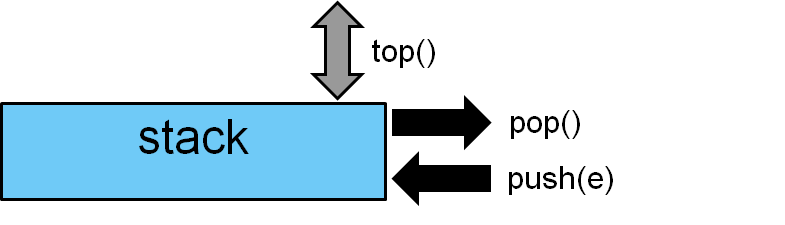
It's time to study the behavior of this popular data structure.
We'll cover the following...
The
std::stack
...