Learn SQL basics with our beginner-friendly guide to understanding the language of data. You’ll start by learning to talk to a database: asking questions and getting meaningful answers using SQL. With AI-assisted guidance, you’ll explore the essentials—selecting columns, filtering rows, sorting results, and applying logic to uncover patterns in raw data.
As your questions become more precise, you’ll explore grouping, aggregation, and subqueries to extract deeper insights. Then you’ll shift gears and learn how to create tables, insert and edit data, and design simple relational schemas. Finally, you’ll tackle real-world scenarios using joins, building multi-table queries, and designing interactive dashboards. You’ll complete hands-on challenges and projects like a student tracker and a game leaderboard. No prior experience with databases or programming is needed—this course is your friendly introduction to the language of data.
Learn SQL basics with our beginner-friendly guide to understanding the language of data. You’ll start by learning to talk to a d...Show More
WHAT YOU'LL LEARN
An understanding of how to query data from tables
The ability to filter, sort, and group information
The ability to create and modify tables
Hands-on experience using JOINs and subqueries to connect data
Experience building SQL projects supported by AI, culminating in a portfolio-ready capstone
An understanding of how to query data from tables
Show more
Learning Roadmap
YOUR ROADMAP
1.
Talk to a Table
Talk to a Table
Learn to ask questions and get answers.
Say “Hello” to the TableQuiz: Say “Hello” to the TableChallenge: Say “Hello” to the TablePick the Columns You WantQuiz: Pick the Columns You WantChallenge: Pick the Columns You WantFind the Rows That MatterQuiz: Find the Rows That MatterProblem: Find the Rows That MatterUse Comparisons and LogicQuiz: Use Comparisons and LogicProblem: Use Comparisons and LogicSort the AnswersQuiz: Sort the AnswersProblem: Sort the AnswersProblem: Help a Pet Lover
2.
Ask Better Questions
Ask Better Questions
Be more precise, summarize, and start grouping things.
Do Math with Your DataQuiz: Do Math with Your DataProblem: Do Math with Your DataGroup Things TogetherQuiz: Group Things TogetherProblem: Group Things TogetherOnly Keep Interesting GroupsQuiz: Only Keep Interesting GroupsProblem: Only Keep Interesting GroupsAsk Questions About QuestionsQuiz: Ask Questions About QuestionsProblem: Ask Questions About QuestionsProject: Find the Top Performers
3.
Create Your Own World
Create Your Own World
13 Lessons
13 Lessons
Learn how to build, insert, and modify your own tables.
4.
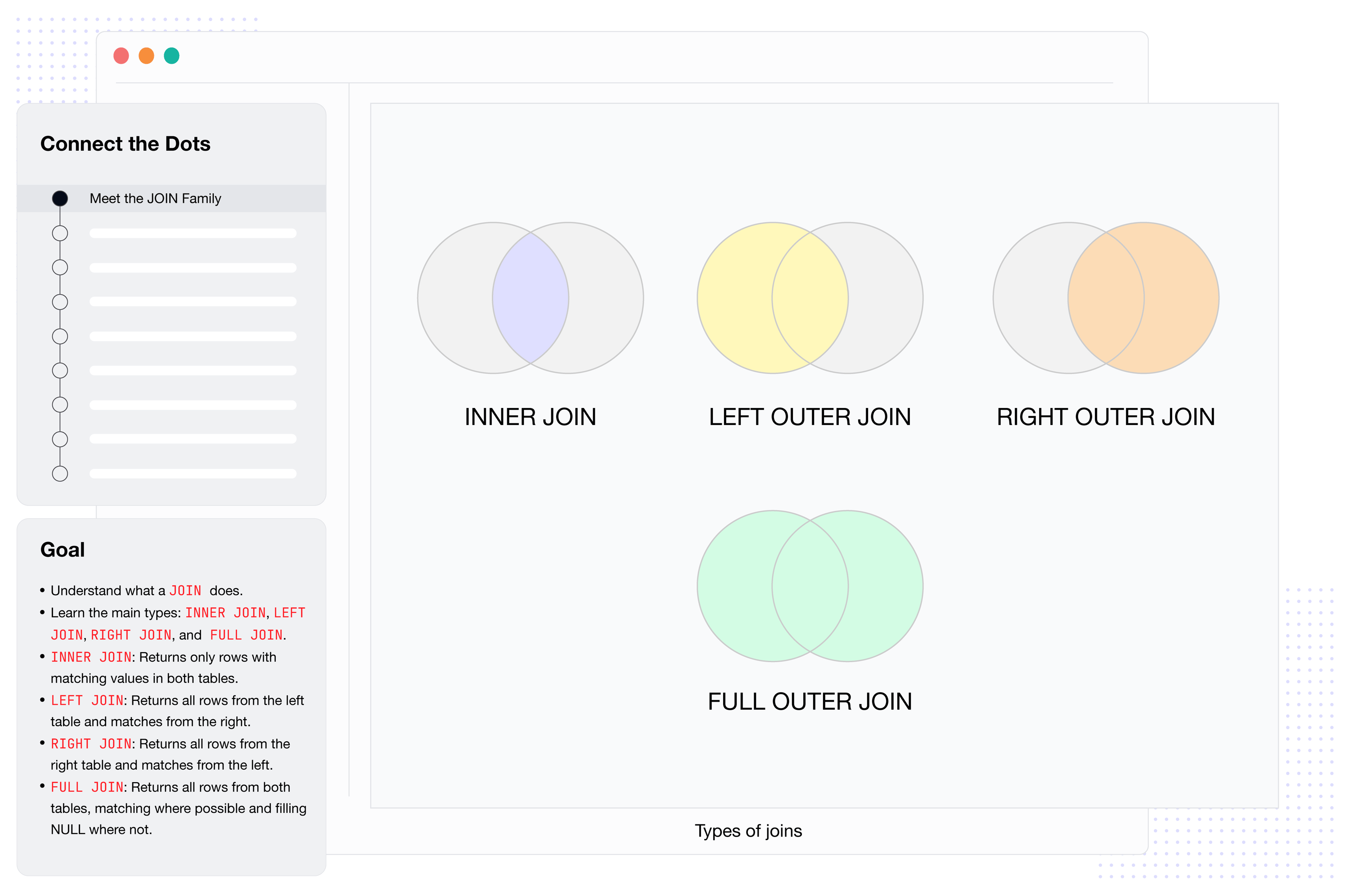
Connect the Dots
Connect the Dots
14 Lessons
14 Lessons
Work with multiple tables like a real-world dataset.
5.
Learning SQL in the Age of AI
Learning SQL in the Age of AI
6 Lessons
6 Lessons
This chapter teaches you how to work with AI to ask better questions, plan smarter SQL analyses, and turn query results into real insight.
Certificate of Completion
Showcase your accomplishment by sharing your certificate of completion.
Complete more lessons to unlock your certificate
Developed by MAANG Engineers
Trusted by 2.9 million developers working at companies
"These are high-quality courses. Trust me the price is worth it for the content quality. Educative came at the right time in my career. I'm understanding topics better than with any book or online video tutorial I've done. Truly made for developers. Thanks"
Anthony Walker
@_webarchitect_
"Just finished my first full #ML course: Machine learning for Software Engineers from Educative, Inc. ... Highly recommend!"
Evan Dunbar
ML Engineer
"You guys are the gold standard of crash-courses... Narrow enough that it doesn't need years of study or a full blown book to get the gist, but broad enough that an afternoon of Googling doesn't cut it."
Software Developer
Carlos Matias La Borde
"I spend my days and nights on Educative. It is indispensable. It is such a unique and reader-friendly site"
Souvik Kundu
Front-end Developer
"Your courses are simply awesome, the depth they go into and the breadth of coverage is so good that I don't have to refer to 10 different websites looking for interview topics and content."
Vinay Krishnaiah
Software Developer
Hands-on Learning Powered by AI
See how Educative uses AI to make your learning more immersive than ever before.
AI Prompt
Code Feedback
Explain with AI
AI Code Mentor
Free Resources
Frequently Asked Questions
How to learn SQL?
How long does it take to learn SQL?
Is SQL hard to learn?
Can I teach myself SQL?
Is SQL easier than Python?
How to learn SQL fast?
