Correlation Is Not Necessarily Causation
Explore the important distinction between correlation and causation in regression analysis. Understand how confounding variables can influence relationships between variables and learn the need for experimental design or control methods to draw accurate causal inferences.
We'll cover the following...
We’ve been cautious when interpreting regression slope coefficients. We always discuss the associated effect of an explanatory variable bty_avg, there is an associated increase of on average 0.067 units of score,” we include the term “associated” to be extra careful, not to suggest we’re making a causal statement. Even though the beauty score of bty_avg is positively correlated with the teaching score, we can’t necessarily make any statements about beauty scores’ direct causal effect on teaching scores. We need more information on how this study was conducted.
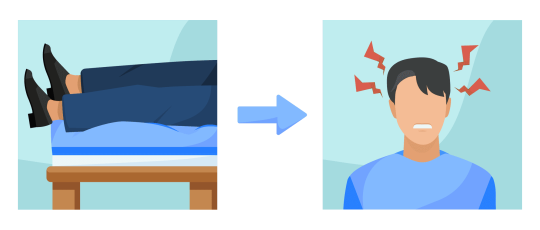
However, there’s a good chance that if someone is sleeping with their shoes on, it’s potentially because they are intoxicated from alcohol. Furthermore, higher levels of drinking leads to more hangovers, and hence more headaches. The amount of alcohol consumption here is what’s known as a confounding/lurking variable. It lurks behind the scenes, confounding the causal relationship (if any) of sleeping with shoes ...