Arithmetic operators Logical operators Relational operators Bitwise operators Assignment operators Misc operators
Table of Contents
Crack the top 50 Golang interview questions
15 mins read
Jun 09, 2026
Share
The Go programming language, or Golang, is an open-source programming language similar to C but is optimized for quick compiling, seamless concurrency, and developer ease of use.
This language was created and adopted by Google but has been gaining popularity in other companies in recent years as the demand for concurrent, networked programs is increasing.
Whether you’re preparing for a Google job interview or just want to remain a cutting edge developer, Go is the right choice for you. Today, we’ll help you practice your Go skills with 50 of the most important Go questions and answers.
Grokking the Coding Interview Patterns in Go
With thousands of potential questions to account for, preparing for the coding interview can feel like an impossible challenge. Yet with a strategic approach, coding interview prep doesn’t have to take more than a few weeks. Stop drilling endless sets of practice problems, and prepare more efficiently by learning coding interview patterns. This course teaches you the underlying patterns behind common coding interview questions. By learning these essential patterns, you will be able to unpack and answer any problem the right way — just by assessing the problem statement. This approach was created by FAANG hiring managers to help you prepare for the typical rounds of interviews at major tech companies like Apple, Google, Meta, Microsoft, and Amazon. Before long, you will have the skills you need to unlock even the most challenging questions, grok the coding interview, and level up your career with confidence. This course is also available in JavaScript, C++, Java, and Python — with more coming soon!
Questions on Golang Basics#
1. What are the benefits of using Go compared to other languages?#
-
Unlike other languages which started as academic experiments, Go code is pragmatically designed. Every feature and syntax decision is engineered to make life easier for the programmer.
-
Golang is optimized for concurrency and works well at scale.
-
Golang is often considered more readable than other languages due to a single standard code format.
-
Automatic garbage collection is notably more efficient than Java or Python because it executes concurrently alongside the program.
2. What are string literals?#
A string literal is a string constant formed by concatenating characters. The two forms of string literal are raw and interpreted string literals.
Raw string literals are written within backticks (foo) and are filled with uninterpreted UTF-8 characters. Interpreted string literals are what we commonly think of as strings, written within double quotes and containing any character except newline and unfinished double quotes.
3. What data types does Golang use?#
Golang uses the following types:
- Method
- Boolean
- Numeric
- String
- Array
- Slice
- Struct
- Pointer
- Function
- Interface
- Map
- Channel
4. What are packages in a Go program?#
Packages (pkg) are directories within your Go workspace that contain Go source files or other packages. Every function, variable, and type from your source files are stored in the linked package. Every Go source file belongs to a package, which is declared at the top of the file using:
package <packagename>
You can import and export packages to reuse exported functions or types using:
import <packagename>
Golang’s standard package is fmt, which contains formatting and printing functionalities like Println().
5. What form of type conversion does Go support? Convert an integer to a float.#
Go supports explicit type conversion to satisfy its strict typing requirements.
i := 55      //int

j := 67.8    //float64

sum := i + int(j) //j is converted to int
6. What is a goroutine? How do you stop it?#
A goroutine is a function or method that executes concurrently alongside any other goroutines using a special goroutine thread. Goroutine threads are more lightweight than standard threads, with most Golang programs using thousands of goroutines at once.
To create a goroutine, add the go keyword before the function declaration.
go f(x, y, z)
You can stop a goroutine by sending it a signal channel. Goroutines can only respond to signals if told to check, so you’ll need to include checks in logical places such as at the top of your for loop.
Enjoying the article? Scroll down to sign up for our free, bi-monthly newsletter.
7. How do you check a variable type at runtime?#
The Type Switch is the best way to check a variable’s type at runtime. The Type Switch evaluates variables by type rather than value. Each Switch contains at least one case, which acts as a conditional statement, and a default case, which executes if none of the cases are true.
For example, you could create a Type Switch that checks if interface value i contains the type int or string:
8. How do you concatenate strings?#
The easiest way to concatenate strings is to use the concatenation operator (+), which allows you to add strings as you would numerical values.
Intermediate Golang Questions#
9. Explain the steps of testing with Golang.#
Golang supports automated testing of packages with custom testing suites.
To create a new suite, create a file that ends with _test.go and includes a TestXxx function, where Xxx is replaced with the name of the feature you’re testing. For example, a function that tests login capabilities would be called TestLogin.
You then place the testing suite file in the same package as the file you wish to test. The test file will be skipped on regular execution but will run when you enter the go test command.
10. What are function closures?#
Function closures is a function value that references variables from outside its body. The function may access and assign values to the referenced variables.
For example: adder() returns a closure, which is each bound to its own referenced sum variable.
11. How do we perform inheritance with Golang?#
This is a bit of a trick question: there is no inheritance in Golang because it does not support classes.
However, you can mimic inheritance behavior using composition to use an existing struct object to define a starting behavior of a new object. Once the new object is created, functionality can be extended beyond the original struct.
type Animal struct {
	// …
}

func (a *Animal) Eat()   { … }
func (a *Animal) Sleep() { … }
func (a *Animal) Run() { … }

type Dog struct {
	Animal
	// …
}
The Animal struct contains Eat(), Sleep(), and Run() functions. These functions are embedded into the child struct Dog by simply listing the struct at the top of the implementation of Dog.
12. Explain Go interfaces. What are they and how do they work?#
Interfaces are a special type in Go that define a set of method signatures but do not provide implementations. Values of interface type can hold any value that implements those methods.
Interfaces essentially act as placeholders for methods that will have multiple implementations based on what object is using it.
For example, you could implement a geometry interface that defines that all shapes that use this interface must have an implementation of area() and perim().
type geometry interface {
    area() float64
    perim() float64
}
13. What are Lvalue and Rvalue in Golang?#
Lvalue
-
Refers to a memory location
-
Represents a variable identifier
-
Mutable
-
May appear on the left or right side of the
=operator
For example: In the statement
x =20,xis an lvalue and20is an rvalue.
Rvalue
-
Represents a data value stored in memory
-
Represents a constant value
-
Always appears on the
=operator’s right side.
For example, The statement
10 = 20is invalid because there is an rvalue (10) left of the=operator.
14. What are the looping constructs in Go?#
Go has only one looping construct: the for loop. The for loop has 3 components separated by semicolons:
-
The
Initstatement, which is executed before the loop begins. It’s often a variable declaration only visible within the scope of theforloop. -
The condition expression, which is evaluated as a Boolean before each iteration to determine if the loop should continue.
-
The post statement, which is executed at the end of each iteration.
15. Can you return multiple values from a function?#
Yes. A Go function can return multiple values, each separated by commas in the return statement.
Grokking the Coding Interview Patterns in Go
With thousands of potential questions to account for, preparing for the coding interview can feel like an impossible challenge. Yet with a strategic approach, coding interview prep doesn’t have to take more than a few weeks. Stop drilling endless sets of practice problems, and prepare more efficiently by learning coding interview patterns. This course teaches you the underlying patterns behind common coding interview questions. By learning these essential patterns, you will be able to unpack and answer any problem the right way — just by assessing the problem statement. This approach was created by FAANG hiring managers to help you prepare for the typical rounds of interviews at major tech companies like Apple, Google, Meta, Microsoft, and Amazon. Before long, you will have the skills you need to unlock even the most challenging questions, grok the coding interview, and level up your career with confidence. This course is also available in JavaScript, C++, Java, and Python — with more coming soon!
Goroutines, channels, and concurrency in Go#
Concurrency is one of Go’s biggest strengths and one of the most frequently tested topics in Golang interviews. Go makes it easy to write concurrent programs using goroutines and channels, allowing applications to handle thousands of tasks efficiently without the complexity often associated with threads.
If you're preparing for backend, cloud, distributed systems, or Kubernetes-related roles, mastering Go concurrency is essential.
Understanding goroutines#
A goroutine is a lightweight concurrent function managed by the Go runtime. You create one simply by using the go keyword before a function call.
Unlike operating system threads, goroutines are extremely lightweight and can be created in large numbers with minimal overhead.
Basic goroutine example#
package mainimport ("fmt""time")func printMessage(msg string) {fmt.Println(msg)}func main() {go printMessage("Hello from goroutine")time.Sleep(time.Second)fmt.Println("Main function completed")}
Multiple goroutines#
package mainimport ("fmt""time")func worker(id int) {fmt.Printf("Worker %d running\n", id)}func main() {for i := 1; i <= 3; i++ {go worker(i)}time.Sleep(time.Second)}
Why does time.Sleep() appear?#
Every Go program starts with a main goroutine.
When the main() function exits:
The program terminates
All running goroutines are stopped
Without synchronization, your program may exit before goroutines finish executing.
Understanding channels#
Channels provide a safe way for goroutines to communicate.
Instead of sharing memory directly, Go encourages:
"Don't communicate by sharing memory; share memory by communicating."
Channels are typed and support:
Sending values
Receiving values
Synchronization between goroutines
Basic channel example#
package mainimport "fmt"func main() {ch := make(chan string)go func() {ch <- "Hello from channel"}()message := <-chfmt.Println(message)}
ch := make(chan int)
Buffered channel#
ch := make(chan int, 3)
Feature | Buffered channels | Unbuffered channels |
Capacity | Stores multiple values | No storage |
Send operation | Blocks only when buffer is full | Blocks until receiver is ready |
Receive operation | Blocks when buffer is empty | Blocks until sender provides value |
Synchronization | Looser coupling | Strong synchronization |
Throughput | Higher | Lower |
Typical use case | Worker queues, pipelines | Coordination and synchronization |
Unbuffered example#
ch := make(chan int)go func() {ch <- 42}()fmt.Println(<-ch)
The sender waits until a receiver is ready.
Buffered example#
ch := make(chan int, 2)ch <- 1ch <- 2fmt.Println(<-ch)fmt.Println(<-ch)
select {case msg := <-ch1:fmt.Println(msg)case msg := <-ch2:fmt.Println(msg)}
Timeout pattern#
One of the most common interview examples:
package mainimport ("fmt""time")func main() {ch := make(chan string)select {case msg := <-ch:fmt.Println(msg)case <-time.After(2 * time.Second):fmt.Println("Timeout occurred")}}
package mainimport ("fmt""sync")func worker(id int, wg *sync.WaitGroup) {defer wg.Done()fmt.Printf("Worker %d completed\n", id)}func main() {var wg sync.WaitGroupfor i := 1; i <= 3; i++ {wg.Add(1)go worker(i, &wg)}wg.Wait()fmt.Println("All workers finished")}
How it works#
Add()increases the counterDone()decreases the counterWait()blocks until counter reaches zero
This is one of the most common concurrency interview questions.
Common Golang concurrency interview questions#
What is a goroutine?#
A goroutine is a lightweight concurrent function managed by the Go runtime. It requires significantly less memory than an OS thread and can be created in large numbers.
Goroutines vs threads#
Threads are managed by the operating system. Goroutines are managed by the Go runtime and are much lighter, allowing thousands or even millions of concurrent tasks.
Buffered vs unbuffered channels#
Unbuffered channels require sender and receiver synchronization. Buffered channels allow values to be stored temporarily before being received.
What causes deadlocks?#
Deadlocks occur when goroutines wait indefinitely for operations that can never complete, such as sending on a channel without a receiver.
What is a race condition?#
A race condition happens when multiple goroutines access shared data simultaneously and at least one modifies it without proper synchronization.
How does select work?#
select waits on multiple channel operations and executes whichever becomes available first.
How do you synchronize goroutines?#
Common approaches include:
Channels
WaitGroups
Mutexes
Context cancellation
Common concurrency mistakes in Go#
Deadlocks#
ch := make(chan int)ch <- 1 // Blocks forever
Why it happens: No receiver exists.
How to avoid it: Ensure every send has a matching receive.
Goroutine leaks#
go func() {for {<-ch}}()
Why it happens: Goroutine waits forever.
How to avoid it: Use context cancellation and proper shutdown mechanisms.
Race conditions#
counter++
close(ch)
If receivers expect more data indefinitely, they may block forever.
Always close channels when no more values will be sent.
Real-world concurrency use cases#
Web servers#
Each incoming request can be processed in its own goroutine.
Background workers#
Concurrent workers process jobs from queues efficiently.
API request aggregation#
Multiple APIs can be called concurrently to reduce response time.
Distributed systems#
Microservices frequently use goroutines for networking and communication.
Streaming pipelines#
Channels naturally model data flowing through processing stages.
Best practices for Go concurrency#
Prefer channels over shared memory
Keep goroutines lightweight
Use
context.Contextfor cancellationAvoid creating unlimited goroutines
Use buffered channels carefully
Use
sync.WaitGroupfor coordinationRun the race detector during development
go test -race
This can catch subtle concurrency bugs before production.
Why Go concurrency is popular#
Go's concurrency model is popular because it provides a simple way to build highly concurrent applications without the complexity of traditional thread management.
This makes Go a natural fit for:
Cloud-native applications
Kubernetes components
Microservices
API gateways
Distributed systems
High-performance backend services
The combination of goroutines, channels, and runtime scheduling allows developers to write scalable concurrent programs with relatively little code.
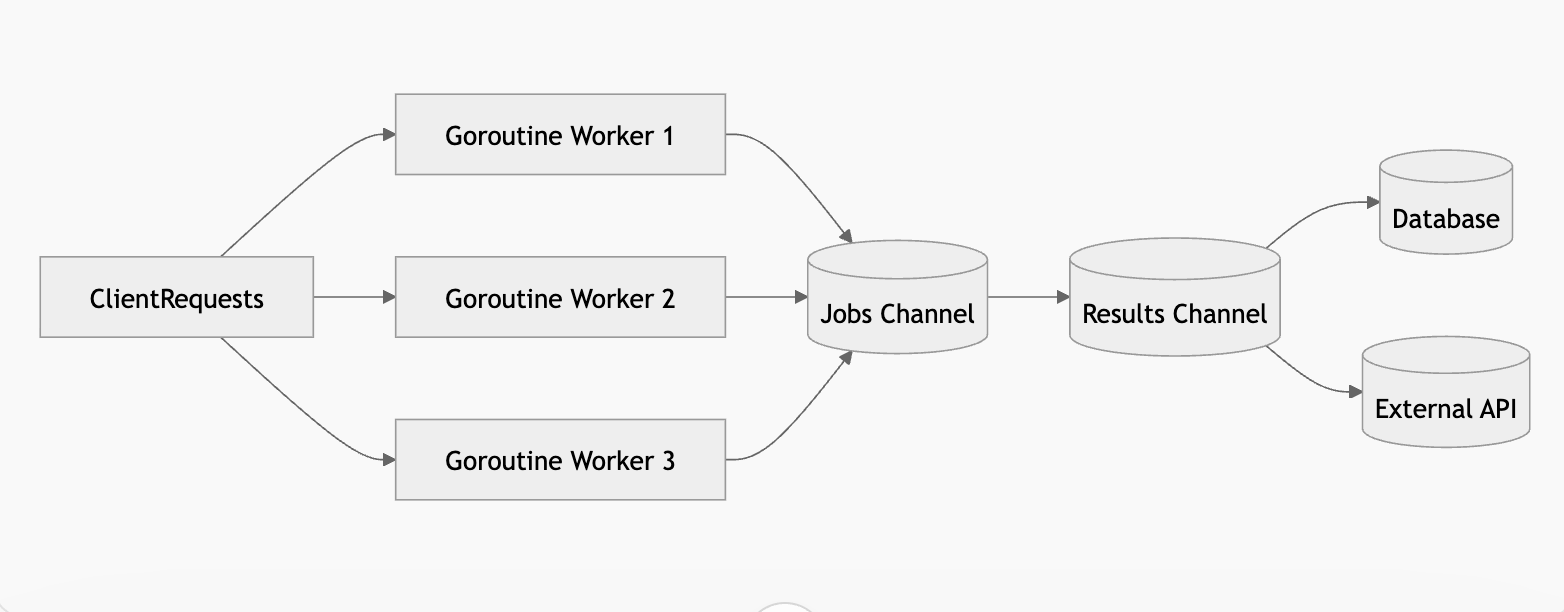
Visual diagram idea#
flowchart LRClientRequests --> Worker1[Goroutine Worker 1]ClientRequests --> Worker2[Goroutine Worker 2]ClientRequests --> Worker3[Goroutine Worker 3]Worker1 --> Channel[(Jobs Channel)]Worker2 --> ChannelWorker3 --> ChannelChannel --> Results[(Results Channel)]Results --> Database[(Database)]Results --> API[(External API)]
This worker-pool pattern is one of the most common concurrency architectures you'll encounter in both Go interviews and production systems.
First, we use the built-in append() function to implement the append behavior. Then we use len(stack)-1 to select the top of the stack and print.
For pop, we set the new length of the stack to the position of the printed top value, len(stack)-1.
17. Print all permutations of a slice characters or string#
Implement the perm() function that accepts a slice or string and prints all possible combinations of characters.
Solution
While this may be tricky in other languages, Go makes it easy.
We can simply include the statement b, a = a, b, what data the variable references without engaging with either value.
19. Implement min and max behavior#
Implement Min(x, y int) and Max(x, y int) functions that take two integers and return the lesser or greater value, respectively.
Solution
By default, Go only supports min and max for floats using math.min and math.max. You’ll have to create your own implementations to make it work for integers.
20. Reverse the order of a slice#
Implement function reverse that takes a slice of integers and reverses the slice in place without using a temporary slice.
Solution
Our for loop swaps the values of each element in the slice will slide from left to right. Eventually, all elements will be reversed.
21. What is the easiest way to check if a slice is empty?#
Create a program that checks if a slice is empty. Find the simplest solution.
Solution
The easiest way to check if a slice is empty is to use the built-in len() function, which returns the length of a slice. If len(slice) == 0, then you know the slice is empty.
For example:
22. Format a string without printing it#
Find the easiest way to format a string with variables without printing the value.
Solution
The easiest way to format without printing is to use the fmt.Sprintf(), which returns a string without printing it.
For example:
Golang Concurrency Questions#
23. Explain the difference between concurrent and parallelism in Golang#
Concurrency is when your program can handle multiple tasks at once while parallelism is when your program can execute multiple tasks at once using multiple processors.
In other words, concurrency is a property of a program that allows you to have multiple tasks in progress at the same time, but not necessarily executing at the same time. Parallelism is a runtime property where two or more tasks are executed at the same time.
Parallelism can therefore be a means to achieve the property of concurrency, but it is just one of many means available to you.
The key tools for concurrency in Golang are goroutines and channels. Goroutines are concurrent lightweight threads while channels allow goroutines to communicate with each other during execution.
24. Merge Sort#
Implement a concurrent Merge Sort solution using goroutines and channels.
You can use this sequential Merge Sort implementation as a starting point:
Solution
Firstly, in merge sort, we keep dividing our array recursively into the right side and the left side and call the MergeSort function on both sides from line 30 to line 34.
Now we have to make sure that Merge(left,right) is executed after we get return values from both the recursive calls, i.e. both the left and right must be updated before Merge(left,right) can be executable. Hence, we introduce a channel of type bool on line 26 and send true on it as soon as left = MergeSort(data[:mid]) is executed (line 32).
The <-done operation blocks the code on line 35 before the statement Merge(left,right) so that it does not proceed until our goroutine has finished. After the goroutine has finished and we receive true on the done channel, the code proceeds forward to Merge(left,right) statement on line 36.
25. Sum of Squares#
Implement the SumOfSquares function which takes an integer, c and returns the sum of all squares between 1 and c. You’ll need to use select statements, goroutines, and channels.
For example, entering 5 would return 55 because
You can use the following code as a starting point:
Solution
Take a look at our SumOfSquares function. First, on line 4, we declare a variable y and then jump to the For-Select loop. We have two cases in our select statements:
-
case c <- (y*y): This is to send the square ofythrough the channelc, which is received in the goroutine created in the main routine. -
case <-quit: This is to receive a message from the main routine that will return from the function.
25 More Golang Questions#
-
What is a workspace?
-
What is CGO? When would you want to use it?
-
What is shadowing?
-
What is the purpose of a GOPATH environment variable?
-
How are pointers used in Go?
-
What types of pointers does Go have?
-
Why is Go often called a “Post-OOP” language?
-
Does Go have exceptions? How does Go handle errors?
-
When would you use a break statement in Go?
-
How do untyped constants interact with Go’s typing system?
-
What is the difference between
=and:=in Go? -
What is the difference between C arrays and Go slices?
-
Does Go support method overloading?
-
What makes Go so fast?
-
How do you implement command-line arguments in Go?
-
How does Go handle dependencies?
-
What is a unique benefit of Go’s compiler?
-
What is in the src directory?
-
Name one Go feature that would be helpful for DevOps.
-
What does GOROOT point to?
-
What makes Go compile quickly?
-
Implement a binary search tree data structure in Go.
-
What does it mean when people say Go has a “rich standard library”?
-
What is an advantage of Go evaluating implicit types at compile time?
-
Describe the crypto capabilities of Go.
Next steps for your learning#
Great job on those practice questions! Go is a rising language and hands-on practice like this is the key to picking it up fast. To best prepare for interviews, you’ll want to:
- Develop a detailed study plan
- Practice Go problems on a whiteboard
- Learn how to articulate your thought process aloud
- Prepare for behavioral interviews
To help you learn even faster, Educative has created Grokking Coding Interview Patterns in Go.
This course includes in-depth explanations and practice projects to show you how to get the most out of different coding design patterns.
By the end of the course, you’ll have the practical Go experience you’ll need to pick up this language in half the time.
Happy learning!
Continue reading about Golang#
Frequently Asked Questions
What are Golang operators?
What are Golang operators?
What are the advantages of Golang?
What are the advantages of Golang?
How do I prepare for a Golang interview?
How do I prepare for a Golang interview?
Written By:
Ryan Thelin
Related Courses
The Way to GoEvent-Driven Architecture in GolangAPI Development in Go Using MongoDBBuilding Practical Applications with Redis Using GoGo Brain TeasersDecode the Coding Interview in Go: Real-World ExamplesWrite Professional Command-line Programs in GoAn Introduction to Programming in GoData Structures & Algorithms In GoWeb Development with Golang and BeegoExploring and Mastering the Full Go FeaturesetConcurrency in Go