Anthropic interview process guide for 2026
Preparing for the anthropic interview process takes more than coding practice. Study System Design, review your past projects, strengthen behavioral answers, and build confidence across every interview stage to maximize your chances of success.
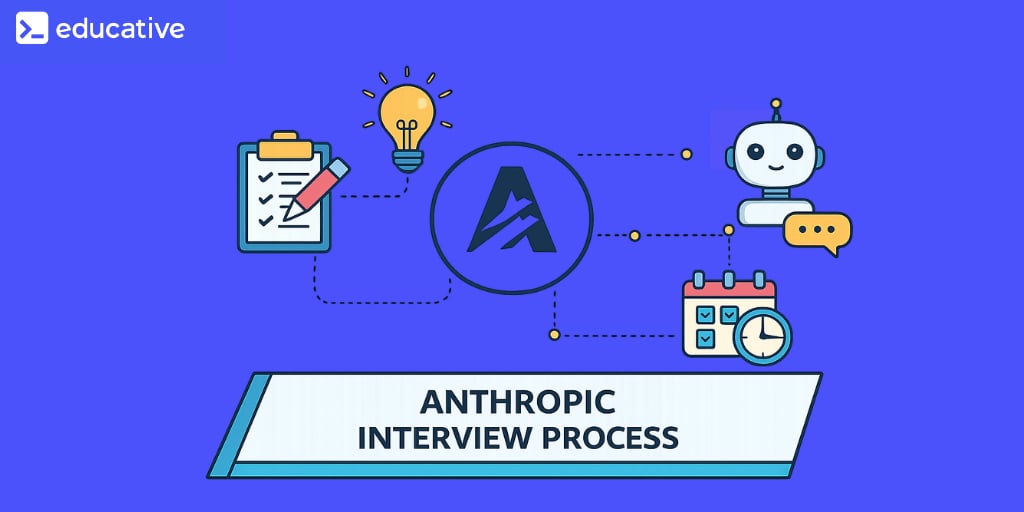
Landing an interview at Anthropic is an exciting opportunity for software engineers, machine learning engineers, researchers, and infrastructure specialists. As one of the leading AI companies behind Claude, Anthropic looks for candidates who combine exceptional technical ability with thoughtful problem-solving, strong communication, and an understanding of building safe and reliable AI systems.
Understanding the anthropic interview process before you begin can significantly improve your preparation. While every role differs slightly, most candidates move through a structured hiring pipeline that evaluates coding ability, System Design, collaboration, technical depth, and alignment with the company's mission of developing trustworthy AI.
In this blog, you'll learn what each interview stage typically involves, the kinds of questions you can expect, and how to prepare effectively for technical and behavioral rounds.
Grokking the Coding Interview Patterns

I created Grokking the Coding Interview because I watched too many talented engineers fail interviews they should have passed. At Microsoft and Meta, I saw firsthand what separated the candidates who succeeded from the ones who didn't. It wasn't how many LeetCode problems they'd solved. It was whether they could look at an unfamiliar problem and know how to approach it the right way. That's what this course teaches. Rather than throwing hundreds of disconnected problems at you, we organize the entire coding interview around 28 fundamental patterns. Each pattern is a reusable strategy. Once you understand two pointers, for example, you can apply them to dozens of problems you've never seen before. The course walks you through each pattern step by step, starting with the intuition behind it, then building through increasingly complex applications. As with every course on Educative, you will practice in a hands-on way with 500+ challenges, 17 mock interviews, and detailed explanations for every solution. The course is available in Python, Java, JavaScript, Go, C++, and C#, so you can prep in the language you'll actually use in your interview. Whether you're preparing for your first FAANG loop or brushing up after a few years away from interviewing, this course will give you a repeatable framework for cracking the coding interview.
Why understanding the Anthropic interview process matters#

Preparing for interviews at AI companies requires more than practicing algorithm problems. Modern AI organizations expect engineers to design scalable infrastructure, collaborate across teams, and make thoughtful engineering decisions under ambiguity.
Anthropic is particularly known for emphasizing reasoning, communication, and engineering judgment alongside raw technical ability. Candidates who only memorize coding patterns often struggle because interviews explore how you think through unfamiliar problems rather than whether you've seen the exact question before.
The interview process is also relatively thorough compared to many traditional software companies. Investing time in understanding the expectations for each stage allows you to prepare strategically instead of treating every interview the same.
Ace the AI Engineer Interviews
This course prepares candidates to confidently tackle AI interviews by covering the most relevant and in-demand topics. You’ll explore neural network training (gradient descent, transfer learning, and model compression), language processing (tokenization, embeddings, and decoding), and transformer attention mechanisms (self-attention, cross-attention, and flash attention). You’ll gain a solid understanding of evaluation metrics like perplexity, BLEU, and ROUGE, and dive into modern AI challenges, including hallucinations, jailbreaks, and interpretability. You’ll also learn cutting-edge methods such as RAG, few-shot learning, and chain-of-thought prompting. You’ll explore efficiency, scalability, Mixture of Experts, vector databases, and agentic AI behaviors.
Overview of the Anthropic interview process#
Although individual roles vary, most engineering candidates follow a hiring pipeline similar to the following.
Interview Stage | Primary Focus | Typical Outcome |
Recruiter Screen | Experience and motivation | Initial qualification |
Hiring Manager Interview | Technical background and role fit | Team evaluation |
Technical Coding Interview | Algorithms and programming | Coding assessment |
System Design Interview | Architecture and scalability | Design evaluation |
Technical Deep Dive | Past projects and expertise | Technical judgment |
Behavioral Interviews | Collaboration and communication | Culture and values fit |
Final Hiring Review | Holistic evaluation | Hiring decision |
Some research positions may include additional discussions around machine learning, LLMs, distributed training, or AI safety, while infrastructure roles may emphasize distributed systems and production engineering.
Stage 1: Anthropic recruiter screening#
The recruiter conversation is typically the first formal step in the anthropic interview process. Rather than testing technical skills, this discussion focuses on your experience, career goals, and interest in the company.
Recruiters often want to understand why you're interested in Anthropic specifically, instead of another AI company. Demonstrating familiarity with the company's work on Claude, constitutional AI, or AI safety research helps show genuine interest rather than broad job searching.
During this conversation, you should also expect questions about your recent projects, preferred technical areas, availability, compensation expectations, and work authorization, where applicable.
Common Topics#
Topic | What Interviewers Look For |
Career history | Relevant technical experience |
Motivation | Interest in Anthropic's mission |
Current role | Scope and responsibilities |
Preferred work | Technical alignment |
Logistics | Availability and expectations |
This stage is also an opportunity for you to ask thoughtful questions about the team, interview structure, and the role itself.
Stage 2: Hiring manager interview#
If the recruiter screen goes well, you'll usually speak with the hiring manager. This interview explores your technical background in greater detail while evaluating whether your experience aligns with the team's needs.
Rather than solving coding problems immediately, you'll often discuss previous engineering projects, technical challenges you've overcome, and the kinds of systems you've built. Interviewers typically ask follow-up questions that explore why particular technical decisions were made instead of focusing only on final outcomes.
Candidates who clearly explain tradeoffs, failures, and lessons learned generally perform better than those who only describe successful projects.
Topics Frequently Discussed#
The hiring manager may ask about large-scale systems you've designed, infrastructure you've maintained, performance optimization efforts, production incidents you've handled, or engineering leadership experiences. Research-oriented candidates may instead discuss publications, model development, or experimental methodology.
Stage 3: Anthropic coding interview#
Coding interviews remain an important component of the anthropic interview process. These interviews generally evaluate your ability to solve programming problems while communicating your reasoning throughout the solution.
Unlike competitive programming contests, interviewers usually care more about your thought process than writing the shortest possible code. They often encourage discussing multiple approaches, comparing tradeoffs, and gradually improving an initial solution.
Candidates should be comfortable writing clean code while explaining complexity analysis, edge cases, and testing strategies.
Topics worth practicing#
The most commonly tested areas include:
Arrays and strings
Hash tables
Trees and graphs
Breadth-first and depth-first search
Dynamic programming
Recursion
Sorting and searching
Binary search
Queues and stacks
Heaps
Sliding window techniques
Graph traversal algorithms
Practicing medium and hard interview questions while verbalizing your reasoning is often more valuable than simply solving hundreds of problems silently.
Stage 4: Anthropic System Design interview#
For experienced engineers, System Design is often one of the most important stages of the anthropic interview process. Interviewers want to understand how you approach designing reliable, scalable, and maintainable systems rather than whether your architecture exactly matches theirs.
Many design discussions involve distributed systems, cloud infrastructure, storage, caching, messaging, APIs, observability, and fault tolerance. AI infrastructure candidates may also discuss GPU clusters, inference serving, vector databases, feature pipelines, or model deployment architectures.
What makes a strong design interview#
A strong interview usually begins by clarifying requirements before drawing architecture diagrams. Candidates who ask thoughtful questions about scale, latency, consistency, availability, and expected workloads demonstrate the structured thinking interviewers expect.
Interviewers also appreciate candidates who identify tradeoffs throughout the discussion instead of presenting every architectural decision as universally correct.
Typical System Design topics#
Problem Area | Possible Discussion |
Distributed systems | Scalability and replication |
APIs | Service communication |
Databases | SQL vs NoSQL decisions |
Caching | Redis and cache invalidation |
Messaging | Kafka, queues, event streaming |
AI Infrastructure | Model serving pipelines |
Observability | Monitoring, metrics, tracing |
Reliability | Fault tolerance and recovery |
Stage 5: Technical deep dive#
One aspect that distinguishes the anthropic interview process from many software engineering interviews is the emphasis on discussing real engineering work.
Interviewers frequently choose one or two significant projects from your resume and spend considerable time exploring technical details. Rather than accepting high-level summaries, they often ask progressively deeper questions about implementation choices, architecture, debugging decisions, and performance improvements.
This interview rewards candidates who genuinely understand the systems they have built rather than those who contributed only small portions of larger projects.
Preparing for Technical Discussions#
Before interviewing, revisit several projects you've worked on over the past few years. Be prepared to explain system architecture, performance bottlenecks, failures, scaling challenges, design tradeoffs, and lessons learned using concrete technical examples.
Stage 6: Anthropic behavioral interviews#
Behavioral interviews at Anthropic tend to focus on collaboration, communication, ownership, and thoughtful decision-making. While technical excellence is important, interviewers also evaluate how you work with others and handle uncertainty.
Many questions explore situations where priorities changed, projects encountered setbacks, or teams disagreed on implementation approaches. Interviewers usually value honesty, self-awareness, and reflection more than stories that portray every project as a complete success.
Using structured storytelling approaches helps keep answers organized while demonstrating problem-solving ability.
Grokking the Behavioral Interview

Behavioral interviews have become a decisive part of the hiring process across roles. Whether you’re a software engineer, product manager, or engineering leader, strong technical skills alone are no longer enough. Companies are evaluating how you think, communicate, and operate in real-world situations. That’s why preparing specifically for behavioral interviews is critical. This is why I built this course around a common gap: candidates often underestimate behavioral interviews or prepare for them too late. As a result, even strong candidates struggle to clearly articulate their experiences, decisions, and impact. The goal here is to give you a structured way to approach behavioral questions with clarity and confidence. You’ll learn how to break down common behavioral interview questions, structure your answers, and communicate your experiences effectively. The course also includes a video recording feature, allowing you to practice your responses, review them, and improve over time. By the end, you’ll have a repeatable approach to behavioral interviews, one that helps you present your experiences clearly and perform with confidence in any interview setting.
Questions you may encounter#
You may be asked to describe a difficult engineering decision, a production incident you resolved, a disagreement with teammates, feedback you received, or a project that failed and what you learned from it.
Candidates should focus on demonstrating ownership, collaboration, adaptability, and continuous learning throughout their responses.
How to prepare for the Anthropic interview process#
Successful preparation involves much more than practicing coding questions. Because Anthropic interviews evaluate multiple dimensions of engineering ability, your preparation should also be well-rounded.
A balanced preparation plan generally produces stronger results than spending every day solving algorithm questions while neglecting communication or System Design.
Preparation Area | Recommended Focus |
Coding | Medium and hard algorithm practice |
System Design | Distributed systems and scalability |
Resume Review | Deep understanding of projects |
Behavioral | Structured storytelling practice |
AI Knowledge | LLMs, inference, safety concepts |
Communication | Thinking aloud while solving problems |
If you're interviewing for infrastructure or AI engineering roles, reviewing distributed training systems, GPU scheduling, vector search, retrieval systems, and model serving architectures can also be valuable.
Common mistakes candidates make#
Many candidates underestimate how conversational Anthropic interviews can be. Instead of racing toward answers, interviewers often want to understand how you reason through uncertainty and evaluate competing approaches.
Another common mistake is neglecting resume preparation. Since interviewers frequently ask detailed questions about previous projects, being unable to explain implementation details can weaken an otherwise strong interview performance.
Some candidates also overlook communication skills. Even excellent technical solutions become less persuasive when explanations are disorganized or assumptions remain unstated.
Final thoughts#
The anthropic interview process is designed to evaluate complete engineers rather than specialists who excel in only one area. Technical coding, System Design, communication, collaboration, and engineering judgment all contribute to the final hiring decision.
The best preparation combines algorithm practice with System Design study, thoughtful review of your previous projects, behavioral interview preparation, and a solid understanding of modern AI systems. By approaching preparation holistically, you'll be much better equipped to demonstrate the skills Anthropic looks for in its engineering teams.