How to Ace the Booking.com System Design Interview
Preparing for the Booking.com System Design interview? Learn what they really test, the exact problem types you’ll face, and a proven framework to structure confident, senior-level answers that maximize your score.
The Booking.com System Design interview is a 45–60 minute session focused on designing resilient, globally distributed systems that handle real-world workloads like hotel search, real-time availability, and dynamic pricing. Interviewers prioritize pragmatic trade-offs, data freshness, and cost-aware architecture over theoretical purity.
Core principles
- Clarify before designing: Establish functional and non-functional requirements, traffic estimates, and consistency expectations before proposing any architecture.
- Prioritize data correctness: Rooms must never be oversold, and prices must propagate quickly, making cache invalidation and anti-oversell guarantees critical design concerns.
- Design for global scale: Strong answers include region-based deployments, sharded databases, multi-layer caches, and event-driven pipelines like Kafka to handle distributed traffic.
- Handle failure explicitly: Graceful degradation through fallback caches, circuit breakers, retries, and regional failover is a major scoring criterion in this interview.
- Show trade-off judgment: Comparing SQL vs. NoSQL, strong vs. eventual consistency, and synchronous vs. asynchronous updates signals the engineering maturity Booking.com expects.
If you’re preparing for the Booking.com System Design interview, you’re stepping into one of the most practical and product-focused architecture interviews in the industry. Booking.com handles massive global traffic, pricing volatility, caching-heavy workloads, partner integrations, and real-time availability updates.
Because of this, their System Design interview assesses your ability to design resilient, scalable, and cost-efficient systems that serve millions of users across dozens of markets.
Grokking Modern System Design Interview
For a decade, when developers talked about how to prepare for System Design Interviews, the answer was always Grokking System Design. This is that course — updated for the current tech landscape. As AI handles more of the routine work, engineers at every level are expected to operate with the architectural fluency that used to belong to Staff engineers. That's why System Design Interviews still determine starting level and compensation, and the bar keeps rising. I built this course from my experience building global-scale distributed systems at Microsoft and Meta — and from interviewing hundreds of candidates at both companies. The failure pattern I kept seeing wasn't a lack of technical knowledge. Even strong coders would hit a wall, because System Design Interviews don't test what you can build; they test whether you can reason through an ambiguous problem, communicate ideas clearly, and defend trade-offs in real time (all skills that matter ore than never now in the AI era). RESHADED is the framework I developed to fix that: a repeatable 45-minute roadmap through any open-ended System Design problem. The course covers the distributed systems fundamentals that appear in every interview – databases, caches, load balancers, CDNs, messaging queues, and more – then applies them across 13+ real-world case studies: YouTube, WhatsApp, Uber, Twitter, Google Maps, and modern systems like ChatGPT and AI/ML infrastructure. Then put your knowledge to the test with AI Mock Interviews designed to simulate the real interview experience. Hundreds of thousands of candidates have already used this course to land SWE, TPM, and EM roles at top companies. If you're serious about acing your next System Design Interview, this is the best place to start.
This guide breaks down the interview format, the core problem types you can expect, how Booking.com evaluates candidates, and the exact steps you should follow to structure a high-quality answer. Whether you're targeting L4/L5 or a senior role, this walkthrough will help you prepare confidently and position yourself for the highest score possible.
What the Booking.com System Design interview is really testing#
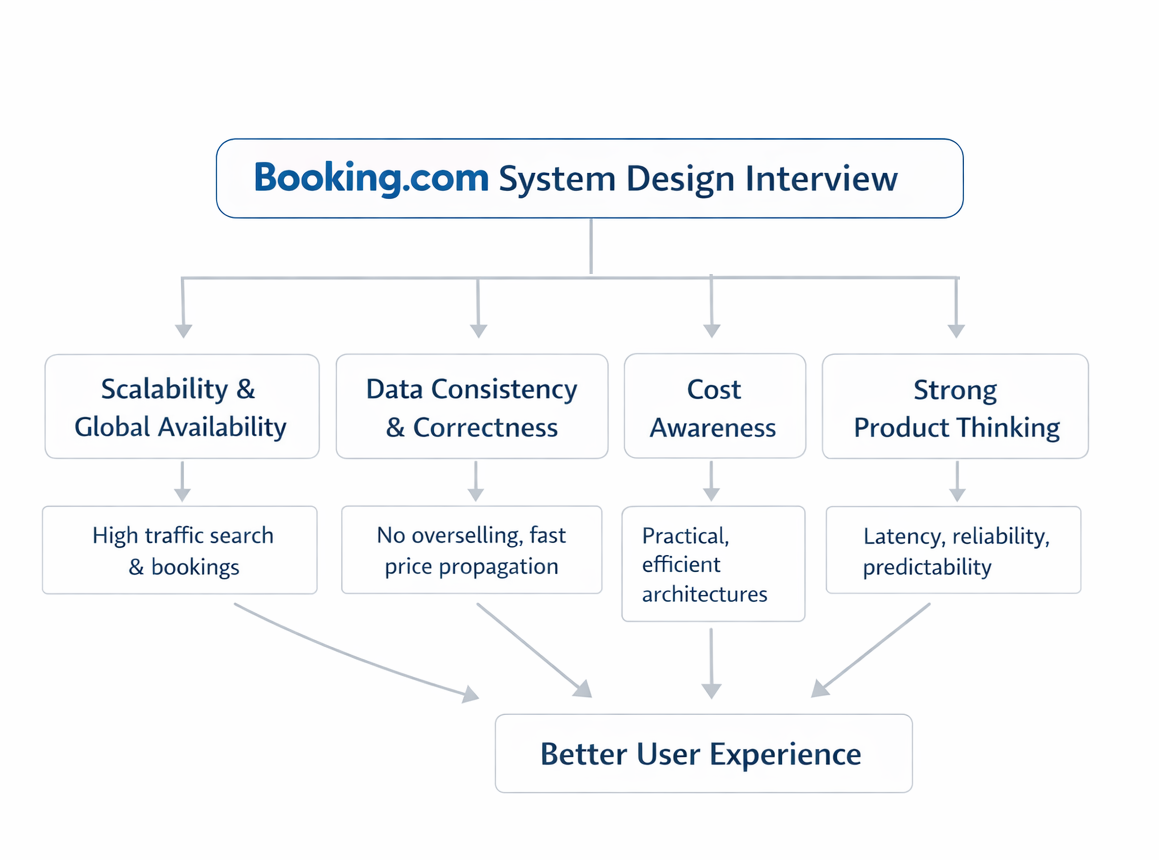
Booking.com optimizes for engineers who can design systems that work globally, remain fast across regions, and degrade gracefully under peak traffic. The company values pragmatism over buzzwords. That means that their System Design interview questions evaluate you on:
Scalability and global availability#
They want to see that you understand how to design services that handle tens of thousands of concurrent hotel searches, price refreshes, and booking operations.
Data consistency and correctness#
Booked rooms must not be oversold. Price changes must propagate fast. Caches must stay coherent. Real-world trade-offs matter more than theoretical purity.
Cost-awareness#
Booking.com runs primarily on a highly optimized cloud setup. They expect you to choose practical architectures, not overengineered ones.
Strong product thinking#
Everything comes back to user impact: latency, reliability, and predictability.
If you show that your design decisions improve real user experience while preserving performance and reliability, you’ll align well with what engineers at Booking.com value.
Format of the Booking.com System Design interview#
Interview stage | What you’re expected to do |
Clarify requirements | Ask about core features, constraints, scale, and data freshness before designing |
Propose a high-level architecture | Outline major services, data stores, and communication patterns |
Deep dive into components | Explain databases, caches, queues, compute layers, and data flow |
Estimate traffic and scale | Provide QPS, data size, read/write ratios, and scaling assumptions |
Handle failures and consistency | Discuss retries, fallbacks, replication, and consistency guarantees |
Discuss trade-offs | Compare design options and justify choices clearly |
Add improvements | Suggest optimizations, extensions, or future enhancements |
You can expect a 45–60 minute session. The interviewer typically gives you a problem aligned with real Booking.com workloads.
A typical structure looks like:
Clarifying the requirements (functional and non-functional)
Proposing a high-level architecture
Deep-diving into components (databases, caches, queues, compute)
Handling traffic estimates and scaling strategy
Managing failures and consistency challenges
Discussing trade-offs
Adding improvements or optional features
You are expected to lead the conversation. The interviewer may ask you to go deeper into specific components like caching, price updates, rate-limits, or database schema design.
Common topics in the Booking.com System Design interview#
While Booking.com can technically ask any general system design question, real interviews tend to cluster around a few recurring themes. These problems closely mirror the company’s actual workloads: search-heavy traffic, cache-sensitive read paths, API-driven integrations, and globally distributed systems that must remain fast and correct under constant change.
Understanding these themes helps you anticipate what interviewers care about and structure your answers in a way that reflects real-world engineering rather than textbook design.
System Design Deep Dive: Real-World Distributed Systems

Modern software systems are expected to operate at a massive scale while meeting strict reliability and latency requirements. Whether it’s a feed refresh, a payment request, or a real-time analytics query, users expect systems to respond instantly and consistently. That expectation has raised the bar for engineers today, understanding that System Design isn’t optional. It’s a core skill for building and evaluating production-grade systems. I built this course from my experience working on large-scale distributed systems at Microsoft (Azure) and Meta (Scuba), and from interviewing hundreds of candidates across both companies. The pattern I kept seeing was this: candidates understood individual components, but struggled to combine them into a coherent system. They knew what a cache or load balancer was, but not when or why to use it. This course is designed to bridge that gap. We start with the foundational building blocks of System Design, including databases, caching layers, load balancing, and messaging systems, and focus on how they interact under real-world constraints. From there, we analyze systems built by companies like Google, Facebook, and Amazon, breaking them down to understand the trade-offs behind each design decision. The goal is not just to learn concepts, but to develop the ability to reason through them in practice. This approach has helped a large number of engineers build stronger intuition for System Design and perform better in interviews. If you want to understand how real systems are designed and be able to design them yourself, this course gives you a clear, practical path forward.
Below are the most common themes.
1. Designing a hotel search system#
The hotel search system is the most common Booking.com System Design interview problem and a favorite starting point for interviewers. You’re typically asked to design a system that allows users to search hotels by location, dates, price range, amenities, or ratings, while supporting pagination across millions of properties.
Interviewers expect you to focus heavily on how search works at scale. That includes explaining how you would index hotel data, route queries efficiently, and rank results in a meaningful way. You’ll likely need to discuss multi-layer caching strategies for location data, availability, and pricing, as well as how those caches stay fresh as prices and inventory change in real time.
Geospatial indexing is another important area. Strong answers explain how techniques like geohashing, R-trees, or Elasticsearch geo queries enable fast location-based searches. You should also cover database sharding and replication strategies that support global traffic, along with mechanisms for propagating price updates quickly without overwhelming the system.
This problem is intentionally open-ended. Your job isn’t to design everything perfectly, but to demonstrate that you can structure complexity, prioritize the right components, and explain trade-offs clearly.
2. Real-time availability service#

Ensuring accurate room availability is one of the hardest engineering problems Booking.com faces, and it frequently appears in System Design interviews. Hotels update inventory continuously, yet the platform must avoid overselling rooms under any circumstances.
In this scenario, you may be asked to design an availability API or a real-time update pipeline that processes partner inventory changes and makes them visible to users quickly. Interviewers expect you to reason about consistency models and explain how updates propagate across distributed systems.
Strong answers typically include techniques like optimistic locking to prevent conflicting updates, event-driven pipelines using systems like Kafka, and thoughtful cache invalidation strategies. You should also discuss read/write separation, high write throughput handling, and explicit anti-oversell guarantees.
This is a great opportunity to show judgment by comparing strong consistency and eventual consistency approaches and explaining why one may be preferable in specific parts of the system.
3. Pricing engine design#
Pricing systems at Booking.com are highly dynamic. Hotels change prices based on demand, seasonality, occupancy, and promotions, and those changes must be reflected quickly across millions of active searches.
In a pricing engine design question, interviewers want to see how you balance freshness, cost, and scalability. You may discuss concepts such as price snapshotting, real-time stream processing, and cache refresh mechanisms that allow fast reads without excessive recomputation.
You should also explain how bulk updates are handled efficiently, how rate limiting protects downstream systems, and how audit trails make pricing changes traceable and debuggable. The key signal here is your ability to reason about trade-offs between real-time accuracy and system cost.
4. Notifications and confirmation systems#
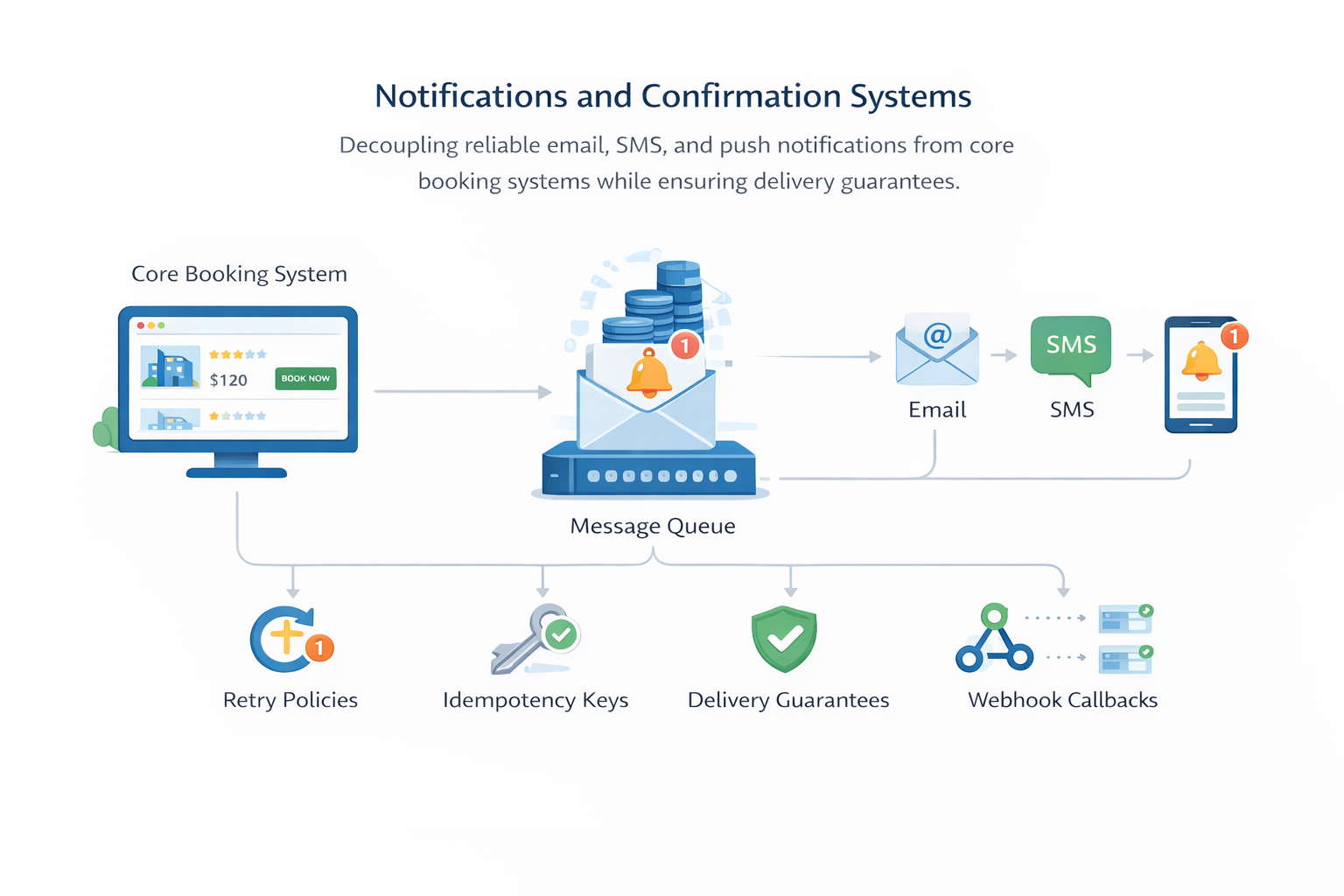
Booking confirmations trigger a cascade of notifications, including emails, SMS messages, and push notifications. These systems are typically asynchronous and must be reliable even under failure.
Interviewers often use this topic to test your understanding of messaging systems. You should be able to explain retry policies, idempotency keys, delivery guarantees, and how message queues or event streams decouple notification delivery from core booking flows. Handling webhook callbacks from external providers is another common angle, especially when discussing failure recovery and duplicate prevention.
5. Designing a review or rating system#
Review and rating systems test your ability to model large, append-only datasets. You may be asked how reviews are stored, ranked, filtered, and displayed at scale.
Strong answers cover data modeling choices, indexing strategies, and techniques for ranking reviews while preventing abuse. You should also demonstrate awareness of moderation pipelines and systems that detect spam or fraudulent content without impacting read performance.
How to structure your answer for the Booking.com System Design interview#
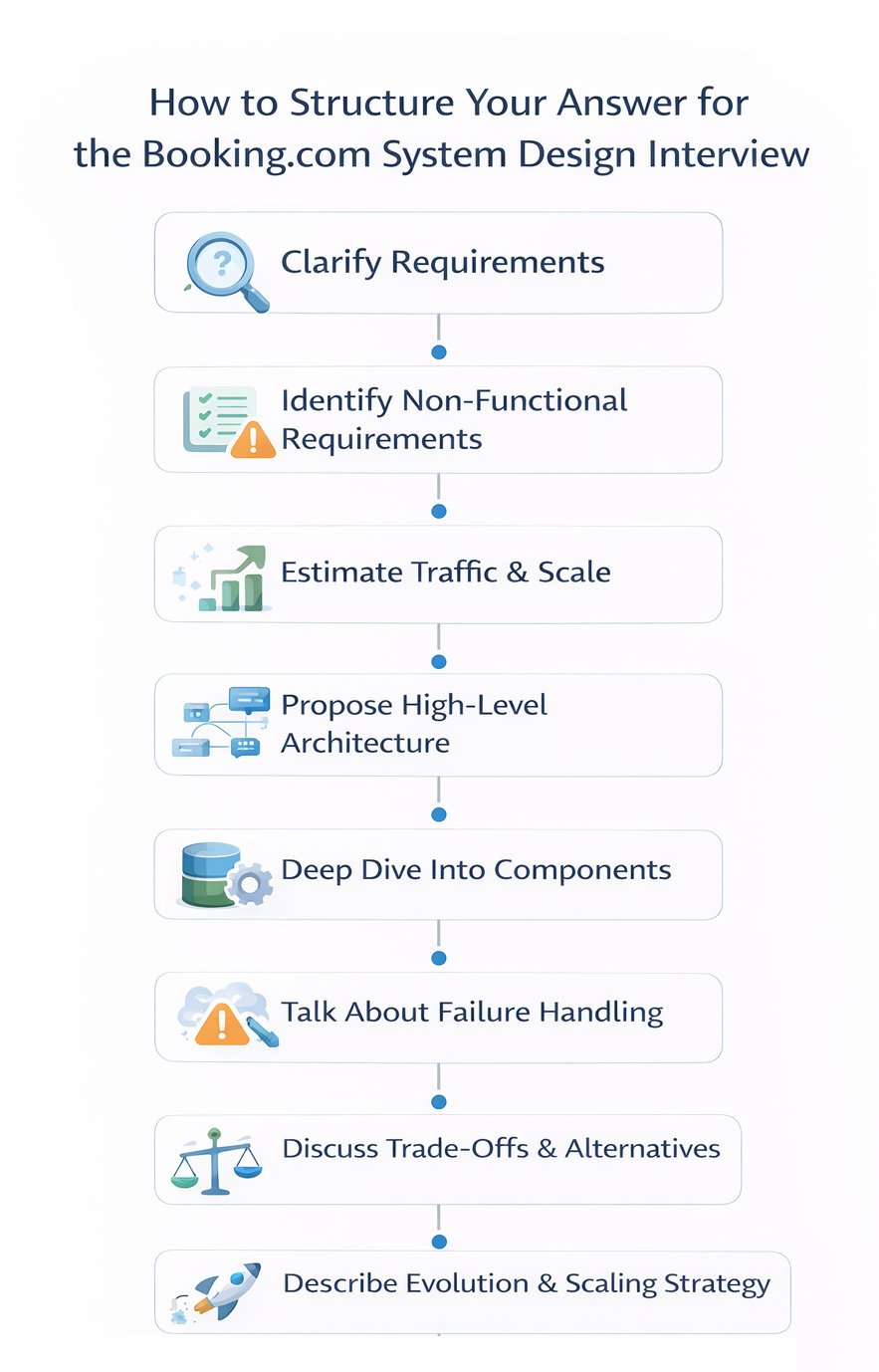
Below is the ideal, snippet-friendly framework you should use. Many candidates fail because they jump directly into the architecture without setting the stage. This structure shows deliberate thinking and matches what Booking.com expects.
1. Clarify functional requirements#
Start by defining the problem clearly. Ask questions about core features, how frequently data changes, whether results are personalized or global, and which filters or workflows matter most. Interviewers expect you to shape the problem before solving it, not assume missing details.
2. Identify non-functional requirements#
Once functionality is clear, explicitly call out non-functional constraints. Booking.com places heavy emphasis on low latency, global availability, consistency requirements, traffic patterns, and data freshness expectations. Being explicit here signals senior-level thinking and helps justify later design decisions.
3. Estimate traffic and scale#
Next, ground your design in scale. Provide rough estimates for daily active users, queries per second, read/write ratios, data size per entity, and expected cache hit rates. Precision matters less than reasonable assumptions that show you can plan capacity and anticipate bottlenecks.
4. Propose a high-level architecture#
With constraints established, outline a clean high-level architecture. This typically includes an API Gateway, stateless web servers, a service layer separating concerns like search, availability, and pricing, a multi-layer cache, sharded databases, messaging queues, and supporting analytics pipelines.
Booking.com values modular service boundaries because they mirror how real teams build and operate systems.
5. Deep dive into critical components#
Choose the components that matter most for the problem at hand and go deep. In a hotel search system, that usually means explaining the search index, availability service, caching layers, database sharding strategy, and API design. Depth matters more than breadth here.
6. Talk about failure handling#
Failure handling is a major scoring criterion. Strong answers explain how the system degrades gracefully using fallback caches, retries, circuit breakers, regional failover, and techniques that prevent cascading failures during peak traffic.
7. Discuss trade-offs and alternatives#
Interviewers want to see judgment, not perfection. Compare alternatives such as SQL versus NoSQL, strong versus eventual consistency, cache invalidation versus refresh strategies, and synchronous versus asynchronous updates. Clearly explain why you chose one approach over another.
8. Describe evolution and scaling strategy#
Close by showing long-term thinking. Explain how the system would scale globally, how costs could be reduced over time, how latency might be improved, and how new features could be added safely. This demonstrates that you think beyond the initial design and understand system evolution in production environments.
Example: high-level design for the Booking.com hotel search system#
Below is a summarised sample answer that aligns with the Booking.com System Design interview expectations.
Requirements#
Users should be able to search hotels by city, date range, filters (price, amenities, rating), and see paginated results sorted by relevance. The system must support millions of daily queries with low latency and fresh availability/pricing data.
Architecture#
A search query hits an API Gateway.
The request goes to the Search Service.
The Search Service pulls data from a Search Index (Elasticsearch) filtered by geolocation and amenities.
For each result, availability and pricing data are fetched from a high-speed cache backed by a real-time availability pipeline.
Cache invalidation happens through event streams that capture partner updates.
All listing details reside in a sharded SQL database with replicas per region.
A global CDN reduces static content load and improves latency.
Kafka streams update search indices and availability caches as changes occur.
This covers scalability, correctness, cost efficiency, and global performance, all key to Booking.com.
How to stand out in a Booking.com System Design interview#
To maximize your score, do the following consistently:
Think in terms of user experience: Booking.com interviewers care about why your design helps the user.
Focus on data freshness: Almost every service relies on availability and pricing accuracy.
Show awareness of global latency: Discuss region-based deployments, local caches, and data replication.
Prioritize cost efficiency: Pick architectures that reflect real-world practicality.
Communicate clearly and concisely: Lead the conversation, summarize each section, and avoid jargon.
Final thoughts#
The Booking.com System Design interview is a great opportunity to showcase your ability to design fast, scalable, global systems that serve millions of travelers every day. If you anchor your answers in real-world engineering, balance performance with cost, and clearly explain your trade-offs, you will stand out from other candidates. Use the framework above, practice solving search- and availability-heavy problems, and apply a strong product mindset to every design decision.
With the right preparation strategy, you can walk into your Booking.com System Design interview with confidence and deliver high-quality, structured, industry-level architectural solutions.
