Amazon System Design Interview Questions
Master Amazon’s System Design interview by learning how real Amazon systems scale, fail, and evolve. This guide breaks down the most common questions and shows you how to think, design, and communicate like a senior Amazon engineer.
Amazon System Design interviews for SDE II and above are grounded in practical, large-scale distributed systems problems drawn directly from systems Amazon has already built and operates. Interviewers evaluate whether candidates can reason about fault tolerance, event-driven architecture, observability, and operational excellence at the scale of Prime Day traffic and a global logistics network.
Core principles
- Event-driven architecture: Nearly every Amazon System Design question expects candidates to model state changes as durable, replayable events rather than synchronous updates.
- Service decomposition over monoliths: Strong answers define clear service boundaries across catalog, order, payment, inventory, and fulfillment rather than treating the system as a single unit.
- Transactional correctness vs. read scalability: Normalized relational schemas handle ACID-critical workflows like payments, while NoSQL stores and cache layers absorb high-volume read traffic on product and recommendation surfaces.
- Cyber-physical system reasoning: Questions covering fulfillment centers and Amazon Locker require candidates to account for hardware failures, IoT device management, and offline resilience alongside cloud-side logic.
- Observability and graceful degradation: Interviewers expect explicit discussion of alarms, audit logs, reconciliation flows, and how the system behaves when individual components fail under load.
When people talk about Amazon’s technical interviews, they often focus on data structures, algorithms, or leadership principles. But if you’re targeting an SDE II, SDE III, or senior backend role, the Amazon System Design interview becomes the real make-or-break moment. And it makes sense, Amazon runs some of the largest distributed systems on the planet, from Prime Video to Amazon.com to AWS to a world-spanning logistics network that rivals FedEx and DHL.
Because of that, Amazon System Design interview questions are intensely practical. They aren’t about hypotheticals. They’re about designing real systems that Amazon has already built, but at a scale most engineers will never see unless they work at a FAANG company.
Grokking Modern System Design Interview

For a decade, when developers talked about how to prepare for System Design Interviews, the answer was always Grokking System Design. This is that course — updated for the current tech landscape. As AI handles more of the routine work, engineers at every level are expected to operate with the architectural fluency that used to belong to Staff engineers. That's why System Design Interviews still determine starting level and compensation, and the bar keeps rising. I built this course from my experience building global-scale distributed systems at Microsoft and Meta — and from interviewing hundreds of candidates at both companies. The failure pattern I kept seeing wasn't a lack of technical knowledge. Even strong coders would hit a wall, because System Design Interviews don't test what you can build; they test whether you can reason through an ambiguous problem, communicate ideas clearly, and defend trade-offs in real time (all skills that matter more than ever now in the AI era). RESHADED is the framework I developed to fix that: a repeatable 45-minute roadmap through any open-ended System Design problem. The course covers the distributed systems fundamentals that appear in every interview – databases, caches, load balancers, CDNs, messaging queues, and more – then applies them across 13+ real-world case studies: YouTube, WhatsApp, Uber, Twitter, Google Maps, and modern systems like ChatGPT and AI/ML infrastructure. Then put your knowledge to the test with AI Mock Interviews designed to simulate the real interview experience. Hundreds of thousands of candidates have already used this course to land SWE, TPM, and EM roles at top companies. If you're serious about acing your next System Design Interview, this is the best place to start.
In this guide, you’ll walk through the most common Amazon System Design interview questions, understand what each question is measuring, and learn how to deliver clear, Amazon-level answers that reflect scale, reliability, operational excellence, and deep architectural thinking.
Why Amazon System Design questions are different#
At Amazon, your interviewer isn’t just evaluating your scalable System Design; they’re also testing whether you think like an Amazon engineer. That means aligning with Customer Obsession, Dive Deep, Invent and Simplify, Insist on the Highest Standards, and Bias for Action.
Amazon System Design interview questions tend to emphasize:
Real-world constraints (latency, cost, on-call impact, regional regulations)
High-volume transactional systems
Event-driven architecture
Decentralized services over monoliths
Fault tolerance and graceful degradation
Operational metrics, observability, and alarms
Scalability under peak events like Prime Day
What Amazon is evaluating in System Design interviews#
Dimension | What Amazon is really testing |
Scale | Can your design handle millions to billions of events reliably? |
Reliability | Does the system degrade gracefully under failure? |
Cost awareness | Are services efficient at massive scale? |
Ownership | Do you consider monitoring, alarms, and recovery? |
Practicality | Are design choices realistic for production systems? |
Leadership principles | Do decisions align with Customer Obsession and Operational Excellence? |
With that in mind, let’s break down the most common Amazon System Design interview questions and how to master them.
System Design Interview: Fast-Track in 48 Hours

I created this System Design interview prep crash course after spending years interviewing engineers at companies like Meta and Microsoft. I kept seeing the same pattern: candidates who were strong in coding would struggle the moment the System Design interview began. It was because they didn’t have a clear way to approach System Design under pressure. That’s exactly why I built this course to help you master System Design in a hurry, without feeling overwhelmed. System Design interviews aren’t about memorizing architectures or listing technologies. They’re about how you think. Can you break down an ambiguous problem? Can you make the right trade-offs? Can you communicate your decisions clearly? The candidates who succeed are the ones with a structured approach they can rely on. In this course, I’ve distilled that approach into a simple, repeatable framework. Instead of scattered topics, you’ll learn System Design step by step, from understanding requirements to designing scalable systems and explaining your choices with confidence. Each lesson builds your intuition and prepares you for real interview scenarios. This is the same mindset I’ve seen successful candidates use to stand out. Whether you’re preparing for your first System Design interview or trying to level up quickly, this course gives you a practical path forward. By the end, you’ll know how to apply System Design concepts effectively, even when time is limited and the pressure is high.
How would you design an Amazon warehouse system or fulfillment center?#
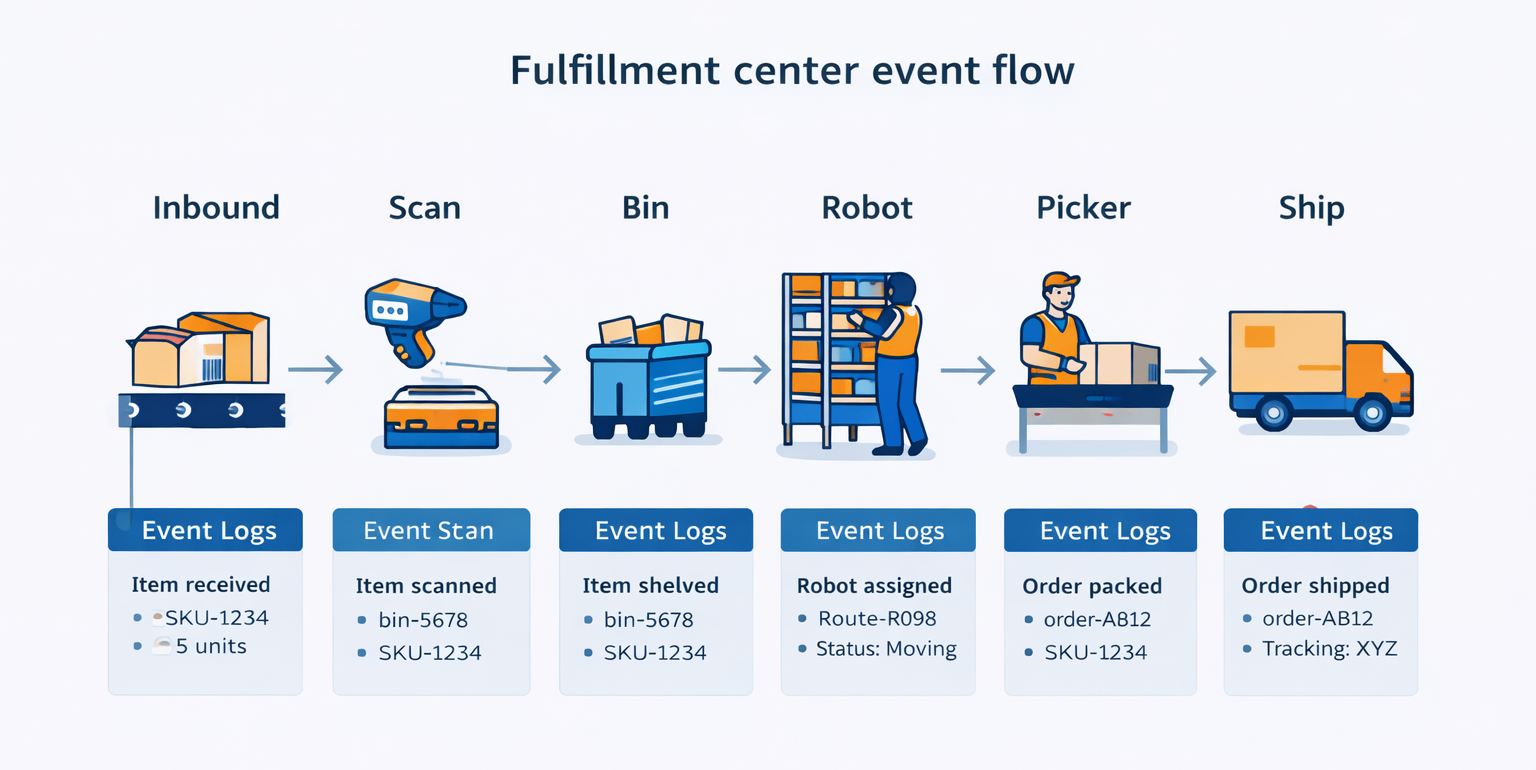
A fulfillment center is the operational backbone of Amazon’s retail business. Designing this system requires reasoning about software and hardware working together in real time. Interviewers use this question to test whether you can think beyond purely digital systems and design cyber-physical workflows that operate continuously under high load.
At a high level, a fulfillment center system must maintain accurate inventory counts while coordinating robots, human associates, scanning devices, packing stations, and outbound logistics. Every movement of an item, from receiving to shelving to picking to shipping, must be captured as an event and reflected in inventory state.
Strong answers describe an inventory tracking system that maintains SKU-level counts and associates items with physical bin locations. This system typically relies on versioning or conditional writes rather than coarse-grained locks to avoid bottlenecks. Each scan updates state through an event pipeline, ensuring durability and replayability.
Fulfillment center subsystems and responsibilities#
Subsystem | Primary responsibility |
Inventory tracking | Maintain accurate SKU counts and bin locations |
Robotics control | Coordinate robot movement and shelf transport |
Picking & packing | Assign optimized picking tasks to associates |
Order routing | Select optimal fulfillment center per order |
Scanning & logging | Capture real-time item movement events |
Reconciliation | Detect and correct inventory mismatches |
What Amazon is really testing#
Ability to design cyber-physical systems (software + hardware)
Understanding of real-time processing and event-driven workflows
Reasoning about inventory accuracy, bin location indexing, and order picking optimization
Key architectural components#
Inventory tracking system
Maintains real-time item counts
Associates each SKU with a bin location
Uses distributed locking or versioning to maintain consistency
Robotics integration
Kiva robots (or successors) transport shelves
Requires low-latency messaging between robots and central controllers
Picking and packing system
Workers receive picking tasks via handheld apps
System sequences tasks to minimize walking distance
Order routing service
Determines which FC fulfills an order
Considers stock levels, shipping speed, labor load, and regional constraints
Outbound sorting + shipping
Packages move through conveyor belts
Scanners update state logs in real time
Interviewer expectations#
Cover:
Failure detection
Graceful degradation (e.g., robot malfunction)
Audit logs for compliance
Reconciliation flows for misplaced items
Mentioning optimization algorithms (e.g., A* routing, bin packing heuristics) shows depth, but only if relevant.
What’s the best way to design Amazon’s customer–order–product database?#
This question evaluates whether you understand how Amazon separates transactional correctness from read scalability. The core of Amazon’s commerce system relies on relational data models that prioritize consistency and correctness for critical workflows.
A strong answer begins with a normalized relational schema that includes customers, orders, order items, products, inventory, and fulfillment records. This structure supports ACID guarantees for order placement, payment processing, and fraud prevention. Normalization ensures data integrity and simplifies transactional updates.
From there, senior-level candidates explain when and why denormalization becomes necessary. Amazon’s product pages and recommendation surfaces are read-heavy, making them poor candidates for strict relational queries at scale. To address this, Amazon uses NoSQL stores, cache layers, and replicated views that trade some freshness for performance.
Global replication is another important topic. Multi-region databases, global tables, and region-aware routing ensure availability while minimizing latency. Event streams propagate changes across systems, allowing caches and downstream services to remain eventually consistent without blocking transactions.
Finally, strong answers distinguish between hot transactional data and analytical data. OLTP workloads power live user interactions, while OLAP systems, such as data lakes and warehouses, support reporting, forecasting, and machine learning without impacting customer-facing latency.
How would you design an e-commerce system like Amazon’s?#
This is one of the broadest System Design questions Amazon asks, and it’s designed to test your ability to decompose a massive product into clear service boundaries. Interviewers are less interested in exhaustive detail and more focused on whether your system is modular, scalable, and observable.
A well-structured answer frames the system around core services. The catalog service manages product metadata and pricing. The search service indexes products and supports relevance-based queries. Recommendation systems personalize discovery using behavioral data. The cart service stores user-specific state with low latency. The order service orchestrates transactional workflows, while the payment service integrates with gateways and fraud detection.
Structure your answer around the major components:#
Catalog service: Stores product metadata, prices, and stock levels
Search service: Uses inverted indexes + ranking algorithms
Recommendation engine: Suggests items using ML models
Cart service: Low-latency, user-specific data store
Order service: Handles order placement, reservation, and transactionality
Payment service: Integrates with payment gateways and fraud detection
Inventory service: Coordinates availability across warehouses
Fulfillment/Logistics: Routes orders to FCs or third-party carriers
Delivery tracking: Updates customers with shipping status
Core e-commerce services and scaling concerns#
Service | Scaling challenge |
Catalog | High read traffic, frequent updates |
Search | Low latency under peak load |
Cart | User-specific state consistency |
Orders | Transactional correctness |
Payments | Idempotency and fraud prevention |
Inventory | Global consistency vs availability |
Fulfillment | Multi-region coordination |
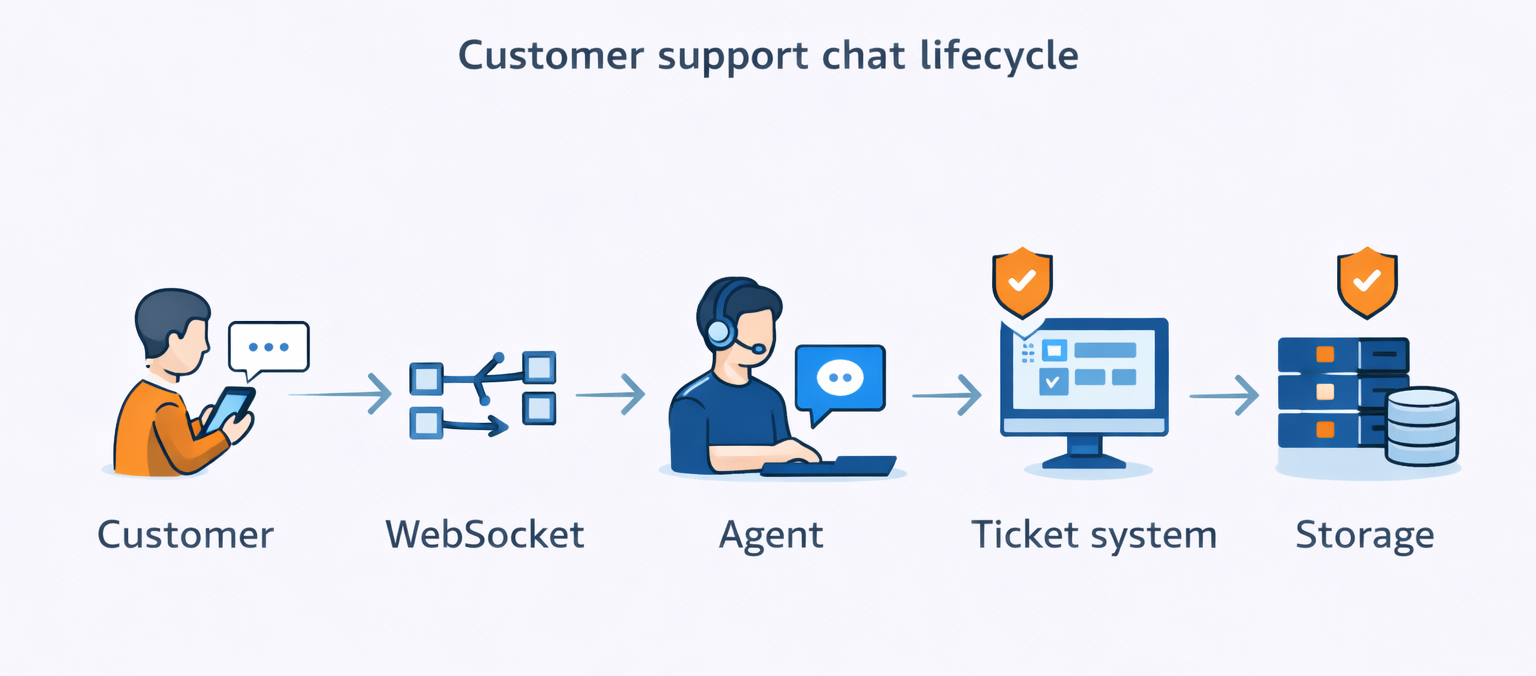
This question blends real-time communication with customer service workflows. It tests your ability to design systems that support live interaction while maintaining auditability and integration with backend systems.
Strong designs use persistent connections like WebSockets for low-latency messaging, backed by durable message stores that preserve transcripts for compliance. Authentication and session management ensure that customers are routed to the correct agents, while routing services balance load across support teams.
Message ordering, handoff between agents, and logging are critical concerns. Since chat transcripts may influence refunds or disputes, designs must ensure durability and traceability. Offline notifications and spam filtering complete the system.
Candidates who reference architectural patterns similar to Amazon Connect or mention integration with ticketing systems demonstrate deeper domain awareness.
How would you build the software behind an Amazon pickup location with lockers?#
Amazon Locker systems combine cloud services with physical hardware. Interviewers use this question to assess your understanding of device management, security, and offline resilience.
At the core is a locker controller that interfaces with sensors, locks, and environmental monitors. A locker assignment service selects appropriate compartments based on package size and availability. Delivery drivers authenticate and trigger compartment access via scanning systems, while customers receive pickup codes and notifications.
Main components#
Locker hardware controller
Integrates with IoT devices
Manages door locks, sensors, and temperature checks
Locker assignment service
Chooses an appropriate locker compartment
Based on package size and locker availability
Delivery scanning system
Last-mile driver scans a QR code
Locker opens automatically
Customer notification system
Sends pickup codes
Handles expired pickups or returns
Security + auditing
Events logged for compliance
Replayable event stream for investigations
What interviewers test#
Your ability to design device management systems
Handling hardware failures gracefully
Offline operation when a locker loses connectivity
What’s the design for an Amazon-like delivery system optimized for the shortest route?#
This question evaluates your ability to reason about optimization problems at scale. Amazon’s delivery network must balance cost, speed, and reliability across millions of daily deliveries.
Strong answers describe pipelines that batch orders geographically and temporally, apply route optimization heuristics, assign routes to drivers, and ingest real-time GPS updates. Traffic conditions, driver availability, package constraints, and delivery windows all influence routing decisions.
Interviewers expect you to discuss trade-offs between optimal routes and computational feasibility, as well as how the system adapts to real-world disruptions like road closures or delayed deliveries.
Route optimization constraints#
Constraint | Why it matters |
Delivery windows | Customer expectations |
Traffic conditions | Real-time rerouting |
Driver availability | Fleet efficiency |
Package weight | Vehicle capacity |
Geography | Multi-day regional planning |
What’s the architecture for Amazon’s recommendation system?#
Amazon’s recommendation engine is a revenue-critical system, making this a high-impact interview question. The focus here is on data pipelines and ranking architectures rather than UI concerns.
Strong answers describe ingestion of behavioral data, storage of embeddings in feature stores, model training pipelines, and real-time inference services that return recommendations within tight latency budgets. Candidate generation, ranking, and re-ranking stages ensure both relevance and performance.
Mentioning A/B testing, personalization per region, and edge caching signals an understanding of how recommendations evolve safely at scale.
Final thoughts#
Amazon’s System Design interviews reward engineers who think holistically. Success comes from designing systems that are not only scalable but also cost-efficient, observable, and resilient. Interviewers want to see that you can reason end-to-end, anticipate failures, and operate systems responsibly at massive scale.
If you approach these interviews with an ownership mindset, emphasize event-driven architectures, and consistently tie design decisions back to customer impact and operational excellence, you’ll demonstrate exactly what Amazon expects from senior engineers.
