How to build your own Large Language Model
Curious how modern AI systems are built? Learn how to build your own large language model and understand the data, architectures, and training pipelines that power today’s most advanced AI technologies.
Large language models have become one of the most transformative technologies in artificial intelligence. Developers, researchers, and organizations are increasingly interested in building their own large language models to gain greater control over AI capabilities and customize models for specialized tasks.
Modern language models power tools such as AI assistants, code generation systems, research automation platforms, and intelligent chat interfaces. While many developers rely on pretrained models, building a custom large language model can provide greater flexibility and a deeper understanding of how these systems work.
Understanding how to build your own large language model requires examining the complete lifecycle of model development. This includes collecting and preparing datasets, selecting architectures, training neural networks, and evaluating performance across different tasks.
Essentials of Large Language Models: A Beginner’s Journey
Large language models (LLMs) are at the core of today’s AI transformation, powering everything from conversational agents to code generation and enterprise automation. As adoption accelerates, understanding how LLMs actually work, and how to use them effectively in real systems, is no longer optional for developers and data professionals. I built this course from my work in neural networks and intelligent systems, where LLMs represent a shift from traditional modeling to probabilistic reasoning at scale. A recurring pattern I observed was that many practitioners could use APIs but lacked a clear mental model of how LLMs process language, make decisions, and fail in edge cases. This course is designed to bridge that gap with a systems-level perspective. You’ll learn LLM fundamentals from first principles, covering architecture, tokenization, embeddings, attention, and training dynamics, before moving into practical workflows like prompting, retrieval-augmented generation (RAG), and tool integration. Each concept is tied to how LLMs are actually deployed in production systems. Engineers and researchers are already building on these foundations to create real-world AI applications. If you want to go beyond surface-level usage of LLMs, this is where you begin.
Understanding What A Large Language Model Is#
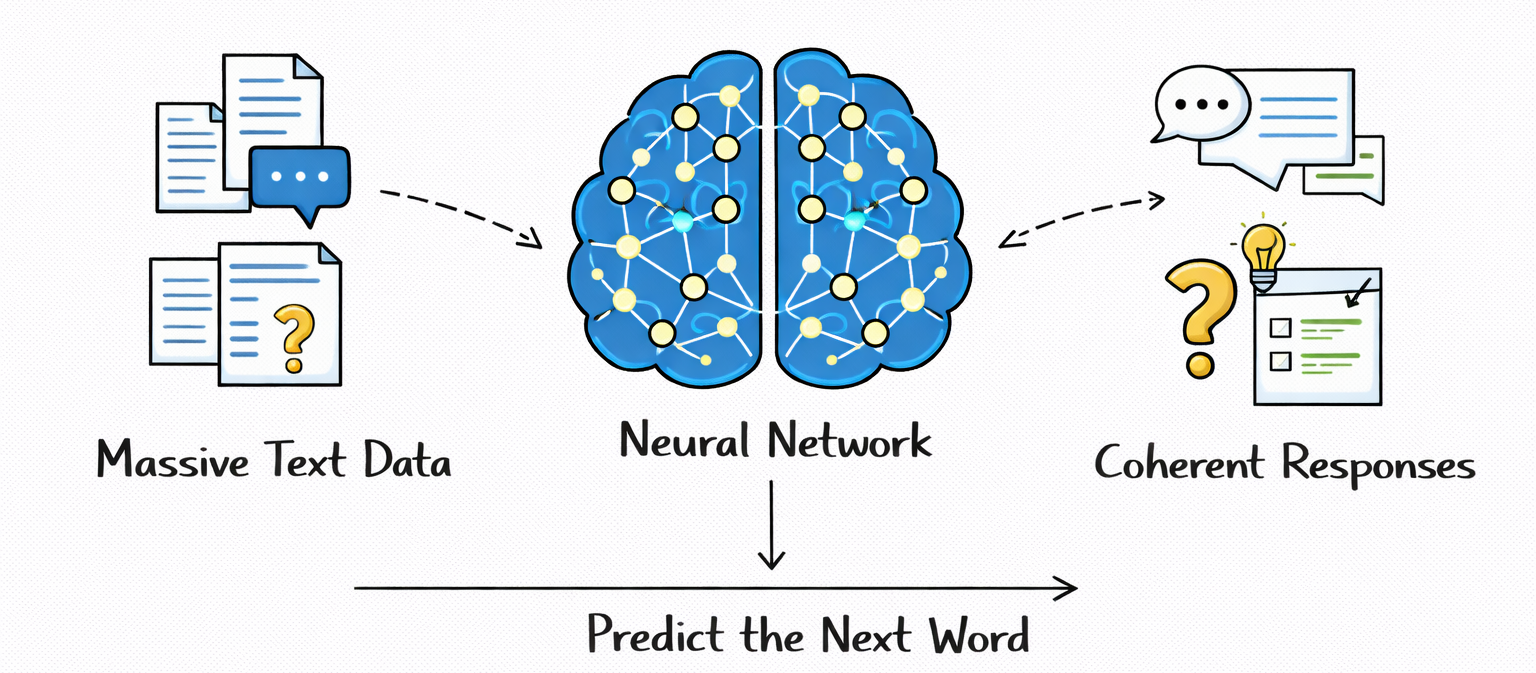
Before exploring how to build your own large language model or how an LLM is trained, it is important to understand the underlying concept behind these systems. A large language model is a type of neural network trained on massive amounts of text data in order to understand language patterns and generate coherent responses.
Language models learn statistical relationships between words and phrases through repeated exposure to training data. Over time, the model develops the ability to predict the next token in a sequence, which allows it to generate sentences, answer questions, and perform reasoning tasks.
These models are typically built using transformer architectures, which enable the system to analyze relationships between words across long sequences of text.
Concept | Description |
Language Model | Predicts the next word or token in text |
Token | A unit of text processed by the model |
Neural Network | The mathematical model used for learning patterns |
Transformer Architecture | The framework used in modern LLMs |
Understanding these core concepts provides a foundation for exploring how large language models are constructed.
Unleash the Power of Large Language Models Using LangChain

LLM and LangChain development have become a cornerstone of modern AI engineering, enabling developers to move from simple model calls to fully orchestrated, context-aware applications. As LLM-powered systems scale, frameworks like LangChain are essential for structuring prompts, managing memory, and integrating tools, turning raw model capability into production-ready solutions. I built this course from my work in intelligent systems and applied AI, where the real challenge is not accessing LLMs, but designing systems that can reason, maintain context, and interact with external data. A recurring pattern I observed was that developers could prototype quickly, but struggled to build structured, extensible applications. LangChain provides that missing layer, and this course is designed to make it practical. You’ll unlock the power of LLMs using LangChain through core components like prompt templates, chains, and memory, then extend into agents, API integrations, and retrieval-augmented generation (RAG). You’ll also explore LangGraph for building dynamic, multi-agent workflows and routing systems. Developers are already using LangChain to build scalable AI applications. If you want to move from experimentation to real-world LLM systems, this is where you start.
Why Developers Want To Build Custom Language Models#
Many organizations explore how to build their own large language model because custom models offer several advantages compared with generic pretrained systems.
Custom models can be trained on specialized datasets related to specific industries, allowing them to generate more accurate and relevant responses. For example, legal organizations may train models on legal documents, while healthcare companies may focus on medical research data.
Building a custom model also provides greater control over data privacy and system behavior. Organizations that manage sensitive information often prefer training models internally rather than relying entirely on external services.
Benefit | Explanation |
Domain Specialization | Models trained on industry-specific data |
Data Control | Organizations maintain control over datasets |
Custom Behavior | Tailored model responses |
Research Opportunities | Greater experimentation flexibility |
These advantages explain why many research teams and technology companies invest in custom language model development.
Become an LLM Engineer
Generative AI is transforming industries, revolutionizing how we interact with technology, automate tasks, and build intelligent systems. With large language models (LLMs) at the core of this transformation, there is a growing demand for engineers who can harness their full potential. This Skill Path will equip you with the knowledge and hands-on experience needed to become an LLM engineer. You’ll start with the generative AI and prompt engineering to communicate with AI models. Then you’ll learn to interact with AI models, store and retrieve information using vector databases, and build AI-powered workflows with LangChain. Next, you’ll learn to enhance AI responses with retrieval-augmented generation (RAG), fine-tune models using LoRA and QLoRA, and develop AI agents with CrewAI to automate complex tasks. By the end, you’ll have the expertise to design, optimize, and deploy LLM-powered solutions, positioning yourself at the forefront of AI innovation.
The Core Components Of A Large Language Model#
Building a large language model involves several interconnected components that form the foundation of the training process. Each component contributes to how the model learns patterns and generates responses.
The first component involves the dataset, which provides the textual information the model will learn from. Large language models require enormous datasets that contain diverse examples of written language.
The second component involves the model architecture, which determines how the neural network processes information. Transformer architectures have become the standard approach for large language models because they handle long sequences effectively.
Component | Role In Model Development |
Training Data | Provides language examples |
Tokenization System | Converts text into tokens |
Neural Network Architecture | Processes tokens during training |
Training Algorithm | Adjusts model parameters |
Evaluation Metrics | Measures model performance |
Each of these components must be carefully designed to ensure effective model training.
Preparing Data For Language Model Training#
Data preparation represents one of the most important steps when attempting to build your own large language model. Training data must be collected, cleaned, and structured before it can be used for model training.
Large language models require enormous text corpora that include books, articles, research papers, and web content. These datasets provide diverse language patterns that help the model understand grammar, semantics, and context.
However, raw text data often contains inconsistencies, duplicates, and irrelevant content. Data preprocessing removes noise and ensures that the dataset reflects high-quality language patterns.
Data Preparation Step | Purpose |
Data Collection | Gather large text datasets |
Cleaning | Remove irrelevant or harmful content |
Tokenization | Convert text into numerical tokens |
Deduplication | Remove repeated text samples |
Data quality plays a critical role in determining the performance of a language model.
Tokenization And Text Processing#
Tokenization is a fundamental process in large language model training because neural networks cannot directly interpret raw text. Instead, text must be converted into numerical representations known as tokens.
Tokens represent individual words, subwords, or characters, depending on the tokenization method used. These tokens allow the neural network to process language mathematically.
Modern language models often use subword tokenization techniques that break complex words into smaller units. This approach helps models understand rare or previously unseen words.
Tokenization Method | Description |
Word Tokenization | Splits text into individual words |
Character Tokenization | Treats each character as a token |
Subword Tokenization | Breaks words into smaller segments |
Choosing an effective tokenization strategy improves the model’s ability to understand language structure.
Transformer Architecture And Model Design#
Modern large language models rely on transformer architectures, which were introduced in the research paper titled Attention Is All You Need. Transformers allow models to analyze relationships between words across entire sentences and documents.
The transformer architecture uses a mechanism known as self-attention to evaluate how different tokens relate to one another. This process allows the model to capture context and meaning across long sequences of text.
Transformer Component | Function |
Embedding Layer | Converts tokens into vector representations |
Self-Attention Mechanism | Identifies relationships between tokens |
Feedforward Network | Processes contextual information |
Output Layer | Generates predictions |
These components work together to process text sequences efficiently during training and inference.
Training The Language Model#
Once data preparation and architecture design are complete, the next step in building your own large language model involves training the neural network. During training, the model learns to predict the next token in a sequence by analyzing millions or billions of text examples.
Training involves adjusting model parameters using optimization algorithms such as gradient descent. The model repeatedly processes training data and updates its internal weights to reduce prediction errors.
Training Stage | Description |
Forward Pass | Model predicts the next token |
Loss Calculation | Measures prediction accuracy |
Backpropagation | Adjusts model parameters |
Parameter Update | Improves prediction performance |
Training large models requires significant computational resources and often involves distributed training across multiple GPUs.
Infrastructure And Hardware Requirements#
Developers interested in learning how to build your own large language model must also consider the hardware infrastructure required for training. Large models often require powerful GPUs or specialized accelerators capable of handling massive computational workloads.
Training modern language models can involve hundreds or thousands of GPUs, depending on model size. Cloud computing platforms allow developers to access distributed computing environments for large-scale training tasks.
Hardware Resource | Purpose |
GPU Clusters | Accelerate neural network training |
High Memory Systems | Store large model parameters |
Distributed Training Frameworks | Coordinate multiple machines |
Access to scalable computing infrastructure is often one of the most significant barriers to training large language models.
Evaluating Language Model Performance#
Once training is complete, developers must evaluate the performance of the language model. Evaluation helps determine whether the model generates accurate, coherent, and contextually appropriate responses.
Evaluation methods include automated metrics that measure prediction accuracy as well as human evaluation that assesses language quality and reasoning capabilities.
Evaluation Metric | Purpose |
Perplexity | Measures prediction accuracy |
BLEU Score | Evaluates translation quality |
Human Evaluation | Assesses response coherence |
These evaluation methods help developers identify areas where the model may require further improvement.
Fine-Tuning And Model Optimization#
After initial training, developers often fine-tune large language models for specific applications. Fine-tuning involves training the model on smaller datasets that focus on particular tasks, such as coding assistance or question answering.
This process allows developers to customize model behavior without retraining the entire neural network from scratch.
Fine-Tuning Goal | Example Application |
Domain Knowledge | Medical or legal language |
Task Specialization | Code generation |
Response Style | Conversational assistants |
Fine-tuning, therefore, plays a critical role in adapting large language models to practical applications.
Challenges In Building Large Language Models#
Developers exploring how to build their own large language model often encounter several challenges related to data availability, computational cost, and model complexity.
Training large models requires massive datasets and significant computational resources, which may not always be accessible to individual developers or small teams. Data quality and ethical considerations also play an important role in model development.
Another challenge involves managing model bias and ensuring that generated responses remain accurate and responsible.
Addressing these challenges requires careful dataset curation, responsible training practices, and ongoing model evaluation.
The Future Of Custom Language Model Development#
The field of language model development continues to evolve rapidly as researchers explore new architectures and training techniques. Emerging approaches such as parameter-efficient training and model distillation are making it easier for smaller teams to experiment with custom models.
Open-source frameworks and pretrained models have also lowered the barrier to entry for developers interested in learning how to build their own large language model.
In the future, language models may become more specialized, efficient, and accessible across a wide range of industries.
Final Thoughts#
Learning how to build your own large language model provides developers with a deeper understanding of modern artificial intelligence systems. Although training large models requires significant resources, understanding the architecture, data pipelines, and training workflows behind these systems offers valuable technical insights.
Developers who study language model development gain the ability to design customized AI systems that support specialized tasks across research, software engineering, and data analysis. As artificial intelligence continues to evolve, expertise in language model development will remain an increasingly valuable skill in the technology industry.
