Chatbot System Design Interview
Ready to ace the Chatbot System Design interview? Master retrieval, LLM orchestration, dialogue management, safety pipelines, and scalable architecture. Learn to design production-grade conversational AI that’s fast, grounded, and reliable.
Preparing for the Chatbot System Design interview means preparing to design AI-driven conversational platforms that behave less like simple rule engines and more like distributed machine learning systems. Modern Chatbots power customer support agents, AI assistants, internal enterprise copilots, search interfaces, banking workflows, and multimodal applications.
They must respond in real time, understand intent, retrieve accurate knowledge, maintain conversational memory, integrate with large language models, enforce safety constraints, and scale under unpredictable traffic patterns. At the same time, they must remain cost-efficient and observable.
Grokking Modern System Design Interview
For a decade, when developers talked about how to prepare for System Design Interviews, the answer was always Grokking System Design. This is that course — updated for the current tech landscape. As AI handles more of the routine work, engineers at every level are expected to operate with the architectural fluency that used to belong to Staff engineers. That's why System Design Interviews still determine starting level and compensation, and the bar keeps rising. I built this course from my experience building global-scale distributed systems at Microsoft and Meta — and from interviewing hundreds of candidates at both companies. The failure pattern I kept seeing wasn't a lack of technical knowledge. Even strong coders would hit a wall, because System Design Interviews don't test what you can build; they test whether you can reason through an ambiguous problem, communicate ideas clearly, and defend trade-offs in real time (all skills that matter more than ever now in the AI era). RESHADED is the framework I developed to fix that: a repeatable 45-minute roadmap through any open-ended System Design problem. The course covers the distributed systems fundamentals that appear in every interview – databases, caches, load balancers, CDNs, messaging queues, and more – then applies them across 13+ real-world case studies: YouTube, WhatsApp, Uber, Twitter, Google Maps, and modern systems like ChatGPT and AI/ML infrastructure. Then put your knowledge to the test with AI Mock Interviews designed to simulate the real interview experience. Hundreds of thousands of candidates have already used this course to land SWE, TPM, and EM roles at top companies. If you're serious about acing your next System Design Interview, this is the best place to start.
In the Chatbot System Design interview, your goal is to design an end-to-end architecture capable of understanding user inputs, retrieving relevant information, generating coherent responses, handling multi-turn conversations, and doing all of this safely and efficiently. This guide walks through what interviewers evaluate and how to structure a high-scoring answer.
Why Chatbot System Design is different#
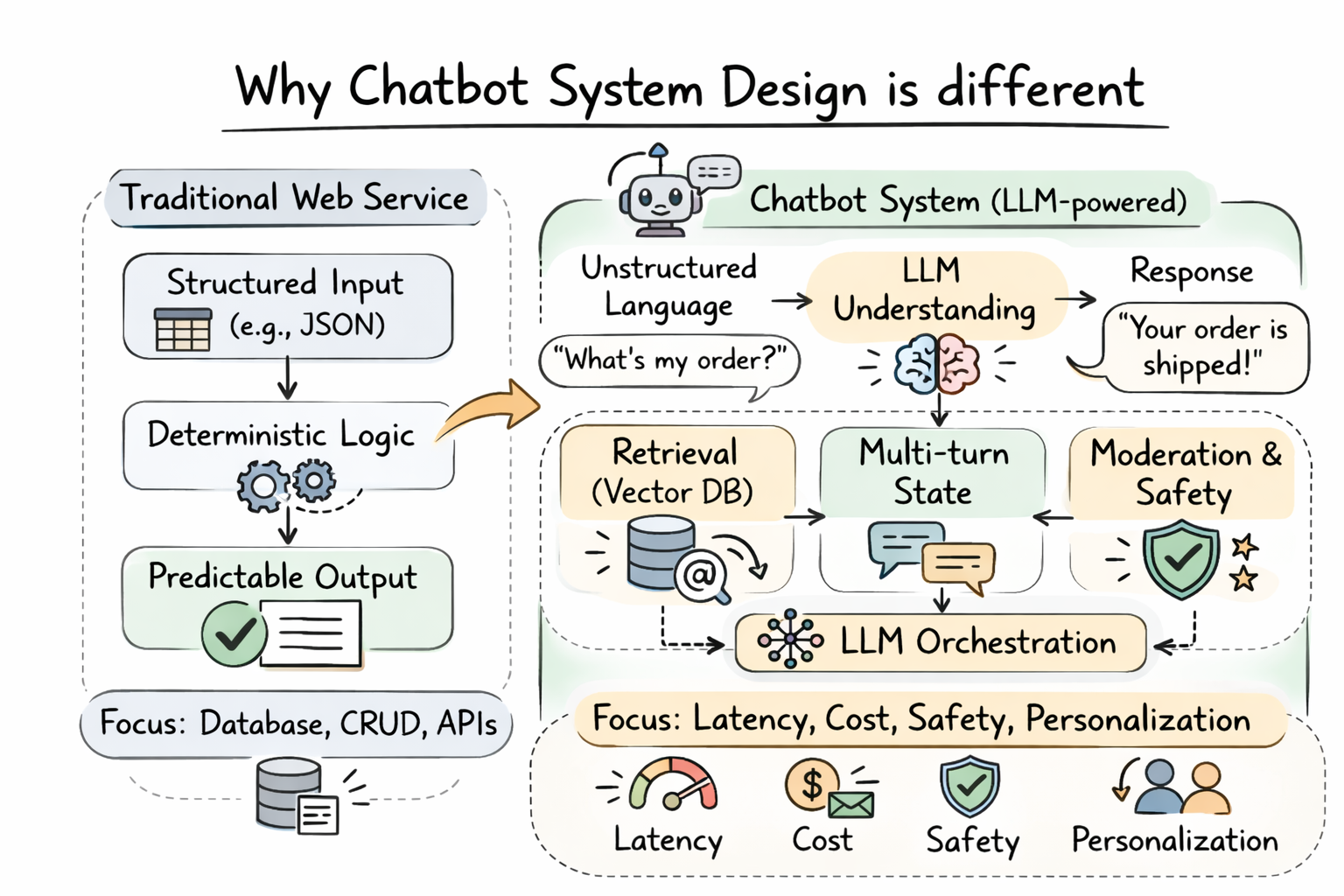
Designing a Chatbot is fundamentally different from designing a traditional web service. A web service typically receives structured input, performs deterministic computation, and returns predictable output. A Chatbot, especially one powered by LLMs, deals with unstructured language, ambiguity, personalization, and safety risks.
The system must manage dynamic prompts, retrieval pipelines, multi-turn state, moderation layers, and model inference orchestration. Unlike CRUD systems, the dominant constraints are often latency, cost per request, and safety enforcement rather than database optimization.
The table below highlights the contrast.
Dimension | Traditional Web Service | Chatbot System |
Input format | Structured | Natural language |
Output | Deterministic | Probabilistic |
Core compute | CPU-based | GPU-based inference |
Memory | Stateless requests | Multi-turn session state |
Risk profile | Limited | Safety & hallucination risks |
Understanding these differences sets the tone for a strong design discussion.
Scalability & System Design for Developers

As you progress in your career as a developer, you'll be increasingly expected to think about software architecture. Can you design systems and make trade-offs at scale? Developing that skill is a great way to set yourself apart from the pack. In this Skill Path, you'll cover everything you need to know to design scalable systems for enterprise-level software.
What the Chatbot System Design interview evaluates#
Interviewers assess whether you can design conversational systems that are accurate, context-aware, scalable, safe, and latency-efficient. They are not testing your knowledge of LLM training internals. They are testing your ability to architect production systems.
The core evaluation areas are summarized below.
Evaluation Area | What You Must Demonstrate |
Natural language understanding | Intent detection and input interpretation |
Retrieval systems | Grounding responses with real data |
Dialogue management | Multi-turn session handling |
LLM orchestration | Efficient, cost-aware generation |
Safety pipelines | Moderation and policy enforcement |
Scalability | Handling high concurrent load |
Observability | Monitoring and feedback loops |
Strong answers connect these components into a cohesive system.
System Design Deep Dive: Real-World Distributed Systems

Modern software systems are expected to operate at a massive scale while meeting strict reliability and latency requirements. Whether it’s a feed refresh, a payment request, or a real-time analytics query, users expect systems to respond instantly and consistently. That expectation has raised the bar for engineers today, understanding that System Design isn’t optional. It’s a core skill for building and evaluating production-grade systems. I built this course from my experience working on large-scale distributed systems at Microsoft (Azure) and Meta (Scuba), and from interviewing hundreds of candidates across both companies. The pattern I kept seeing was this: candidates understood individual components, but struggled to combine them into a coherent system. They knew what a cache or load balancer was, but not when or why to use it. This course is designed to bridge that gap. We start with the foundational building blocks of System Design, including databases, caching layers, load balancing, and messaging systems, and focus on how they interact under real-world constraints. From there, we analyze systems built by companies like Google, Facebook, and Amazon, breaking them down to understand the trade-offs behind each design decision. The goal is not just to learn concepts, but to develop the ability to reason through them in practice. This approach has helped a large number of engineers build stronger intuition for System Design and perform better in interviews. If you want to understand how real systems are designed and be able to design them yourself, this course gives you a clear, practical path forward.
Natural language understanding#
The Chatbot must interpret user input correctly. In enterprise scenarios, intent classification and entity extraction remain important even when LLMs are used.
Some systems use a hybrid approach. An intent classifier routes the query to specific workflows such as billing, order tracking, or password reset. An LLM handles open-ended queries. Entity extraction identifies structured information such as dates, product names, or account numbers.
Even in LLM-centric architectures, lightweight classifiers can reduce cost by routing simple queries away from expensive models.
A mature design explains how the system detects out-of-domain queries and handles ambiguous input gracefully.
Retrieval and grounding#
Most production Chatbots rely on retrieval-augmented generation. Without retrieval, LLMs may hallucinate.
A retrieval layer typically stores document embeddings in a vector database. User queries are embedded and compared using nearest-neighbor search. The top-k relevant chunks are retrieved and inserted into the LLM prompt.
The table below summarizes key retrieval design decisions.
Retrieval Component | Design Consideration |
Document chunking | Balance context vs recall |
Embedding model | Trade-off between cost and quality |
Vector store | Scalability and indexing speed |
Re-ranking | Improve precision |
Caching | Reduce repeated lookup latency |
A strong answer explains how retrieval improves factual accuracy while keeping latency within budget.
Dialogue management and session state#
Chatbots must maintain conversational continuity. Multi-turn context must persist across requests. This requires session identifiers, context storage, and prompt assembly logic.
Context windows are limited. Therefore, older messages may need summarization or truncation. A dialogue manager decides what information to retain and what to discard.
For task-oriented bots, slot-filling logic ensures required parameters are collected before executing actions. For open-domain bots, context prioritization balances relevance with token limits.
A well-designed dialogue manager separates conversational logic from LLM inference, allowing flexibility and maintainability.
LLM integration and orchestration#
Large language models generate responses. However, naive integration leads to high cost and unpredictable latency.
LLM orchestration involves prompt templating, context assembly, model selection, and streaming responses. Some systems route queries to smaller models for simple tasks and reserve larger models for complex reasoning.
The following table summarizes orchestration considerations.
Concern | Architectural Strategy |
Latency | Warm inference pools |
Cost | Tiered model routing |
Context limits | Dynamic pruning |
Consistency | Structured prompt templates |
Throughput | Request batching |
Demonstrating cost-awareness and latency budgeting is critical.
Safety, moderation, and compliance#
Safety is a defining requirement of Chatbot systems. Inputs and outputs must be moderated.
Input moderation may include toxicity detection, abuse filtering, or detection of self-harm content. Output moderation ensures generated responses comply with policy. Retrieval pipelines must prevent sensitive document leakage.
A layered safety architecture often includes pre-generation checks, post-generation filters, and audit logging.
Failing to integrate safety explicitly is a common interview mistake.
Real-time performance and scalability#
Users expect conversational responses instantly. Latency budgets must be clearly defined.
Retrieval may need to respond within 100–200 milliseconds. LLM generation may take up to one second, but streaming responses improve perceived latency.
Horizontal scaling across inference servers, vector stores, and API gateways ensures reliability. Rate limiting prevents resource monopolization.
The table below outlines performance layers.
Layer | Latency Target |
Input validation | < 50 ms |
Retrieval | < 200 ms |
LLM inference | < 1000 ms |
Streaming | Immediate token emission |
Explicitly defining latency budgets signals strong System Design discipline.
Observability and feedback loops#
A Chatbot system requires continuous monitoring. Metrics include latency distribution, retrieval success rates, hallucination frequency, safety triggers, and fallback usage.
Logs feed into retraining pipelines. A/B testing evaluates prompt variants or ranking strategies. Observability pipelines must capture structured data without exposing PII unnecessarily.
The presence of monitoring systems distinguishes a prototype from a production-grade architecture.
Format of the Chatbot System Design interview#
The interview typically lasts 45 to 60 minutes. You begin by clarifying requirements. You then identify non-functional constraints such as latency, safety, and cost. Next, you propose a modular architecture. The interviewer may ask you to deep dive into retrieval, dialogue management, or LLM orchestration.
You should discuss failure scenarios, trade-offs, and long-term improvements before concluding.
Structuring your answer effectively#
A high-scoring structure follows a logical progression.
First, clarify requirements. Determine whether the Chatbot is customer support-oriented, open-domain, or transactional. Identify whether retrieval is mandatory and whether sensitive operations require authentication.
Second, define non-functional constraints. These may include response time targets, compliance rules, concurrency limits, and cost ceilings.
Third, estimate scale. Provide reasonable assumptions, such as tens of thousands of concurrent users or millions of daily requests. Scale awareness signals senior-level thinking.
Fourth, present a high-level architecture. A strong architecture includes an API gateway, authentication service, input moderation, NLU or routing logic, retrieval layer, dialogue manager, LLM orchestration service, output moderation, caching, monitoring, and session storage.
Deep dive into critical components#
Retrieval layer#
Documents are chunked and embedded during preprocessing. Embeddings are stored in a scalable vector database. Queries generate embeddings at runtime and retrieve relevant documents. A re-ranking model improves precision before context assembly.
Dialogue manager#
The dialogue manager maintains session state, constructs prompts with system instructions and retrieved context, handles slot filling, and manages topic shifts. Summarization reduces context size when necessary.
LLM orchestration#
The orchestration service selects appropriate models, builds prompt templates, manages token limits, supports streaming responses, and enforces rate limits. It also implements fallback logic when inference fails.
Safety pipeline#
Safety checks operate before and after generation. Harmful input is blocked early. Generated responses pass through moderation filters. Violations trigger safe fallback messages.
Handling failures gracefully#
Failure handling must be explicit. If the LLM times out, a fallback message or smaller model may respond. If retrieval returns no documents, the system may ask for clarification. If moderation blocks content, the user should receive a safe explanation.
Never leave the user without a response. Graceful degradation preserves trust.
Trade-offs in Chatbot System Design#
Trade-offs reveal maturity. Larger models improve quality but increase cost and latency. Deeper retrieval improves grounding but adds latency. Strict safety reduces risk but may limit conversational freedom. Large context windows improve coherence but raise memory cost.
Clearly articulating these trade-offs strengthens your answer.
Example: RAG-based customer support Chatbot#
Consider a Chatbot that answers customer queries using a knowledge base.
A user message reaches the API gateway. Input moderation checks for abuse. The system generates an embedding and queries the vector store. Retrieved documents are re-ranked. The dialogue manager assembles a prompt containing system instructions, relevant documents, and session history. The LLM generates a response. Output moderation validates safety. The response is streamed back to the user. Logs feed into monitoring and retraining pipelines.
This design balances grounding, safety, and performance.
Final thoughts on the Chatbot System Design interview#
The Chatbot System Design interview challenges you to build safe, scalable conversational systems that integrate natural language understanding, retrieval pipelines, dialogue management, LLM orchestration, safety enforcement, and observability.
The strongest answers emphasize modular architecture, latency budgeting, cost awareness, retrieval grounding, structured multi-turn logic, and explicit safety pipelines. Simply adding an LLM to a prompt is not enough.
If you follow a structured approach, justify trade-offs thoughtfully, and demonstrate production-grade thinking, you will stand out as a candidate capable of building real-world conversational AI systems.
