ChatGPT System Design Explained
Designing ChatGPT tests real-world system design skills: state management, GPU scheduling, safety pipelines, and cost trade-offs. Master this architecture, and you show interview-ready judgment for modern AI platforms.
ChatGPT looks like a simple chat box. You type a question and receive a thoughtful response within seconds. What users don’t see is a large-scale distributed system coordinating GPU-heavy inference, real-time streaming, safety enforcement, and conversational memory.
That combination makes ChatGPT System Design a compelling modern System Design interview question. It blends classical distributed systems thinking with AI-specific constraints such as token streaming, moderation pipelines, and cost-aware scheduling. Designing ChatGPT is not about building a model. It is about designing a platform that reliably delivers safe, low-latency conversations at a global scale.
Grokking Modern System Design Interview
For a decade, when developers talked about how to prepare for System Design Interviews, the answer was always Grokking System Design. This is that course — updated for the current tech landscape. As AI handles more of the routine work, engineers at every level are expected to operate with the architectural fluency that used to belong to Staff engineers. That's why System Design Interviews still determine starting level and compensation, and the bar keeps rising. I built this course from my experience building global-scale distributed systems at Microsoft and Meta — and from interviewing hundreds of candidates at both companies. The failure pattern I kept seeing wasn't a lack of technical knowledge. Even strong coders would hit a wall, because System Design Interviews don't test what you can build; they test whether you can reason through an ambiguous problem, communicate ideas clearly, and defend trade-offs in real time (all skills that matter more than ever now in the AI era). RESHADED is the framework I developed to fix that: a repeatable 45-minute roadmap through any open-ended System Design problem. The course covers the distributed systems fundamentals that appear in every interview – databases, caches, load balancers, CDNs, messaging queues, and more – then applies them across 13+ real-world case studies: YouTube, WhatsApp, Uber, Twitter, Google Maps, and modern systems like ChatGPT and AI/ML infrastructure. Then put your knowledge to the test with AI Mock Interviews designed to simulate the real interview experience. Hundreds of thousands of candidates have already used this course to land SWE, TPM, and EM roles at top companies. If you're serious about acing your next System Design Interview, this is the best place to start.
This guide walks through how to design a ChatGPT-like system step by step, focusing on architecture, trade-offs, and real-world constraints rather than model internals.
Defining the core system problem#
At its heart, ChatGPT is a real-time conversational system. Users send messages, the system interprets them in a conversational context, and responses are generated incrementally. Unlike single-request inference systems, ChatGPT must maintain dialogue continuity while serving millions of concurrent users.
The core challenge is that the system is both stateful and compute-intensive. Each request depends on prior conversation context while also requiring expensive GPU-backed inference. On top of that, safety checks must run continuously, not just once.
A useful way to frame the problem is shown below.
Design dimension | Why it matters |
Stateful conversations | Context directly affects response quality |
GPU-heavy inference | Drives latency, cost, and scaling limits |
Streaming responses | Improves perceived speed but complicates delivery |
Safety enforcement | Must happen before and after inference |
Cost control | Inference cost grows with tokens and traffic |
Recognizing these constraints early helps avoid designs that look correct on paper but fail under real-world load.
Functional requirements of ChatGPT#
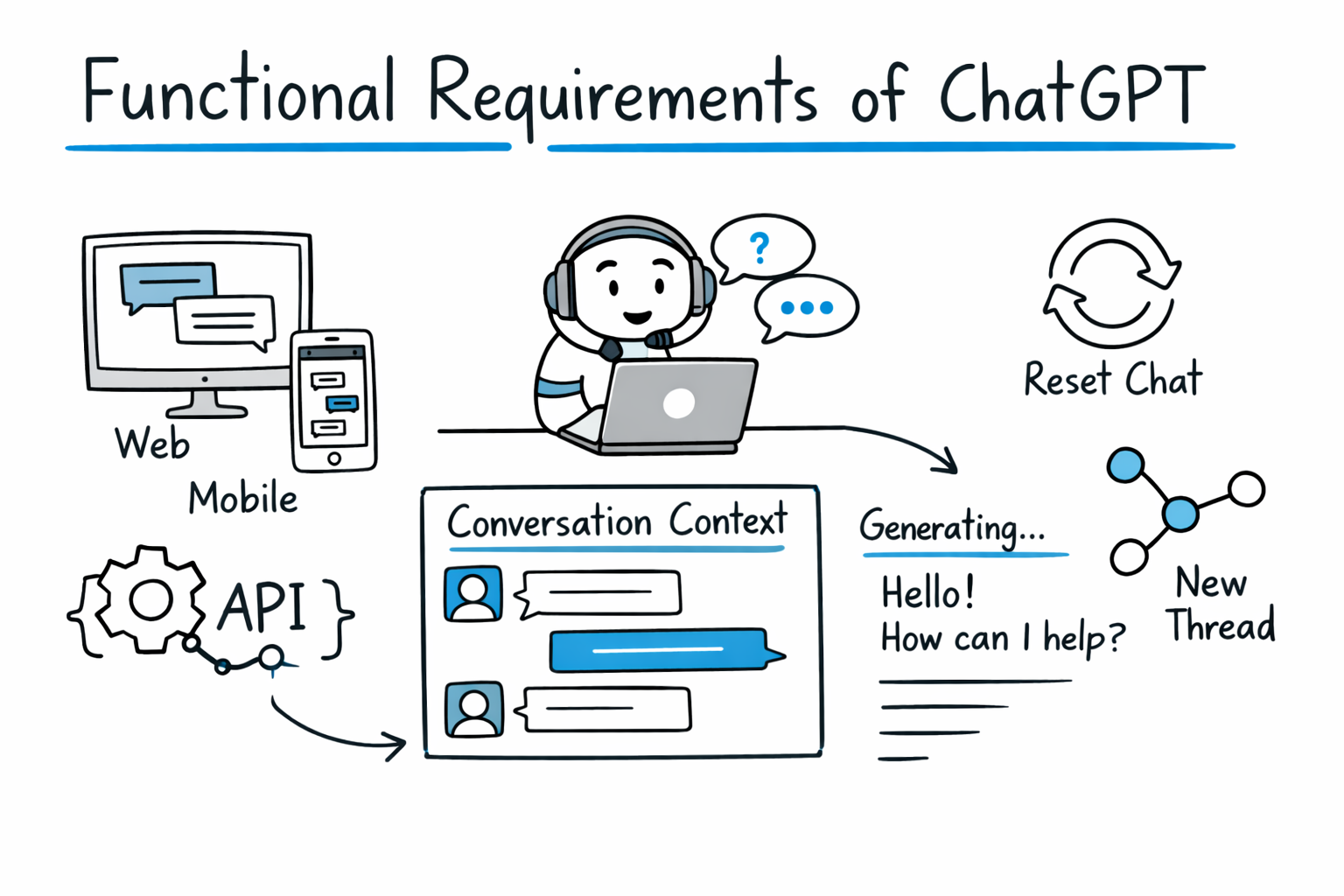
From a user’s perspective, ChatGPT must behave like a coherent conversational assistant. Users expect the system to remember prior turns, respond naturally to follow-up questions, and generate answers quickly.
Functionally, the system needs to support text-based conversations across web, mobile, and API clients. Each message must be tied to a conversation session, processed in context, and returned as a streamed response. Users must also be able to reset conversations or start new threads without interference from previous context.
In interviews, it is reasonable to scope the design to text-only interactions unless multimodal features are explicitly requested.
System Design Deep Dive: Real-World Distributed Systems

Modern software systems are expected to operate at a massive scale while meeting strict reliability and latency requirements. Whether it’s a feed refresh, a payment request, or a real-time analytics query, users expect systems to respond instantly and consistently. That expectation has raised the bar for engineers today, understanding that System Design isn’t optional. It’s a core skill for building and evaluating production-grade systems. I built this course from my experience working on large-scale distributed systems at Microsoft (Azure) and Meta (Scuba), and from interviewing hundreds of candidates across both companies. The pattern I kept seeing was this: candidates understood individual components, but struggled to combine them into a coherent system. They knew what a cache or load balancer was, but not when or why to use it. This course is designed to bridge that gap. We start with the foundational building blocks of System Design, including databases, caching layers, load balancing, and messaging systems, and focus on how they interact under real-world constraints. From there, we analyze systems built by companies like Google, Facebook, and Amazon, breaking them down to understand the trade-offs behind each design decision. The goal is not just to learn concepts, but to develop the ability to reason through them in practice. This approach has helped a large number of engineers build stronger intuition for System Design and perform better in interviews. If you want to understand how real systems are designed and be able to design them yourself, this course gives you a clear, practical path forward.
Non-functional requirements that shape the architecture#
Most architectural decisions in the ChatGPT System Design are driven by non-functional requirements rather than features.
Latency must be low and predictable to maintain the illusion of a real-time assistant. Availability is critical because users expect ChatGPT to be accessible at all times. Scalability is essential due to unpredictable traffic spikes. Fairness ensures that a small group of users cannot monopolize GPU resources. Cost efficiency matters because inference is expensive. Safety and compliance are mandatory and cannot be treated as optional layers.
These constraints often conflict, and strong designs explicitly explain how trade-offs are made.
High-level architecture overview#
ChatGPT is best designed as a layered system with clearly separated responsibilities. This separation allows safety policies, models, and user experience to evolve independently.
Layer | Responsibility |
Client interfaces | Web UI, mobile apps, and APIs |
API gateway | Authentication, rate limiting, and routing |
Session services | Conversation tracking and context retrieval |
Safety pipelines | Input and output moderation |
Inference orchestration | Scheduling and model selection |
Model serving | GPU-backed inference workers |
Observability | Logging, metrics, and tracing |
This structure keeps the system modular and easier to reason about at scale.
Scalability & System Design for Developers

As you progress in your career as a developer, you'll be increasingly expected to think about software architecture. Can you design systems and make trade-offs at scale? Developing that skill is a great way to set yourself apart from the pack. In this Skill Path, you'll cover everything you need to know to design scalable systems for enterprise-level software.
Request ingestion and conversation management#
Every interaction begins at the API gateway. The system authenticates the user, enforces rate limits, and determines whether the message belongs to an existing conversation or starts a new one.
Conversation context must be retrieved efficiently because it directly influences model output. However, sending the full conversation history to the model is expensive. Most real systems balance quality and cost by truncating context, summarizing older messages, or applying system prompts that guide behavior without inflating token count.
Context management is one of the most important areas to discuss in interviews because it directly impacts latency, cost, and response quality.
Safety and moderation as a first-class pipeline#
Safety is not an add-on in ChatGPT System Design. It is a core pipeline.
User input is evaluated before inference to prevent unsafe or disallowed content from consuming GPU resources. Generated output is evaluated again before delivery to ensure policy compliance. These checks must be fast, reliable, and adaptable as policies evolve.
Moderation stage | Purpose |
Pre-inference checks | Block unsafe prompts early |
Post-inference checks | Validate generated content |
Policy evolution | Allow rapid rule updates without redeploying models |
Treating safety as a modular pipeline rather than embedded logic keeps the system flexible and trustworthy.
Inference orchestration and request scheduling#
Inference orchestration determines how requests are executed under load.
Once a request passes validation and safety checks, it enters an inference scheduler. This scheduler decides which model variant to use, where to run it, and how to prioritize the request relative to others.
Scheduling concern | Impact |
Fairness | Prevents resource starvation |
Model selection | Balances quality and latency |
Queue management | Handles traffic spikes gracefully |
Load awareness | Improves GPU utilization |
Because GPUs are expensive and limited, good scheduling decisions directly affect both user experience and operational cost.
GPU-backed model serving#
Model serving is where responses are actually generated. GPU workers load one or more models and process inference requests dispatched by the scheduler.
These workers are typically stateless. Statelessness allows fast scaling and easier recovery when nodes fail, but it requires external systems to handle session data and context.
Versioned deployments and health checks ensure models can be updated safely without interrupting live traffic.
Streaming responses and perceived latency#
Streaming is one of ChatGPT’s defining user experience features. Instead of waiting for a full response, users see tokens appear incrementally.
This reduces perceived latency even if total generation time remains the same. However, streaming requires long-lived connections, careful handling of partial outputs, and incremental safety validation.
Designing streaming as a natural extension of inference rather than a separate system keeps complexity manageable.
Conversation context and memory strategies#
Conversation memory is central to ChatGPT’s usefulness. The system must decide how much context to include for each request.
Too little context leads to shallow or incoherent responses. Too much context increases latency and cost. Practical systems strike a balance using recent-turn windows, summaries of older exchanges, and system-level instructions.
Explicitly explaining this trade-off demonstrates strong System Design judgment.
Failure handling and graceful degradation#
Failures are inevitable at scale. GPU nodes crash, requests time out, and safety checks occasionally block responses.
A resilient ChatGPT design handles failures predictably. Retries with backoff, fallback responses, and clear error messaging preserve user trust. Graceful degradation is more important than perfect availability.
Observability and operational visibility#
Running ChatGPT without deep observability would be risky.
Metric category | Why it matters |
Latency and streaming time | User experience quality |
GPU utilization | Cost and efficiency |
Safety intervention rate | Policy effectiveness |
Token usage | Cost control |
These signals help teams scale proactively, detect regressions, and manage operational spend.
Cost management as a design constraint#
Cost is a first-class concern in ChatGPT System Design. Inference cost grows with traffic, model size, and token count.
Systems control cost through context trimming, batching, tiered access, and intelligent model routing. Strong interview answers explicitly acknowledge these trade-offs instead of treating cost as an afterthought.
How interviewers assess ChatGPT System Design#
Interviewers are not testing knowledge of transformer internals. They evaluate how well you design for stateful, compute-heavy workloads, enforce safety at scale, balance latency and cost, and communicate trade-offs clearly.
Clear reasoning and structured explanations matter more than naming specific tools.
Final thoughts#
ChatGPT System Design represents the evolution of System Design interviews in the AI era. It combines classic distributed systems principles with modern challenges like inference orchestration, safety pipelines, and conversational state.
If you can clearly explain how a message flows through ingestion, moderation, inference, streaming, and monitoring, you demonstrate the system-level thinking expected of modern AI engineers.