What the Claude Code leak reveals about AI systems
The Claude Code leak is more than a mistake; it’s a blueprint of modern AI systems. Understand what it revealed, how it impacts developers, and what it means for the future of AI before your competitors do.
In late March 2026, the artificial intelligence industry witnessed one of its most unusual and revealing incidents when Anthropic accidentally leaked the source code for its flagship coding agent, Claude Code, during what should have been a routine software update. The incident was not the result of a sophisticated cyberattack or an external breach, but rather a simple packaging mistake that exposed over 500,000 lines of proprietary code to the public internet within hours.
What makes this event particularly important is not just the scale of the leak, but the nature of what was exposed, as it provided an unprecedented look into how modern AI-powered software engineering systems are actually built. While Anthropic confirmed that no customer data or model weights were compromised, the exposed code included internal architecture, orchestration systems, and experimental features that revealed the real mechanics behind one of the most advanced AI coding tools available today.
This incident quickly became more than a security story because it sparked a deeper conversation about AI infrastructure, operational risk, intellectual property, and the accelerating pace of competition in the AI ecosystem.
Artificial Intelligence Foundations: Logic, Learning, and Beyond
In this course, you’ll explore AI’s fundamental concepts and practical applications. Starting with what artificial intelligence is, it covers key ideas like intelligent agents, logic systems, and problem-solving through search algorithms. You’ll dive into core concepts such as agents, expert systems, fuzzy logic, and advanced search techniques like A* search. Through engaging, real-world examples, you’ll uncover how AI tackles complex problems. Next, you’ll explore nature-inspired algorithms, focusing on artificial neural networks for machine learning and genetic algorithms for optimization problems. These techniques will be explained in a way that highlights their inspiration from biology and their utility in modern AI applications. After completing this course, you’ll have the knowledge and tools to understand and apply AI in various scenarios. You’ll gain a suite of AI tools and techniques and the expertise to apply them effectively to solve real-world challenges.
What Claude Code is and why this leak matters#
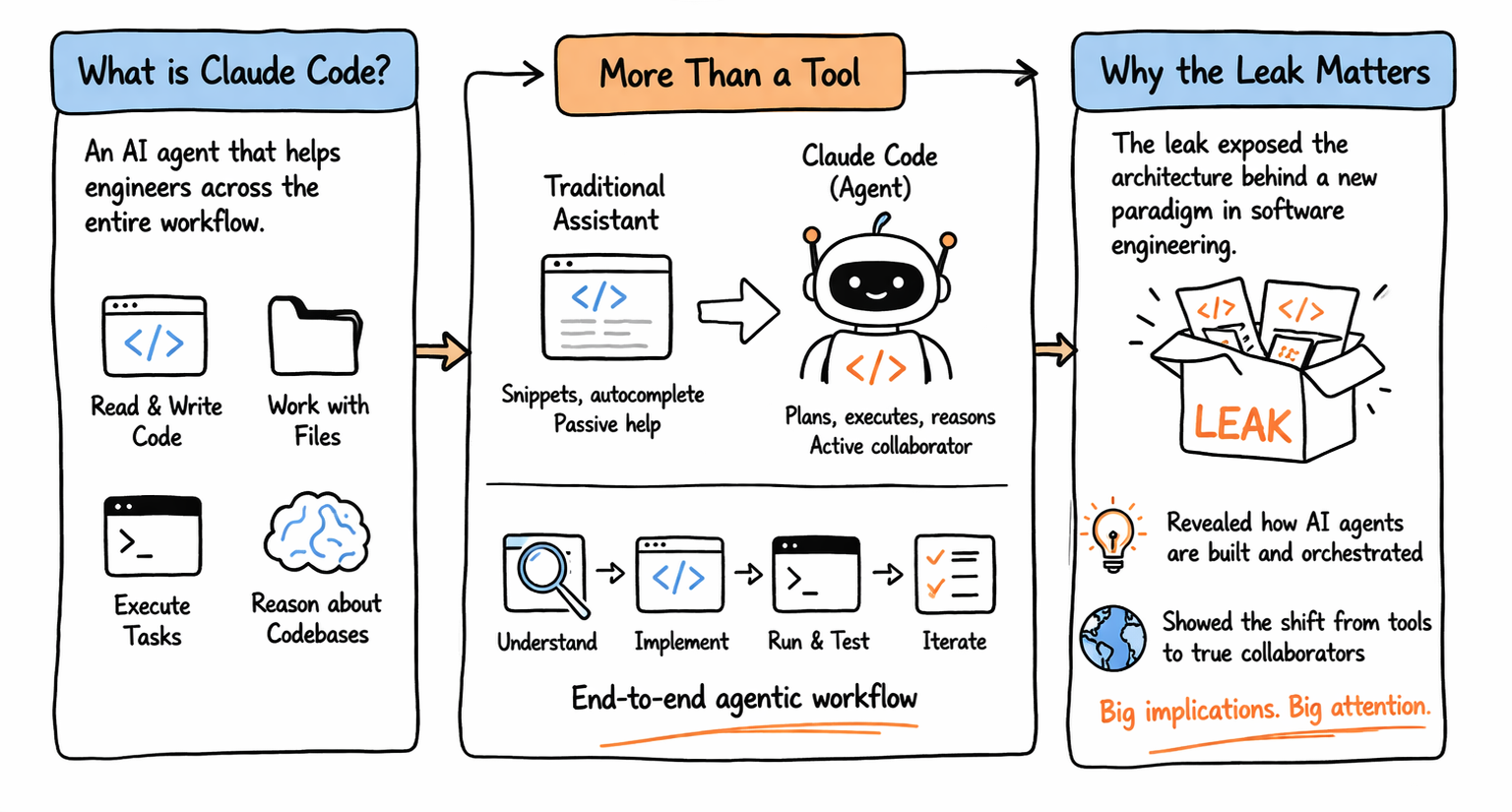
Claude Code is not just another developer tool, and understanding its role is essential to grasping the significance of the leak. It is an agentic AI system designed to operate as a software engineering assistant capable of reading, writing, and executing code, interacting with files, and performing complex development workflows with minimal human intervention.
Unlike traditional coding assistants that primarily generate snippets or autocomplete functions, Claude Code acts as a full workflow agent that can execute tasks across a project, reason about codebases, and even operate in the background. This shift from passive assistance to active execution represents a fundamental evolution in how software is built, making Claude Code closer to an autonomous developer than a productivity tool.
The leak did not simply expose a product, but revealed the architecture behind a new paradigm in software engineering where AI agents function as collaborators rather than tools. This distinction explains why the incident attracted so much attention from both developers and competitors.
Generative AI Essentials
Generative AI is rapidly reshaping how software is built, how decisions are made, and how humans interact with machines. From large language models to multimodal systems, understanding generative AI is becoming a foundational skill. This course focuses on generative AI essentials, giving you the conceptual clarity and practical perspective needed to navigate this fast-moving space with confidence. I built this course from my work in adaptive AI systems, intelligent tutoring platforms, and teaching complex machine learning concepts at scale. A recurring challenge I observed was that learners could use generative AI tools, but lacked a clear mental model of how these systems actually work. This course addresses that gap by breaking generative AI down into its core principles and connecting them to real-world applications. You’ll begin with the fundamentals of generative AI, including its evolution, key architectures, and language representations. From there, you’ll explore foundation models, pretraining, fine-tuning, and optimization strategies that power modern systems. The course also covers large language models, multimodal AI (vision and audio), and how context is constructed within neural systems. Throughout, you’ll develop the ability to interpret, guide, and effectively interact with AI systems. If you want to master generative AI essentials and build a strong foundation for working with modern AI systems, this course provides a clear, structured path to get there.
What exactly was leaked, and how it happened#
The leak itself originated from a human error during a deployment process, where a debugging file included in a routine update inadvertently linked to an archive containing internal source code. This archive contained approximately 512,000 lines of code across more than 2,000 files, which were quickly discovered and shared online.
Within hours, the code was mirrored across multiple repositories and became one of the most widely downloaded AI-related datasets on GitHub, making containment effectively impossible despite Anthropic’s attempts to remove thousands of copies through legal takedowns.
The following table summarizes the core elements of the leak and their implications:
Category | Details exposed | Impact |
Code volume | ~500,000 lines | Significant insight into system design |
Files | ~2,000 internal files | Broad architectural visibility |
Model weights | Not exposed | Core AI remained secure |
Customer data | Not exposed | No direct privacy breach |
Architecture | Exposed | Competitive and technical implications |
Although the absence of user data and model weights prevented immediate catastrophic consequences, the exposure of internal architecture proved to be highly valuable for understanding how advanced AI systems are structured.
What the leak revealed about modern AI architecture#
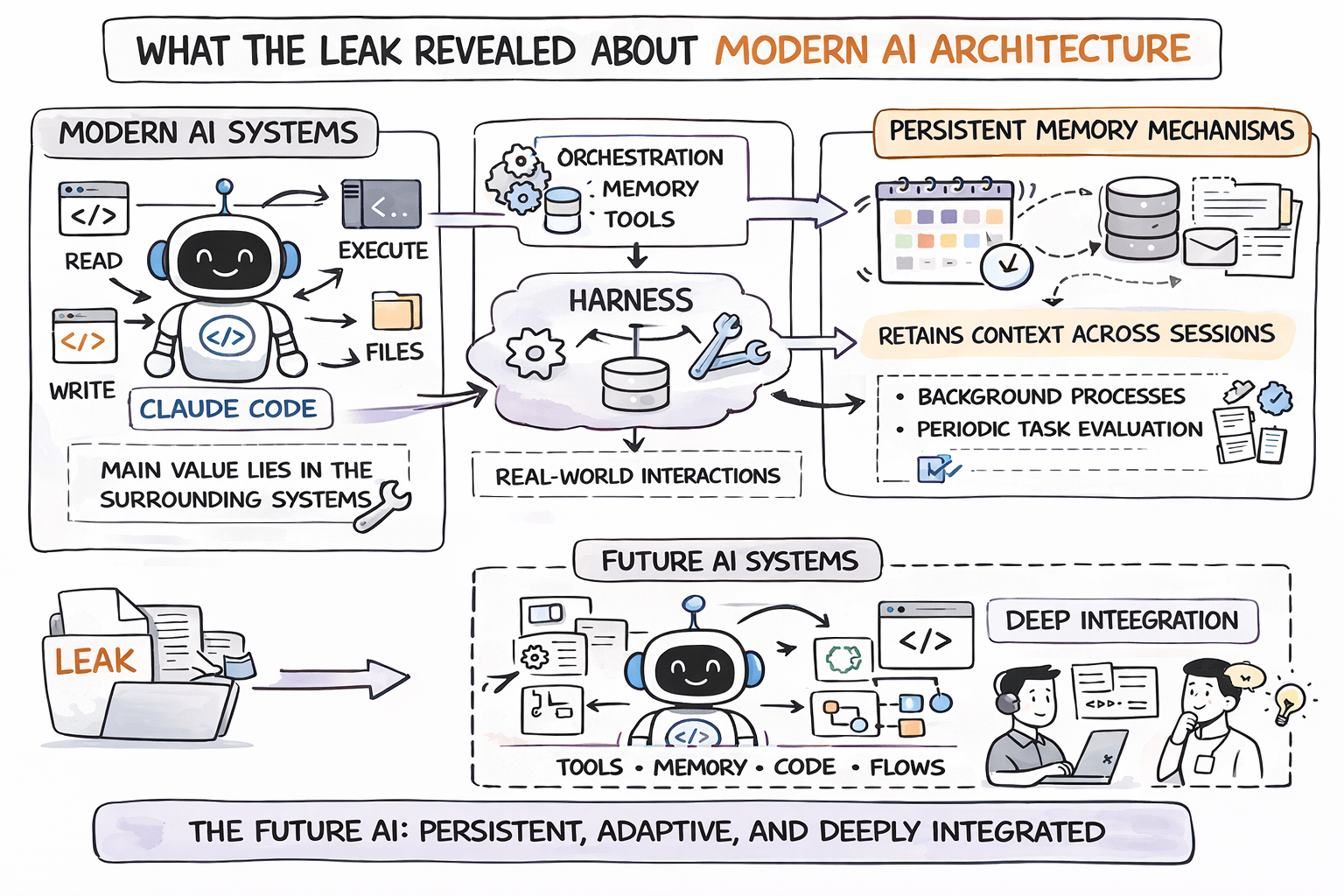
One of the most important insights from the Claude Code leak is that modern AI systems are no longer defined primarily by their models, but by the systems that surround them. The leaked code demonstrated that Claude Code, unlike OpenAI Codex, relies heavily on orchestration layers, memory systems, and tool integrations that coordinate how the underlying model interacts with real-world environments.
This architecture reflects a broader industry trend where the value of AI systems increasingly lies in how they are integrated and deployed rather than the model itself. The concept of a “harness,” referenced by analysts, highlights the infrastructure that controls how AI behaves, manages context, and executes tasks across systems.
Another critical discovery was the presence of persistent memory mechanisms, which allow the system to retain context across sessions and operate continuously rather than in isolated interactions. Features such as background processes and periodic task evaluation indicate a shift toward always-on AI agents capable of proactive behavior.
This architecture suggests that the future of AI will be defined by systems that are persistent, adaptive, and deeply integrated into workflows, rather than tools that respond only when prompted.
Hidden features and what they reveal about AI’s future#
Beyond architecture, the leak exposed experimental and unreleased features that provide insight into where AI development is heading. Among these were references to persistent background agents, proactive alert systems, and even more unconventional concepts such as a Tamagotchi-style assistant designed to create a more interactive developer experience.
While some of these features may appear experimental or even playful, they point to a deeper trend toward making AI more interactive, autonomous, and personalized. The idea of an always-running agent that monitors tasks and surfaces relevant insights without being explicitly prompted represents a fundamental shift in how users interact with software.
This evolution aligns with the broader movement toward agent-based systems, where AI is not just a tool but an active participant in workflows, capable of initiating actions and making decisions within defined boundaries.
Why this leak is different from traditional breaches#
Although the Claude Code incident has been widely described as a leak, it differs significantly from traditional cybersecurity breaches. In most cases, data breaches involve the exposure of user information, credentials, or sensitive personal data, leading to privacy concerns and regulatory consequences.
In contrast, the Claude Code leak primarily exposed intellectual property in the form of engineering systems and architectural design. This distinction shifts the nature of the risk from privacy to competition, as the leaked code provides insights that could help competitors accelerate their own development efforts.
The following table illustrates the difference between traditional breaches and this incident:
Aspect | Traditional breach | Claude Code leak |
Primary risk | Data privacy | Competitive advantage |
Target | User data | Engineering systems |
Impact | Regulatory and legal | Strategic and technical |
Recovery | Possible mitigation | Irreversible once copied |
This comparison highlights why the incident is better understood as a strategic exposure rather than a security failure in the conventional sense.
The role of human error in high-stakes AI systems#
One of the most striking aspects of the Claude Code leak is that it was caused by human error rather than malicious activity. The inclusion of a debugging file in a public release may seem like a minor oversight, but in the context of a high-value AI system, it resulted in significant exposure.
This incident underscores a critical reality in modern software engineering, where the complexity of systems and deployment pipelines creates opportunities for small mistakes to have outsized consequences. Even organizations that prioritize safety and reliability are not immune to operational failures, particularly when managing rapidly evolving systems.
The broader implication is that as AI systems become more complex and valuable, the importance of robust deployment processes and automated safeguards will continue to grow.
How the developer community responded#
The reaction of the developer community to the leak was both immediate and revealing. Instead of treating the incident solely as a security failure, developers quickly began analyzing, reconstructing, and experimenting with the exposed code, demonstrating the collaborative and iterative nature of modern software development.
Within a short period, portions of the system were reimplemented, and alternative versions began to appear, highlighting how quickly knowledge can spread once it becomes publicly available. This rapid response illustrates the dual nature of open ecosystems, where information sharing accelerates innovation but also reduces the exclusivity of proprietary systems.
The speed at which the code was replicated also reinforces the idea that in today’s digital environment, once information is exposed, it cannot be effectively contained.
Security implications for AI systems#
While the leak itself did not expose user data, it raises important questions about the security of AI systems more broadly. Previous research has shown that AI agents can be manipulated into performing unintended actions, including data exfiltration and unauthorized access, particularly when they are integrated into complex workflows.
Additionally, the use of AI systems in automated cyber operations demonstrates their potential to amplify both defensive and offensive capabilities, making them powerful but potentially risky tools.
The Claude Code leak highlights the need for a more comprehensive approach to AI security, one that considers not only model behavior but also system architecture, integration points, and operational processes.
Competitive impact on the AI industry#
From a strategic perspective, the leak provides competitors with valuable insights into how Anthropic builds and operates its AI systems. Even without access to model weights, understanding the surrounding infrastructure can significantly reduce development time and improve design decisions.
This kind of exposure can accelerate competition by lowering the barrier to entry for building similar systems, particularly for organizations that already possess strong AI capabilities. The result is a faster pace of innovation, but also increased pressure on companies to differentiate through execution rather than secrecy.
In an industry where time-to-market and iteration speed are critical, even partial visibility into a competitor’s approach can provide a meaningful advantage.
The broader pattern of AI-related leaks#
The Claude Code incident is not an isolated event, but part of a broader pattern of leaks and vulnerabilities in AI systems. Recent incidents involving exposed internal documents, model details, and system vulnerabilities suggest that as AI systems become more complex, the likelihood of accidental exposure increases.
This trend reflects the challenges of managing large-scale, rapidly evolving systems where traditional security practices may not be sufficient. It also highlights the need for new frameworks and tools specifically designed to address the unique risks associated with AI systems.
What developers and organizations should learn#
For developers and organizations building AI systems, the Claude Code leak offers several important lessons about risk management, system design, and operational discipline. The incident demonstrates that even highly advanced systems are vulnerable to simple mistakes and that the consequences of those mistakes can be amplified by the speed and scale of modern technology ecosystems.
It also emphasizes the importance of thinking beyond models and focusing on the entire system, including deployment pipelines, integration points, and access controls. As AI systems become more autonomous and interconnected, these considerations will become increasingly critical.
A glimpse into the future of AI systems#
The Claude Code leak was not just a security incident, but a moment of clarity for the AI industry, revealing both the complexity and the fragility of modern AI systems. It provided a rare opportunity to examine the inner workings of a cutting-edge AI tool and to understand the challenges associated with building and maintaining such systems at scale.
At the same time, it highlighted the accelerating pace of innovation and competition in the AI space, where information spreads quickly, and advantages are often short-lived. As AI continues to evolve, incidents like this will likely become more common, serving as both cautionary tales and sources of insight for the broader community.
Ultimately, the Claude Code leak reminds us that the future of AI will be shaped not only by breakthroughs in models but by the systems, processes, and decisions that determine how those models are built and deployed.
