Cloudflare System Design Interview
Ready to ace the Cloudflare System Design interview? Master anycast, CDN caching, edge compute, and DDoS defense with structured thinking and global-scale reasoning. Start designing like an edge engineer today and stand out as a senior-level candidate.

Preparing for the Cloudflare System Design interview means learning how to architect internet-scale systems that run at the network edge. Cloudflare provides a globally distributed platform handling DNS, CDN caching, DDoS prevention, bot mitigation, load balancing, Zero Trust security, serverless compute, and traffic routing for millions of websites.
This isn’t a standard backend interview. It requires deep knowledge of networking, distributed systems, performance optimization, global scaling, and security engineering. You must be able to reason about latency, availability, traffic distribution, edge compute, and failover in a multi-region, anycast-driven infrastructure.
Grokking Modern System Design Interview

For a decade, when developers talked about how to prepare for System Design Interviews, the answer was always Grokking Modern System Design Interview. This is that course — updated for the current tech landscape. As AI handles more of the routine work, engineers at every level are expected to operate with the architectural fluency that used to belong to Staff engineers. That's why System Design Interviews still determine starting level and compensation, and the bar keeps rising. I built this course from my experience building global-scale distributed systems at Microsoft and Meta — and from interviewing hundreds of candidates at both companies. The failure pattern I kept seeing wasn't a lack of technical knowledge. Even strong coders would hit a wall, because System Design Interviews don't test what you can build; they test whether you can reason through an ambiguous problem, communicate ideas clearly, and defend trade-offs in real time (all skills that matter more than ever now in the AI era). RESHADED is the framework I developed to fix that: a repeatable 45-minute roadmap through any open-ended System Design problem. The course covers the distributed systems fundamentals that appear in every interview – databases, caches, load balancers, CDNs, messaging queues, and more – then applies them across 13+ real-world case studies: YouTube, WhatsApp, Uber, Twitter, Google Maps, and modern systems like ChatGPT and AI/ML infrastructure. Then put your knowledge to the test with AI Mock Interviews designed to simulate the real interview experience. Hundreds of thousands of candidates have already used this course to land SWE, TPM, and EM roles at top companies. If you're serious about acing your next System Design Interview, this is the best place to start.
This guide walks you through exactly what the Cloudflare System Design interview questions assess, the typical design scenarios you’ll encounter, and how to structure a strong, senior-level design.
Why the Cloudflare System Design interview is different#
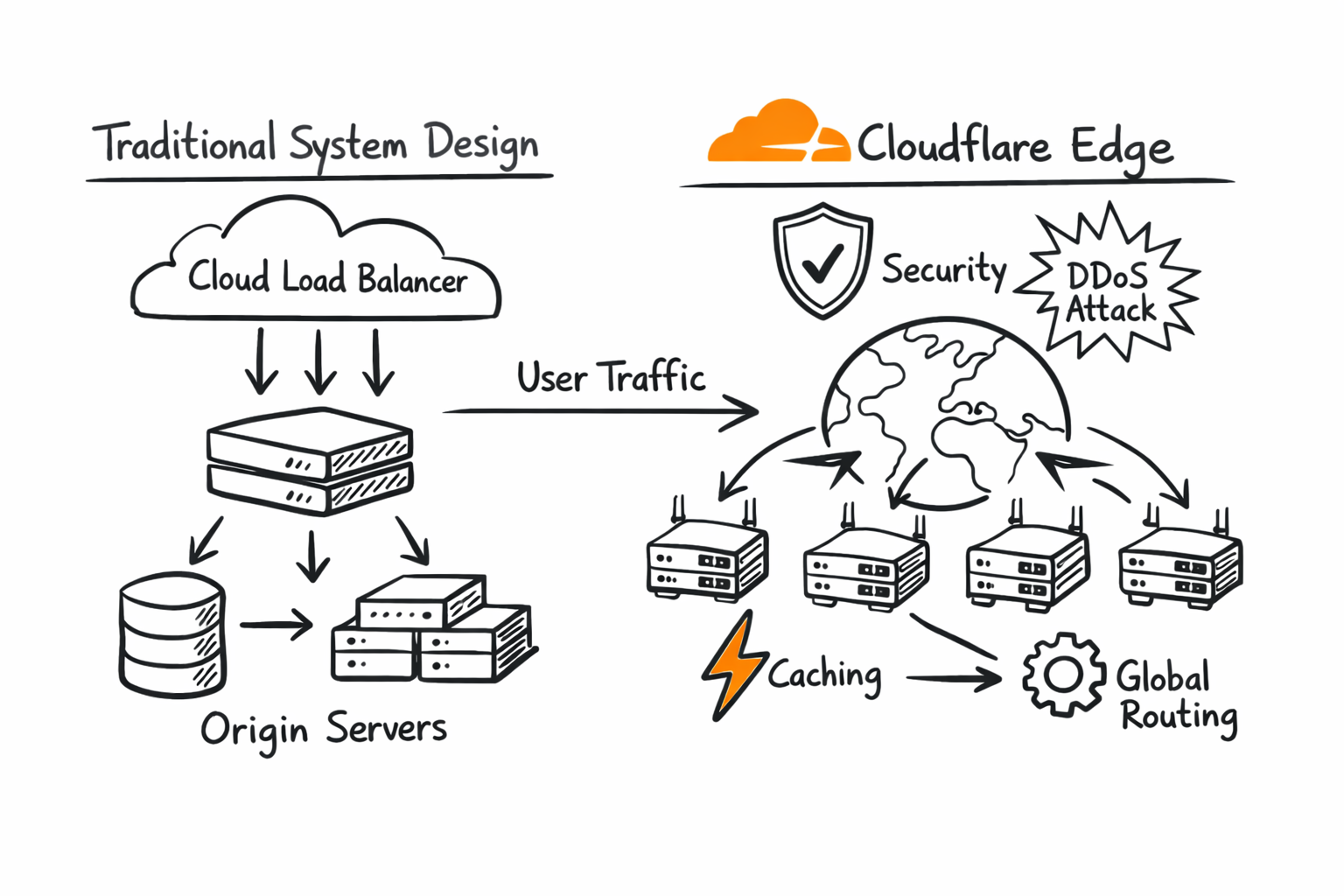
The first shift you must make when preparing for the Cloudflare System Design interview is understanding that Cloudflare operates at the network edge, not at the origin. Most System Design interviews assume traffic reaches your servers through cloud load balancers. Cloudflare, however, intercepts and processes traffic before it ever touches origin infrastructure.
In practical terms, this means your architecture must account for global routing behavior, edge-level security enforcement, and latency budgets that are sensitive to milliseconds. It also means you must reason about how systems behave under massive traffic spikes or DDoS attacks.
Traditional System Design often revolves around scaling databases and horizontally scaling stateless services. Cloudflare’s System Design revolves around routing traffic intelligently, caching content efficiently, filtering malicious traffic proactively, and replicating logic and state across hundreds of edge locations.
If you treat this interview like a generic microservices exercise, you will struggle. If you treat it like designing internet-scale infrastructure with strong networking and security awareness, you will stand out.
Scalability & System Design for Developers

As you progress in your career as a developer, you'll be increasingly expected to think about software architecture. Can you design systems and make trade-offs at scale? Developing that skill is a great way to set yourself apart from the pack. In this Skill Path, you'll cover everything you need to know to design scalable systems for enterprise-level software.
What the Cloudflare System Design interview evaluates#
Cloudflare evaluates engineers across several foundational architectural domains. Each of these areas maps directly to Cloudflare’s core products and infrastructure. Understanding how they connect is critical.
The following table summarizes the major evaluation categories and why each is important.
Domain | What You Must Demonstrate | Why It Matters |
Anycast networking | Understanding BGP routing, route announcements, and failover | Traffic must reach the nearest and healthiest POP |
CDN caching | Multi-layer cache design, TTL trade-offs, invalidation | Performance and origin offload depend on cache efficiency |
DDoS mitigation | Rate limiting, heuristics, anomaly detection | Security-first filtering prevents origin overload |
DNS systems | Resolution flow, TTL behavior, failover logic | DNS performance directly affects user latency |
Edge compute | Isolate-based execution, state consistency | Workers execute logic globally at the edge |
Zero Trust security | Identity-aware policies, enforcement at the edge | Secure access control is enforced before the origin |
Each of these areas may be explored independently during the interview, but more often they intersect within a single design problem. For example, designing a CDN naturally requires understanding anycast routing and edge caching, while designing a DDoS mitigation system requires knowledge of networking and request classification.
System Design Deep Dive: Real-World Distributed Systems

Modern software systems are expected to operate at a massive scale while meeting strict reliability and latency requirements. Whether it’s a feed refresh, a payment request, or a real-time analytics query, users expect systems to respond instantly and consistently. That expectation has raised the bar for engineers today, understanding that System Design isn’t optional. It’s a core skill for building and evaluating production-grade systems. I built this course from my experience working on large-scale distributed systems at Microsoft (Azure) and Meta (Scuba), and from interviewing hundreds of candidates across both companies. The pattern I kept seeing was this: candidates understood individual components, but struggled to combine them into a coherent system. They knew what a cache or load balancer was, but not when or why to use it. This course is designed to bridge that gap. We start with the foundational building blocks of System Design, including databases, caching layers, load balancing, and messaging systems, and focus on how they interact under real-world constraints. From there, we analyze systems built by companies like Google, Facebook, and Amazon, breaking them down to understand the trade-offs behind each design decision. The goal is not just to learn concepts, but to develop the ability to reason through them in practice. This approach has helped a large number of engineers build stronger intuition for System Design and perform better in interviews. If you want to understand how real systems are designed and be able to design them yourself, this course gives you a clear, practical path forward.
Anycast networking and global traffic distribution#
Anycast is foundational to Cloudflare’s architecture. A strong Cloudflare System Design interview answer almost always references it early.
In an anycast model, multiple geographically distributed data centers announce the same IP prefix using BGP. The global internet routing system directs user traffic to the nearest or most optimal location based on routing policies. This allows a single IP address to represent a globally distributed service.
When you discuss anycast in the interview, you should explain how IP ranges are announced from multiple points of presence and how routing convergence determines which POP receives traffic. You should describe what happens when a POP goes offline and how BGP route withdrawal shifts traffic automatically to other regions. You should also consider how load balancing interacts with routing and how capacity planning prevents overload when traffic shifts unexpectedly.
The following table illustrates the behavioral difference between unicast and anycast routing models.
Characteristic | Unicast | Anycast |
IP ownership | One server per IP | Multiple servers share the same IP |
Routing behavior | Fixed destination | Routed to the nearest or best path |
Failover | Requires explicit redirection | Automatic via routing convergence |
Latency optimization | Limited | Naturally optimized by proximity |
Cloudflare leverages anycast to achieve low latency and seamless failover. If you demonstrate a nuanced understanding of routing convergence time and traffic redistribution, you signal strong domain awareness.
CDN caching and edge acceleration#
Caching is one of the most important architectural pillars in the Cloudflare System Design interview. Designing a CDN requires careful reasoning about cache hierarchies, freshness, invalidation, and origin shielding.
At a high level, a user request arrives at the nearest edge POP. The edge cache checks for the requested asset. If the content is present and fresh, it is served immediately. If not, the request escalates to a regional cache layer or directly to the origin server.
The following table shows a simplified tiered cache model.
Cache Layer | Role in Request Flow | Primary Benefit |
Edge cache | First lookup point | Ultra-low latency response |
Regional cache | Shields origin from repeated misses | Reduces origin load |
Core storage | Long-term asset storage | Durability and persistence |
In the Cloudflare System Design interview, you should explain how TTL values influence freshness and cache hit rates. You should discuss stale-while-revalidate patterns that allow slightly outdated content to be served while new content is fetched in the background. You should reason about eviction policies, such as least recently used or least frequently used, and explain how compression and TLS termination at the edge improve performance.
Most importantly, you must articulate trade-offs. Aggressive caching improves performance but risks serving stale content. Conservative caching protects freshness but increases origin traffic. Strong answers balance both.
DDoS detection and mitigation at scale#
Security reasoning is central to the Cloudflare System Design interview. Cloudflare is known for protecting websites against large-scale DDoS attacks, so interviewers expect you to understand layered defense strategies.
DDoS attacks generally fall into volumetric, protocol-level, and application-level categories. Volumetric attacks attempt to saturate bandwidth. Protocol attacks exploit weaknesses in TCP or UDP handling. Application-layer attacks flood HTTP endpoints with seemingly valid requests.
The table below outlines mitigation strategies for each attack type.
Attack Category | Typical Behavior | Edge-Level Mitigation |
Volumetric | Massive bandwidth flooding | Network filtering, rate limiting |
Protocol | Exploiting connection handling | SYN cookies, connection validation |
Application | HTTP request flooding | WAF rules, bot detection, behavioral analysis |
In your design, explain how traffic is inspected at the edge before reaching the origin infrastructure. Describe rate-limiting strategies that limit requests per IP or per session. Explain how IP reputation systems can identify repeat offenders. Discuss challenge flows such as CAPTCHA or browser validation for suspicious traffic.
A strong candidate also considers false positives and user experience. Overly strict filtering can block legitimate users. Security must be strong but precise.
DNS performance and global reliability#
DNS is often overlooked in traditional System Design interviews, but it plays a major role in the Cloudflare System Design interview. Cloudflare operates both authoritative DNS services and recursive resolvers.
You should understand the DNS resolution flow, including how clients query recursive resolvers, which in turn query root, TLD, and authoritative servers. You should explain how TTL values influence caching behavior and how shorter TTLs allow faster failover at the expense of increased DNS traffic.
The following table compares key DNS design considerations.
Design Concern | Impact on System |
TTL length | Trade-off between freshness and query volume |
Geographic distribution | Reduces latency and improves resilience |
DNSSEC | Protects against spoofing and tampering |
Health checks | Enables dynamic failover |
When designing DNS infrastructure, discuss geo-distributed authoritative servers and latency-based routing policies. Explain how health checks detect origin failures and adjust DNS responses accordingly.
DNS reliability directly affects user-perceived availability. A strong answer demonstrates this awareness.
Edge compute and Cloudflare Workers#
Cloudflare Workers provide serverless compute at the edge. Unlike container-based serverless platforms, Workers execute inside lightweight V8 isolates. This design reduces startup latency and allows extremely fast request handling.
In the Cloudflare System Design interview, compare isolate-based execution to container-based execution. Isolates provide faster cold starts and better resource efficiency, while containers offer stronger isolation at the cost of startup overhead.
The following table clarifies this distinction.
Feature | Container-Based Model | Isolate-Based Model |
Startup time | Seconds | Milliseconds |
Resource overhead | Higher | Lower |
Isolation boundary | OS-level | VM isolate-level |
Ideal use case | Backend microservices | Edge request handling |
You should also discuss state management. Workers KV provides globally distributed key-value storage with eventual consistency. Durable Objects provide a strongly consistent state for specific keys by assigning a single authoritative instance.
Explain how consistency trade-offs influence latency and global scalability. Strong candidates demonstrate awareness of geo-replication challenges.
Zero Trust and identity-aware access control#
Cloudflare’s Zero Trust platform enforces identity-aware security policies at the edge. In the Cloudflare System Design interview, you may be asked to design secure access control for internal applications.
Discuss how identity providers integrate via OAuth or OIDC. Explain how edge policies evaluate user identity, device posture, and contextual signals before granting access. Describe encrypted tunnels between Cloudflare and the origin infrastructure.
Zero Trust reasoning emphasizes the principle that no request should be implicitly trusted. Enforcement at the edge reduces exposure and centralizes policy control.
Structuring your answer in the Cloudflare System Design interview#
Success in the Cloudflare System Design interview depends not only on technical depth but also on structured communication.
Begin by clarifying requirements and constraints. Confirm whether latency, security, or consistency is the top priority. Establish geographic scope and expected scale. Ask about acceptable failure modes.
Next, explicitly state non-functional requirements. These may include millisecond-level latency, high availability targets above 99.99 percent, security-first filtering, elastic scalability, and strong observability.
Then provide rough scale estimates. Quantify expected requests per second, cache hit ratios, and traffic burst scenarios. Even approximate numbers demonstrate architectural maturity.
After that, present a high-level architecture diagram verbally. Describe how traffic flows from the client to anycast routing, to edge POP, through security pipelines, into caching layers, possibly through edge compute, and finally to origin servers.
Deep dive into two or three components. For example, explain how multi-tier caching reduces origin load and how DDoS filtering prevents malicious traffic from escalating.
Finally, discuss failure scenarios and trade-offs. The table below illustrates typical failure conditions and mitigation strategies.
Failure Scenario | Design Response |
POP outage | Withdraw BGP routes and reroute traffic |
Origin failure | Serve cached responses or fallback |
Traffic surge | Autoscale filtering and rate limits |
KV inconsistency | Accept eventual consistency with reconciliation |
Conclude by suggesting future improvements, such as smarter routing algorithms or predictive scaling for attack mitigation.
Example high-level Cloudflare CDN design#
Consider a design prompt asking you to build a Cloudflare-style CDN.
A user request is routed via anycast to the nearest POP. The edge firewall inspects traffic and blocks malicious requests. The edge cache checks for the requested asset. If present, it serves the asset immediately. If not, it escalates to a regional cache or origin server. The response is compressed, cached, and returned to the client. Logs are streamed to analytics systems for monitoring and anomaly detection.
This architecture reduces latency, improves resilience, and protects origin infrastructure.
Final thoughts#
The Cloudflare System Design interview evaluates your ability to think at internet scale. It requires a strong understanding of networking, caching, security pipelines, edge compute, and distributed state management.
You must demonstrate clarity in architectural thinking, depth in technical reasoning, and awareness of trade-offs. If you structure your answer thoughtfully, quantify scale, explore failure handling deeply, and explain your decisions with precision, you position yourself as a senior engineer capable of designing systems at the edge of the internet.
