Do you need to learn Algorithms for a Frontend interview?
Wondering if algorithms matter for frontend interviews? Learn what to expect, which topics to focus on, and how to balance JavaScript skills with problem-solving practice to confidently crack your next frontend role.
Developers who focus on building user interfaces often reach a point where they begin preparing for technical interviews, and many naturally ask do you need to learn algorithms for a frontend interview. The question arises because frontend development is strongly associated with designing interactive interfaces, working with browser APIs, and implementing responsive layouts rather than solving complex algorithmic problems.
Frontend interviews typically evaluate a combination of technical and practical skills. Employers expect candidates to understand JavaScript deeply, work effectively with modern frameworks, and design user interfaces that are both responsive and maintainable. However, some interviews also include algorithmic questions, which can create uncertainty for candidates who primarily work with frontend technologies.
The truth is that expectations vary widely across companies and roles. Some organizations emphasize practical frontend development skills, while others include algorithmic challenges to evaluate general programming ability. Understanding how algorithms fit into frontend interviews and which algorithms you should know helps developers prepare efficiently and focus on the areas that matter most.
Become a Front-end Developer

Front-end web developers are proficient in HTML, CSS, and JavaScript, and their primary role is to create web applications so users can view and interact with websites. Front-end developers are in high demand as tech companies are always looking to improve the visuals and interactivity of their applications. This path gives a comprehensive insight into the fundamental components of web development. You’ll start with the fundamentals of web development and get an overview of the complete process. Moving ahead, you’ll cover the basics of HTML, CSS, and JavaScript from scratch, which are essential for web development. You’ll also get hands-on practice adding interactivity to websites, including creating a drop-down menu, tooltip, auto-validation form, and an infinitely scrolling list. Finally, you’ll get a comprehensive step-by-step description of how to launch a website on the internet. By the end of this path, you'll have gained the skills to create functional websites and web applications.
Why algorithms sometimes appear in frontend interviews#
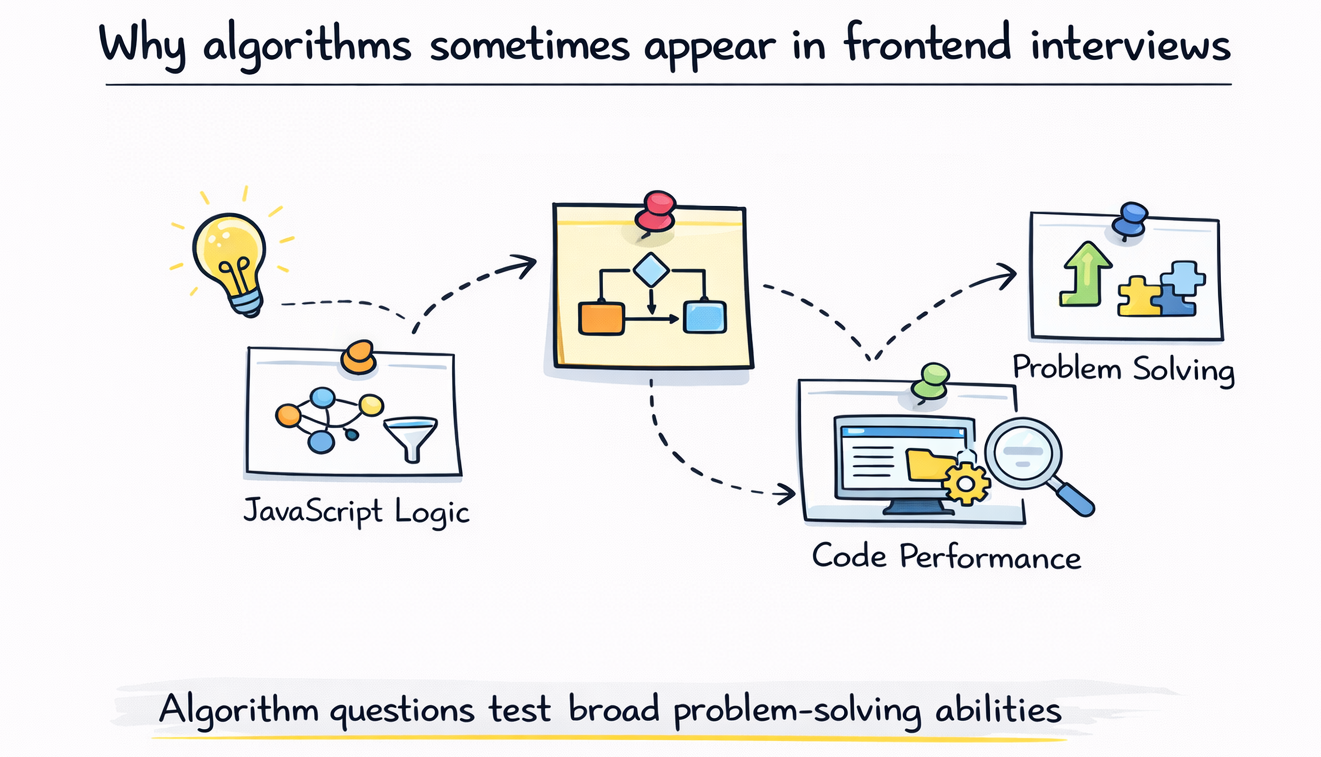
Although frontend roles focus heavily on user interface development, many companies include algorithm questions during interviews to evaluate broader programming skills. Algorithms provide a standardized way to assess how candidates approach problem solving, structure solutions, and reason about efficiency.
From an interviewer’s perspective, algorithm questions help reveal how a developer thinks through unfamiliar challenges. The goal is not necessarily to test deep theoretical knowledge, but rather to observe how candidates analyze problems, break them into smaller steps, and produce logical solutions.
However, the level of difficulty in algorithm questions for frontend roles is usually lower than what is expected for backend engineers or systems programmers. Most frontend interviews focus on practical JavaScript logic, data manipulation, and reasoning about code performance rather than complex algorithm design.
This distinction often answers the question developers ask when researching do you need algorithms for a frontend interview.
A Visual Introduction to Algorithms

Learn introductory computer science algorithms, including searching, sorting, recursion, and graph theory through a combination of articles, visualizations, quizzes, and coding challenges. Implement Challenges in Java, Python, C++ or Javascript.
What frontend interviews typically test#
Frontend developer interviews usually evaluate a range of technical abilities rather than focusing exclusively on algorithms.
Skill Category | Description |
Core JavaScript knowledge | Understanding closures, event loops, and asynchronous programming |
DOM manipulation | Ability to interact with browser APIs and user interfaces |
CSS and layout systems | Knowledge of responsive design and layout techniques |
Framework expertise | Experience with React, Vue, or Angular |
Basic algorithms and problem solving | Ability to reason through coding challenges |
Core JavaScript knowledge is one of the most important areas because JavaScript powers modern web applications. Developers are often expected to understand closures, asynchronous execution, promises, and the event loop.
DOM manipulation reflects the practical skills needed to build interactive web interfaces. Candidates should understand how JavaScript interacts with browser APIs and how user interface elements are updated dynamically.
CSS and layout systems are essential for designing responsive interfaces that work across different devices and screen sizes.
Framework expertise is frequently evaluated because modern web applications are commonly built using frameworks such as React, Angular, or Vue.
Finally, basic algorithms and problem-solving demonstrate a candidate’s ability to write efficient code and reason about logic within applications.
Algorithm topics that may appear in frontend interviews#
Although advanced algorithm knowledge is rarely required for frontend roles, certain basic concepts frequently appear in coding interviews. These questions are typically designed to evaluate programming fundamentals rather than theoretical algorithm expertise.
One common category involves array and string manipulation, such as reversing a string, filtering elements, or finding duplicates in an array. These tasks test a developer’s ability to use language features effectively.
Another common topic involves hash maps or JavaScript objects for efficient data lookup. Interviewers may ask candidates to store and retrieve values efficiently, which demonstrates understanding of data structures commonly used in applications.
Some interviews also include recursion or simple dynamic programming problems, although these are usually introductory in difficulty. These questions help interviewers evaluate reasoning about repeated subproblems.
Finally, developers may be asked to analyze time complexity, which involves understanding how an algorithm’s performance changes as input size grows.
These topics demonstrate the level of preparation developers should consider when evaluating do you need to use algorithms for a frontend interview.
Frontend interviews vs backend interviews#
The expectations for frontend and backend roles differ significantly, particularly in how algorithms are evaluated.
Interview Focus | Frontend Roles | Backend Roles |
UI design and architecture | High importance | Low importance |
JavaScript knowledge | Critical | Moderate |
Data structures and algorithms | Moderate | High |
System design | UI-focused | Distributed systems |
Frontend roles prioritize user interface architecture, browser behavior, and JavaScript expertise. Backend roles, in contrast, often focus heavily on data structures, algorithms, and distributed systems design.
Because of this difference, algorithm questions in frontend interviews are usually less complex and more focused on programming fundamentals.
How frontend developers should prepare#
Preparing for frontend interviews requires balancing practical development skills with basic algorithm knowledge.
Strengthen JavaScript fundamentals#
A strong understanding of JavaScript is essential for frontend developers. Topics such as closures, asynchronous programming, promises, event loops, and scope often appear in technical interviews.
Practice basic algorithm questions#
Practicing beginner-level coding challenges helps developers improve logical thinking and become comfortable solving problems under time constraints. These exercises often involve arrays, strings, and simple data structures.
Build practical frontend projects#
Real-world projects often demonstrate skills more effectively than theoretical knowledge. Building applications that include responsive design, API integration, and interactive components helps showcase frontend expertise.
Practice explaining your reasoning#
Interviewers frequently evaluate how developers communicate their thought processes. Explaining design decisions and problem-solving strategies clearly can make a strong impression during interviews.
Developers who follow this balanced approach often gain clarity about do you need to learn algorithms for a frontend interview and how much emphasis to place on algorithm practice.
Practical example of a frontend-style algorithm question#
Many frontend coding challenges focus on simple data manipulation tasks. For example, an interviewer might ask a candidate to remove duplicate values from an array.
function removeDuplicates(arr) {return [...new Set(arr)];}
This solution uses the JavaScript Set object to eliminate duplicate elements and then converts the result back into an array. Questions like this demonstrate a developer’s familiarity with language features and logical thinking.
Although simple, these problems help interviewers evaluate how developers approach coding challenges.
FAQ#
Are algorithms required for every frontend interview?#
Algorithms are not required for every frontend interview. Some companies focus primarily on JavaScript knowledge, UI development, and framework expertise. However, many organizations include at least one coding challenge to evaluate problem-solving ability.
How difficult are algorithm questions in frontend interviews?#
Algorithm questions for frontend roles are typically easier than those for backend or systems engineering roles. Most problems involve simple data manipulation, logical reasoning, or basic data structures rather than advanced algorithms.
Should frontend developers practice coding challenges?#
Yes, practicing coding challenges helps improve programming fluency and logical thinking. Even if algorithm questions are not the primary focus of an interview, strong problem-solving skills are valuable for writing efficient code.
How much time should I spend studying algorithms?#
Frontend developers should aim to develop a solid understanding of basic algorithms and data structures without neglecting core frontend skills. Practicing coding challenges alongside building frontend projects usually provides balanced preparation.
Final words#
Frontend developer interviews evaluate a wide range of skills, including JavaScript expertise, browser knowledge, UI architecture, and practical problem-solving ability. While algorithms are sometimes included in interviews, they are rarely the central focus of frontend roles.
Understanding if you need to know about algorithms for a frontend interview helps developers prepare more efficiently by balancing algorithm practice with strong frontend fundamentals. By focusing on both programming logic and real-world interface development, developers can approach interviews with confidence and demonstrate the skills employers expect from modern frontend engineers.
