Entry-Level Software Engineer Interview Questions
Mastering entry-level interviews isn’t about perfection; it’s about fundamentals, clarity, and a growth mindset. Prepare smarter, communicate clearly, and show how you think. That’s how junior engineers get hired.
Entry-level software engineering interviews are designed to evaluate foundational engineering instincts and growth potential, not senior-level expertise. Recruiters assess your ability to write clean code, communicate your reasoning, handle behavioral scenarios, and demonstrate basic System Design thinking.
Key takeaways
- Coding fundamentals come first: Expect problems involving strings, arrays, hash maps, recursion, and basic tree or graph traversals rather than obscure algorithms.
- Behavioral questions carry real weight: Interviewers evaluate collaboration, coachability, and how you handle feedback, conflict, and uncertainty alongside your technical performance.
- System Design expectations are scoped to your level: You should be able to outline a simple architecture, describe data flow, and identify basic trade-offs for apps like a URL shortener or note-taking tool.
- Debugging and refactoring tasks reflect actual job work: You may be asked to diagnose broken functions or clean up existing code, so practicing hypothesis-driven reasoning on unfamiliar codebases matters.
- Structure and communication often separate candidates: Clarifying the problem, proposing a correct solution before optimizing, and walking through edge cases aloud signal the engineering habits interviewers are actively looking for.
Landing your first entry-level software engineering role is one of the biggest milestones in your career. However, for many new graduates, boot camp graduates, and self-taught developers, the interview process can feel unpredictable and overwhelming.
What exactly are recruiters testing? How much system design do you need to know? Are behavioral questions as important as coding ones? And what does a truly great entry-level answer actually sound like?
Become the Highest Paid Engineer at Your Company

Learn the essential skills to operate at a Staff+ level, from integrating AI safely to guiding teams through crises. This free course gives you a clear roadmap to high-impact engineering and delivers it with a wink to Educative’s viral meme: John, the top-paid engineer who’s never around.
This guide breaks down what entry-level software engineer interview questions evaluate, what formats you should expect, and the practical skills that matter more than you think.
What Do Entry-Level Software Engineer Interviews Actually Test?#
For entry-level software engineer interview prep, you need to practice your fundamental engineering instincts, not senior-level architectural mastery. Recruiters understand that you’re just starting your career; they don’t expect you to have shipped major distributed systems. Instead, they want to see evidence of:
Core coding competency:
Can you solve basic algorithmic and data-structure problems without falling apart under pressure?
Problem decomposition: Do you know how to break large tasks into manageable pieces?
Communication clarity: Are you able to explain your thought process logically?
Learning ability: Do you show curiosity, openness, and the ability to quickly adapt?
Professionalism and teamwork: You’ll be working with other developers right away. Can you collaborate, ask questions, and contribute?
This interview is less about mastery and more about your potential. Interviewers are scanning for strong foundational skills and the right mindset for growth.
What interviewers are evaluating at the entry level#
Evaluation area | What interviewers look for | What a strong signal looks like |
Coding fundamentals | Correctness, basic data structures, control flow | Clean logic, working solution, edge cases handled |
Problem decomposition | Ability to break down tasks | Step-by-step approach, clear subproblems |
Communication | Explaining the thought process | Thinking out loud, asking clarifying questions |
Learning mindset | Coachability and curiosity | Adjusts approach based on feedback |
Professionalism | Collaboration readiness | Calm, respectful, growth-oriented attitude |
Interview format | What it tests | How to prepare |
Live coding (IDE / Doc) | Real-time problem solving | Practice typing solutions while explaining |
Whiteboard coding | Structured thinking under pressure | Focus on clarity over syntax |
Take-home assignment | Code quality and completeness | Write readable, well-documented code |
Pair programming | Collaboration and communication | Narrate decisions and ask questions |
Debugging task | Reading and fixing code | Practice tracing bugs and test failures |
You may encounter live coding exercises in an online editor, collaborative documents, or traditional whiteboard settings. Some companies also use take-home assignments or pair programming sessions to observe how you think in a more realistic environment.
The topics covered tend to focus on fundamentals. Interviewers frequently ask questions involving strings, arrays, hash maps, loops, conditionals, and basic recursion. Simple sorting or searching problems are common, as are introductory tree or graph traversals. These problems are chosen because they reveal how well you understand core concepts rather than obscure algorithms.
Time and space complexity often come up, but at a conceptual level. Interviewers want to know that you recognize inefficient solutions and can reason about performance trade-offs, even if your initial approach is not optimal.
The key takeaway is that these exercises are not designed to trick you. They exist to validate that you can write clean, functional code under mild pressure and reason through problems in a structured way.
Are Behavioral Questions Included in Entry-Level Software Engineer Interviews?#
Behavioral questions are a critical part of entry-level interviews, often carrying as much weight as technical rounds. Even junior engineers work in teams, contribute to shared codebases, and interact with stakeholders. Interviewers need confidence that you will integrate well into these environments.
You should expect questions that explore how you handle collaboration, feedback, conflict, and uncertainty. Interviewers often ask about challenging projects, disagreements with teammates, moments when you struggled, or times when you had to learn something quickly.
Even for junior engineers, companies want to see whether you:
Work well in teams
Take feedback positively
Communicate clearly
Navigate ambiguity
Ask good questions
Handle conflict professionally
Have the humility to learn and grow
You might hear questions like:
“Tell me about a time you worked on a difficult project.”
“Describe a situation where you disagreed with someone.”
“How do you handle not knowing the answer?”
“What motivates you as an engineer?”
Behavioral interviews make up a significant portion of your final evaluation, especially for companies that value culture fit and collaboration.
Grokking the Behavioral Interview

Behavioral interviews have become a decisive part of the hiring process across roles. Whether you’re a software engineer, product manager, or engineering leader, strong technical skills alone are no longer enough. Companies are evaluating how you think, communicate, and operate in real-world situations. That’s why preparing specifically for behavioral interviews is critical. This is why I built this course around a common gap: candidates often underestimate behavioral interviews or prepare for them too late. As a result, even strong candidates struggle to clearly articulate their experiences, decisions, and impact. The goal here is to give you a structured way to approach behavioral questions with clarity and confidence. You’ll learn how to break down common behavioral interview questions, structure your answers, and communicate your experiences effectively. The course also includes a video recording feature, allowing you to practice your responses, review them, and improve over time. By the end, you’ll have a repeatable approach to behavioral interviews, one that helps you present your experiences clearly and perform with confidence in any interview setting.
What Soft Skills Matter for an Entry-Level Software Engineer Interview?#
Soft skills often determine final hiring decisions when technical abilities are similar. Entry-level engineers work closely with mentors and peers, so interpersonal effectiveness matters from day one.
Soft skills vs technical skills (entry-level reality)#
Skill type | Importance at the entry level | Common candidate mistake |
Coding fundamentals | High | Over-focusing on advanced algorithms |
Communication | Very high | Staying silent while thinking |
Coachability | Very high | Defensiveness when corrected |
Systems thinking (basic) | Medium | Assuming none is needed |
Optimization skills | Low–medium | Premature optimization |
Clear communication is essential. Interviewers observe whether you explain your logic, ask thoughtful questions, and adapt your explanations based on feedback. Communication is not about verbosity; it is about clarity and intent.
Coachability is another major signal. Entry-level engineers are expected to learn continuously. Interviewers pay close attention to how you respond to hints, suggestions, or corrections. Candidates who adjust their approach gracefully demonstrate maturity and readiness for growth.
Curiosity also stands out. Showing interest in understanding why something works, rather than just how, signals strong learning instincts. Ownership is equally important. Even junior engineers are expected to take responsibility for their work, follow through on tasks, and care about outcomes.
A positive attitude rounds out this picture. Resilience, humility, and steady problem-solving under pressure reassure interviewers that you will handle the inevitable challenges of real-world engineering.
How Much System Design Is Expected at the Entry Level?#
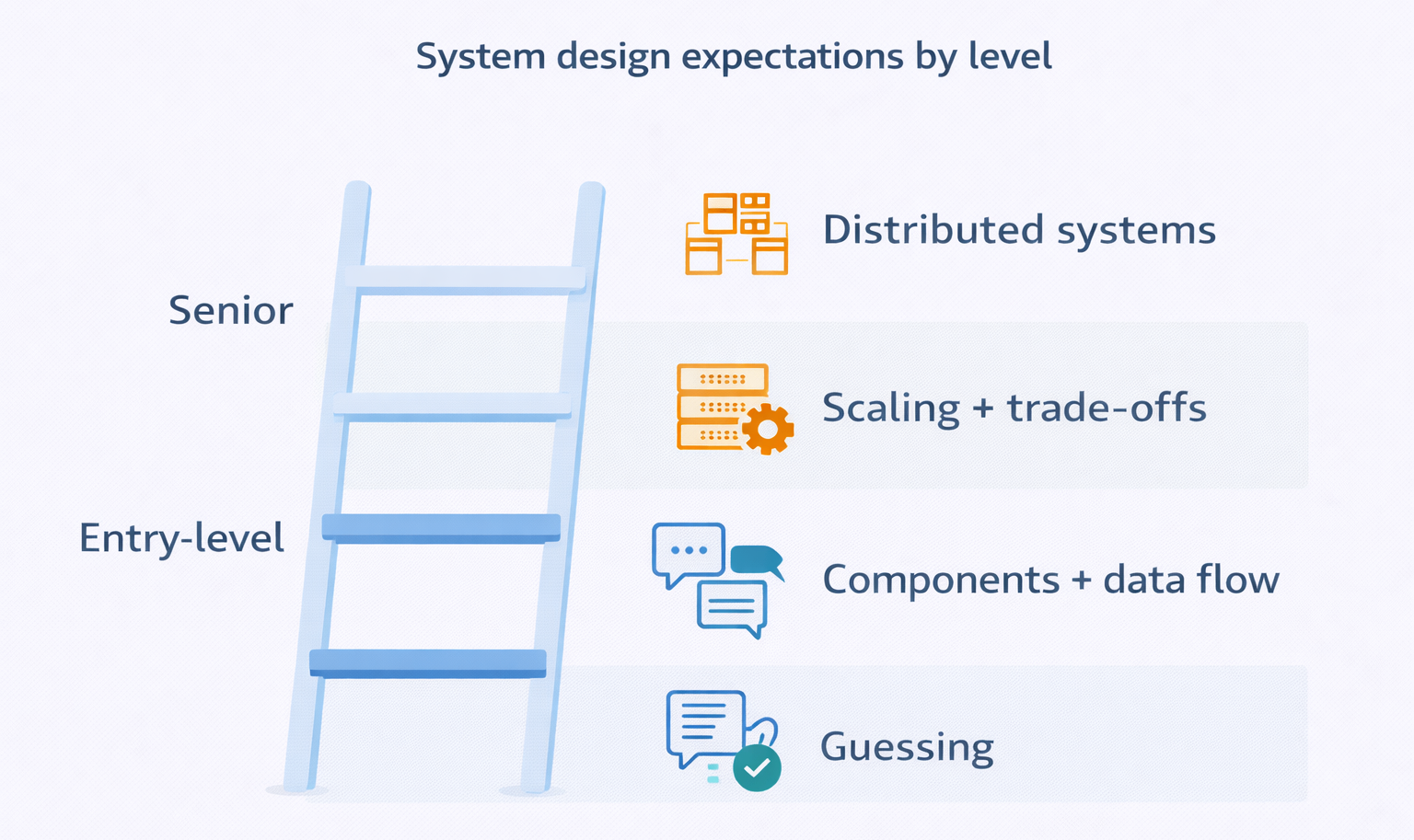
System design expectations at the entry level are intentionally limited. You will not be asked to design complex distributed systems or reason about advanced scalability challenges. However, basic system thinking is often evaluated.
Interviewers may ask you to design a simple application, such as a URL shortener, a note-taking app, or a basic chat system. These questions test your ability to think in terms of components, data flow, and responsibilities rather than deep technical optimization.
What matters most is clarity. Interviewers want to see that you can outline a reasonable architecture, explain how data moves through the system, and identify basic trade-offs. Simple discussions around data storage, APIs, and error handling are sufficient.
Demonstrating structured thinking, even at a high level, shows that you are beginning to develop systems intuition. That signal is far more important than technical depth at this stage.
Common entry-level system design questions include:
“Design a URL shortener.”
“How would you build a basic chat app?”
“Design a note-taking app with CRUD operations.”
“Explain how you would structure a simple API.”
Focus on:
High-level architecture
Simple diagrams
Clear reasoning
Trade-offs (even basic ones)
Data storage choices
Error handling
You’re not expected to talk about distributed consensus or the CAP theorem, but you should show mature reasoning for your level.
Will You Face Debugging or Refactoring Tasks?#
Debugging and refactoring tasks are increasingly common in entry-level interviews because they reflect real work more accurately than greenfield coding. Many junior engineers spend a significant portion of their time understanding and improving existing code.
You may be asked to diagnose a broken function, interpret failing tests, or clean up poorly structured code. These exercises test your attention to detail, logical reasoning, and comfort navigating unfamiliar codebases.
Interviewers observe how you approach the problem. Strong candidates read carefully, form hypotheses, test assumptions, and explain their reasoning as they go. Communication is just as important as correctness in these scenarios.
What debugging interviews test#
Signal | What interviewers observe |
Attention to detail | Reads code carefully |
Logical reasoning | Forms hypotheses |
Comfort with unfamiliar code | Navigates unknown styles |
Communication | Explains debugging steps |
Engineering judgment | Improves clarity, not just fixes bugs |
Entry-level engineers spend a surprising amount of time debugging on the job, so interviewers want to confirm you can handle it.
What Are Common Pitfalls to Avoid During Entry-Level Interviews?#
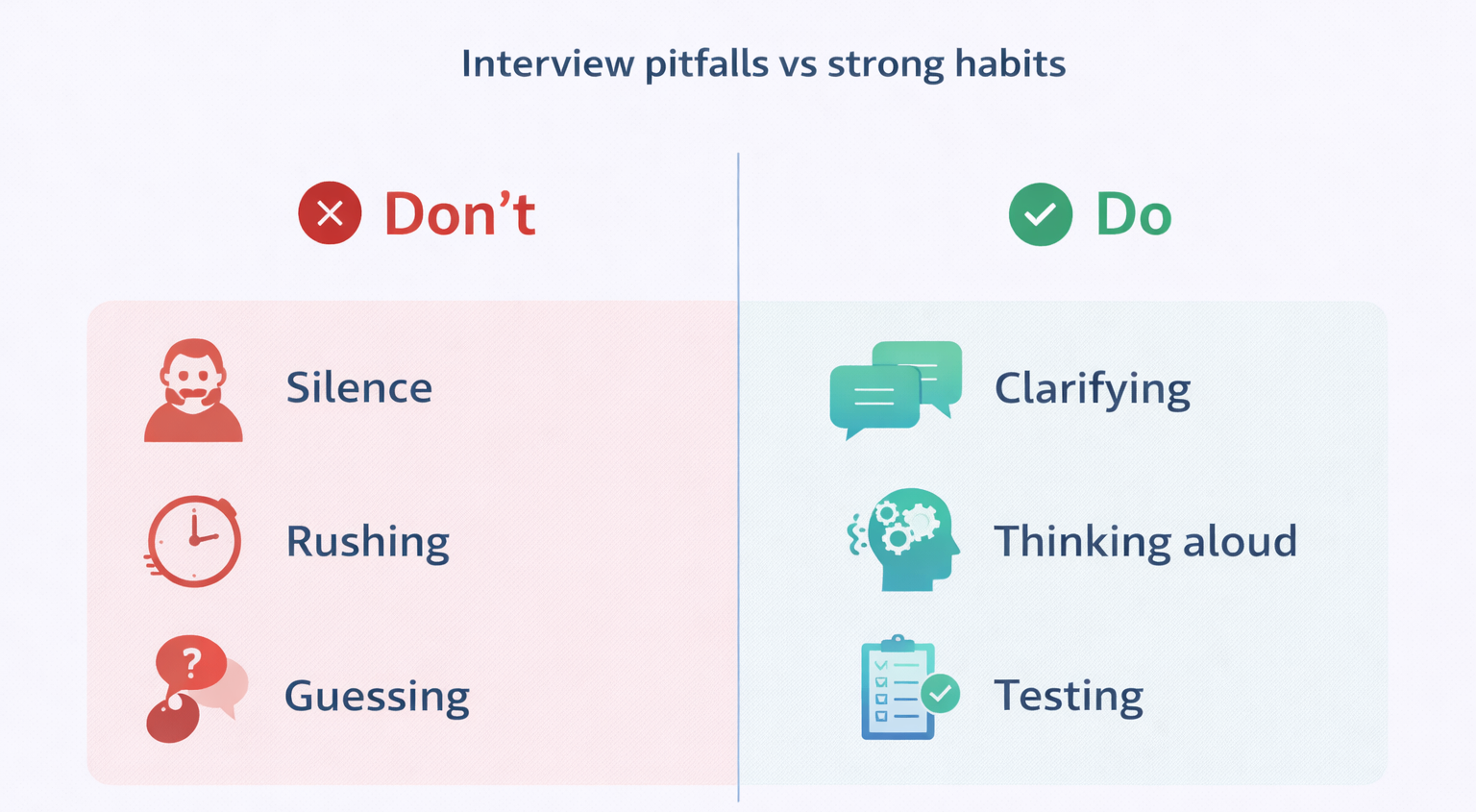
Many candidates lose points not because they lack skill, but because they fall into common traps.
Not asking clarifying questions – Jumping into coding without understanding the problem is a red flag.
Panicking when stuck – It’s normal to get stuck; what matters is how you talk through it.
Overusing memorized LeetCode solutions – Interviewers can tell instantly when someone is pattern-matching instead of reasoning.
Talking too little or too much – Silence makes it hard for interviewers to follow. Rambling makes you appear unfocused.
Not writing readable code – Messy variable names or inconsistent logic suggest poor engineering habits.
Being aware of these pitfalls can dramatically improve your performance.
How Should You Structure Your On-the-Spot Approach?#
A consistent structure helps you stay calm and focused during interviews. Strong candidates begin by clarifying the problem and restating it in their own words to confirm understanding.
They then propose a simple, correct solution before optimizing. This demonstrates prioritization and correctness-first thinking. Coding proceeds deliberately, with decisions explained aloud.
Testing is an integral step. Walking through examples, edge cases, and boundary conditions shows thoroughness. If time permits, refactoring improves readability and polish.
This structured approach mirrors real engineering workflows and reassures interviewers that you can work methodically under pressure.
What Does an “Excellent” Entry-Level Answer Sound Like?#
A great answer is not the fanciest one; it’s the clearest, most complete, and most thoughtful one.
Here’s what interviewers love to see:
1. Clear reasoning – You explain the logic behind your choices, not just the steps.
2. Trade-off awareness – Even a simple acknowledgment like “This solution is O(n²), but since n < 10,000, it's acceptable.” shows maturity.
3. Edge-case handling – You consider unusual inputs without being asked.
4. Clean code – Readable names and structured logic feel senior even when the problem is basic.
5. Self-testing – You walk through the code proactively.
6. Calmness under pressure – A relaxed, deliberate approach signals real readiness for the job.
Interviewers aren’t looking for perfection; they’re looking for growth potential and strong engineering habits.
Final Thoughts#
Entry-level software engineer interviews test the fundamentals that will shape your engineering career: clear communication, structured thinking, debugging instincts, teamwork readiness, and foundational coding skills. If you prepare strategically, balancing algorithms, simple system design, behavioral readiness, and debugging practice, you’ll walk into your interviews with confidence.
