Feature scaling in machine learning
Learn how feature scaling in machine learning improves model performance and training stability. Explore normalization, standardization, and robust scaling techniques used in modern machine learning workflows.

Machine learning models rely heavily on numerical data to identify patterns, make predictions, and improve decision-making processes across many industries. However, raw data often contains features with vastly different ranges and units, which can create significant challenges during model training. Understanding feature scaling in machine learning is essential for ensuring that algorithms learn effectively and produce accurate results.
Feature scaling refers to the process of transforming numerical variables so that they share a similar scale or distribution. This transformation helps machine learning algorithms process data more efficiently by preventing features with larger values from dominating the learning process.
Many beginners overlook the importance of feature scaling in machine learning during data preprocessing, but it can dramatically affect the performance of models such as logistic regression, neural networks, and clustering algorithms. This guide explains the concept of feature scaling, the methods used to perform it, and why it plays a critical role in building effective machine learning systems.

Machine learning interviews at top tech companies now focus more on open-ended system design problems. “Design a recommendation system.” “Design a search ranking system.” “Design an ad prediction pipeline.” These questions evaluate your ability to reason about machine learning systems end-to-end. However, most candidates prepare for isolated concepts instead of system-level design. This course focuses specifically on building that System Design muscle. You’ll work through 9 real-world ML System Design problems (the same questions asked at Meta, Google, Amazon, and Microsoft) and learn a repeatable methodology for breaking each one down: defining the problem, choosing metrics, selecting model architectures, designing data pipelines, and evaluating trade-offs. Each system you design builds on practical ML techniques covered earlier in the course: embeddings, transfer learning, online experimentation, model debugging, and performance considerations. By the time you’re designing your third or fourth system, you'll have the technical vocabulary and judgment to explain why your design choices work. This is exactly what interviewers are looking for. The course also includes 6 mock interviews so you can practice articulating your designs under realistic conditions. If you have an ML or System Design interview coming up at any major tech company, this course will help you walk in with a clear framework for tackling whatever they throw at you.
Understanding the problem of uneven feature magnitudes#
Real-world datasets frequently contain variables measured in different units and magnitudes. For example, a dataset used to predict housing prices may include features such as house size measured in square feet, number of bedrooms, and distance from the city center measured in kilometers.
These features often vary significantly in scale. One feature might contain values in the thousands, while another may contain values between one and ten. Machine learning algorithms that rely on distance calculations or gradient optimization may treat larger numerical values as more important simply because they have higher magnitudes.
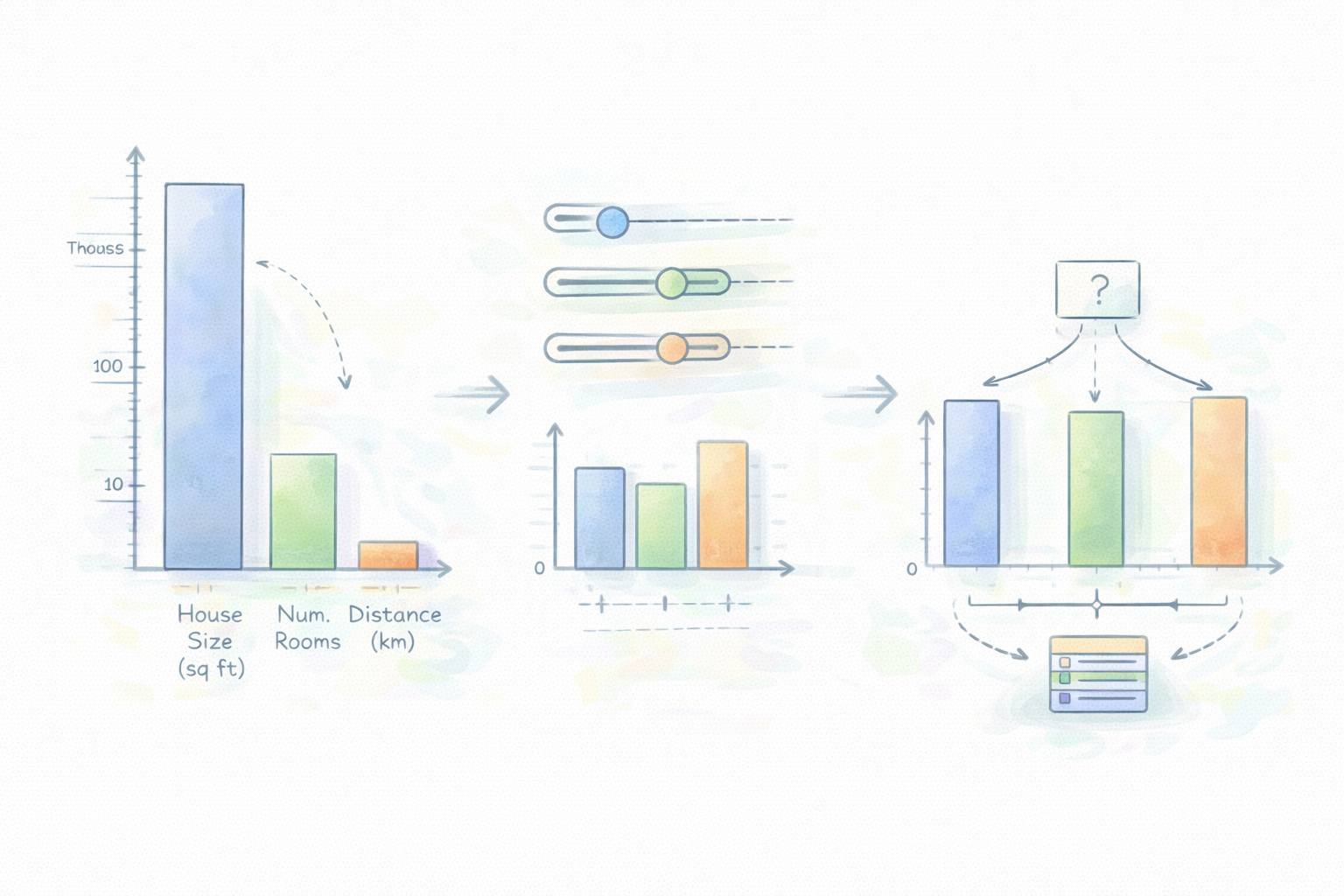
This imbalance can cause models to focus disproportionately on certain features while ignoring others that may actually be more informative. As a result, the model may converge slowly or produce inaccurate predictions.
Feature scaling in machine learning addresses this issue by transforming all features to comparable ranges, allowing algorithms to evaluate each variable more fairly during training.
Why feature scaling is important for machine learning algorithms#
Many machine learning algorithms assume that input features have similar ranges and distributions. When features vary significantly in magnitude, the optimization processes used by these algorithms may behave unpredictably.
Algorithms that rely on gradient descent are particularly sensitive to differences in feature scales. When one feature has extremely large values compared to others, the gradient updates may become unstable and slow the training process.
Distance-based algorithms such as k-nearest neighbors and clustering techniques are also affected by unscaled data. These algorithms calculate distances between data points, which means features with larger values dominate the distance calculations.
The following table illustrates how feature ranges can differ across variables in a dataset.
Feature | Typical Range | Example Dataset Variable |
Age | 18 – 70 | Customer demographics |
Salary | 30,000 – 150,000 | Income data |
Credit Score | 300 – 850 | Financial data |
Years Of Experience | 0 – 40 | Employment records |
Without feature scaling in machine learning, algorithms may interpret salary as far more influential than age simply because of its larger numerical values.
When feature scaling is required#
Not all machine learning algorithms require feature scaling, but many widely used models benefit from it. Understanding when scaling is necessary helps practitioners apply the correct preprocessing techniques.
Algorithms that rely on distance calculations or gradient optimization typically require scaled data. Examples include k-nearest neighbors, support vector machines, logistic regression, and neural networks.
Tree-based models such as decision trees and random forests are generally less sensitive to feature scaling. These algorithms split data based on feature thresholds rather than distance metrics, which makes them less affected by varying magnitudes.
The following table summarizes how different machine learning algorithms respond to feature scaling.
Algorithm | Sensitivity To Feature Scaling | Reason |
K-Nearest Neighbors | High | Uses distance calculations |
Support Vector Machines | High | Depends on feature magnitudes |
Logistic Regression | Moderate | Uses gradient descent |
Neural Networks | High | Optimization sensitive to scale |
Decision Trees | Low | Splits based on thresholds |
Understanding these relationships helps machine learning practitioners decide when feature scaling in machine learning should be applied during data preprocessing.
Types of feature scaling techniques#
Several techniques are commonly used to perform feature scaling in machine learning. Each method transforms numerical data differently depending on the desired distribution or algorithm requirements.
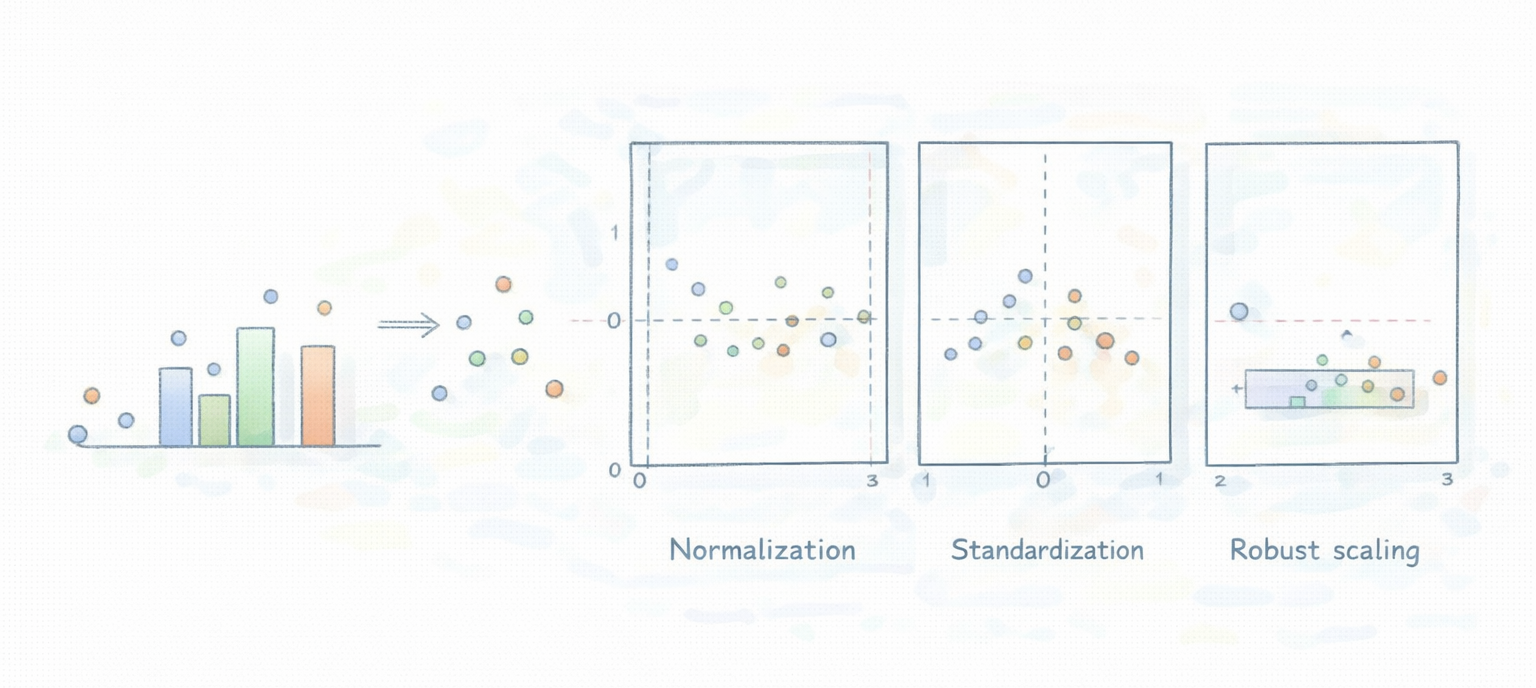
The most widely used techniques include normalization, standardization, and robust scaling. Each technique adjusts feature values in a way that reduces differences between variable magnitudes.
Normalization rescales data to a fixed range, typically between zero and one. Standardization transforms features so that they have a mean of zero and a standard deviation of one.
Robust scaling focuses on reducing the influence of outliers by using statistical measures such as medians and interquartile ranges. Selecting the appropriate scaling method depends on the characteristics of the dataset and the algorithms being used.
Normalization in feature scaling#
Normalization is one of the most common methods used for feature scaling in machine learning. This technique transforms feature values so that they fall within a specific range, usually between zero and one.
Normalization is particularly useful when the dataset does not follow a Gaussian distribution. It ensures that all features contribute equally during distance calculations or optimization processes.
The mathematical formula for normalization typically involves subtracting the minimum value of a feature and dividing by the difference between the maximum and minimum values.
Normalization is often applied when working with neural networks or algorithms that rely on distance metrics.
Standardization in feature scaling#
Standardization is another widely used technique for feature scaling in machine learning. Unlike normalization, standardization does not restrict values to a fixed range.
Instead, it transforms features so that they have a mean value of zero and a standard deviation of one. This transformation ensures that each feature follows a standardized distribution.
Standardization is especially useful when features are normally distributed or when models assume Gaussian distributions.
The following table compares normalization and standardization methods.
Scaling Method | Resulting Range | Common Use Case |
Normalization | Typically 0 to 1 | Distance-based algorithms |
Standardization | Mean 0, Standard Deviation 1 | Regression models |
Robust Scaling | Based on interquartile range | Data with outliers |
Understanding these differences helps practitioners choose the correct method when implementing feature scaling in machine learning workflows.
Robust scaling and outlier handling#
Real-world datasets often contain outliers that can significantly affect traditional scaling techniques. Outliers are extreme values that deviate from the majority of observations within a dataset.
Normalization and standardization methods may be heavily influenced by these extreme values. As a result, the scaled data may still contain distortions that affect model training.
Robust scaling addresses this issue by relying on statistical measures that are less sensitive to outliers. Instead of using mean and standard deviation, robust scaling uses the median and interquartile range.
This approach ensures that extreme values do not dominate the transformation process, making robust scaling particularly useful for datasets with irregular distributions.
The role of feature scaling in gradient descent#
Gradient descent is one of the most widely used optimization techniques in machine learning. Many algorithms rely on gradient descent to minimize error functions and improve model performance.
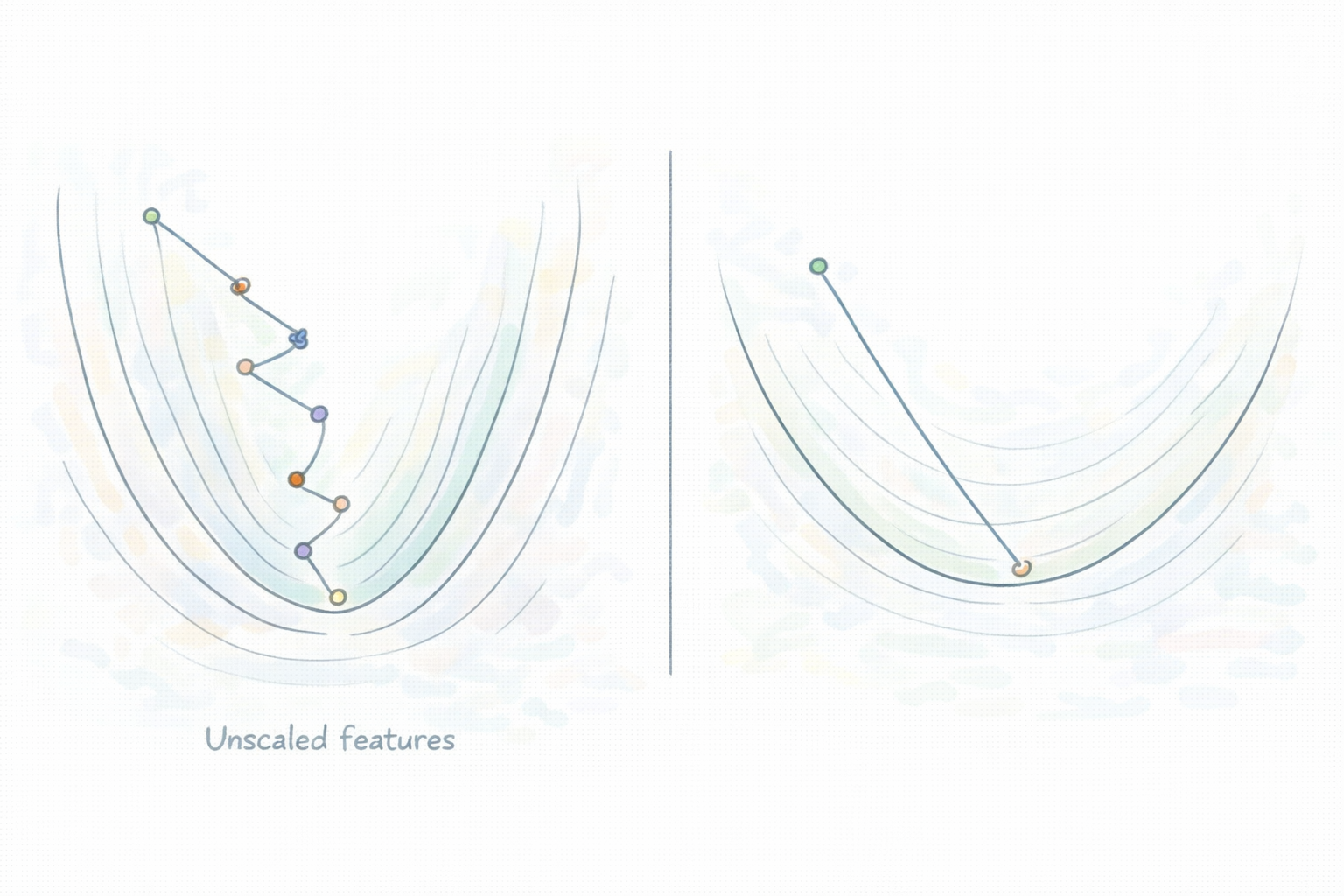
When features have drastically different scales, gradient descent may take longer to converge because the optimization path becomes uneven. Features with larger magnitudes produce steeper gradients, causing the algorithm to move inefficiently through the parameter space.
Feature scaling in machine learning helps stabilize the optimization process by ensuring that all features contribute proportionally to gradient updates.
This results in faster convergence and more reliable model training, particularly when working with large datasets or complex neural network architectures.
Feature scaling in neural networks#
Neural networks rely heavily on numerical optimization during training. The weights within a neural network are updated iteratively using gradient-based methods.
If input features vary widely in magnitude, the gradients may become unstable, which can slow down the learning process or cause the model to converge to suboptimal solutions.
Feature scaling in machine learning helps neural networks learn more efficiently by ensuring that inputs fall within ranges that the network can process effectively.
Many neural network architectures perform best when input features are normalized between zero and one or standardized to follow a normal distribution.
Feature scaling in clustering algorithms#
Clustering algorithms attempt to group data points based on similarity. Many clustering techniques rely on distance calculations to determine which points belong in the same cluster.
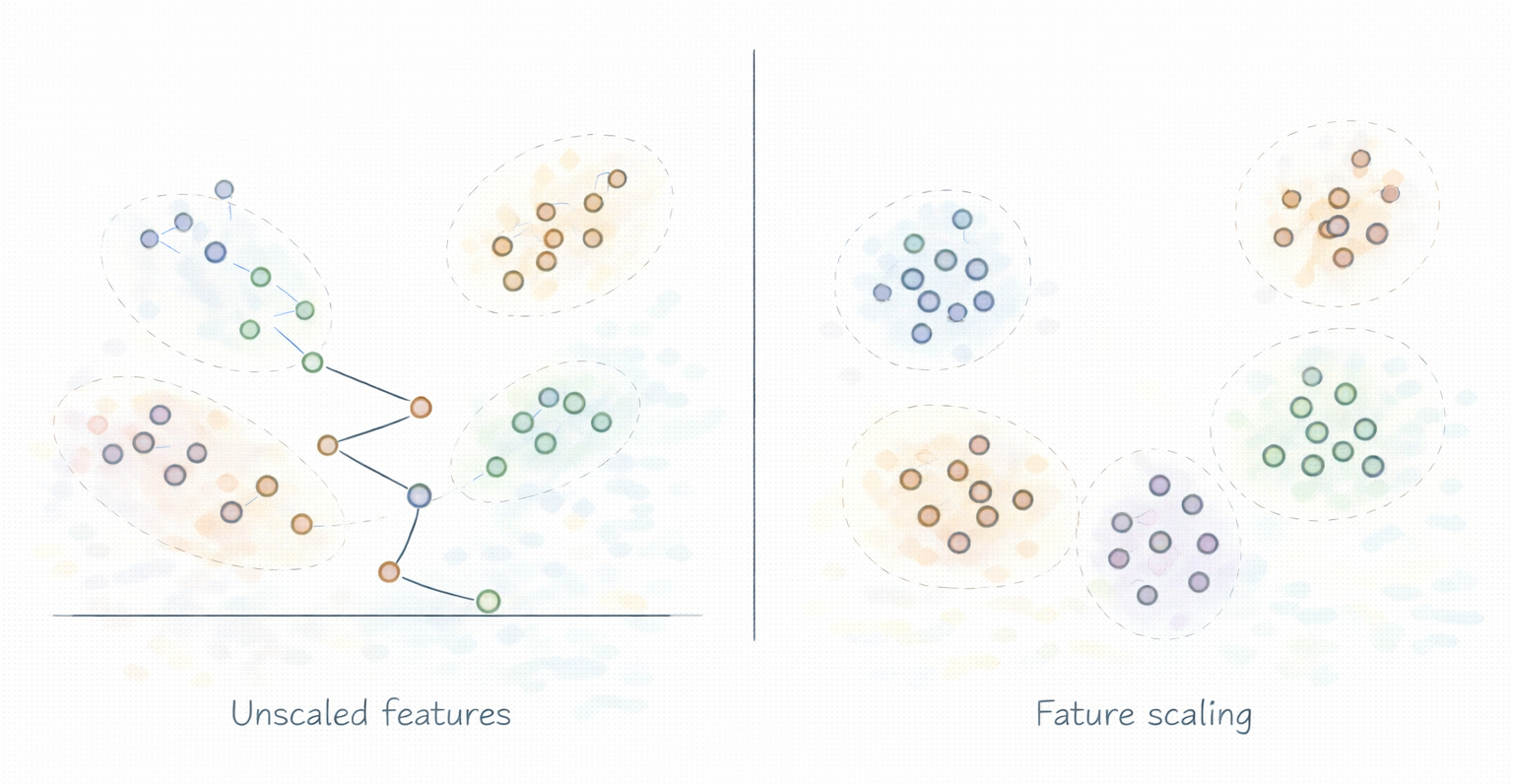
When feature values differ significantly in magnitude, features with larger ranges dominate the distance calculations. This may cause clustering algorithms to ignore other features entirely.
Feature scaling in machine learning ensures that all features contribute equally to similarity calculations, improving the accuracy of clustering results.
Algorithms such as k-means clustering often require careful preprocessing to ensure that clusters are formed based on meaningful relationships within the data.
Practical implementation of feature scaling#
Implementing feature scaling in machine learning pipelines typically occurs during the data preprocessing stage. Practitioners often use specialized libraries such as Scikit-learn to perform scaling transformations automatically.
Data scientists usually fit scaling transformations on training data and then apply the same transformations to validation and test datasets. This approach ensures that the model does not gain information from unseen data during training.
The following table illustrates common scaling techniques available in machine learning libraries.
Scaling Technique | Library Function | Typical Application |
Min-Max Scaling | MinMaxScaler | Neural networks |
Standard Scaling | StandardScaler | Regression models |
Robust Scaling | RobustScaler | Data with outliers |
Max Absolute Scaling | MaxAbsScaler | Sparse datasets |
Using standardized preprocessing pipelines ensures consistent feature transformations across different datasets.
Common mistakes in feature scaling#
Many beginners make mistakes when applying feature scaling in machine learning workflows. One common error involves scaling training and test data separately rather than using the same transformation parameters.
Another mistake involves applying scaling before splitting datasets into training and testing subsets. This can introduce data leakage because information from the test dataset influences the transformation process.
Practitioners must also consider whether scaling is necessary for the specific algorithm being used. Applying unnecessary transformations may increase computational overhead without improving model performance.
Avoiding these mistakes ensures that machine learning models remain reliable and unbiased.
The future of data preprocessing In machine learning#
As machine learning systems become more sophisticated, automated data preprocessing tools are becoming increasingly important. Modern machine learning pipelines often include automated scaling steps that ensure features are transformed consistently before model training.
Advances in automated machine learning platforms allow practitioners to experiment with multiple preprocessing strategies quickly. These systems evaluate different scaling techniques and select the most effective approach for a given dataset.
Despite these advancements, understanding feature scaling in machine learning remains essential for building reliable models and diagnosing performance issues.
Practitioners who understand data preprocessing techniques can better interpret model behavior and optimize machine learning workflows.
Final words#
Feature scaling in machine learning plays a critical role in preparing data for effective model training. Without proper scaling, many algorithms struggle to learn patterns efficiently because differences in feature magnitudes distort optimization processes and distance calculations.
Techniques such as normalization, standardization, and robust scaling allow practitioners to transform features into comparable ranges that improve algorithm performance. These preprocessing steps ensure that machine learning models treat each feature appropriately during training.
Understanding feature scaling in machine learning is an essential skill for anyone working with data science or artificial intelligence systems. By applying the appropriate scaling techniques, practitioners can build models that converge faster, perform more accurately, and deliver reliable predictions across a wide range of applications.
