How to design a key-value store from scratch
Learn how to design a scalable key-value store from scratch by understanding partitioning, replication, consistency, durability, storage engines, and distributed systems trade-offs used in real-world infrastructure systems.
So you want to dive into designing a key-value store from scratch? Good call.
If you’re working through System Design or building your own storage component, this blog will walk you through the full journey: from a simple single-node version to a scalable, distributed system.
Let’s get started.
Grokking Modern System Design Interview

For a decade, when developers talked about how to prepare for System Design Interviews, the answer was always Grokking System Design. This is that course — updated for the current tech landscape. As AI handles more of the routine work, engineers at every level are expected to operate with the architectural fluency that used to belong to Staff engineers. That's why System Design Interviews still determine starting level and compensation, and the bar keeps rising. I built this course from my experience building global-scale distributed systems at Microsoft and Meta — and from interviewing hundreds of candidates at both companies. The failure pattern I kept seeing wasn't a lack of technical knowledge. Even strong coders would hit a wall, because System Design Interviews don't test what you can build; they test whether you can reason through an ambiguous problem, communicate ideas clearly, and defend trade-offs in real time (all skills that matter more than ever now in the AI era). RESHADED is the framework I developed to fix that: a repeatable 45-minute roadmap through any open-ended System Design problem. The course covers the distributed systems fundamentals that appear in every interview – databases, caches, load balancers, CDNs, messaging queues, and more – then applies them across 13+ real-world case studies: YouTube, WhatsApp, Uber, Twitter, Google Maps, and modern systems like ChatGPT and AI/ML infrastructure. Then put your knowledge to the test with AI Mock Interviews designed to simulate the real interview experience. Hundreds of thousands of candidates have already used this course to land SWE, TPM, and EM roles at top companies. If you're serious about acing your next System Design Interview, this is the best place to start.
What is a key-value store?#
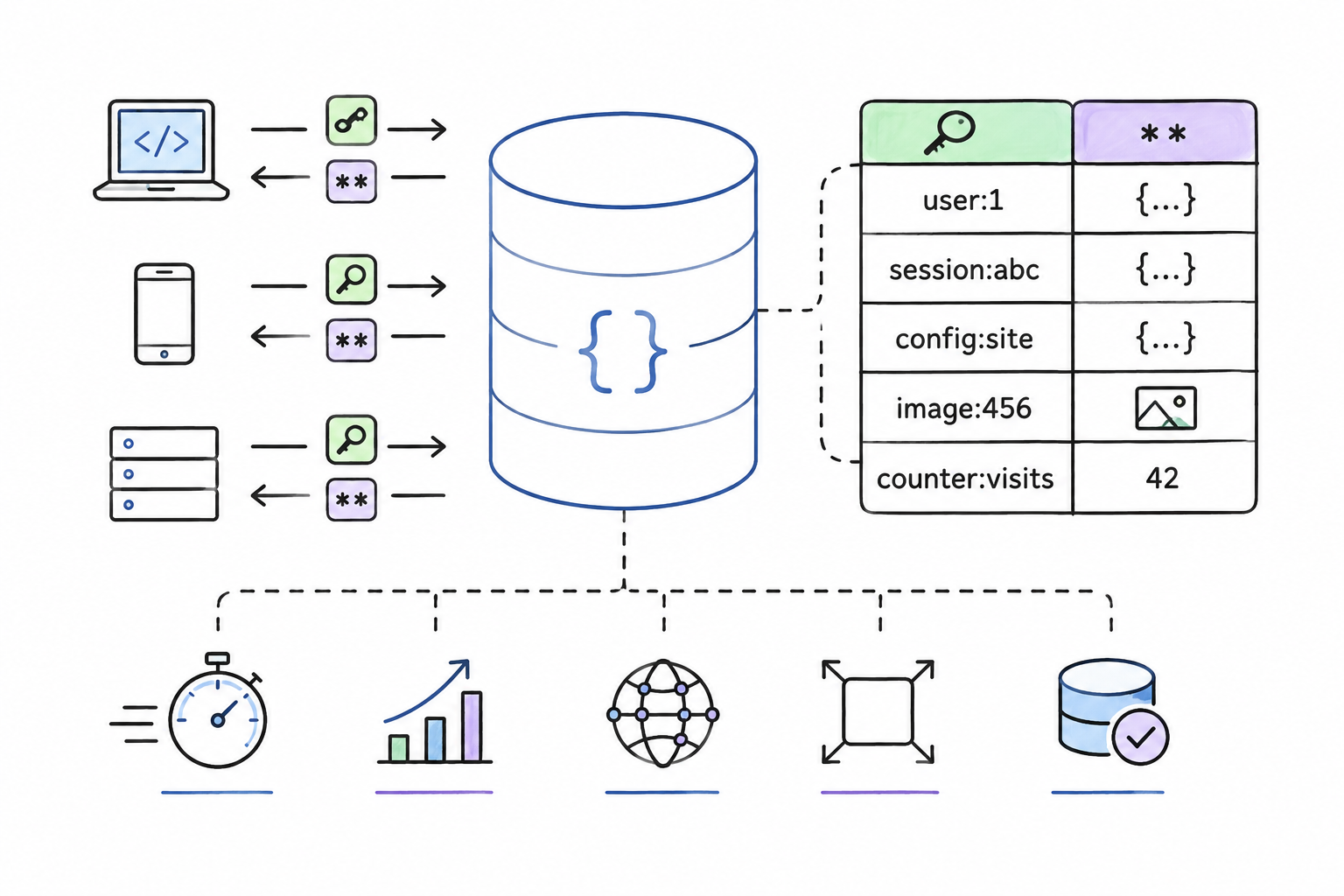
At its simplest, a key-value store is a database system that stores information as pairs of keys and values. The key acts as a unique identifier, while the value contains the associated data. That value could be almost anything: a JSON document, a binary blob, image metadata, a configuration object, session state, or even entire application records.
The reason key-value stores became foundational in modern distributed systems is because of their simplicity. Instead of supporting complex joins and relational queries, these systems optimize for extremely fast reads and writes. That trade-off makes them highly scalable and ideal for workloads involving massive traffic volumes.
When you begin designing a key-value store from scratch, you are essentially solving a deceptively simple question:
“How can I store and retrieve data efficiently while ensuring the system remains scalable, durable, fault-tolerant, and fast under heavy load?”
That question quickly expands into a full distributed System Design question.
At a small scale, a key-value store may look like a simple hash map stored in memory. At internet scale, however, the system must coordinate data across multiple machines, recover from failures automatically, replicate data safely, and maintain predictable performance under millions of operations per second.
This is why key-value stores sit at the heart of so many modern systems:
Redis powers caching and real-time applications
DynamoDB handles globally distributed workloads
RocksDB powers embedded storage engines
Cassandra manages write-heavy distributed systems
Riak and Dynamo-inspired systems focus on high availability
Understanding how these systems are designed gives you deep insight into distributed systems fundamentals.
Grokking the Fundamentals of System Design

System Design is central to building applications that scale reliably and operate securely. This is why I built this course to help you explore the foundational concepts behind modern system architecture and why these principles matter when creating real-world software systems or preparing for System Design interviews. You’ll begin by examining the basics of system architecture, then move on to distributed system concepts, including consistency, availability, coordination, and fault tolerance. Next, you’ll explore communication patterns, concurrency handling, and strategies like retries, backoff policies, and idempotency. You’ll also compare SQL, NoSQL, and NewSQL databases and dive into data partitioning, replication, and indexing techniques. The course concludes with security and observability, rounding out the pillars you need for System Design interviews. You’ll be able to analyze complex design problems, reason about trade-offs, and structure systems that are scalable, maintainable, and ready for real-world demands.
Where key-value stores are commonly used#
Use case | Why key-value stores work well |
Session management | Extremely fast lookups |
Caching layers | Low-latency reads/writes |
User profiles | Simple object retrieval |
Feature flags | Lightweight configuration access |
Shopping carts | Fast mutable state storage |
IoT telemetry | High write throughput |
When you learn how to design a key-value store from scratch, you are not just learning about databases. You are learning about partitioning, replication, durability, distributed coordination, and large-scale infrastructure design.
Define your requirements#
One of the biggest mistakes candidates make in System Design interviews is jumping directly into architecture diagrams before clarifying requirements. Strong engineers understand that architecture decisions only make sense when grounded in clear functional and non-functional goals.
When designing a key-value store from scratch, requirement clarification becomes especially important because every design trade-off depends on the expected workload, consistency expectations, and scaling targets.
For example, a lightweight caching system optimized for latency may make completely different decisions compared to a financial ledger store that prioritizes durability and consistency.
That is why experienced engineers spend time defining both what the system must do and how the system must behave under production conditions.
Functional requirements#
At the functional level, the core operations of a key-value store are straightforward. The system must support inserting or updating values using a PUT operation, retrieving values through GET requests, and deleting entries using DELETE operations.
However, real-world systems often expand beyond those basic operations. Many production key-value stores support additional functionality such as:
Time-to-live (TTL) expiration
Batch reads/writes
Range scans
Versioning
Secondary indexes
Atomic counters
The specific feature set depends heavily on the target use case.
For example, session stores often prioritize TTL expiration, while analytics systems may require batch ingestion pipelines.
Non-functional requirements#
The non-functional requirements usually shape the architecture far more than the functional API itself.
Latency requirements determine how aggressively the system optimizes in-memory access and caching layers. Throughput expectations influence partitioning and replication strategies. Availability targets affect redundancy and failover design. Durability requirements determine logging and persistence behavior.
Consistency expectations become especially important because distributed systems force trade-offs between availability and coordination overhead.
A globally distributed store serving billions of users may prioritize eventual consistency for responsiveness, while a financial platform may require stronger consistency guarantees despite additional latency.
Key non-functional design questions#
Requirement | Design impact |
Low latency | More caching + memory optimization |
High throughput | Partitioning + horizontal scaling |
Strong consistency | Synchronous coordination overhead |
High availability | Replication + failover systems |
Durability | WAL + persistent storage |
Massive scale | Distributed architecture |
Strong System Design interviews usually become much smoother once these requirements are clarified early.
Start simple: single-node design#
One of the most effective ways to approach distributed systems design is by starting with the simplest possible implementation first. Many candidates immediately jump into replication, partitioning, and distributed coordination without first defining the core storage engine.
That usually creates confusion.
When designing a key-value store from scratch, the single-node version helps establish the foundation before introducing distributed complexity.
At this stage, the goal is straightforward:
Build a system capable of handling PUT, GET, and DELETE operations efficiently on a single machine.
This allows you to reason clearly about storage structures, durability, memory usage, and persistence behavior before worrying about replication or distributed coordination.
In-memory storage#
The simplest implementation uses an in-memory hash map:
Map<Key, Value>
This provides O(1) average lookup time for reads and writes, making operations extremely fast.
However, this approach immediately introduces limitations. If the machine crashes, all data disappears because memory is volatile. The dataset size also becomes constrained by available RAM.
This is why most real-world systems combine in-memory access with persistent disk storage.
Durability and persistence#
To survive crashes safely, most systems introduce a Write-Ahead Log (WAL). Before modifying the in-memory structure, every operation is appended sequentially to disk.
This creates a durable recovery mechanism.
If the process crashes unexpectedly, the system can replay the WAL during restart to reconstruct the lost in-memory state.
Periodic snapshots improve recovery speed further. Instead of replaying massive logs indefinitely, the system occasionally persists a full snapshot of the in-memory state and truncates older log entries.
Single-node storage components#
Component | Purpose |
Hash map | Fast in-memory lookups |
WAL | Crash recovery |
Snapshotting | Faster restart recovery |
Disk persistence | Long-term durability |
Even though this design is simple, it already introduces many important distributed systems concepts such as durability, recovery, and storage optimization.
Scale out: distributed key-value store#
The real complexity begins once a single machine is no longer sufficient.
Eventually, traffic grows beyond what one node can handle. Storage requirements exceed available disk space. Reliability targets require redundancy. At this point, the architecture must evolve into a distributed system.
This transition fundamentally changes the design conversation.
Instead of asking:
“How do I store data?”
You now ask:
“How do I coordinate storage across many machines safely and efficiently?”
That shift introduces some of the most important distributed systems concepts in modern infrastructure engineering.
Partitioning and sharding#
Partitioning allows the system to split data across multiple nodes so no single machine becomes a bottleneck.
The simplest strategy hashes each key:
hash(key) % N
This distributes keys across available nodes.
However, static hashing introduces major operational problems because adding or removing nodes forces massive remapping of existing data.
This is why many large-scale systems adopt consistent hashing instead.
Consistent hashing minimizes redistribution during topology changes, making scaling much more operationally efficient.
Partitioning strategies#
Strategy | Benefit | Drawback |
Static hashing | Simple implementation | Expensive resharding |
Consistent hashing | Easier elasticity | More complex routing |
Range partitioning | Ordered scans possible | Hotspot risk |
Partitioning becomes one of the most foundational scalability mechanisms in distributed systems.
Replication and fault tolerance#
Partitioning improves scalability, but replication improves reliability.
Without replication, node failures cause permanent data loss and service outages. Distributed systems replicate data across multiple machines to improve durability and availability.
A common replication factor might be:
Replication Factor = 3
This means every key exists on three separate nodes.
Replication strategies vary significantly:
Primary-secondary replication
Multi-leader replication
Leaderless replication
Quorum-based coordination
Each introduces different trade-offs between consistency, latency, and operational complexity.
Strong consistency often requires synchronous coordination before acknowledging writes, increasing latency. Eventual consistency improves availability and responsiveness but risks temporarily stale reads.
Replication trade-offs#
Strategy | Strength | Weakness |
Strong consistency | Accurate reads | Higher latency |
Eventual consistency | High availability | Stale reads possible |
Synchronous replication | Safer durability | Slower writes |
Asynchronous replication | Faster writes | Replication lag |
These trade-offs sit at the heart of distributed systems engineering.
Storage engine and compaction#
Once data volume grows significantly, storage layout becomes extremely important.
Many modern key-value stores use Log-Structured Merge Trees (LSM Trees) because they optimize write throughput efficiently.
Instead of updating data in-place repeatedly, writes are appended sequentially. Over time, these segments are compacted and merged into larger sorted files called SSTables.
This design dramatically improves write performance because sequential disk writes are much faster than random writes.
However, compaction introduces operational overhead. Systems must continuously merge files in the background while balancing read amplification, write amplification, and storage efficiency.
Bloom filters also become useful here because they help avoid unnecessary disk lookups during reads.
LSM-tree trade-offs#
Advantage | Drawback |
Excellent write throughput | Compaction overhead |
Sequential disk writes | Read amplification |
Efficient scaling | Background merge complexity |
Understanding these storage engine trade-offs demonstrates deeper systems knowledge during interviews.
Walk through a request path#
One of the best ways to explain distributed systems during interviews is by walking through the lifecycle of a request.
This demonstrates operational understanding instead of just architectural memorization.
For a PUT request:
The client sends a write request.
The system hashes the key.
The request routes to the responsible partition.
The write is appended to the WAL.
The in-memory structure updates.
Replication propagates to replica nodes.
Acknowledgment returns based on the consistency policy.
GET requests follow a similar path but prioritize efficient retrieval through memory caches, memtables, indexes, bloom filters, and disk lookups.
DELETE requests often create tombstone markers rather than immediately removing data. During future compaction cycles, those tombstones purge obsolete entries safely.
This operational walkthrough helps interviewers visualize how the system behaves internally.
Key design trade-offs you must decide#
The most important part of designing a key-value store from scratch is not just memorizing the key System Design patterns. It is understanding the trade-offs behind them.
Distributed systems engineering is fundamentally about balancing competing constraints.
Strong consistency improves correctness but increases coordination overhead. High availability improves uptime but may require weaker consistency guarantees. Heavy caching reduces latency but increases infrastructure cost and invalidation complexity.
Similarly, keeping more data in memory improves read performance but becomes expensive operationally. Disk-based systems scale more cheaply but increase latency.
Common distributed systems trade-offs#
Trade-off | What you gain | What you sacrifice |
Strong consistency | Correctness | Availability/latency |
Heavy caching | Faster reads | Higher memory cost |
Async replication | Lower latency | Potential stale data |
Aggressive compaction | Better storage efficiency | CPU overhead |
Interviewers care deeply about whether candidates understand these tensions clearly.
Things to watch out for (pitfalls)#
Real-world distributed systems rarely fail because of obvious design mistakes. They fail because of edge cases, skewed workloads, operational blind spots, and scaling assumptions that eventually collapse under production traffic.
Hot keys become a common issue when a small subset of data receives disproportionate traffic. This overloads specific nodes despite otherwise balanced partitioning.
Data skew introduces similar problems when partitions grow unevenly in size.
Compaction storms can create severe performance degradation when background merge operations consume excessive resources simultaneously.
Network latency, replication lag, retry storms, and cascading failures also become major operational challenges at scale.
Common pitfalls in distributed key-value stores#
Pitfall | Operational impact |
Hot keys | Node overload |
Data skew | Uneven storage distribution |
Compaction storms | Performance degradation |
Replication lag | Stale reads |
Node recovery delays | Reduced availability |
Understanding these operational realities makes your design discussions feel far more realistic and senior-level.
Putting it all together: architecture sketch#
At a high level, a production-grade distributed key-value store often contains several coordinated layers.
The client communicates with a routing layer or load balancer. Requests then route through partitioning logic that determines ownership using consistent hashing.
Each node contains:
Memtables
WAL persistence
SSTables
Compaction engines
Replication modules
Failure detection systems
Additional infrastructure handles:
Monitoring
Auto-scaling
Node rebalancing
Snapshotting
Backup management
Disaster recovery
This layered architecture allows the system to scale horizontally while maintaining durability and fault tolerance.
Why this matters for you#
When you practice designing a key-value store from scratch, you are effectively learning the foundations of modern distributed systems engineering.
Nearly every large-scale platform relies on concepts introduced here:
Partitioning
Replication
Durability
Distributed coordination
Failure recovery
Scalability trade-offs
This is why key-value store design appears so frequently in senior System Design interviews.
Beyond interviews, this knowledge fundamentally changes how you think about infrastructure systems. You stop viewing databases as black boxes and begin understanding the engineering trade-offs underneath them.
That shift is incredibly valuable for backend engineering growth.
Final thoughts#
Designing a key-value store from scratch may initially seem overwhelming because it touches nearly every major distributed systems concept simultaneously. However, once you break the system into layers and decisions, the architecture becomes much easier to reason about.
The real value of this exercise is not memorizing one “correct” architecture. It is learning how infrastructure systems evolve under scale, failures, and operational pressure.
That is exactly the type of thinking strong System Design interviews are designed to evaluate.
