Step-by-step framework to ace a System Design interview
Master System Design interviews with a clear, step-by-step framework that helps you structure problems, communicate decisions, and handle ambiguity with confidence. Learn how to think like a senior engineer and stand out in every technical interview.
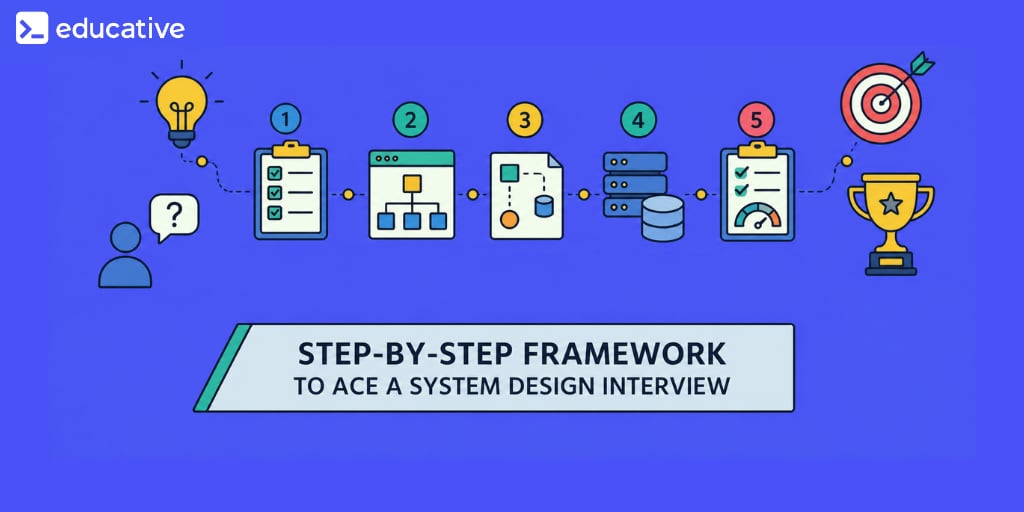
If you’re preparing for a big tech interview, understanding the step-by-step framework to ace a System Design interview can completely change how you approach these conversations. System Design rounds are rarely about finding a perfect answer, and more about demonstrating how you think, structure problems, and communicate decisions under uncertainty. This blog walks you through a practical and repeatable framework that helps you stay composed, structured, and persuasive throughout the interview.
Instead of memorizing architectures, the goal is to develop a mental model that you can apply across different prompts. When you consistently follow a clear process, you shift from reacting to the problem toward confidently leading the discussion. That shift is often what separates average candidates from those who leave a strong impression.
Grokking Modern System Design Interview

For a decade, when developers talked about how to prepare for System Design Interviews, the answer was always Grokking System Design. This is that course — updated for the current tech landscape. As AI handles more of the routine work, engineers at every level are expected to operate with the architectural fluency that used to belong to Staff engineers. That's why System Design Interviews still determine starting level and compensation, and the bar keeps rising. I built this course from my experience building global-scale distributed systems at Microsoft and Meta — and from interviewing hundreds of candidates at both companies. The failure pattern I kept seeing wasn't a lack of technical knowledge. Even strong coders would hit a wall, because System Design Interviews don't test what you can build; they test whether you can reason through an ambiguous problem, communicate ideas clearly, and defend trade-offs in real time (all skills that matter more than ever now in the AI era). RESHADED is the framework I developed to fix that: a repeatable 45-minute roadmap through any open-ended System Design problem. The course covers the distributed systems fundamentals that appear in every interview – databases, caches, load balancers, CDNs, messaging queues, and more – then applies them across 13+ real-world case studies: YouTube, WhatsApp, Uber, Twitter, Google Maps, and modern systems like ChatGPT and AI/ML infrastructure. Then put your knowledge to the test with AI Mock Interviews designed to simulate the real interview experience. Hundreds of thousands of candidates have already used this course to land SWE, TPM, and EM roles at top companies. If you're serious about acing your next System Design Interview, this is the best place to start.
Why this framework matters#
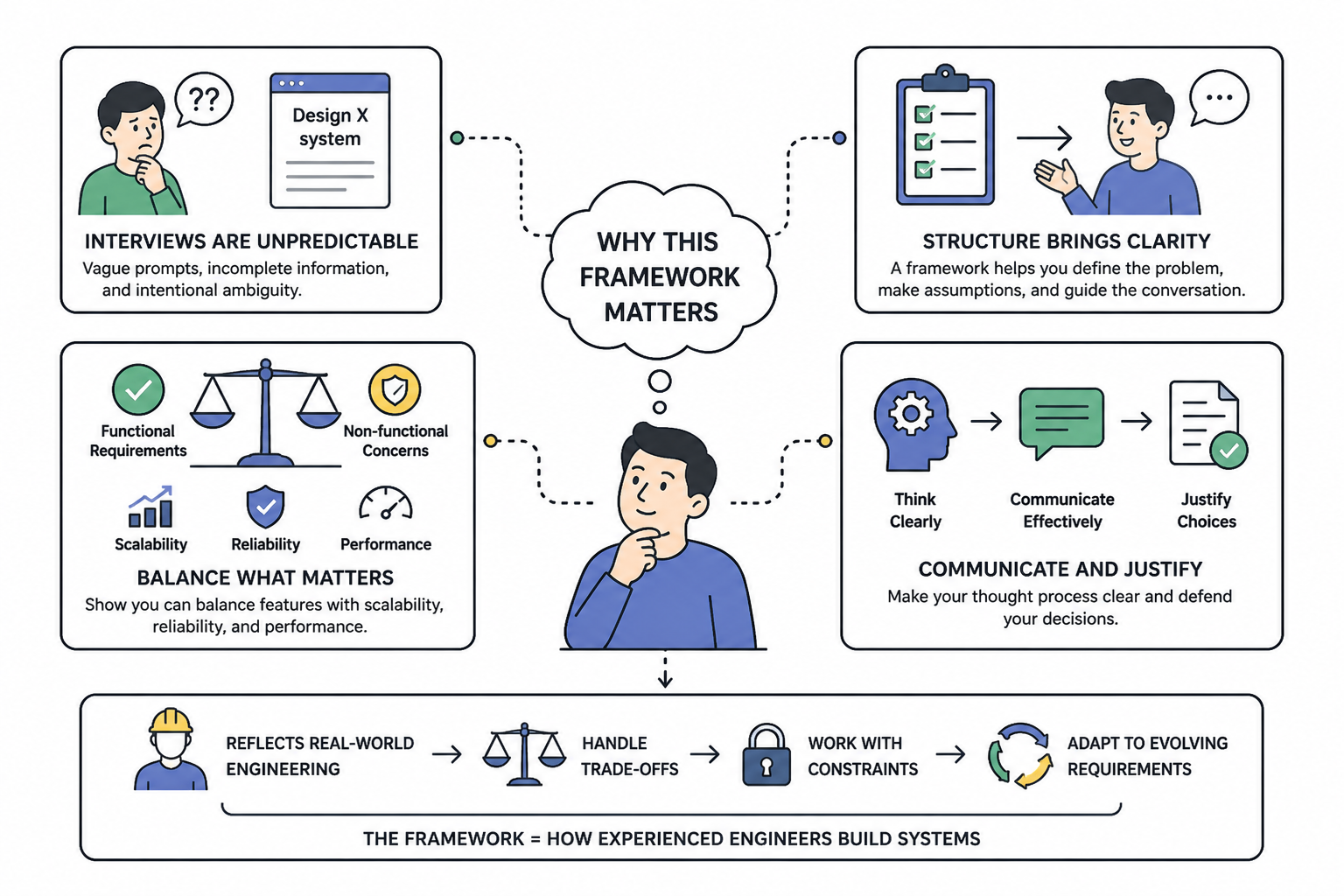
System Design interview questions are often unpredictable because they lack the rigid structure of coding problems. You are typically given a vague prompt such as “Design X system,” and expected to define the problem, make assumptions, and guide the conversation forward. This ambiguity is intentional, as interviewers want to evaluate your ability to navigate incomplete information and make thoughtful engineering decisions.
Following a structured framework allows you to bring clarity to that ambiguity. It demonstrates that you can balance functional requirements with non-functional concerns such as scalability, reliability, and performance. At the same time, it shows that you can communicate your thought process clearly and justify your choices, which are critical skills for any engineer working on real-world systems.
Ultimately, this framework is not just about answering interview questions. It reflects how experienced engineers think about building systems in production, where trade-offs, constraints, and evolving requirements are part of everyday work.
Grokking the Fundamentals of System Design

System Design is central to building applications that scale reliably and operate securely. This is why I built this course to help you explore the foundational concepts behind modern system architecture and why these principles matter when creating real-world software systems or preparing for System Design interviews. You’ll begin by examining the basics of system architecture, then move on to distributed system concepts, including consistency, availability, coordination, and fault tolerance. Next, you’ll explore communication patterns, concurrency handling, and strategies like retries, backoff policies, and idempotency. You’ll also compare SQL, NoSQL, and NewSQL databases and dive into data partitioning, replication, and indexing techniques. The course concludes with security and observability, rounding out the pillars you need for System Design interviews. You’ll be able to analyze complex design problems, reason about trade-offs, and structure systems that are scalable, maintainable, and ready for real-world demands.
Step 1: Clarify requirements#
The first step in any System Design interview should always be to clarify the problem. It might feel tempting to jump straight into designing the system, but doing so often leads to incorrect assumptions and misaligned solutions. Taking a moment to ask questions shows that you are thoughtful and methodical in your approach.
You should aim to understand both the functional requirements and the non-functional expectations of the system. This includes identifying what the system must do, who the users are, and what scale you are dealing with. It is equally important to explore constraints such as latency requirements, availability expectations, and any limitations related to technology or infrastructure.
By carefully defining the problem upfront, you create a solid foundation for the rest of your design. This step ensures that your solution is aligned with the interviewer’s expectations and prevents unnecessary rework later in the conversation.
Step 2: Estimate scale and key metrics#
Once you have a clear understanding of the requirements, the next step is to ground your design in realistic assumptions about scale. Even rough estimations can significantly influence your architectural decisions and help you avoid designing something that is either too simple or unnecessarily complex.
At this stage, you should think about the number of users, the expected traffic patterns, and the volume of data the system will handle. These estimates help you determine whether you need techniques such as sharding, caching, or distributed processing. They also give context to your design choices, making your solution feel more practical and grounded.
The key here is not to aim for perfect accuracy but to demonstrate that you can reason about system behavior under realistic conditions. This ability to think in terms of scale is a hallmark of strong System Design skills.
Step 3: Design the high-level architecture#
With your assumptions in place, you can begin outlining the high-level architecture of the system. This step involves identifying the main components and explaining how they interact with each other. The goal is to provide a clear overview of the system without getting lost in implementation details.
A well-structured high-level design typically includes the client layer, application servers, data storage systems, and supporting infrastructure such as load balancers and caching layers. As you describe the architecture, it is important to explain the flow of data and how requests are processed within the system.
This stage sets the direction for the rest of your discussion. A clear and logical high-level design makes it easier to dive deeper into specific components and helps the interviewer follow your thought process.
Step 4: Dive deeper into key components#
After establishing the overall architecture, you should focus on a few critical components and explore them in detail. This is where you demonstrate depth in your understanding and show that you can make informed technical decisions.
For instance, you might discuss your choice of database and explain why a particular model is suitable for the system’s requirements. You could also explore how caching improves performance, or how message queues enable asynchronous processing and improve system resilience. The important part is not just describing these components but explaining why they are necessary and how they fit into the overall design.
By diving deeper into specific areas, you move beyond surface-level explanations and show that you can handle the complexities of real-world systems.
System Design Deep Dive: Real-World Distributed Systems

Modern software systems are expected to operate at a massive scale while meeting strict reliability and latency requirements. Whether it’s a feed refresh, a payment request, or a real-time analytics query, users expect systems to respond instantly and consistently. That expectation has raised the bar for engineers today, understanding that System Design isn’t optional. It’s a core skill for building and evaluating production-grade systems. I built this course from my experience working on large-scale distributed systems at Microsoft (Azure) and Meta (Scuba), and from interviewing hundreds of candidates across both companies. The pattern I kept seeing was this: candidates understood individual components, but struggled to combine them into a coherent system. They knew what a cache or load balancer was, but not when or why to use it. This course is designed to bridge that gap. We start with the foundational building blocks of System Design, including databases, caching layers, load balancing, and messaging systems, and focus on how they interact under real-world constraints. From there, we analyze systems built by companies like Google, Facebook, and Amazon, breaking them down to understand the trade-offs behind each design decision. The goal is not just to learn concepts, but to develop the ability to reason through them in practice. This approach has helped a large number of engineers build stronger intuition for System Design and perform better in interviews. If you want to understand how real systems are designed and be able to design them yourself, this course gives you a clear, practical path forward.
Step 5: Address scalability, reliability, and trade-offs#
At this stage, the focus shifts to how your system behaves under pressure. A strong System Design is not just functional but also scalable and resilient. You need to demonstrate how your system handles increased traffic, recovers from failures, and maintains performance over time.
This is also the point where you should explicitly discuss trade-offs. Every design decision comes with compromises, whether it is between consistency and availability or between performance and cost. Acknowledging these trade-offs shows that you understand the realities of building systems in production and are capable of making informed decisions.
By addressing these aspects, you demonstrate a level of maturity that goes beyond simply designing a working system.
Step 6: Iterate and extend the design#
System Design interviews are rarely about presenting a final, polished solution. Instead, they are an opportunity to show how you think about evolving a system over time. Once you have presented your design, you should consider how it might change under different conditions or additional requirements.
For example, you might discuss how the system would handle rapid growth, support new features, or adapt to stricter performance requirements. This iterative thinking shows that you are comfortable with change and can continuously improve your design based on new information.
It also keeps the conversation dynamic and demonstrates that you are thinking beyond the immediate problem.
Step 7: Summarize and communicate clearly#
A strong conclusion reinforces your structured approach and leaves a positive impression on the interviewer. After walking through your design, take a moment to summarize the key decisions and highlight the most important aspects of your solution.
This summary should briefly cover the system’s goals, the architecture you proposed, and the trade-offs you made. It is also a good opportunity to invite feedback or ask if the interviewer would like to explore a specific part of the system in more detail.
Clear communication at this stage ensures that your ideas are well understood and demonstrates your ability to lead technical discussions effectively.
Putting the framework into practice#
Applying this framework to real-world scenarios is where the learning truly happens. When you practice with different System Design prompts, you start to see patterns and develop intuition about which approaches work best in different situations. Over time, the framework becomes second nature, allowing you to focus more on the quality of your ideas rather than the structure of your response.
The key is to practice actively by explaining your designs out loud, refining your assumptions, and seeking feedback from others. This process helps you identify gaps in your understanding and improve your ability to communicate complex ideas clearly.
Why this framework helps you stand out#
When you internalize the step-by-step framework to ace a System Design interview, you bring clarity and confidence to what is often seen as a challenging part of the interview process. You demonstrate structured thinking, strong communication skills, and the ability to make thoughtful decisions under uncertainty.
You also show that you can take ownership of the problem, guide the discussion, and adapt your design as new constraints emerge. These qualities are exactly what hiring managers look for when evaluating candidates for System Design roles.
Final thoughts#
If you want to succeed in System Design interviews, focus on building a clear and repeatable approach rather than memorizing specific solutions. The ability to structure problems, justify decisions, and communicate effectively will always be more valuable than any single architecture.
By practicing this framework consistently, you will develop the confidence and clarity needed to handle even the most open-ended System Design questions. Over time, what once felt overwhelming will become a structured and manageable process that allows you to showcase your strengths as an engineer.