
The Google DeepMind Software Engineer interview can be technically demanding because candidates may need to demonstrate strong coding fundamentals, problem-solving skills, software design knowledge, and clear technical communication. The difficulty also depends on the position and seniority, since infrastructure, product engineering, and ML-focused software engineering roles can emphasize different technical areas. A structured preparation plan can make the process much more manageable because many of the underlying skills are standard software engineering competencies. Focus on understanding algorithms, practicing System Design, strengthening your primary programming language, and preparing to explain technical decisions rather than relying on memorized solutions.
Google DeepMind Software Engineer interview: 2026 guide
Prepare for the Google DeepMind Software Engineer interview with focused practice in coding, System Design, ML concepts, and problem-solving. Learn what to expect, strengthen your technical foundation, and approach each interview with confidence.
Working at the intersection of software engineering and artificial intelligence can put you in the middle of some of the most technically demanding problems in computing. If you are preparing for a Google DeepMind Software Engineer interview, you should expect a process that examines your programming fundamentals, problem-solving ability, software design judgment, and capacity to work on complex systems where engineering and machine learning frequently overlap.
The preparation challenge is breadth because strong software engineering fundamentals still matter even when the organization is best known for AI research. You need to be comfortable writing reliable code, reasoning about algorithms, designing scalable systems, discussing engineering trade-offs, and collaborating with researchers or engineers whose work may involve large-scale machine learning infrastructure.
This guide breaks down the skills you should prioritize for a Google DeepMind Software Engineer interview, the types of technical questions worth practicing, and a structured preparation roadmap. The exact interview loop can vary by team, seniority, and specialization, so your goal should be building transferable engineering depth rather than memorizing one supposed interview sequence.
What is the Google DeepMind Software Engineer interview?#
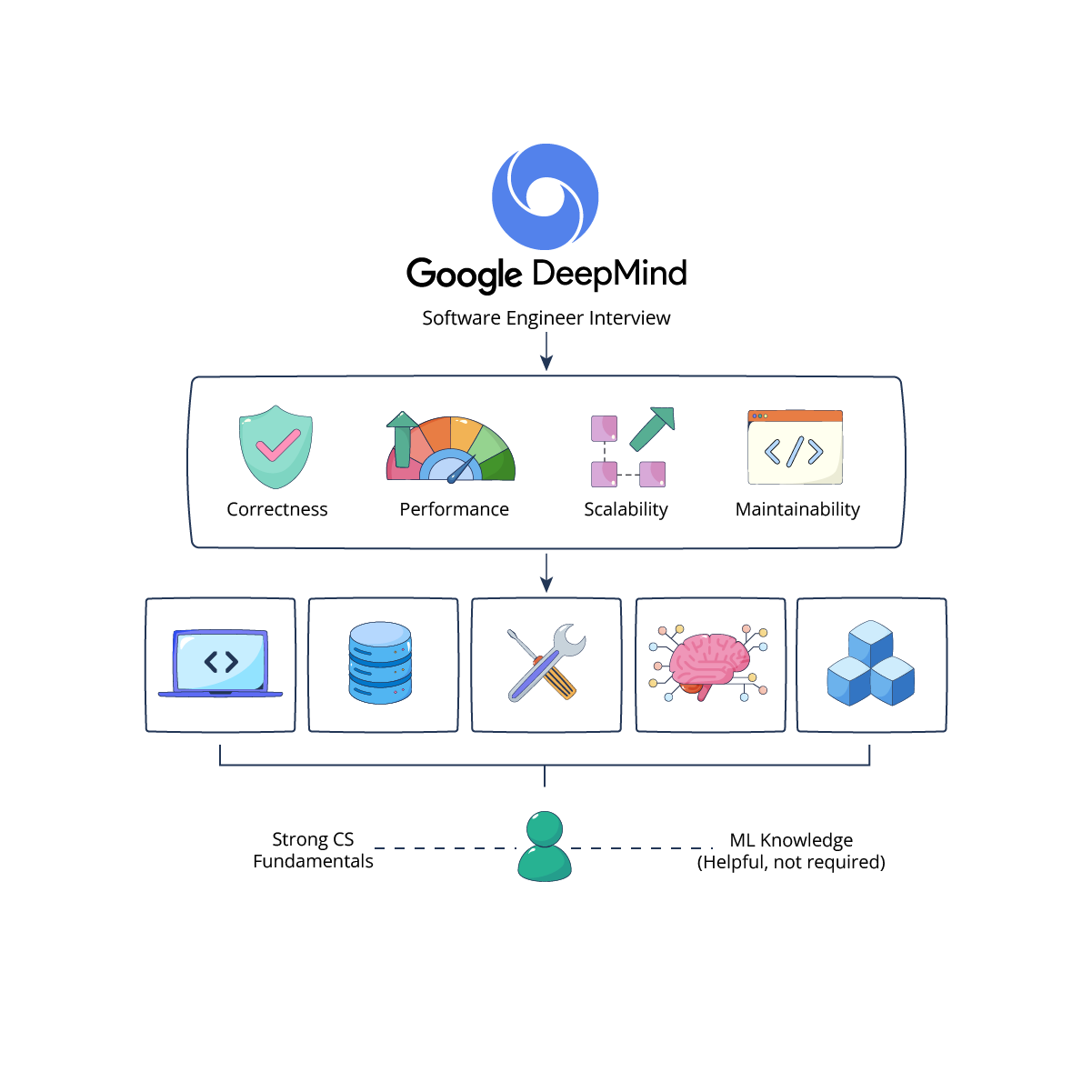
The Google DeepMind Software Engineer interview is designed to determine whether you can solve challenging engineering problems while maintaining strong standards for correctness, performance, scalability, and maintainability. Depending on the position, the role can involve everything from general software development to research infrastructure, distributed systems, developer tooling, machine learning platforms, or AI-focused product engineering.
That distinction matters because you should not prepare as though you were interviewing exclusively for a machine learning researcher position. A software engineering role still demands excellent computer science fundamentals, although familiarity with machine learning concepts can become increasingly valuable when the team works closely with models, training infrastructure, or research systems.
A candidate's experience can vary, but your preparation can generally be organized around the following areas rather than treating the process as a rigid sequence.
Interview area | What you should prepare to demonstrate |
Initial conversations | Relevant experience, motivation, communication, and role alignment |
Coding and algorithms | Data structures, algorithms, correctness, complexity, and clean implementation |
Software or System Design | Architecture, scalability, reliability, APIs, storage, and technical trade-offs |
Role-specific technical depth | Distributed systems, ML infrastructure, frontend, backend, or another relevant specialization |
Behavioral discussions | Collaboration, ownership, ambiguity, communication, and learning |
Cross-functional thinking | Ability to work effectively with researchers, engineers, and other technical stakeholders |
Your recruiter should remain the most reliable source for the exact structure of your particular interview loop. Once you know the team and interview format, you can allocate preparation time toward the areas most relevant to that position.
What skills should you prepare for the Google DeepMind Software Engineer interview?#
Preparing effectively requires more than solving a large number of algorithm problems because interviewers need evidence that you can apply computer science principles to unfamiliar situations. You should therefore build depth across coding, System Design, software engineering fundamentals, and the technical domain described in the job posting.
The strongest preparation strategy connects these areas rather than studying them independently. For example, an algorithm question can lead into complexity analysis, while a System Design discussion can quickly expand into distributed computing, storage, concurrency, or reliability.
Data structures and algorithms#
Coding fundamentals should be one of the first areas you strengthen because they give interviewers a direct way to observe your reasoning. You should be comfortable transforming ambiguous requirements into a precise solution, selecting an appropriate data structure, analyzing complexity, and implementing the solution without introducing unnecessary complexity.
High-value topics include arrays, strings, hash maps, stacks, queues, linked lists, trees, graphs, heaps, recursion, sorting, searching, and dynamic programming. Instead of trying to memorize hundreds of solutions, practice recognizing recurring patterns and explaining why a particular approach fits the constraints.
Learn Data Structures and Algorithms
Modern applications, including search engines and AI systems, rely on efficient data handling and fast decision-making. As software systems scale, the difference between functional code and performant code becomes critical. Proficiency in data structures and algorithms is essential; it underpins the design of reliable, scalable, and high-performance systems. I built this course from my background in computer science research and my work in intelligent systems, where efficiency and optimization directly impact real-world outcomes. My experience with adaptive AI, neural networks, and intelligent tutoring systems shows a consistent pattern: developers often struggle more with selecting efficient problem-solving approaches than with syntax. This course focuses on addressing that gap. You will learn Data Structures and Algorithms in Python through a structured, hands-on approach that prioritizes clarity and practical application. Instead of memorizing concepts, you will understand how to apply arrays, linked lists, trees, graphs, and algorithms like recursion, sorting, and graph traversal to real problems. You will also build intuition for time and space complexity using Big-O analysis. Thousands of learners use Educative to strengthen their problem-solving skills and prepare for technical interviews. If you want to write efficient code, think like an engineer, and confidently solve complex problems in Python, this course is the right place to start.
Programming language fundamentals#
Choose the interview language in which you can reason and implement solutions most naturally, provided it fits the expectations communicated for your interview. Python and C++ are particularly useful languages to understand in AI and systems-oriented environments, although your actual preparation should follow the role and guidance from the recruiting team.
Knowing syntax is only the starting point because interviewers can explore memory behavior, concurrency, error handling, object-oriented design, testing, and language-specific performance considerations. You should be able to write code that another engineer could understand and maintain instead of treating the interview like a competitive programming contest.
Complexity analysis#
A correct solution is valuable, but understanding its computational behavior demonstrates stronger engineering judgment. Practice discussing time complexity, space complexity, expected versus worst-case behavior, and the trade-offs created by alternative data structures.
When you finish an implementation, make complexity analysis part of your normal explanation rather than waiting for the interviewer to request it. This habit encourages you to evaluate your solution from an engineering perspective and can reveal optimization opportunities before follow-up questions begin.
System Design for Google DeepMind software engineering roles#
System Design becomes increasingly important for experienced software engineers because large AI organizations depend on infrastructure capable of supporting enormous workloads. Even when your role is not directly responsible for model training, understanding scalable systems helps you reason about the engineering environment surrounding modern AI development.
Your preparation should cover distributed systems, APIs, storage, caching, queues, load balancing, consistency, replication, fault tolerance, observability, and capacity planning. You should also practice starting with requirements instead of immediately drawing services because strong System Design begins by establishing what the system actually needs to accomplish.
Grokking Modern System Design Interview
For a decade, when developers talked about how to prepare for System Design Interviews, the answer was always Grokking System Design. This is that course — updated for the current tech landscape. As AI handles more of the routine work, engineers at every level are expected to operate with the architectural fluency that used to belong to Staff engineers. That's why System Design Interviews still determine starting level and compensation, and the bar keeps rising. I built this course from my experience building global-scale distributed systems at Microsoft and Meta — and from interviewing hundreds of candidates at both companies. The failure pattern I kept seeing wasn't a lack of technical knowledge. Even strong coders would hit a wall, because System Design Interviews don't test what you can build; they test whether you can reason through an ambiguous problem, communicate ideas clearly, and defend trade-offs in real time (all skills that matter more than ever now in the AI era). RESHADED is the framework I developed to fix that: a repeatable 45-minute roadmap through any open-ended System Design problem. The course covers the distributed systems fundamentals that appear in every interview – databases, caches, load balancers, CDNs, messaging queues, and more – then applies them across 13+ real-world case studies: YouTube, WhatsApp, Uber, Twitter, Google Maps, and modern systems like ChatGPT and AI/ML infrastructure. Then put your knowledge to the test with AI Mock Interviews designed to simulate the real interview experience. Hundreds of thousands of candidates have already used this course to land SWE, TPM, and EM roles at top companies. If you're serious about acing your next System Design Interview, this is the best place to start.
Example System Design prompt#
Imagine you are asked to design a platform that allows internal teams to submit computationally expensive AI experiments and monitor their execution. Researchers should be able to submit jobs, specify resource requirements, track status, access logs, retrieve results, and recover gracefully when infrastructure failures occur.
A thoughtful discussion would consider a submission API, persistent job metadata, scheduling, worker pools, resource allocation, queues, retries, checkpointing, monitoring, and access controls. You could then discuss how the architecture changes when thousands of experiments compete for expensive accelerators or when jobs run for several days.
Discussing trade-offs effectively#
There is rarely one perfect architecture in a System Design interview, which means your reasoning becomes more important than drawing the largest possible diagram. Explain why you selected each major component, what assumptions influenced the choice, and where the architecture might eventually encounter limitations.
For example, introducing a message queue may improve workload buffering and decouple services, but it also introduces operational complexity and delivery semantics that the rest of the system must handle. Demonstrating awareness of these consequences makes your answer more convincing than simply naming technologies.
Machine learning knowledge: How much do you need?#
One of the biggest questions candidates have about the Google DeepMind Software Engineer interview is whether they need advanced machine learning expertise. The answer depends heavily on the specific role because a software engineer supporting research infrastructure can face different expectations from an engineer building general product services.
For a general software engineering position, prioritize the requirements stated in the job description rather than trying to become a machine learning researcher before the interview. However, understanding foundational concepts can make technical conversations easier and help you reason about the workloads that AI engineering systems need to support.
Useful concepts include training versus inference, supervised and unsupervised learning, neural networks, transformers, embeddings, tokenization, evaluation, model serving, GPUs and other accelerators, batching, and distributed training. You do not necessarily need to derive every mathematical formula, but you should understand the engineering implications when these concepts are relevant to your prospective team.
Grokking the Machine Learning Interview
Machine learning interviews at top tech companies now focus more on open-ended system design problems. “Design a recommendation system.” “Design a search ranking system.” “Design an ad prediction pipeline.” These questions evaluate your ability to reason about machine learning systems end-to-end. However, most candidates prepare for isolated concepts instead of system-level design. This course focuses specifically on building that System Design muscle. You’ll work through 9 real-world ML System Design problems (the same questions asked at Meta, Google, Amazon, and Microsoft) and learn a repeatable methodology for breaking each one down: defining the problem, choosing metrics, selecting model architectures, designing data pipelines, and evaluating trade-offs. Each system you design builds on practical ML techniques covered earlier in the course: embeddings, transfer learning, online experimentation, model debugging, and performance considerations. By the time you’re designing your third or fourth system, you'll have the technical vocabulary and judgment to explain why your design choices work. This is exactly what interviewers are looking for. The course also includes 6 mock interviews so you can practice articulating your designs under realistic conditions. If you have an ML or System Design interview coming up at any major tech company, this course will help you walk in with a clear framework for tackling whatever they throw at you.
Distributed systems and AI infrastructure#
Large-scale AI development creates demanding infrastructure problems because training and serving modern models can involve enormous computational resources. Software engineers working close to these AI systems may encounter distributed workloads, high-throughput data pipelines, accelerator scheduling, storage bottlenecks, networking constraints, and fault recovery.
You should therefore understand concepts such as horizontal scaling, replication, partitioning, distributed coordination, consistency models, backpressure, retries, idempotency, and observability. Knowing how these ideas interact becomes particularly valuable when interviewers introduce failures or scale changes into a design problem.
Example infrastructure question#
Suppose a distributed training workload runs across hundreds of machines and one worker fails several hours into the job. An interviewer might ask how you would prevent the entire computation from being lost and how you would design the surrounding infrastructure to recover efficiently.
Your answer could explore checkpointing, durable storage, worker health monitoring, orchestration, retry policies, and the consistency requirements surrounding recovery. The important part is explaining how each decision affects reliability, performance, and infrastructure cost rather than presenting a collection of disconnected technologies.
Coding questions you should practice#
The Google DeepMind Software Engineer interview can require strong algorithmic reasoning, so regular timed coding practice should remain part of your preparation. You should practice reaching a correct solution systematically while communicating your reasoning clearly enough for another engineer to follow.
Rather than attempting every possible coding problem, organize your preparation around recurring patterns.
Problem pattern | Concepts worth practicing |
Arrays and strings | Two pointers, sliding windows, prefix sums |
Hash-based problems | Frequency counting, lookup optimization, grouping |
Trees | DFS, BFS, recursion, traversal, lowest common ancestor |
Graphs | Traversal, topological sorting, shortest paths, connectivity |
Heaps | Top-K problems, scheduling, priority processing |
Dynamic programming | State definition, recurrence relationships, memoization |
Search | Binary search, search spaces, boundary handling |
Intervals | Sorting, merging, overlap detection, scheduling |
When practicing, resist the temptation to look at the solution immediately after getting stuck. Spend time defining examples, testing simpler cases, identifying brute-force approaches, and then finding the bottleneck because that reasoning process is exactly what interviews are designed to expose.
Grokking the Coding Interview Patterns
I created Grokking the Coding Interview because I watched too many talented engineers fail interviews they should have passed. At Microsoft and Meta, I saw firsthand what separated the candidates who succeeded from the ones who didn't. It wasn't how many LeetCode problems they'd solved. It was whether they could look at an unfamiliar problem and know how to approach it the right way. That's what this course teaches. Rather than throwing hundreds of disconnected problems at you, we organize the entire coding interview around 28 fundamental patterns. Each pattern is a reusable strategy. Once you understand two pointers, for example, you can apply them to dozens of problems you've never seen before. The course walks you through each pattern step by step, starting with the intuition behind it, then building through increasingly complex applications. As with every course on Educative, you will practice in a hands-on way with 500+ challenges, 17 mock interviews, and detailed explanations for every solution. The course is available in Python, Java, JavaScript, Go, C++, and C#, so you can prep in the language you'll actually use in your interview. Whether you're preparing for your first FAANG loop or brushing up after a few years away from interviewing, this course will give you a repeatable framework for cracking the coding interview.
How to approach a coding problem during the interview#
A coding interview should feel like a technical conversation rather than a silent race toward an implementation. Start by restating the problem, confirming inputs and outputs, and identifying constraints that could influence your choice of algorithm.
Once the requirements are clear, explain a straightforward solution before optimizing it. This gives the interviewer a visible reasoning path and prevents you from spending half the interview implementing an elegant solution to a problem you misunderstood.
Test before declaring the solution complete#
After implementing your solution, walk through it using representative examples and important edge cases. Empty inputs, duplicate values, large inputs, unusual boundaries, and failure conditions frequently reveal mistakes that are difficult to notice while coding.
Finish by stating the time and space complexity and identifying any meaningful trade-offs. If you see an optimization that you did not have time to implement, explain it clearly rather than pretending the existing solution is optimal.
Software engineering and code quality#
Algorithmic correctness alone does not tell an interviewer whether you can build software that survives beyond an interview environment. Your implementation should demonstrate sensible naming, manageable functions, clear control flow, appropriate abstractions, and awareness of potential failure conditions.
Testing deserves similar attention because high-quality engineering requires confidence that changes behave as expected. Practice explaining unit tests, integration tests, edge cases, dependency isolation, and how you would diagnose a failure that appears only under production workloads.
Behavioral preparation for Google DeepMind#
Technical interviews determine whether you can solve engineering problems, while behavioral discussions help interviewers understand how you operate when those problems involve other people. Research and engineering environments often involve uncertainty, changing requirements, competing ideas, and collaboration across specialized disciplines.
Prepare several stories involving difficult technical decisions, projects that did not go according to plan, disagreements with teammates, ambiguous requirements, production failures, and situations where you had to learn something quickly. Your examples should make your individual contribution clear while still demonstrating that you can collaborate without treating every technical disagreement as something to win.
Working with researchers and multidisciplinary teams#
One useful area to prepare is collaboration with people whose priorities differ from conventional product engineering. A researcher may prioritize experimentation speed while an infrastructure engineer prioritizes reliability, which creates legitimate trade-offs that require thoughtful communication.
Think about situations where you translated vague goals into technical requirements or helped another discipline understand engineering constraints. Strong examples demonstrate that you can preserve experimentation and creativity while introducing enough structure to keep systems dependable.
Why do you want to work at Google DeepMind?#
You should expect some variation of this question because motivation provides useful context about how seriously you understand the role. Generic answers about artificial intelligence being exciting rarely communicate much about your interests or what you could contribute.
Connect your answer to specific engineering problems that genuinely interest you, such as scalable ML infrastructure, developer platforms, AI products, model serving, distributed computing, or reliable systems for research. Then connect those interests to your existing experience so your answer explains both why Google DeepMind interests you and why your background makes the opportunity logical.
A five-week Google DeepMind Software Engineer interview preparation plan#
A structured schedule helps you avoid spending all your preparation time on algorithm problems while leaving System Design or behavioral preparation until the final few days. You can adjust the following roadmap based on your experience level, interview date, and the technical focus of the position.
Week | Primary focus | Preparation goal |
Week 1 | Data structures and algorithms | Refresh fundamentals and identify weak patterns |
Week 2 | Advanced coding and language fundamentals | Improve implementation speed, testing, and complexity analysis |
Week 3 | System Design and distributed systems | Practice scalable architectures and technical trade-offs |
Week 4 | Role-specific topics and AI fundamentals | Connect software engineering knowledge to the target team's domain |
Week 5 | Mock interviews and behavioral preparation | Practice complete interviews under realistic time constraints |
During the first two weeks, prioritize deliberate practice over raw question volume. Ten problems that you can solve, explain, test, and revisit independently are usually more useful than dozens of solutions you recognize only because you recently read them.
During the final weeks, increase the amount of spoken practice because knowing an answer internally is different from communicating it under interview conditions. Conduct System Design sessions on a whiteboard or shared document, explain coding solutions aloud, and rehearse behavioral stories until you can adapt them naturally instead of reciting scripts.
Common mistakes to avoid#
A demanding interview process can encourage candidates to study everything they can find, but unfocused preparation frequently creates shallow knowledge across too many areas. The better approach is to identify the competencies relevant to the specific position and build enough depth to handle follow-up questions.
Preparing as though this were purely an ML research interview#
Google DeepMind's reputation can lead software engineering candidates to spend disproportionate amounts of time studying advanced machine learning theory. If the job description emphasizes software engineering, infrastructure, distributed systems, or product development, those requirements should guide the majority of your preparation.
Machine learning knowledge can strengthen your understanding of the environment, but it should not come at the expense of coding and software engineering fundamentals. Adjust this balance when the actual position explicitly demands deeper ML expertise.
Memorizing coding solutions#
Recognizing a familiar problem can create false confidence because interviewers can modify constraints or introduce follow-up requirements. If your preparation depends on remembering a specific implementation, small changes can quickly make the solution unusable.
Practice deriving solutions from first principles and explaining why your algorithm works. This gives you a reusable problem-solving framework that remains useful even when the interview question is completely unfamiliar.
Designing systems before clarifying requirements#
Jumping directly into databases, queues, and microservices can make a System Design answer appear sophisticated while leaving the fundamental problem undefined. Establish users, traffic, latency expectations, consistency requirements, availability goals, and important product functionality before selecting architecture.
This approach also gives you a defensible reason for each major design decision. Instead of saying that you chose a distributed cache because large systems use caches, you can explain precisely which latency or throughput requirement it addresses.
Ignoring communication practice#
You can understand algorithms and distributed systems deeply while still struggling to demonstrate that knowledge in an interview. Technical communication requires practice because you need to explain assumptions, alternatives, failures, and trade-offs while simultaneously solving the problem.
Mock interviews are particularly useful for identifying moments where your reasoning becomes difficult to follow. Record yourself solving several problems or explaining a System Design and look for places where you skip important reasoning because the connection seems obvious in your own head.
How to prepare during the final week#
The final week should focus on consolidation instead of trying to learn entire areas of computer science from scratch. Review your recurring coding patterns, revisit several System Designs, refresh role-specific concepts, and practice the behavioral stories that best demonstrate your engineering experience.
You should also reread the job description carefully and identify every technical requirement you would struggle to discuss for several minutes. Use the remaining preparation time to strengthen those gaps because role-specific knowledge can matter more than another collection of random interview questions.
Final thoughts#
The Google DeepMind Software Engineer interview requires a combination of strong computer science fundamentals, disciplined problem solving, architectural judgment, and clear technical communication. Depending on the position, knowledge of machine learning systems and distributed infrastructure can strengthen your preparation, but your priority should remain aligned with the requirements of the actual software engineering role.
Prepare to demonstrate how you think rather than how many interview questions you have memorized. When you can break unfamiliar problems into manageable pieces, write clean solutions, evaluate system trade-offs, and communicate effectively with people working across engineering and research, you will be developing skills that matter well beyond the interview itself.
Frequently Asked Questions
Is the Google DeepMind Software Engineer interview difficult?
Is the Google DeepMind Software Engineer interview difficult?
What coding topics should I prepare for the Google DeepMind Software Engineer interview?
What coding topics should I prepare for the Google DeepMind Software Engineer interview?
Do I need machine learning knowledge for a Google DeepMind Software Engineer interview?
Do I need machine learning knowledge for a Google DeepMind Software Engineer interview?
Does the Google DeepMind Software Engineer interview include System Design?
Does the Google DeepMind Software Engineer interview include System Design?
How long should I prepare for the Google DeepMind Software Engineer interview?
How long should I prepare for the Google DeepMind Software Engineer interview?