Hotel Booking System Design
This blog explains how to approach a hotel booking System Design interview by reasoning about time-based inventory, temporary holds, payments, cancellations, and failure handling instead of jumping straight to architecture.
A hotel booking system is one of those System Design interview problems that looks deceptively simple at first glance. Most candidates immediately picture a search box, a list of hotels, a booking button, and a confirmation email. That mental shortcut is exactly why interviewers like this question. It feels familiar, which encourages shallow thinking, but it hides complexity that only shows up when you reason carefully about time, inventory, and failure.
From an interviewer’s perspective, this problem is not about hotels. It is about how you reason about systems where availability changes over time, where users commit money before receiving a guaranteed outcome, and where partial failures are the norm rather than the exception. Hotel booking systems combine several hard problems: time-based inventory, dynamic pricing, cancellations, retries, and trust. The way you navigate those problems reveals far more about your engineering maturity than the number of services you can name.
What the interviewer is actually testing:
Whether you can slow down, model time and state correctly, and explain trade-offs under uncertainty without panicking.
This blog is a coaching-style guide. It is meant to help you talk through a hotel booking system in an interview, not just sketch one. You will see why naive designs break, how real-world edge cases shape better designs, and how to adapt your reasoning as the interviewer pushes back.

For a decade, when developers talked about how to prepare for System Design Interviews, the answer was always Grokking System Design. This is that course — updated for the current tech landscape. As AI handles more of the routine work, engineers at every level are expected to operate with the architectural fluency that used to belong to Staff engineers. That's why System Design Interviews still determine starting level and compensation, and the bar keeps rising. I built this course from my experience building global-scale distributed systems at Microsoft and Meta — and from interviewing hundreds of candidates at both companies. The failure pattern I kept seeing wasn't a lack of technical knowledge. Even strong coders would hit a wall, because System Design Interviews don't test what you can build; they test whether you can reason through an ambiguous problem, communicate ideas clearly, and defend trade-offs in real time (all skills that matter ore than never now in the AI era). RESHADED is the framework I developed to fix that: a repeatable 45-minute roadmap through any open-ended System Design problem. The course covers the distributed systems fundamentals that appear in every interview – databases, caches, load balancers, CDNs, messaging queues, and more – then applies them across 13+ real-world case studies: YouTube, WhatsApp, Uber, Twitter, Google Maps, and modern systems like ChatGPT and AI/ML infrastructure. Then put your knowledge to the test with AI Mock Interviews designed to simulate the real interview experience. Hundreds of thousands of candidates have already used this course to land SWE, TPM, and EM roles at top companies. If you're serious about acing your next System Design Interview, this is the best place to start.
Framing the problem before you design anything#
Strong candidates do not start with architecture. They start with framing. This is where you establish shared context with the interviewer and prevent the discussion from drifting into arbitrary design choices.
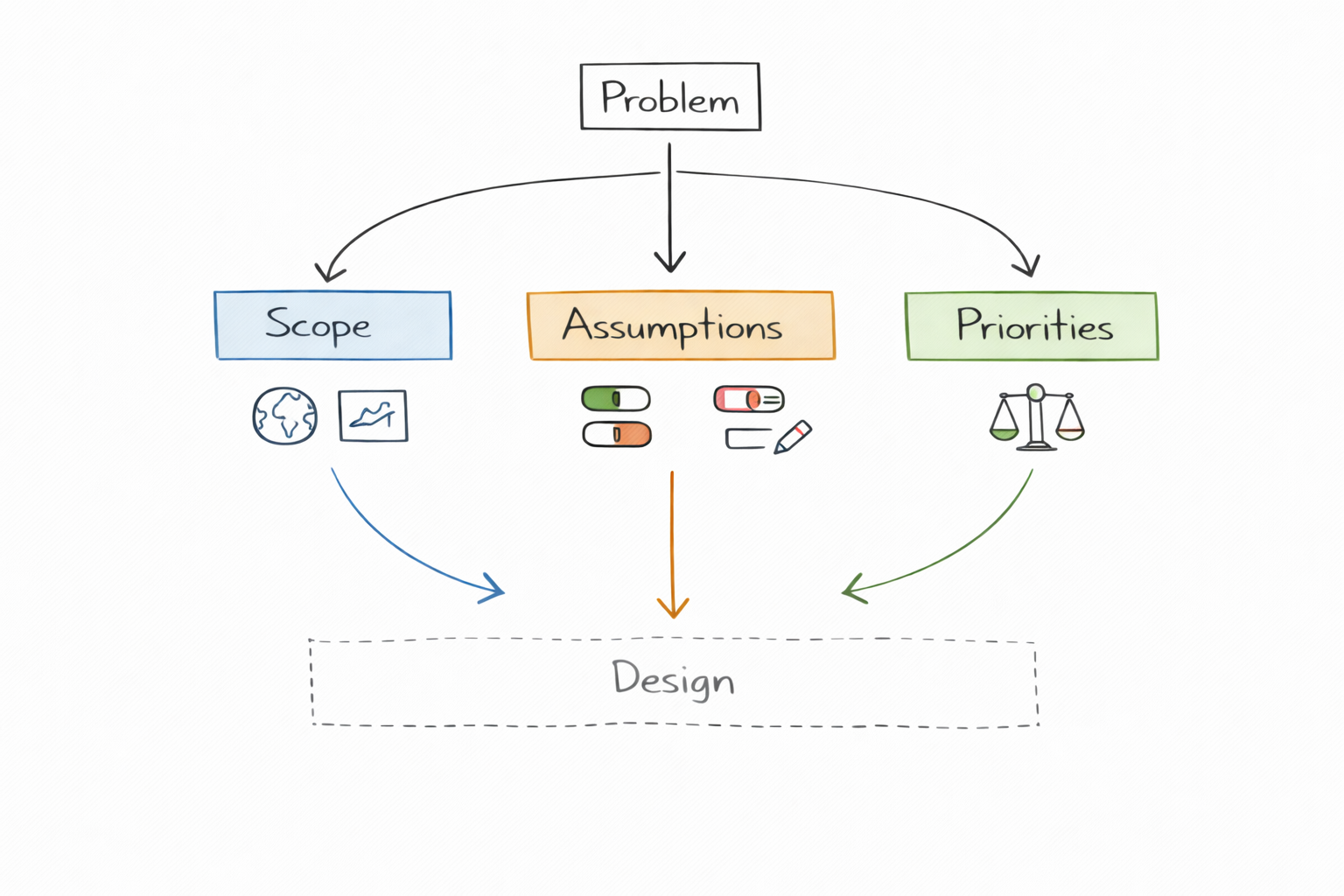
The first thing you should clarify is scope. Are we designing a global platform with millions of properties across continents, or a regional booking site with a smaller footprint? Are hotels managing inventory dynamically, or is availability updated infrequently? Are users mostly browsing, or is this a booking-heavy system during peak seasons?
These questions are not about stalling. They are about anchoring the design. A system optimized for global reach and multi-currency pricing looks very different from one optimized for a single market. Interviewers want to see that you recognize this and choose a reasonable starting point.
Interview signal:
You explicitly state assumptions and treat them as adjustable, not as fixed truths.
You should also clarify business priorities early. Is it acceptable to show a hotel during search and later reject the booking because availability changed? Is occasional overbooking tolerable, or must availability be strictly enforced? Is search speed more important than perfectly accurate pricing?
These priorities shape everything that follows. If you skip them, your design decisions may be technically sound but feel unmotivated.
Understanding the flows before naming components#
A hotel booking system is best understood as a set of flows that change character over time. If you jump straight to services and databases, you risk missing where the real complexity lives.
Start with the user journey. A user searches for a city and date range, browses options, selects a room, proceeds to payment, and receives a confirmation. Later, they might cancel or modify the booking. Each of these steps stresses the system in different ways.
Search is read-heavy and forgiving. Users expect fast responses and tolerate slightly stale data. Selection and booking are write-heavy and unforgiving. Payment is slow, external, and failure-prone. Cancellations reopen inventory and introduce refunds. Explaining these differences out loud shows that you are thinking in terms of system behavior, not just features.
Why this matters in production:
Most real bugs and outages happen at flow boundaries, not inside individual services.
A useful way to ground this discussion is to tie each user action to a system responsibility and a consistency expectation.
User action | System responsibility | Consistency expectation |
Search city and dates | Fetch candidate hotels and prices | Eventual consistency acceptable |
View room options | Show best-effort availability | Mild staleness acceptable |
Select room | Validate availability for date range | Strong consistency required |
Proceed to payment | Place temporary hold on inventory | Strong consistency required |
Complete payment | Record financial transaction | Correctness and auditability |
Confirm booking | Commit reservation | Durable, exactly-once |
Cancel booking | Release inventory, issue refund | Correctness over speed |
This table is not the answer. It is a scaffold that helps you reason clearly as the interview progresses.
Why time-based inventory is fundamentally hard#
Hotel booking systems differ from simpler booking problems because inventory is not a single slot. A booking spans multiple nights. That single fact introduces a surprising amount of complexity.
The naive approach is to think of availability as a boolean: a room is either free or not. This breaks down immediately when bookings span ranges. A room that is free on Monday and Wednesday but booked on Tuesday cannot be used for a two-night stay. Availability is not a property of a room; it is a property of a room over a time interval.
Common pitfall:
Treating availability as a static attribute instead of a function of time.
Once you acknowledge this, you also realize that availability checks must consider overlapping date ranges. Two bookings overlap if their date ranges intersect, even partially. Failing to reason about this correctly leads to subtle bugs that only appear under real usage.
Interviewers do not expect you to derive a perfect schema for this. They expect you to recognize why it is hard and to reason carefully about the implications.
Room types versus individual rooms: a deceptively deep decision#
One of the most common decision points interviewers probe is how you model inventory. Do you track individual rooms, or do you track room types with counts?
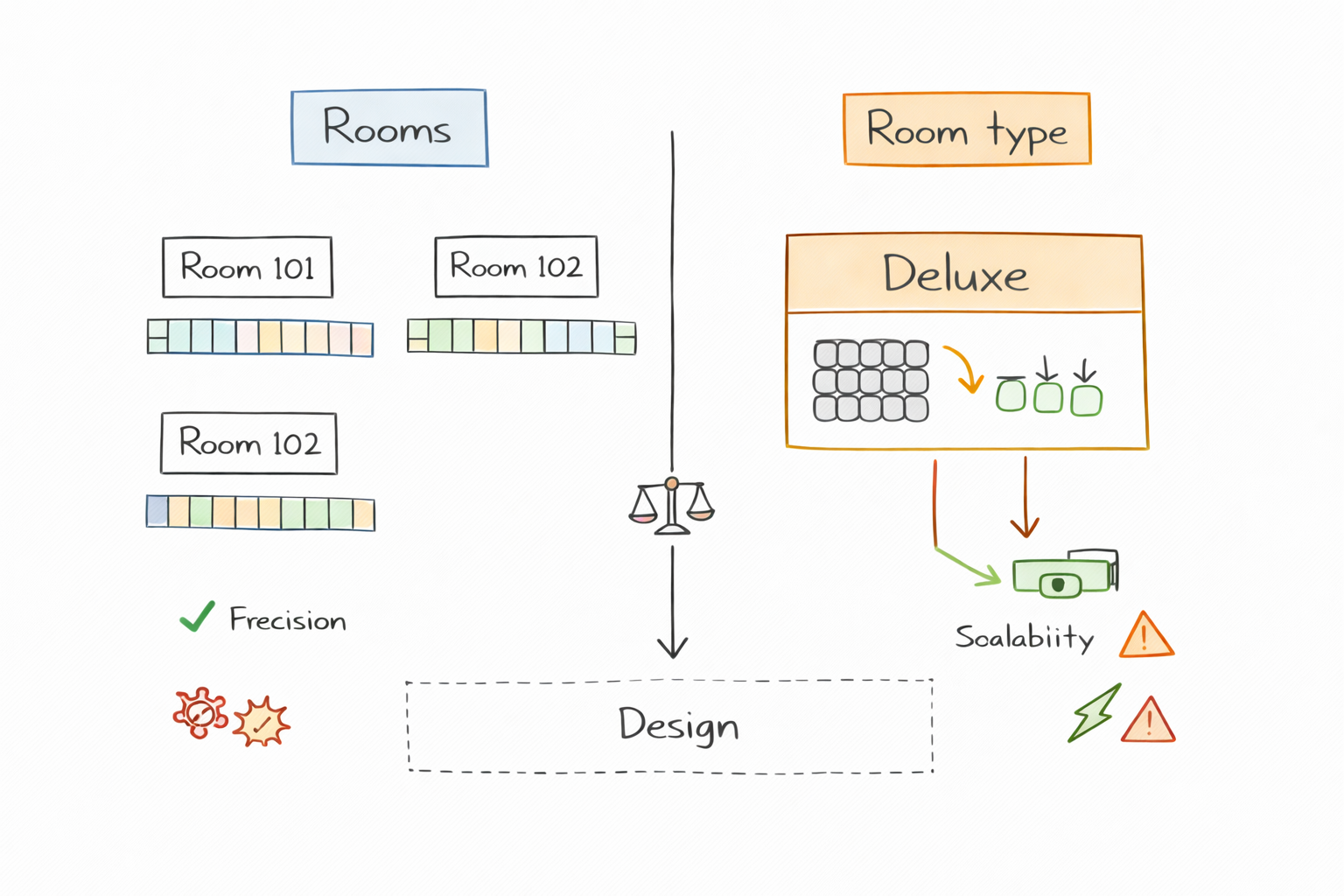
At first glance, tracking individual rooms seems clean. Each room has its own calendar, and bookings simply mark ranges as occupied. This avoids overbooking entirely. The downside is complexity. At scale, managing calendars for millions of rooms across date ranges becomes expensive, both computationally and operationally.
Tracking room types with counts is simpler. You treat “Deluxe King” as an inventory pool with, say, ten units per night. A booking decrements availability for each night in the range. This approach scales well but introduces risk: if your counting logic is wrong under concurrency, you overbook.
Individual rooms | Precise allocation | High complexity and cost |
Room type counts | Simpler, scalable | Risk of overbooking |
What the interviewer is actually testing:
Whether you can articulate trade-offs and choose a model that fits the assumed scale and business goals.
There is no universally correct choice. A boutique hotel chain might track individual rooms. A global aggregator likely uses room-type counts with safeguards. What matters is that you can defend your choice and adapt if constraints change.
Search and discovery: fast, forgiving, and intentionally imperfect#
Search is often where candidates start, but it is rarely where interviews are won or lost. The key is not how search works internally, but how it interacts with availability and pricing.
In real hotel systems, search results are often best-effort. A hotel might appear available during search and then fail during booking because someone else booked the last room moments earlier. This is not a bug; it is a trade-off in favor of fast discovery.
You should say this explicitly. Search optimizes for availability and speed. Booking optimizes for correctness. Mixing those guarantees is how systems become slow and brittle.
Interview signal:
You intentionally allow search results to be slightly stale and explain why that is acceptable.
This framing also prepares you for a common follow-up: “What if a user sees a hotel but cannot book it?” Your answer should tie back to user expectations and system design, not to technical excuses.
Temporary holds: why they exist and why they expire#
Once a user selects a room and proceeds to payment, the system must decide whether to reserve inventory. Without a hold, multiple users can race through payment and overbook. With an indefinite hold, inventory becomes artificially scarce when users abandon checkout.
This is why temporary holds exist. A hold is a time-bound reservation that prevents others from booking the same inventory while a user completes payment.
The naive approach is to skip holds entirely and only check availability at confirmation. This leads to frequent booking failures at the last step, which frustrates users and increases retries. Another naive approach is to hold inventory indefinitely until payment completes. Under slow payments or user abandonment, this blocks inventory and hurts utilization.
No hold | Simple design | Frequent conflicts |
Long hold | Fewer conflicts | Inventory starvation |
Short, time-bound hold | Balanced utilization | Some payment failures |
Why this matters in production:
Abandoned checkouts are normal behavior. Holds must expire or inventory will slowly disappear.
In an interview, you do not need to pick an exact duration. You need to explain why duration is a tuning knob and how it affects user experience and revenue.
Walking through one complete booking flow#
To really demonstrate understanding, you should be able to narrate one booking end to end.
A user searches for hotels in a city for a three-night stay. The system returns a list of hotels and room types based on best-effort availability. The user selects a room and proceeds.
At this point, the system performs a strict availability check across the entire date range. If availability exists, it places a temporary hold for those nights and returns a hold identifier with an expiration time.
The user is redirected to payment. Payment initiation creates a payment intent tied to the hold. The payment provider may respond quickly, slowly, or not at all.
If payment succeeds before the hold expires, the system confirms the booking. This is the commit point: availability is permanently decremented, and a durable booking record is created. The user receives confirmation.
If payment fails or the hold expires, the system releases the inventory. The user is informed and can try again.
Interview signal:
You clearly identify the commit point where the system transitions from tentative to permanent state.
Payment, retries, and reconciliation#
Payment is where many otherwise solid designs fall apart. Payment systems are external, slow, and unreliable. You should never assume they succeed once and only once.
The naive approach is to treat payment success as immediate and final. In reality, gateways retry callbacks, clients retry requests, and networks fail. Without idempotency, these retries create duplicate charges or duplicate bookings.
You should explain that every payment attempt is associated with a stable identifier. Repeated requests with the same identifier return the same outcome. This allows safe retries and simplifies reconciliation.
You should also explain reconciliation explicitly. If payment succeeds but booking confirmation fails, the system must detect this and either retry confirmation or issue a refund. This is not an edge case; it is a normal failure mode.
What the interviewer is actually testing:
Whether you design for partial failure and eventual consistency between money and inventory.
Failure scenarios candidates underestimate#
One scenario candidates often overlook is overlapping date ranges during modification. A user may change dates on an existing booking. This is effectively a cancellation plus a new booking, with all the same risks, but now tied to an existing reservation and payment state.
Another overlooked scenario is delayed cancellation. A cancellation request might succeed logically but fail to propagate immediately to availability caches. During that window, search results may still show reduced availability. This is acceptable if booking enforces correctness, but dangerous if it does not.
Why this matters in production:
Most “impossible” bugs come from state transitions that were never discussed explicitly.
How user behavior shapes correctness#
Users refresh pages. They retry actions. They abandon checkout. These behaviors are not anomalies; they are the norm.
A robust design assumes retries and makes operations idempotent. It also avoids trusting the client as the source of truth. The server decides whether a hold exists, whether it is valid, and whether a booking can be confirmed.
Interview signal:
You treat retries as expected behavior, not as exceptions.
How the design evolves at extreme scale#
At small scale, a single-region system with simple availability logic may suffice. At global scale, new challenges appear: regional pricing, time zones, cross-region consistency, and data locality.
A strong interview answer does not design all of this upfront. Instead, it explains how the system could evolve. You might start with regional isolation and eventually introduce asynchronous replication for search data while keeping booking local.
If the interviewer pushes back…
“At global scale, I would isolate booking by region to preserve correctness and accept eventual consistency in cross-region search.”
Communicating under interview pressure#
Designing the system is only half the challenge. Communicating it is the other half.
Narrate your reasoning. State assumptions clearly. When the interviewer changes constraints, adapt instead of defending your original design. Treat the interview as a collaborative design session, not a performance.
What the interviewer is actually testing:
How you think aloud when the problem changes.
Final reflection#
A hotel booking system is a powerful interview problem because it forces you to reason about time, state, and trust. There is no perfect design. There are only designs that make their trade-offs explicit and behave predictably under failure.
If you can frame the problem clearly, reason through naive approaches and their failures, and explain how your design adapts as constraints change, you demonstrate exactly the qualities interviewers are looking for.
Happy learning!
