ML System Design Explained
ML System Design tests real-world engineering judgment: data pipelines, model lifecycle, monitoring, and cost trade-offs. Master this end-to-end view to design ML systems that scale, adapt, and perform reliably in production.
Machine learning systems often appear simple in theory. You gather data, train a model, and generate predictions. In production, however, ML systems are significantly more complex. They must ingest constantly changing data, retrain models safely, serve predictions at scale, and adapt to real-world behavior that rarely matches offline assumptions.
This is why ML System Design has become a core System Design interview question. It evaluates whether you understand the full lifecycle of machine learning in production, including data pipelines, infrastructure, monitoring, and operational trade-offs. A strong ML System Design demonstrates your ability to build systems that evolve over time, remain reliable under load, and deliver sustained business value.
Grokking Modern System Design Interview
For a decade, when developers talked about how to prepare for System Design Interviews, the answer was always Grokking System Design. This is that course — updated for the current tech landscape. As AI handles more of the routine work, engineers at every level are expected to operate with the architectural fluency that used to belong to Staff engineers. That's why System Design Interviews still determine starting level and compensation, and the bar keeps rising. I built this course from my experience building global-scale distributed systems at Microsoft and Meta — and from interviewing hundreds of candidates at both companies. The failure pattern I kept seeing wasn't a lack of technical knowledge. Even strong coders would hit a wall, because System Design Interviews don't test what you can build; they test whether you can reason through an ambiguous problem, communicate ideas clearly, and defend trade-offs in real time (all skills that matter more than ever now in the AI era). RESHADED is the framework I developed to fix that: a repeatable 45-minute roadmap through any open-ended System Design problem. The course covers the distributed systems fundamentals that appear in every interview – databases, caches, load balancers, CDNs, messaging queues, and more – then applies them across 13+ real-world case studies: YouTube, WhatsApp, Uber, Twitter, Google Maps, and modern systems like ChatGPT and AI/ML infrastructure. Then put your knowledge to the test with AI Mock Interviews designed to simulate the real interview experience. Hundreds of thousands of candidates have already used this course to land SWE, TPM, and EM roles at top companies. If you're serious about acing your next System Design Interview, this is the best place to start.
This guide walks through how to design a production-grade ML system step by step, focusing on architecture, responsibilities, and real-world constraints rather than algorithmic details.
Understanding the core problem#
At its core, an ML system transforms input data into predictions or decisions. What makes it fundamentally different from traditional software is that its behavior depends on both data quality and learned model behavior, both of which change over time.
The defining challenges of ML System Design are summarized below.
Challenge | Why it matters |
Dynamic data | Real-world data is noisy, incomplete, and constantly changing |
Model degradation | Performance can decline silently due to drift |
Training vs inference | Each has very different scalability and latency needs |
Feedback loops | Poor design can reinforce bias or errors |
Inference scale | Serving predictions is often harder than training models |
Strong ML System Designs start by acknowledging that the model is only one component in a much larger system.
Functional requirements of an ML system#
Functional requirements describe what the ML system must deliver from a product perspective.
At a minimum, the system must generate predictions based on incoming data. Depending on the use case, this could involve fraud detection, recommendations, ranking, forecasting, or classification. These capabilities must be reliable, repeatable, and measurable.
The table below outlines typical functional responsibilities in production ML systems.
Function | Responsibility |
Data ingestion | Collect raw data from internal or external sources |
Model training | Periodically update models using historical data |
Prediction serving | Expose predictions through APIs or batch jobs |
Model management | Support versioning, rollbacks, and experimentation |
Logging | Record predictions and outcomes for analysis |
In interviews, it is common to start with a single use case, such as real-time inference, and expand the scope only if prompted.
System Design Deep Dive: Real-World Distributed Systems

Modern software systems are expected to operate at a massive scale while meeting strict reliability and latency requirements. Whether it’s a feed refresh, a payment request, or a real-time analytics query, users expect systems to respond instantly and consistently. That expectation has raised the bar for engineers today, understanding that System Design isn’t optional. It’s a core skill for building and evaluating production-grade systems. I built this course from my experience working on large-scale distributed systems at Microsoft (Azure) and Meta (Scuba), and from interviewing hundreds of candidates across both companies. The pattern I kept seeing was this: candidates understood individual components, but struggled to combine them into a coherent system. They knew what a cache or load balancer was, but not when or why to use it. This course is designed to bridge that gap. We start with the foundational building blocks of System Design, including databases, caching layers, load balancing, and messaging systems, and focus on how they interact under real-world constraints. From there, we analyze systems built by companies like Google, Facebook, and Amazon, breaking them down to understand the trade-offs behind each design decision. The goal is not just to learn concepts, but to develop the ability to reason through them in practice. This approach has helped a large number of engineers build stronger intuition for System Design and perform better in interviews. If you want to understand how real systems are designed and be able to design them yourself, this course gives you a clear, practical path forward.
Non-functional requirements that shape the design#
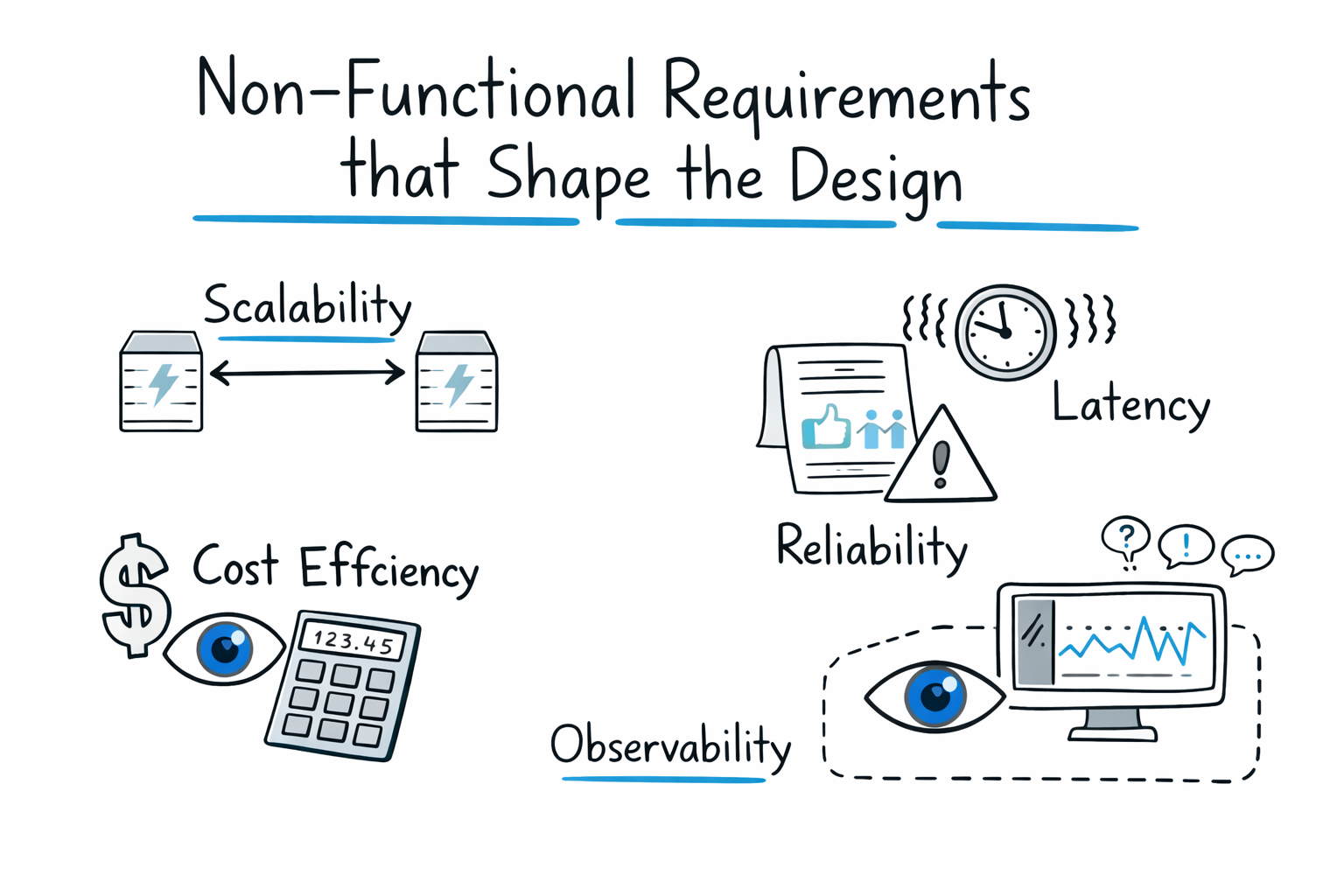
Non-functional requirements drive most architectural decisions in ML System Design.
Unlike deterministic systems, ML systems must tolerate uncertainty and changing behavior. They must scale reliably while maintaining acceptable latency, accuracy, and cost efficiency. Observability is especially critical because failures are often subtle and delayed.
Constraint | Design impact |
Scalability | Inference systems must handle peak traffic |
Latency | Real-time predictions require tight response times |
Reliability | Systems must handle unexpected model behavior |
Explainability | Required in regulated or high-risk domains |
Cost efficiency | Compute usage must be carefully controlled |
Observability | Drift and degradation must be detectable |
Explicitly surfacing these constraints early signals production-level thinking.
High-level architecture overview#
A well-designed ML system follows a pipeline-oriented architecture with clear separation of concerns between data, training, and serving.
Layer | Purpose |
Data pipelines | Ingest, validate, and transform raw data |
Feature layer | Compute and store reusable features |
Training services | Train and evaluate candidate models |
Model registry | Track versions, metadata, and artifacts |
Serving layer | Deliver predictions at scale |
Monitoring systems | Track system and model health |
This separation prevents changes in one layer from destabilizing the entire system.
Scalability & System Design for Developers

As you progress in your career as a developer, you'll be increasingly expected to think about software architecture. Can you design systems and make trade-offs at scale? Developing that skill is a great way to set yourself apart from the pack. In this Skill Path, you'll cover everything you need to know to design scalable systems for enterprise-level software.
Data ingestion and pipeline design#
Data is the foundation of any ML system.
Production data often originates from logs, databases, user interactions, sensors, or third-party APIs. Before it can be used, this data must be validated, cleaned, and transformed. Poor data quality directly translates into poor model performance, regardless of algorithm choice.
Robust data pipelines enforce schemas, handle missing values, normalize formats, and store data in data lakes or warehouses for downstream use. Designing these pipelines carefully is one of the highest-leverage investments in ML System Design.
Feature engineering and feature stores#
Feature engineering connects raw data to models.
In production systems, features used during training must exactly match those used during inference. Even small inconsistencies can lead to subtle bugs and degraded performance. Feature stores solve this problem by centralizing feature definitions and access patterns.
Feature store capability | Value |
Consistent computation | Prevents training-serving skew |
Offline access | Supports model training |
Online access | Enables low-latency inference |
Versioning | Supports safe evolution of features |
Mentioning feature stores in interviews often signals real-world ML experience.
Model training and evaluation workflows#
Model training is typically offline and compute-intensive but not latency-sensitive.
Training pipelines fetch historical data and features, train one or more candidate models, and evaluate them against predefined metrics. The best-performing model is then selected for deployment.
Treating training as an automated, repeatable workflow allows models to be retrained safely as data distributions change. This mindset separates production ML systems from experimental notebooks.
Model registry and lifecycle management#
Once a model is trained, it must be managed deliberately.
A model registry stores trained models along with metadata such as training data versions, evaluation metrics, and configuration parameters. This enables reproducibility, controlled rollouts, and fast rollbacks.
Registry responsibility | Why it matters |
Version tracking | Enables safe experimentation |
Metadata storage | Supports debugging and audits |
Rollback support | Reduces risk during deployment |
Explicit lifecycle management demonstrates system-level maturity.
Model serving and inference design#
Model serving is often the most critical and visible part of ML System Design.
Inference systems must respond quickly and reliably. Real-time inference prioritizes low latency and availability, while batch inference prioritizes throughput and cost efficiency. Strong designs clearly distinguish between these modes and avoid conflating their requirements.
Online versus offline inference#
Not all predictions need to be generated in real time.
Inference mode | Typical use cases |
Online inference | Recommendations, personalization, fraud detection |
Offline inference | Reporting, ranking, pre-computation |
Clarifying which mode is in scope prevents unnecessary complexity and over-engineering.
Monitoring models in production#
Monitoring is where ML systems diverge most from traditional software.
In addition to system metrics like latency and throughput, ML systems must monitor data distributions, prediction behavior, and performance over time. Without this visibility, failures often go unnoticed until business impact occurs.
Effective monitoring enables teams to detect drift, bias, and regressions early.
Feedback loops and retraining strategies#
Many ML systems improve over time by learning from user feedback.
Clicks, conversions, or corrections can be logged and incorporated into future training runs. However, feedback loops must be designed carefully to avoid reinforcing bias or noise. Separating training and inference data paths and validating retrained models before deployment preserves system stability.
Failure handling and graceful degradation#
ML systems must fail safely.
Models may produce low-confidence predictions, inference services may be unavailable, or inputs may be missing. In these cases, the system should fall back to default logic or simpler heuristics rather than failing catastrophically. Graceful degradation ensures ML failures do not become user-facing outages.
Cost management and efficiency#
Cost is a first-class constraint in ML System Design.
Training large models and serving predictions at scale can be expensive. Systems often balance accuracy and cost by using simpler models where possible and reserving complex models for high-impact scenarios. Cost-aware design decisions directly influence model complexity, inference frequency, and data retention policies.
How interviewers evaluate ML System Design#
Interviewers are not testing algorithm knowledge. They evaluate how you design end-to-end ML systems, manage data and model lifecycles, monitor behavior in production, and explain architectural trade-offs clearly.
Structured reasoning consistently matters more than naming tools or frameworks.
Final thoughts#
ML System Design is about building systems that learn safely and reliably in the real world. It requires combining data engineering, distributed systems, and product thinking into a cohesive architecture.
If you can clearly explain how data flows from ingestion to training to inference, how models are monitored, and how the system responds to failure, you demonstrate the judgment required to build production-grade ML systems.
