How do Diffusion Models work?
Curious how AI tools like Stable Diffusion and DALL·E create images from text? Explore how diffusion models transform random noise into realistic outputs and power today’s most advanced generative AI systems.
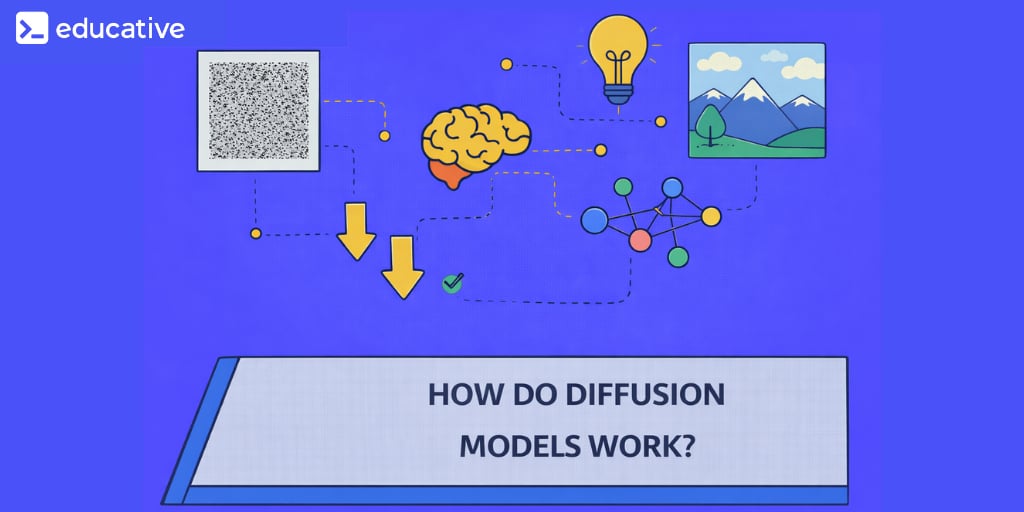
Modern generative AI models can create images, music, text, and other types of data using deep learning models. Over the past few years, image generation systems such as Stable Diffusion, DALL·E, and Midjourney have demonstrated remarkable capabilities, producing detailed images from short text prompts. As people explore the technology behind these systems, they often begin asking how do diffusion models work and why they have become so effective for generative tasks.
Diffusion models generate new data by gradually transforming random noise into structured outputs. This process is inspired by concepts from statistical physics, where particles diffuse over time. In the context of machine learning, the diffusion process refers to progressively adding noise to data and then learning how to reverse that process.
By training neural networks to reconstruct original data from noisy inputs, diffusion models learn the structure and distribution of complex datasets. During generation, the model begins with pure noise and gradually refines it until a coherent image or data sample emerges.
Introduction to Diffusion Models
In this course, you’ll gain practical insight into the theoretical concepts associated with diffusion models and hands-on expertise in creating images from noise and training neural networks for effective image sampling. You’ll start with an introduction to generative models, focusing on what is a diffusion model, specifically focusing on how diffusion models fall under this category. You’ll dive deep into how diffusion models work, exploring their workings, architecture, and the theoretical foundations supporting them. Subsequently, various diffusion model tasks will be introduced, and you will implement them using the Diffusers library, which provides cutting-edge pretrained diffusion models. You’ll learn how to set up and train a neural network model and sample images. After completing this course, you’ll understand diffusion models clearly, generate images from noise, navigate the complexities of diffusion models, and harness the full potential of generative models in diverse applications.
Understanding this process requires examining both the broader context of generative models and the specific mechanisms that diffusion architectures use during training and generation.
Understanding generative models#
Generative models are machine learning systems designed to produce new data that resembles the examples they were trained on. Instead of simply classifying or predicting labels for data, generative models attempt to learn the underlying probability distribution of a dataset.
When a model successfully learns this distribution, it can generate new samples that appear realistic and consistent with the training data. For example, a generative model trained on images of faces can produce entirely new faces that do not correspond to any specific image in the dataset.
Several major approaches to generative modeling have emerged over the years.
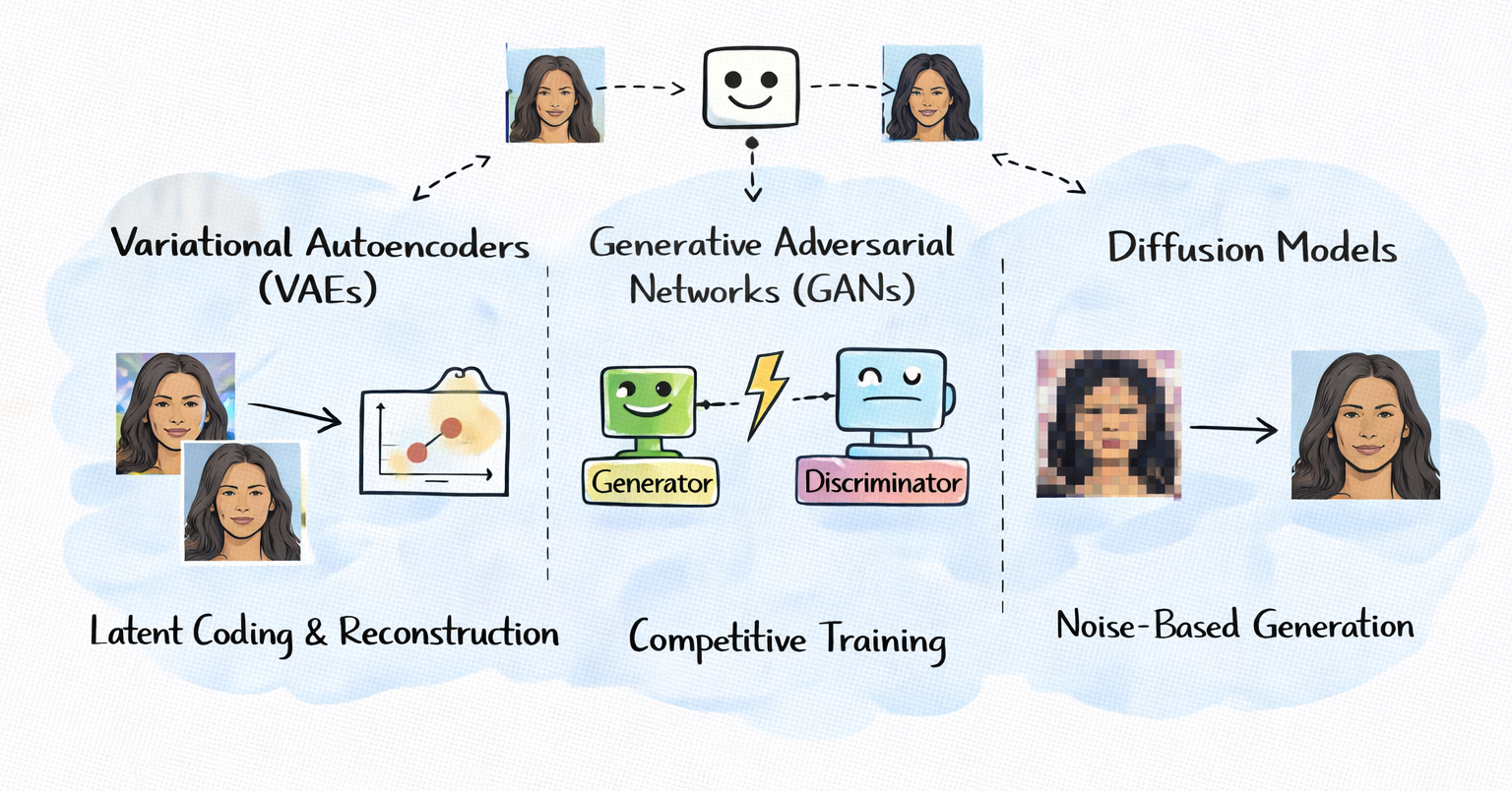
Variational autoencoders (VAEs) learn compact latent representations of data and generate new samples by decoding points from this latent space. These models focus on probabilistic encoding and reconstruction.
Generative adversarial networks (GANs) use a competitive training process between two neural networks: a generator that produces synthetic data and a discriminator that attempts to distinguish real data from generated samples.
Diffusion models represent a newer approach that relies on a noise-based generative process. Instead of directly generating samples from latent representations or adversarial training, diffusion models learn how to reverse a process that gradually corrupts data with noise.
This reverse process forms the foundation for understanding how do diffusion models work in modern generative systems.
Generative AI Handbook
Since the rise of generative AI, the landscape of content creation and intelligent systems has profoundly transformed with large language models (LLMs). This free generative AI course will guide you through the fascinating evolution of generative AI, exploring how these models power everything from text generation to advanced multimodal capabilities. You’ll begin with the basics of content creation. You’ll explore what generative AI is and how does generative AI works. You’ll learn how LLMs and diffusion models are used to generate everything from text to images. You’ll get familiar with LangChain and vector databases in managing AI-generated content. You’ll also cover RAG and the evolving role of AI agents and smart chatbots. From fine-tuning LLMs for specialized tasks to creating multimodal AI experiences with AI-powered images and speech recognition, you’ll unlock the full potential of generative AI with this free course and navigate the future challenges of this dynamic field.
The core idea behind diffusion models#
Diffusion models operate through two complementary processes that occur during training and generation.
First, a forward diffusion process gradually adds noise to training data over many steps. This process slowly destroys the structure of the original data until it becomes nearly indistinguishable from random noise.
Second, a reverse diffusion process learns how to remove this noise step by step. A neural network is trained to predict the noise added at each stage so that the original data can be reconstructed.
During training, the model repeatedly observes noisy versions of real data and learns how to reverse the corruption process. Over time, it learns how structured data transitions into noise and how noise can be transformed back into meaningful patterns.
Once training is complete, the model can generate new samples by starting with random noise and applying the learned reverse diffusion process.
Diffusion model training explanation#
Training a diffusion model involves exposing the neural network to many progressively noisier versions of the same data sample.
For each training image, the system generates noisy variations by adding small amounts of Gaussian noise across multiple timesteps. Each timestep represents a stage in the diffusion process where additional noise is introduced.
The neural network then receives two pieces of information: the noisy sample and the timestep at which the noise was added. Its task is to predict the noise component present in that sample.
If the network successfully predicts the noise, the model can subtract it and move closer to the original image. By repeating this process across many images and noise levels, the model learns a general strategy for reversing the diffusion process.
This training approach allows the model to develop a strong understanding of how structured patterns emerge from noise, which ultimately enables high-quality image generation.
The forward diffusion process#
The forward diffusion process gradually corrupts original data by adding small amounts of Gaussian noise over a sequence of timesteps.
At the beginning of this process, the input image remains mostly recognizable. However, as additional noise is applied, the image becomes increasingly distorted. After many steps, the original image is transformed into a nearly uniform noise distribution.
This process is deterministic and does not require any neural network training. Instead, it serves as a controlled method for generating noisy training examples.
The forward diffusion process provides the model with a series of intermediate states between structured data and pure noise. By learning how these transitions occur, the neural network can later reverse them during generation.
The reverse diffusion process#
The reverse diffusion process represents the learned component of the model.
In this phase, a neural network is trained to predict the noise that was added to the image at a specific timestep. By estimating the noise accurately, the model can remove it and recover a cleaner version of the data.
This process occurs gradually across many steps. At each timestep, the network slightly reduces the noise in the image and produces a more structured representation.
The reverse diffusion process effectively guides the transformation from random noise back toward a realistic data sample. Because the model has learned the statistical patterns of the training dataset, the final result reflects those patterns.
This denoising procedure is the key mechanism behind how do diffusion models work when generating images.
Forward vs reverse diffusion comparison#
Process | Purpose | Behavior |
Forward diffusion | Gradually add noise to data | Converts structured data into noise |
Reverse diffusion | Remove noise step by step | Generates new data samples |
The forward diffusion process provides training examples by progressively corrupting real data. The reverse diffusion process learns how to undo this corruption.
Together, these processes form the complete generative framework used by diffusion models.
Step-by-step image generation using diffusion models#
Once the model has been trained, it can generate new images through an iterative denoising process.
Step 1: Start with random noise#
The generation process begins with a tensor containing completely random noise. At this stage, there is no recognizable structure in the data.
Step 2: Predict noise at each timestep#
The trained neural network evaluates the noisy sample and predicts the noise component present at the current timestep. This prediction provides the information needed to partially remove the noise.
Step 3: Gradually denoise the sample#
After removing the predicted noise, the model produces a slightly cleaner version of the image. This process repeats across many timesteps, with each iteration gradually revealing more structure.
Step 4: Produce a structured output#
After sufficient iterations, the noisy input evolves into a coherent image that reflects the patterns learned from the training data.
This iterative refinement process explains how diffusion-based generative systems produce detailed and realistic images.
Real-world applications of diffusion models#
Diffusion models have become central to many modern generative AI systems due to their ability to produce high-quality outputs.
One of the most visible applications involves AI-powered image generation tools. Systems such as Stable Diffusion allow users to create images from text prompts, enabling artists, designers, and developers to explore new creative workflows.
Video generation systems are also beginning to use diffusion-based architectures. By extending the denoising process to temporal data, researchers can generate coherent sequences of frames.
Medical imaging is another area where diffusion models show promise. These models can assist in reconstructing images from incomplete data, improving the accuracy of diagnostic imaging techniques.
Scientific simulations also benefit from diffusion models. Researchers can generate synthetic datasets that resemble real-world observations, which helps train and evaluate machine learning systems.
These applications illustrate why understanding how do diffusion models work is important for anyone studying modern generative AI technologies.
Why diffusion models became popular#
Diffusion models gained popularity because they overcome several limitations associated with earlier generative approaches.
One advantage is training stability. Unlike GANs, which require balancing two competing neural networks, diffusion models rely on a single network trained with a well-defined objective function.
Another advantage involves output quality. Diffusion models often produce highly detailed images with fewer artifacts compared to earlier generative techniques.
Diffusion architectures are also flexible and can be adapted to various data types beyond images, including audio, video, and three-dimensional data.
These characteristics have contributed to the rapid adoption of diffusion models across both research and industry.
FAQ#
What is the difference between GANs and diffusion models?#
Generative adversarial networks rely on a competition between two neural networks: a generator that creates samples and a discriminator that evaluates their authenticity. Diffusion models use a different approach in which data is gradually corrupted with noise and a neural network learns to reverse that corruption. This difference often leads to more stable training in diffusion models.
Are diffusion models only used for images?#
Although diffusion models are widely known for image generation, they can be applied to many other data types. Researchers have successfully adapted diffusion architectures to generate audio, video, molecular structures, and three-dimensional objects.
Why do diffusion models start with noise?#
Diffusion models begin with random noise because the training process teaches the neural network how to transform noise into meaningful patterns. By reversing the noise corruption process step by step, the model can generate new samples that resemble the training data.
Do diffusion models require large datasets?#
Like many deep learning systems, diffusion models typically benefit from large datasets because they must learn the statistical structure of complex data distributions. Larger datasets allow the model to generate more realistic and diverse outputs.
Conclusion#
Diffusion models represent one of the most important advances in modern generative AI. By combining a forward noise process with a learned reverse denoising process, these models are able to transform random noise into detailed and realistic data samples.
Understanding how do diffusion models work provides insight into the mechanisms behind many image generation tools and emerging generative technologies. As diffusion architectures continue to evolve, they will likely play an increasingly important role in applications ranging from creative tools to scientific research.
Happy learning!