Mid-Level Software Engineer Interview Questions
Mid-level engineering interviews reward ownership, judgment, and real-world thinking, not just algorithms. Master coding fundamentals, debugging, system design basics, and incident awareness to show you’re ready to operate independently and grow.

Mid-level software engineer interviews assess engineering maturity beyond raw coding ability, covering System Design fundamentals, debugging instincts, and incident awareness. Interviewers want to confirm you can operate independently, communicate technical decisions clearly, and ship production-quality work without constant oversight.
Key takeaways
- Coding quality over cleverness: Interviewers prioritize readable, modular code with proper edge case handling over algorithmically tricky solutions.
- System Design at the component level: You are expected to reason about clients, services, databases, APIs, and basic trade-offs like SQL vs NoSQL or caching strategies, not globally distributed architectures.
- Debugging and refactoring are first-class signals: Tasks like fixing broken functions, tracing logs, simplifying nested logic, and improving code readability reflect real mid-level work and are evaluated accordingly.
- Incident discussions require specificity: When talking about outages, interviewers want your concrete role, the diagnosis process, the tools you used, and the improvements that followed.
- Mid-level versus senior distinction matters: Mid-level candidates demonstrate consistency and competence, while senior candidates are expected to proactively surface risks, lead design conversations, and reason about long-term system impact.
Moving from junior to mid-level software engineer is one of the most meaningful transitions in your career. At this stage, interviewers expect you to demonstrate more than raw coding ability. They want to see ownership, engineering judgment, debugging instincts, incident awareness, and an ability to design or improve systems with limited guidance.
The challenge is that many candidates preparing for mid-level roles study as if they are still interviewing for junior positions. This usually leads to a mismatch between expectations and performance. To help you prepare effectively, this guide breaks down what “mid-level” really means during interviews for software engineers, which skills are prioritized, and how System Design, debugging, and incident discussions factor into your evaluation.
Become the Highest Paid Engineer at Your Company

Learn the essential skills to operate at a Staff+ level, from integrating AI safely to guiding teams through crises. This free course gives you a clear roadmap to high-impact engineering and delivers it with a wink to Educative’s viral meme: John, the top-paid engineer who’s never around.
What Does “Mid-Level” Mean in Interviews?#
In interviews, “mid-level” refers to a candidate who can operate independently on well-defined tasks, contribute meaningfully to team architecture discussions, and ship production-quality work without constant oversight.
Interviewers are assessing whether you have moved beyond the beginner phase and can now:
Understand how your code impacts the rest of the system
Work through ambiguity with moderate guidance
Communicate technical decisions clearly
Balance correctness, readability, and trade-offs
Reason about performance and scalability in realistic scenarios
Mid-level engineers are not expected to operate at the depth of a senior engineer, but they must consistently demonstrate strong fundamentals and practical engineering maturity.
What Coding Topics Are Prioritized for Mid-Level Software Engineer Roles?#
Coding expectations increase significantly at the mid-level. The focus shifts from syntactic correctness to engineering quality. Interviewers want to see that you can write code that is robust, maintainable, performant, and thoughtful.
Area | What interviewers look for |
Data structures | Confident use of common structures without hesitation |
Algorithms | Correct, readable solutions over clever tricks |
Complexity | Accurate time and space analysis |
Code quality | Clean structure, good naming, modular logic |
Edge cases | Proactively identified and tested |
Production realism | Null checks, guard clauses, safe assumptions |
Common topics include:
Data structures and algorithms#
You will still encounter familiar data structures and algorithms, including arrays, strings, hash maps, linked lists, trees, graphs, stacks, queues, and heaps. However, the emphasis is no longer on whether you recognize a pattern quickly. Instead, interviewers evaluate how you structure your solution, how clearly you communicate your reasoning, and how well you handle edge cases.
Algorithmic patterns#
Algorithmic patterns such as two pointers, sliding window, BFS and DFS, recursion, sorting, and greedy techniques are still relevant. What changes is the expectation that you can analyze time and space complexity confidently and justify your choices. You should be able to explain why a particular approach is acceptable given the constraints, rather than defaulting to the most optimal solution on paper.
Readable, modular code#
Code readability becomes a first-class signal at this level. Interviewers pay attention to naming, function boundaries, and logical flow. Even in algorithmic problems, mid-level engineers are expected to include small production-minded touches such as null checks, early exits, and clear abstractions. Proactively testing edge cases, rather than waiting to be prompted, signals maturity.
The coding bar for mid-level engineers is practical rather than “tricky.” Interviewers want to see strong engineering habits, not algorithmic wizardry.
Software Design Patterns: Best Practices for Software Developers

Being good at problem-solving is one thing but to take your career to the next level, one must know how complex software projects are architected. Software design patterns provide templates and tricks used to design and solve recurring software problems and tasks. Applying time-tested patterns result in extensible, maintainable and flexible high-quality code, exhibiting superior craftsmanship of a software engineer. Being well-versed in knowledge of design patterns allows one to spot brittle and immature code from miles away. The course goes to great lengths to lay bare the esoteric concepts of various design patterns before the reader and is replete with real-world examples and sample code. The readership for this course is expected to be familiar with some object orientated language. The course examples and snippets are written in the Java language but folks with experience in other OOP languages should easily be able to follow the discussion and code intent.
Difference Between Mid-Level and Senior Interview Expectations#
Dimension | Mid-level engineer | Senior engineer |
Depth | Solid fundamentals | Deep trade-off reasoning |
Scope | Components and subsystems | End-to-end architectures |
Risk handling | Responds when prompted | Proactively surfaces risks |
Communication | Clear and structured | Leads and shapes discussion |
Incident handling | Explains contribution | Owns root cause and prevention |
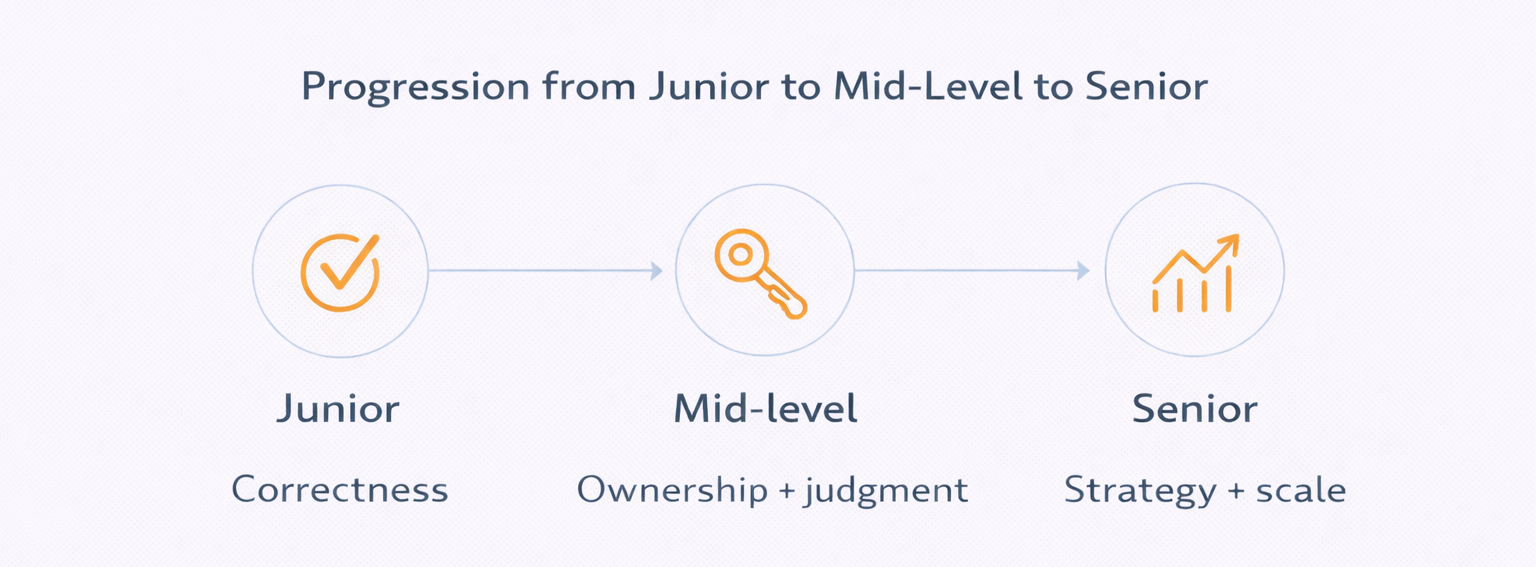
Many candidates misunderstand the gap between mid-level and senior expectations. The core distinction is depth.
Mid-level engineers must demonstrate consistency and competence. Senior engineers must demonstrate leadership and depth of reasoning.
Key differences include:
Scope of reasoning: Mid-level candidates reason about correctness and performance. Senior candidates reason about trade-offs, system behavior, and long-term impact.
Proactive consideration of risks: Mid-level engineers address edge cases when prompted. Senior engineers identify risks before being asked.
System Design responsibility: Mid-level design focuses on components or smaller systems. Senior design addresses end-to-end architectures, scalability strategies, and operational complexity.
Communication leadership: Mid-level candidates communicate clearly. Senior candidates guide and structure the entire conversation.
Incident maturity: Mid-level candidates can explain their role in outages. Senior candidates discuss root causes, mitigations, and cross-functional lessons.
Understanding this distinction helps you avoid overstretching into senior territory while still showing maturity for a mid-level role.
Are Debugging or Maintenance Scenarios Part of the Mid-Level SE Interview?#
Yes. Debugging is a major part of mid-level work, so interviewers frequently include scenarios that test maintenance and troubleshooting capability.
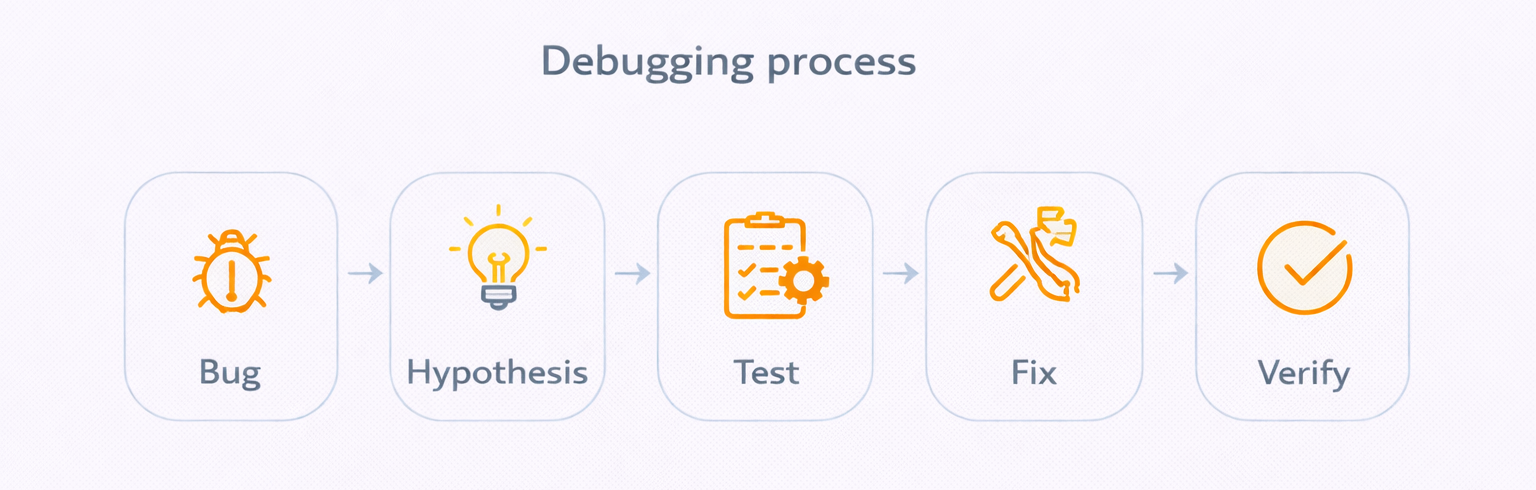
Examples include:
Fixing a broken function
Identifying failure points in an existing code snippet
Improving the readability or correctness of a block of code
Explaining why a system behaves unexpectedly
Talking through logs or test failures
Evaluating edge cases and input validation
Making a code path more robust or maintainable
These tasks test how well you can work in real-world conditions. Mid-level engineers often inherit code, maintain services, and resolve production bugs, so companies want to know that you can diagnose problems with clarity and precision.
How Deep Does System Design Go for Mid-Level Software Engineer Interviews?#
Mid-level System Design interviews focus on foundational design reasoning rather than large-scale distributed systems. Interviewers want to assess whether you understand how components interact, how data flows through a system, and which design choices matter for reliability and performance.
Level | System design focus |
Entry-level | Components and basic data flow |
Mid-level | Trade-offs, scaling awareness, APIs, reliability |
Senior | Distributed systems, failure domains, evolution |
Common expectations include:
Basic architectural structure: You should be able to outline clients, services, databases, and APIs.
Trade-off awareness: Choosing SQL vs NoSQL, caching strategies, or synchronous vs asynchronous calls at a high level.
Component-level reasoning: You might design a rate limiter, a basic analytics pipeline, a CRUD service, or a simplified message queue.
Scalability awareness: Not at a senior level depth, but you should understand concepts like horizontal scaling, caching layers, and read/write patterns.
Operational considerations: Logging, monitoring, error handling, and versioning.
Mid-level candidates are not expected to design globally distributed load balancers, sharded data stores, or multi-region failover strategies. But you should demonstrate that you understand how systems behave beyond the code in a single function.
Do Mid-Level Software Engineer Interviews Include Debugging or Refactoring?#
Yes, and these tasks are becoming increasingly common. Companies want assurance that mid-level engineers can improve existing codebases, not just write new ones.
Refactoring tasks may involve:
Renaming variables for clarity
Extracting helper functions
Simplifying nested logic
Improving performance by reducing redundancy
Consolidating repeated logic
Rewriting code for readability without changing behavior
Optimizing inefficient operations
Debugging tasks may involve:
Reading unfamiliar code
Identifying subtle off-by-one errors
Diagnosing concurrency or state bugs
Tracing the execution flow through logs or tests
These exercises help interviewers evaluate engineering discipline, not just correctness.
How Should I Talk About Incidents or Outages During a Mid-Level SE Interview?#
Mid-level engineers are expected to discuss incidents honestly and constructively, but not at the same depth as senior engineers. Interviewers want to understand your ability to contribute to operational stability, respond to issues, and learn from failures.
When discussing outages or incidents:
Be specific – Show that you understood the root cause and the impact.
Clarify your role – Explain concretely what you did, rather than speaking generally.
Highlight the diagnosis process – Discuss how you approached debugging, what tools you used, and how you reasoned through uncertainty.
Emphasize lessons and improvements – Interviewers want to hear what you learned and what changes occurred afterward.
Avoid blame – Focus on systems and processes, not people.
The goal is to demonstrate reliability, responsibility, and the ability to handle real production scenarios, even if you were not the primary owner.
Final Thoughts#
Mid-Level Software Engineer Interview Questions are designed to assess more than raw coding skills. Companies want engineers who can write maintainable code, reason about systems at a foundational level, collaborate effectively, debug issues, and contribute to production health. By aligning your preparation with mid-level expectations, including coding fundamentals, System Design basics, debugging maturity, and incident awareness, you demonstrate that you are ready to operate independently and transition into more senior responsibilities.
