Node.js Coding Interview Questions
Ace your Node.js interviews by mastering async JavaScript, backend design, performance, and security. This guide shows what interviewers really test, and how to prepare like a production-ready Node.js engineer.
Node.js coding interviews evaluate your ability to build fast, reliable server-side applications by testing a broad mix of asynchronous programming knowledge, backend engineering depth, and practical production experience. Companies assess whether candidates understand how the platform actually behaves under load, not just whether they can write JavaScript syntax.
Key takeaways
Event loop mastery: Interviewers frequently test knowledge of event loop phases, microtask vs. macrotask prioritization, and how blocking code degrades application performance.
Async patterns and concurrency: Candidates are expected to work confidently with callbacks, promises, and async/await while managing error propagation and concurrency limits across I/O-heavy operations.
API design and middleware: Questions cover routing, request validation, authentication, rate-limiting, caching, and how middleware pipelines are structured in frameworks like Express.js or Fastify.
Advanced runtime topics: Senior roles often include questions on the cluster module, worker threads, streams with backpressure handling, and message queue integration for high-throughput workloads.
Security and memory hygiene: Interviews at experienced levels test injection prevention, safe handling of environment variables, V8 heap profiling, and diagnosing memory leaks caused by event listeners or misconfigured closures.
Node.js has become one of the most widely used backend technologies, powering everything from real-time chat systems to high-throughput APIs and microservices.
Because of its event-driven, non-blocking nature, Node.js interviews test a unique combination of JavaScript knowledge, backend engineering strength, asynchronous programming mastery, and practical experience with production systems.
Grokking the Coding Interview Patterns

I created Grokking the Coding Interview because I watched too many talented engineers fail interviews they should have passed. At Microsoft and Meta, I saw firsthand what separated the candidates who succeeded from the ones who didn't. It wasn't how many LeetCode problems they'd solved. It was whether they could look at an unfamiliar problem and know how to approach it the right way. That's what this course teaches. Rather than throwing hundreds of disconnected problems at you, we organize the entire coding interview around 28 fundamental patterns. Each pattern is a reusable strategy. Once you understand two pointers, for example, you can apply them to dozens of problems you've never seen before. The course walks you through each pattern step by step, starting with the intuition behind it, then building through increasingly complex applications. As with every course on Educative, you will practice in a hands-on way with 500+ challenges, 17 mock interviews, and detailed explanations for every solution. The course is available in Python, Java, JavaScript, Go, C++, and C#, so you can prep in the language you'll actually use in your interview. Whether you're preparing for your first FAANG loop or brushing up after a few years away from interviewing, this course will give you a repeatable framework for cracking the coding interview.
This guide breaks down what Node.js coding interviews truly evaluate, the topics most companies focus on, and the advanced areas you should understand if you want to ace your coding interview.
What Do Node.js Coding Interviews Usually Test?#
At its core, a Node.js interview evaluates your ability to build fast, reliable, and maintainable server-side applications using JavaScript. Since Node.js sits at the intersection of backend architecture and asynchronous JavaScript, companies want to assess whether you understand how the platform actually behaves in production.
Interviewers typically evaluate:
Asynchronous programming mastery – Callbacks, promises, async/await, error propagation patterns, concurrency limits, and I/O handling.
API design and backend fundamentals – Routing, request validation, response patterns, middleware processing, authentication, and session handling.
Performance awareness – Throughput, event loop utilization, memory optimization, and load considerations.
Reliability and error handling – Proper try/catch strategies, centralized error handlers, and robustness against crashes.
Real-world patterns – Logging, scaling, configuration management, environment variables, and inter-service communication.
Evaluation Area | What Interviewers Look For | Why It Matters |
Async programming | Promises, async/await, error propagation, concurrency | Core to Node’s non-blocking model |
API design | Clean routes, validation, auth, middleware | Reflects real backend work |
Performance | Event loop health, throughput, and memory use | Node apps fail silently under load |
Reliability | Centralized error handling, crash safety | Production stability |
Real-world patterns | Logging, config, scaling, env vars | Signals production readiness |
Node.js interviews are rarely just about JavaScript syntax. They test whether you can build backend services that behave predictably at scale.
Decode the Coding Interview in Java: Real-World Examples

Preparing for coding interviews has become a daunting task. Trying to solve enough practice questions and remember solutions can feel impossible. Fortunately, the best way to be successful in the coding interview is not to just grind through problems. The best way is to develop the skills to break down a new problem and deploy the right tools to come up with a solution. That’s why in this course, you’ll prepare for coding interviews by tackling real world problems faced by tech companies. When you solve real problems related to real projects (for example, paginating attendees in a Zoom call), not only will you have more fun preparing, but you’ll also have an easier time remembering what you’ve learned. After each project, we’ll also show you what kinds of interview problems you’ll now be able to solve using the techniques you just applied, so that your knowledge is adaptable to new problems. (This course is also available in Rust, C++, C#, Go, Python, Ruby, Elixir, Scala, Swift, Kotlin, and JavaScript.)
What Topics Do Node.js Interview Rounds Usually Cover?#
Topic Category | Examples | Interview Focus |
Core JavaScript | Closures, prototypes, scoping | Language fundamentals |
Async internals | Event loop, microtasks vs macrotasks | Concurrency reasoning |
Frameworks | Express, Nest, Fastify | Practical backend experience |
Databases | MongoDB, SQL, and indexing | Data modeling & efficiency |
Testing | Jest, mocks, integration tests | Code reliability |
Runtime & deployment | Logging, profiling, env config | Production awareness |
Modern Node.js interview rounds typically span both JavaScript patterns and backend engineering concepts. The most common topics include:
Core JavaScript behaviors – Closures, prototypes, this binding, event delegation, hoisting, scoping, and modules.
Async operations – Timers, microtasks vs macrotasks, event loop phases, scheduling, concurrency patterns, and I/O handling.
Framework experience – Express.js is the most commonly tested framework, but questions may also involve Nest.js, Fastify, Koa, or Hapi.
API and service design – CRUD operations, pagination, error handling, authentication, rate-limiting, caching, and versioning.
Database interaction – Working with MongoDB, PostgreSQL, or MySQL; connection pooling; schema design; and indexing basics.
Testing – Unit tests, integration tests, mocking patterns, and testing strategies using Jest, Mocha, or similar libraries.
Deployment and runtime considerations – Environment configuration, logging strategies, monitoring, memory leaks, and performance profiling.
These topics reflect how Node.js engineers actually spend their time in real environments, so interviews are structured around practical skill evaluation rather than theoretical trivia.
Are Questions About npm and Package Management Common in Node.js Interviews?#
Yes. npm and package management in general are fundamental parts of developing applications in Node.js. Interviewers expect you to demonstrate an understanding of:
Dependency versioning: Caret (^), tilde (~), semantic versioning, and version resolution.
Package.json responsibilities: Scripts, dependencies vs devDependencies, engines, and project metadata.
Security principles: Checking for vulnerabilities, dependency audits, and avoiding unmaintained packages.
Global vs. local installs: How npm resolves modules, how the node_modules tree is structured, and when global installs make sense.
Monorepos and workspaces: Some companies will ask about npm workspaces or yarn/pnpm usage, especially in large-scale projects.
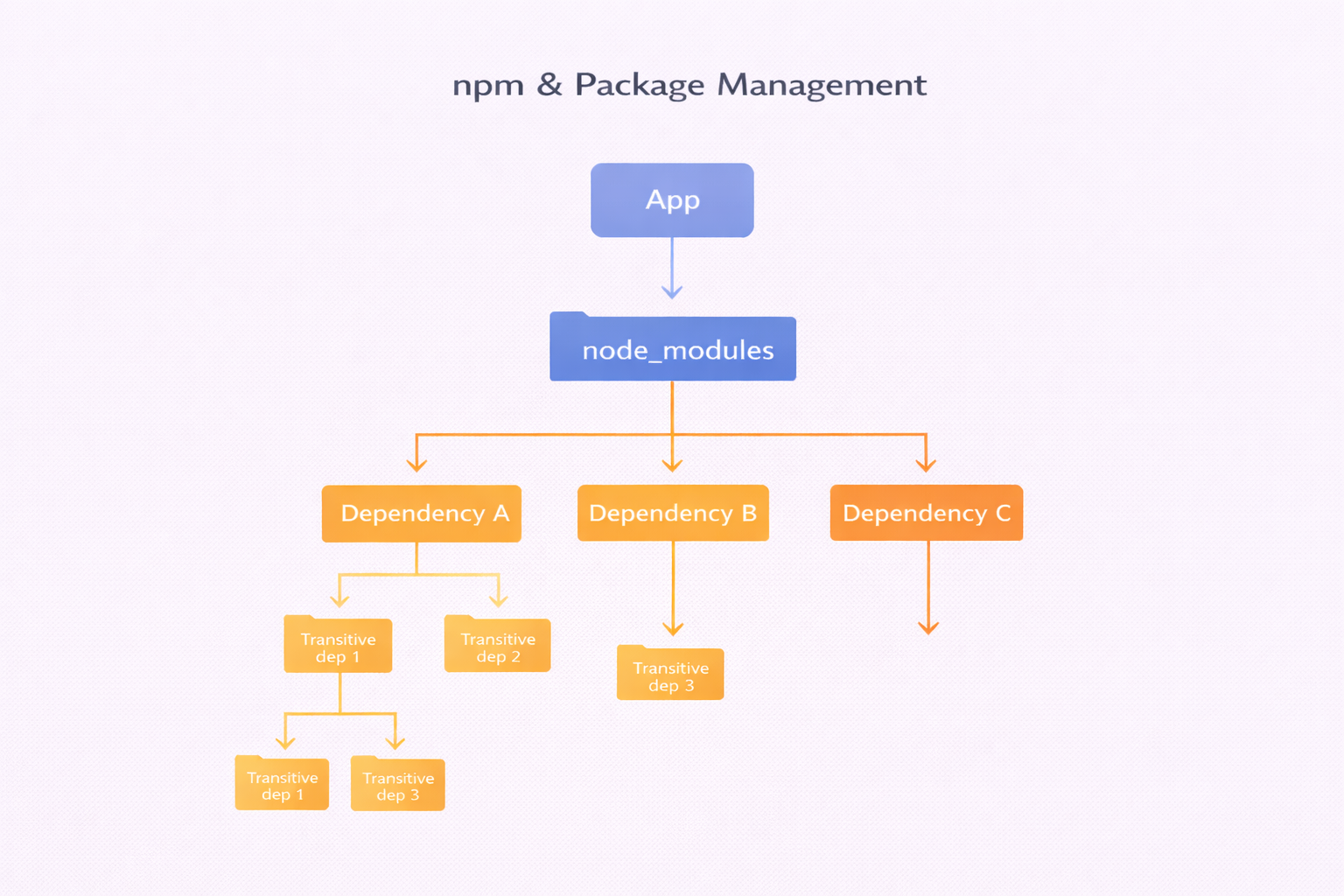
npm questions are common because dependency management mistakes often lead to production issues, security vulnerabilities, or bloated deployments. Strong candidates show awareness of how to use npm responsibly.
Will Advanced Topics Like Clusters or Stream Handling Come Up During Node.js Coding Interviews?#
It depends on the role. For mid-level or backend-heavy roles, advanced Node.js topics often appear in interviews.
Topic | Junior | Mid-level | Senior |
Clustering | Aware | Explains scaling | Designs multi-core strategy |
Streams | Basic usage | Backpressure handling | High-throughput pipelines |
Worker threads | Rare | Conditional use | CPU-heavy architecture |
Queues | Conceptual | Implements jobs | Designs async systems |
Cluster module and scaling: Interviewers may ask how Node.js scales across CPU cores, how clustering works under the hood, and what types of workloads benefit from it.
Streams: Readable, writable, transform streams, piping, buffering, backpressure, file I/O, and stream error handling.
Worker threads: When to use workers, CPU-intensive tasks, and the differences compared to clustering.
Message queues and background processing: Bull, RabbitMQ, Kafka, and Node-based job execution strategies.
Companies rarely expect junior candidates to explain these deeply, but senior engineers are often evaluated on their ability to work with high-throughput or CPU-heavy applications.
If the role mentions performance, distributed systems, microservices, or real-time features, you should expect questions involving streams, workers, and clustering.
Is Memory Usage, Debugging, or Security Ever Part of the Node.js Coding Interview?#
Yes, especially for experienced positions. Node.js applications frequently run into memory leaks, excessive CPU usage, or unhandled exceptions, so companies often want to know whether you can diagnose issues effectively.
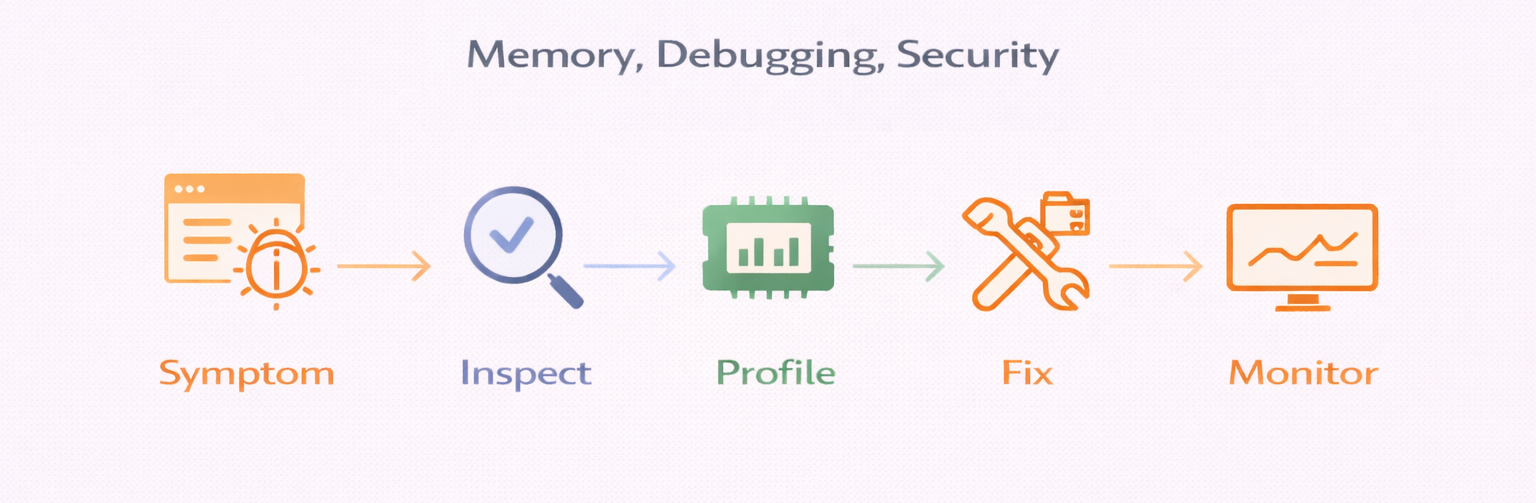
Common areas include:
Memory usage awareness: Understanding the V8 heap, garbage collection, memory profiling, and common causes of leaks, such as event listeners, caching, closures, or misconfigured intervals.
Debugging skills: Using Chrome DevTools, Node’s built-in inspector, logging strategies, breakpoints, and diagnosing async stack traces.
Security considerations: Avoiding insecure patterns such as eval, preventing injection attacks, sanitizing inputs, protecting secrets, and using libraries responsibly.
Node.js applications are often exposed to the public internet, making memory and security skills essential for safe production deployment.
How Does the Node.js Event Loop Actually Work in Interviews?#
The event loop is one of the most important interview topics for Node.js engineers. It demonstrates that you understand how Node handles concurrency, scheduling, and asynchronous operations.
Interviewers may ask you to explain:
Event loop phases: Timers, pending callbacks, idle/prepare, poll, check, and close callbacks.
Macro tasks vs micro tasks: setTimeout, setImmediate, promises, nextTick, and how they are prioritized.
I/O behavior: Why Node.js can handle large numbers of connections efficiently, and how libuv interacts with the OS.
Concurrency limits: The thread pool behavior, the relationship between CPU-bound tasks, and event loop blocking.
Blocking vs non-blocking code: Which operations block the loop, and how can they be avoided to prevent freezing the application?
Understanding the event loop shows that you know how Node.js achieves its performance characteristics and how to write code that does not degrade under load.
What Are Common Node.js Security Interview Questions?#
Security is a major topic in Node.js interviews because backend engineers must ensure user data is protected and applications are robust against common web threats.
Common security questions include:
Preventing injection attacks – SQL injection, command injection, NoSQL injection, and unsafe string concatenation.
Handling authentication securely – Token-based authentication, hashed passwords, cookie security, and session expiration.
Managing environment variables – Using .env files properly, preventing leakage of secrets, and enforcing correct configs across environments.
Avoiding unsafe Node.js features – Dangers of eval, Function(), insecure regex patterns, and tailable logs.
Rate-limiting and throttling – Preventing abuse of public endpoints.
Package vulnerabilities – Working with npm audits and dependency review.
A strong Node.js engineer understands that performance is irrelevant if the application is vulnerable, so many companies emphasize security topics during the interview.
Final Thoughts#
Node.js Coding Interview Questions evaluate much more than JavaScript syntax. Companies want engineers who understand the platform’s asynchronous nature, event-driven architecture, performance behavior, security considerations, and real-world operational challenges. By preparing across the full spectrum of topics, such as asynchronous code, API design, npm usage, streams, clustering, debugging, memory usage, and security, you position yourself as a capable backend engineer ready to build production-grade Node.js services.
