OpenAI Frontend Engineer interview: Guide for 2026
Preparing for the OpenAI Frontend Engineer interview takes more than coding practice. Strengthen your React skills, frontend architecture knowledge, System Design, and product thinking with structured learning and consistent mock interview practice.
Artificial intelligence is changing the way software is built, and frontend engineers are no longer responsible only for creating polished user interfaces. If you are preparing for an OpenAI Frontend Engineer interview, you are entering a hiring process that evaluates your ability to build reliable, accessible, performant, and AI-powered user experiences while collaborating closely with product designers, researchers, and backend engineers.
The OpenAI Frontend Engineer interview examines how you think about building products that millions of people can trust. Interviewers want to understand whether you can design scalable frontend architectures, solve real product problems, communicate technical trade-offs, and create delightful experiences for users interacting with advanced AI models.
This blog explains every stage of the OpenAI Frontend Engineer interview, the skills you should master, common interview questions, preparation strategies, and the mistakes candidates often make. By the end, you will know exactly how to structure your preparation and confidently approach each interview round.
What is the OpenAI Frontend Engineer interview?#
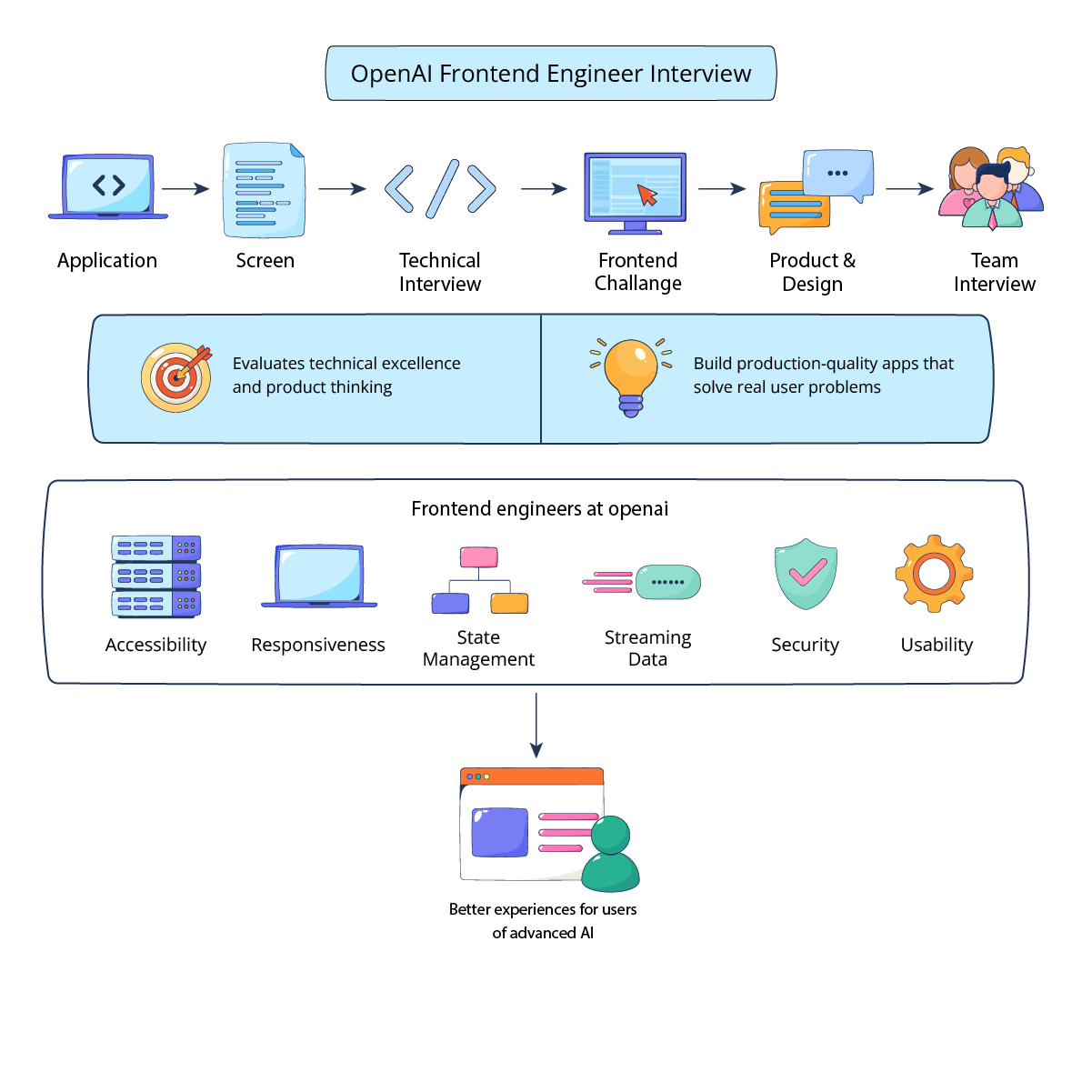
The OpenAI Frontend Engineer interview is a multi-stage hiring process designed to evaluate both technical excellence and product thinking. Rather than testing isolated programming knowledge, the interview measures whether you can build production-quality applications that solve meaningful user problems.
Frontend engineers at OpenAI frequently work on products that expose complex AI capabilities through intuitive interfaces. This means your decisions about accessibility, responsiveness, state management, streaming data, security, and usability directly affect how users experience advanced language models.
Although interview formats evolve over time depending on the role, candidates should generally expect a combination of recruiter conversations, technical coding assessments, frontend architecture discussions, product-focused interviews, and behavioral conversations.
Interview stage | What interviewers evaluate |
Recruiter screen | Background, experience, communication, motivation |
Technical coding interview | JavaScript, TypeScript, React, algorithms, debugging |
Frontend architecture interview | Component design, scalability, performance, maintainability |
Product engineering interview | UX decisions, collaboration, customer thinking |
Behavioral interview | Ownership, teamwork, learning ability, decision-making |
Final interviews | Cross-functional collaboration and overall engineering fit |
What skills are tested during the OpenAI Frontend Engineer interview?#
Preparing for the OpenAI Frontend Engineer interview requires much more than memorizing React APIs. Interviewers usually explore whether you understand how modern frontend applications behave under real production conditions.
Your preparation should cover several technical areas simultaneously because interview questions often blend multiple concepts into a single discussion.
JavaScript and TypeScript#
Modern frontend applications depend heavily on JavaScript fundamentals. Interviewers frequently ask candidates to explain asynchronous programming, closures, prototypes, promises, event loops, generators, and object-oriented concepts before moving into more practical coding exercises.
TypeScript knowledge has become increasingly important because larger applications require better maintainability and safer development practices. You should be comfortable with interfaces, generics, utility types, discriminated unions, and advanced type inference.
React expertise#
React remains one of the most important technologies for frontend engineering roles. Interviewers typically expect candidates to understand not only how React works but also why certain architectural decisions produce better applications.
Expect discussions around:
Functional components
React Hooks
Context API
State management
Server-side rendering
Hydration
Suspense
Streaming UI
Error boundaries
React performance optimization
Rather than asking definitions, interviewers often present a poorly designed application and ask how you would improve it.
React Deep Dive: From Beginner to Advanced

The primary goal of this course is to give you an excellent introduction to React and its ecosystem, tackle advanced features, and teach you as many best practices as possible. Furthermore, this course digs deeper into the most popular, latest, and straight forward ways to use React.
Frontend architecture#
Architecture discussions usually become increasingly open-ended as interviews progress. Instead of asking for a perfect answer, interviewers want to understand how you evaluate trade-offs.
Topics frequently include component organization, folder structure, reusable design systems, API integration, state synchronization, caching, authentication, feature flags, and maintainability over time.
Performance optimization#
AI applications frequently process large datasets, stream responses, and update interfaces continuously. Because of this, frontend performance becomes significantly more important than in traditional web applications.
Interviewers may ask how you would improve:
Bundle size
Rendering performance
Lazy loading
Virtualization
Image optimization
Network requests
Memoization
Code splitting
Streaming updates
Accessibility#
Accessibility is often overlooked by candidates, yet it plays a critical role in high-quality frontend engineering. OpenAI products serve users worldwide, making inclusive design an essential engineering responsibility rather than an optional enhancement.
You should understand semantic HTML, ARIA attributes, keyboard navigation, screen readers, focus management, color contrast, and accessible form design.
Understanding Frontend System Design#
Many candidates prepare only for backend System Design interviews, but frontend architecture discussions have become equally important. During the OpenAI Frontend Engineer interview, you may be asked to design an application from scratch while explaining how different frontend components communicate efficiently.
Interviewers care less about drawing diagrams and more about understanding your reasoning. They want to hear how you balance scalability, maintainability, performance, developer experience, and user experience throughout your design.
Grokking the Frontend System Design Interview

Frontend System Design interviews have become standard for senior frontend and full-stack roles at major tech companies. The expectation is that you can take a broad prompt, “design the frontend for a chat application” or “architect a video streaming interface”, and walk through the full system, including component architecture, state management, API design, performance optimization, and tradeoffs. When I was building production systems at Microsoft and Meta, many of the hardest engineering decisions happened at the frontend layer. Questions like how to manage state across complex UIs, how to keep things responsive under load, and how to structure components so a growing team could work on them without stepping on each other. Those are exactly the kinds of decisions this course prepares you to make and articulate. In this course, you’ll start with foundational concepts, such as browser rendering, CSS positioning, DOM manipulation, state management, and non-functional requirements like performance, accessibility, and localization. From there, the course moves into optimization techniques, API architecture styles, design patterns (component-driven design, micro-frontends), and frontend security. The course’s backbone is the REDCAAP framework. This is a structured approach for breaking down any frontend System Design problem into manageable steps. You’ll apply it to three real-world systems: a newsfeed, a video streaming platform, and a chat application. Each design walks through requirements, architecture decisions, component structure, and performance considerations- all the same progression you'd follow in an actual interview.
Example interview prompt#
Imagine you need to design a ChatGPT-like interface supporting:
Streaming responses
Conversation history
Syntax highlighting
File uploads
Markdown rendering
Mobile responsiveness
Offline support
Rather than immediately discussing React components, begin by understanding product requirements. Then gradually move into architecture, state management, rendering strategy, networking, caching, accessibility, testing, and monitoring.
Coding interview expectations#
Coding interviews usually focus on writing clean, maintainable solutions instead of clever tricks. While algorithm knowledge remains valuable, interviewers often emphasize readable code, communication, and problem-solving.
You may solve problems involving:
Arrays
Strings
Objects
Trees
Graphs
Async programming
DOM manipulation
API requests
UI rendering
State synchronization
During the interview, explain your assumptions before writing code. Thinking aloud helps interviewers understand your decision-making process even if your final implementation is not perfect.
Grokking the Coding Interview Patterns

I created Grokking the Coding Interview because I watched too many talented engineers fail interviews they should have passed. At Microsoft and Meta, I saw firsthand what separated the candidates who succeeded from the ones who didn't. It wasn't how many LeetCode problems they'd solved. It was whether they could look at an unfamiliar problem and know how to approach it the right way. That's what this course teaches. Rather than throwing hundreds of disconnected problems at you, we organize the entire coding interview around 28 fundamental patterns. Each pattern is a reusable strategy. Once you understand two pointers, for example, you can apply them to dozens of problems you've never seen before. The course walks you through each pattern step by step, starting with the intuition behind it, then building through increasingly complex applications. As with every course on Educative, you will practice in a hands-on way with 500+ challenges, 17 mock interviews, and detailed explanations for every solution. The course is available in Python, Java, JavaScript, Go, C++, and C#, so you can prep in the language you'll actually use in your interview. Whether you're preparing for your first FAANG loop or brushing up after a few years away from interviewing, this course will give you a repeatable framework for cracking the coding interview.
React interview questions you should expect#
React discussions generally become conversational instead of quiz-like. Interviewers often begin with a simple problem before gradually increasing complexity through follow-up questions.
Some common topics include:
Explain how React reconciliation works.#
Describe how React compares virtual DOM trees, identifies differences efficiently, and updates only the necessary parts of the interface.
When should you use useMemo?#
Discuss expensive computations, dependency arrays, unnecessary re-renders, and situations where memoization actually hurts performance.
How would you prevent unnecessary component rendering?#
Explain memoization, React.memo, state isolation, context optimization, stable callbacks, and component splitting.
How would you manage global state?#
Compare Context API, Redux, Zustand, Jotai, and server state solutions while discussing their strengths and limitations.
How do you debug memory leaks?#
Explain cleanup functions, event listeners, subscriptions, timers, asynchronous requests, and browser developer tools.
AI-specific frontend questions#
Unlike many technology companies, OpenAI may explore how you think about interfaces powered by language models. These questions evaluate product thinking as much as engineering ability.
Examples include:
How would you display streaming model responses?
How would you handle partial responses?
How would you design conversational history?
How would you reduce hallucination confusion through interface design?
How would you communicate model uncertainty?
How would you manage token usage indicators?
How would you design retry behavior after failed responses?
These discussions demonstrate your understanding of AI products rather than your knowledge of machine learning algorithms.
Behavioral interview preparation#
Behavioral interviews often differentiate strong candidates from excellent ones. Technical ability gets you into the interview process, but collaboration, ownership, and communication determine whether interviewers trust you with complex product development.
Prepare detailed stories covering projects where you improved application performance, resolved production incidents, influenced technical direction, handled disagreements, mentored teammates, or delivered features under challenging deadlines. Every story should emphasize the problem, your specific contribution, the decisions you made, and the measurable outcome.
Instead of memorizing scripted responses, focus on explaining your thinking process. Interviewers appreciate candidates who can honestly discuss mistakes, lessons learned, and how they adapted their approach based on new information.
A practical preparation roadmap#
Many candidates spend weeks solving random coding problems without building a structured study plan. A focused roadmap helps you strengthen the skills most likely to appear during the OpenAI Frontend Engineer interview while avoiding unnecessary topics.
Week | Primary focus | Suggested outcome |
Week 1 | JavaScript and TypeScript fundamentals | Strong language fundamentals and clean coding |
Week 2 | React architecture and Hooks | Confident React problem-solving |
Week 3 | Frontend System Design | Ability to discuss scalable frontend architectures |
Week 4 | Performance, accessibility, testing | Production-ready engineering mindset |
Week 5 | Mock interviews and behavioral practice | Improved communication and interview confidence |
Throughout your preparation, continue building small projects instead of relying only on interview questions. Real applications expose challenges involving state management, rendering performance, asynchronous data, and debugging that isolated coding exercises rarely capture.
Common mistakes candidates make#
Even experienced engineers sometimes struggle because they prepare for generic frontend interviews instead of tailoring their approach to AI product development. Avoiding these common mistakes can significantly improve your performance.
Ignoring product thinking#
Many candidates jump directly into technical implementation without understanding the user's needs. Interviewers value engineers who first clarify requirements before proposing architectural solutions.
Focusing only on React#
React expertise is essential, but it represents only one part of the interview. Strong candidates also understand browser behavior, networking, accessibility, security, testing, performance, and modern frontend architecture.
Overengineering solutions#
Complicated solutions often create unnecessary maintenance challenges. Interviewers generally prefer simple, scalable designs that evolve naturally as product requirements change.
Forgetting communication#
Interview performance depends as much on communication as coding ability. Explain assumptions, discuss alternatives, acknowledge trade-offs, and invite clarification throughout every technical discussion.
Neglecting AI product experience#
Building interfaces for AI applications introduces unique challenges involving streaming responses, latency, uncertainty, user feedback, and conversational workflows. Familiarity with these patterns helps distinguish your preparation from candidates focused only on traditional web applications.
Final thoughts#
Preparing for the OpenAI Frontend Engineer interview requires balancing deep frontend engineering knowledge with product thinking, communication skills, and an understanding of AI-powered user experiences. Candidates who demonstrate clean engineering practices, thoughtful architectural decisions, and empathy for end users consistently stand out during the interview process.
Instead of treating preparation as a checklist of React topics or algorithm problems, focus on becoming the kind of engineer who can design reliable interfaces, collaborate across disciplines, and build products that millions of users can trust. That mindset will not only improve your interview performance but also prepare you for the challenges of working on modern AI applications.