Real-world examples of AI agents in use today
Curious how AI agents actually work in the real world? Discover how modern systems handle support, infrastructure, logistics, and fraud detection, going beyond chatbots to autonomous, decision-making systems used in production today.

Real-world examples of AI agents in use today#
When people ask, Can you give me some real-world examples of AI agents in use today?, they often expect a list of flashy demos or futuristic robots. But the most interesting AI agents aren’t humanoid assistants or cinematic sci-fi systems. They are quiet, task-focused systems embedded inside production workflows, routing tickets, scaling infrastructure, optimizing delivery routes, and triaging medical cases.
To understand real-world examples, we first need clarity on what actually qualifies as an AI agent. Not every script that calls a model is an agent. Not every chatbot is autonomous. In production environments, the distinction between simple automation and true agent-based systems matters operationally and architecturally.
Build AI Agents and Multi-Agent Systems with CrewAI
Building AI agents and multi-agent systems with CrewAI is quickly becoming a core capability for developers working with modern LLM-powered applications. As workflows grow more complex, the shift is no longer about single prompts, but about orchestrating multiple agents that can collaborate, delegate tasks, and operate as coordinated systems. I built this course from my work in adaptive AI and intelligent orchestration, where designing agentic workflows requires structure, coordination, and control. A recurring pattern I observed was that developers could build individual agents, but struggled to scale them into reliable multi-agent systems. CrewAI provides a practical framework for this, and this course is designed to make it actionable. You’ll learn how to build AI agents and multi-agent systems with CrewAI through hands-on workflows, starting with core agent concepts, then progressing into task delegation, hierarchical orchestration, and human-in-the-loop systems. You’ll implement real automation pipelines and explore advanced features like conditional tasks, monitoring, and scalable agent operations. Developers are already using CrewAI to build coordinated AI systems at scale. If you want to move from single agents to fully orchestrated AI workflows, this is where you begin.
This blog explores what makes an AI agent an agent, how they differ from automation pipelines, and how they function today in domains like customer support, DevOps, logistics, healthcare, and finance.
What qualifies as an AI agent?#
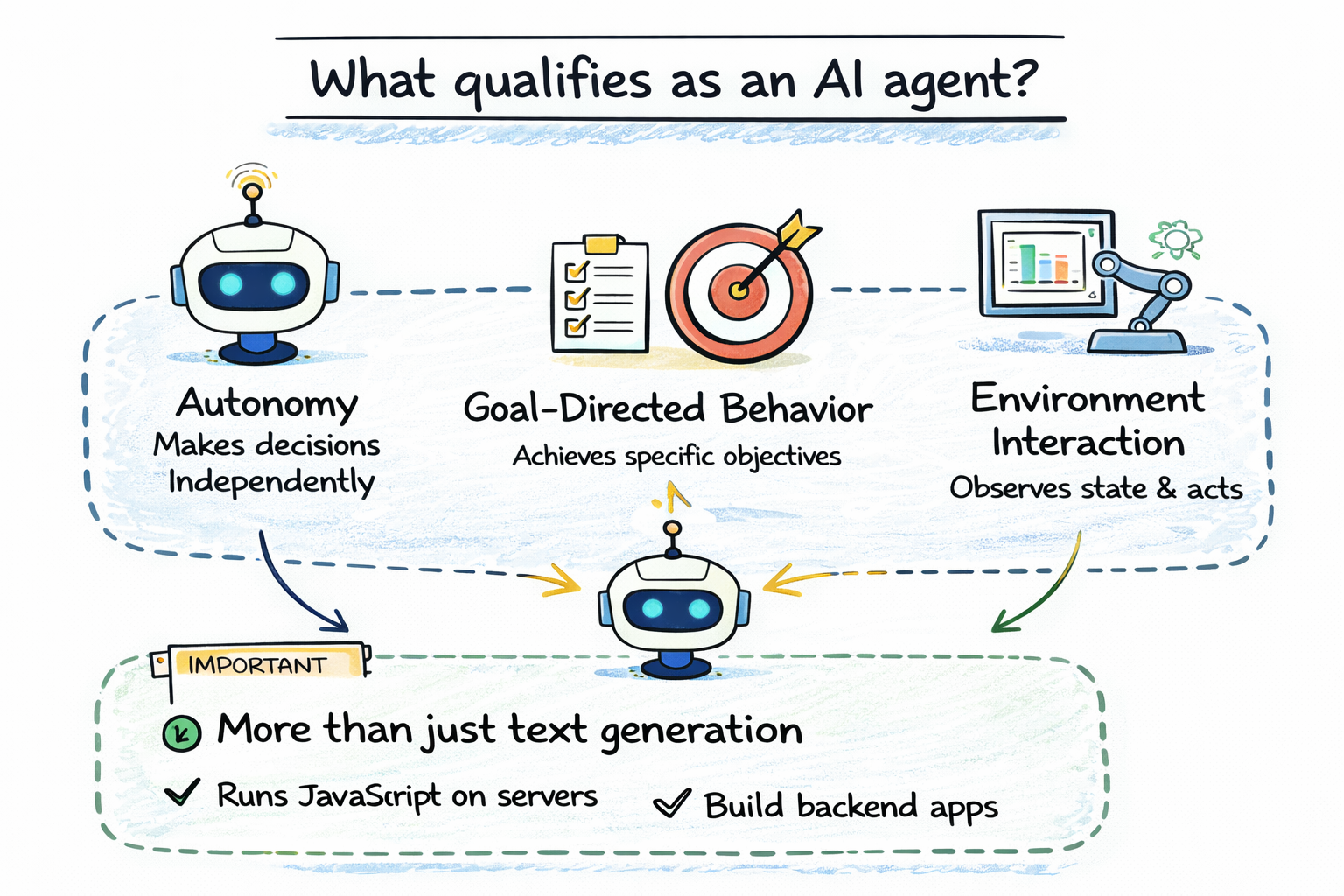
When getting started with AI agents, you should understand that they are typically defined by three characteristics: autonomy, goal-directed behavior, and environment interaction.
Autonomy means the system can make decisions without constant human prompting. Goal-directed behavior means it is oriented toward achieving specific objectives, resolving tickets, maintaining uptime, and optimizing delivery times. Environment interaction means it doesn’t just generate text; it observes the state, takes actions, and updates its strategy based on feedback.
This is where many misconceptions arise.
The main AI agent characteristics are not simply a large language model wrapped in a chat interface. It is a system that observes, decides, acts, and learns within a defined operational environment.
For example, a chatbot that answers a single question based on a prompt is not necessarily an agent. But a system that monitors incoming tickets, classifies them, drafts responses, escalates edge cases, and updates internal CRM systems, that begins to look like agent behavior.
Agent systems usually involve a loop:
Perceive environment state.
Decide next action.
Execute action.
Observe outcome.
Update internal context.
This feedback loop distinguishes agents from static pipelines.
Agentic System Design
Agentic system design is rapidly redefining how modern AI systems are built, moving from single-model interactions to autonomous, multi-step systems that can reason, plan, and act. As large language models evolve, the real challenge is no longer just using them, but orchestrating them into reliable, goal-driven agents that operate safely and effectively in real-world environments. I built this course from my work in adaptive AI and intelligent systems, where designing autonomous behavior requires more than model accuracy. It demands structured reasoning, control, and safety. A recurring pattern I observed was that teams could experiment with LLMs, but struggled to design cohesive agentic systems that could handle ambiguity, coordinate tasks, and remain aligned with user intent. This course is designed to bring that structure. You will study real-world examples, including the Multi-Agent Conversational Recommender System (MACRS), NVIDIA’s Eureka for reward generation, and advanced agents navigating live websites and creating complex images. Drawing on insights from industry deployments and cutting-edge research, you will gain the foundational knowledge to confidently start designing your agent-based systems. Engineers and researchers are already using these patterns to build next-generation AI systems. If you want to design agents that go beyond prompts and into action, this is where to begin.
Automation versus agent-based systems#
Automation systems are rule-based or workflow-driven. They execute predefined sequences. If condition X occurs, run action Y. These systems are predictable and bounded.
Agent-based systems, by contrast, operate under partial uncertainty. They may choose among multiple actions. They often incorporate probabilistic models. They evaluate outcomes and adapt decisions within constraints.
Consider a support automation that sends a canned email when a form is submitted. That is automation. Now consider a support agent that reads a ticket, determines intent, checks knowledge bases, drafts a personalized response, updates internal systems, and decides whether to escalate based on confidence. That is closer to an AI agent.
The difference is not just semantic. It changes monitoring requirements, safety controls, and architecture.
Customer support: AI agents in production#
One of the most mature real-world deployments of AI agents today is in customer support.
In many SaaS companies, AI agents handle first-line triage. These systems ingest support tickets, classify intent, retrieve relevant knowledge base entries, draft responses, and sometimes send replies automatically if confidence thresholds are met.
The agent operates within a constrained environment:
It has access to a CRM.
It can retrieve past conversation history.
It can query internal documentation.
It can escalate tickets to humans.
Autonomy is bounded by guardrails. For example, the agent may only auto-respond if confidence exceeds 90%. Otherwise, it drafts a suggestion for a human agent to review.
Technically, these systems often use a stack involving:
An LLM for reasoning and response generation.
A retrieval layer (vector search or keyword search).
A rules engine for confidence gating.
APIs to CRM and ticketing platforms.
Logging and monitoring systems.
The agent’s value lies in reducing resolution time and offloading repetitive tasks. Its limitation lies in hallucination risk, misclassification, and context drift.
DevOps and infrastructure management#
In DevOps, AI agents are increasingly being used for anomaly detection and remediation.
Consider a production monitoring agent. It ingests metrics from observability systems. When it detects unusual latency spikes, it correlates logs, checks recent deployments, and suggests potential causes. In more advanced setups, it can trigger rollback procedures automatically if predefined thresholds are breached.
This is not simple alerting. Traditional alerting notifies humans. An AI agent might:
Diagnose the likely source of failure.
Recommend or execute mitigation steps.
Update incident documentation.
Notify appropriate on-call engineers.
The autonomy here is carefully constrained. Fully autonomous remediation is rare in critical systems without layered approval mechanisms. But semi-autonomous remediation, where the agent proposes actions, is increasingly common.
The architecture typically includes:
Metrics ingestion (Prometheus, Datadog, etc.).
Event processing pipeline.
LLM or ML model for root cause analysis.
Policy engine for action gating.
Integration with deployment systems (Kubernetes, CI/CD).
The operational risk lies in false positives and incorrect remediation. This is why human oversight remains integral.
Logistics and supply chain optimization#
Logistics provides another concrete example.
AI agents in logistics optimize routing and scheduling in real time. They ingest traffic data, delivery constraints, vehicle capacity, and weather conditions. Based on these variables, they adjust routes dynamically.
Traditional route optimization used static algorithms. Modern AI agents can incorporate probabilistic predictions and continuously update plans based on new inputs.
For example, a delivery optimization agent might:
Monitor live GPS and traffic feeds.
Predict delay risks.
Reroute drivers to minimize cost and time.
Notify customers of updated arrival windows.
The agent interacts continuously with its environment, roads, drivers, and inventory systems. Its objective is measurable: reduce delivery time and fuel cost.
The technical stack here often combines:
Optimization algorithms.
Reinforcement learning components.
Real-time data ingestion pipelines.
APIs for driver communication systems.
These are not conversational agents. They are decision-making systems embedded in operational infrastructure.
Healthcare triage systems#
Healthcare deployments illustrate both promise and risk.
AI triage agents in telehealth platforms can intake patient symptoms, ask clarifying questions, and recommend next steps, self-care, urgent care, or emergency intervention. These systems operate within strict regulatory and safety boundaries.
The agent’s autonomy is constrained by medical guidelines. It cannot prescribe arbitrarily. It must escalate uncertain cases.
The architecture typically involves:
Symptom classification models.
Conversational reasoning models.
Clinical rule databases.
Human-in-the-loop review for high-risk cases.
The limitations are significant. Misclassification can have serious consequences. Therefore, these agents are often assistive rather than fully autonomous.
Financial compliance monitoring#
In finance, AI agents monitor transactions for fraud and compliance violations.
Unlike static rule-based systems, agent-based fraud detection systems adapt to evolving patterns. They analyze transaction sequences, user behavior, and anomaly signals. When suspicious activity is detected, they can freeze accounts, request additional verification, or escalate to human analysts.
These systems balance precision and recall carefully. Over-triggering causes friction. Under-triggering causes financial loss.
The technical backbone includes:
Streaming data pipelines.
Feature extraction systems.
ML models for anomaly detection.
Policy engines for action gating.
Audit logging systems.
In finance, explainability and auditability are critical. Agents must provide traceable reasoning for decisions.
Comparative overview#
To summarize how these deployments differ structurally, consider the following:
Use Case | Agent Type | Core Capability | Deployment Context | Limitation |
Customer Support | Conversational + Retrieval Agent | Ticket triage and response drafting | SaaS platforms | Hallucination risk |
DevOps | Monitoring & Remediation Agent | Root cause analysis and mitigation | Cloud infrastructure | False positives |
Logistics | Optimization Agent | Dynamic route planning | Fleet management systems | Data dependency |
Healthcare | Triage Agent | Symptom assessment and escalation | Telehealth platforms | Safety constraints |
Finance | Compliance Agent | Fraud detection and action gating | Banking systems | Regulatory scrutiny |
These systems operate under different constraints but share agent characteristics: autonomy, goal orientation, and environmental interaction.
A narrative case study: support triage agent#
Consider a mid-sized SaaS company handling 10,000 support tickets per week.
The company deploys an AI triage agent integrated with its ticketing system. When a ticket arrives, the agent classifies its category and retrieves relevant knowledge base entries. It drafts a response and assigns a confidence score.
If confidence exceeds a predefined threshold, the response is sent automatically. If not, the draft is presented to a human support agent for review. All interactions are logged. Feedback from human edits is fed back into evaluation metrics.
Over time, the system handles 60% of tickets autonomously. Human agents focus on edge cases and high-value interactions.
The agent operates within strict boundaries:
It cannot modify billing information.
It cannot issue refunds above a threshold.
It must escalate sensitive topics.
The production stack includes an LLM for drafting, a retrieval system for knowledge lookup, a policy layer for gating actions, and a monitoring system for auditing decisions.
This is not a demo chatbot. It is an operational system integrated into CRM infrastructure with measurable business impact.
Operational risks and constraints#
AI agents in production introduce new risks.
They can hallucinate incorrect actions. They can misinterpret context. They can amplify bias in training data. And because they act autonomously, their errors can propagate quickly.
Mitigation strategies typically include:
Human-in-the-loop gating.
Confidence thresholds.
Strict action boundaries.
Observability and logging.
Regular evaluation and retraining.
Agents must be treated as socio-technical systems, not just models.
Returning to the core question#
So, can you give me some real-world examples of AI agents in use today?
Yes, but they are not theatrical robots. They are support triage systems, DevOps remediation tools, logistics optimizers, healthcare triage assistants, and fraud detection engines. They operate quietly inside infrastructure, driven by autonomy, goal orientation, and feedback loops.
They differ from simple automation because they reason under uncertainty, choose actions dynamically, and adapt within constrained environments.
Understanding these systems requires looking beyond surface-level AI demos and examining architecture, constraints, and operational risk. That perspective is far more informative than a list of impressive product names.