Understanding the Robinhood System Design
Explore how Robinhood handles real-time trading for millions of users. This deep dive covers order routing, risk controls, ledgers, market data, and how the platform stays reliable during volatility.
Robinhood feels radically simple to users. You open the app, see a clean chart, tap “Buy,” and your portfolio updates almost instantly. There are no trading floors, no complicated order tickets, and no visible friction. That simplicity is intentional, and incredibly difficult to achieve.
Behind the scenes, Robinhood System Design tackles one of the hardest problems in software engineering: building a consumer-friendly interface on top of deeply complex, highly regulated financial infrastructure. Robinhood must handle real-time market data, order execution, risk controls, clearing and settlement, compliance, and extreme traffic spikes, often driven by retail investor behavior.
This makes Robinhood a strong System Design interview question. It tests whether you can design systems where latency, correctness, regulatory compliance, and user trust must coexist. In this blog, we’ll walk through how a Robinhood-like system can be designed, focusing on architecture, trade-offs, and operational realities rather than market jargon.
Grokking Modern System Design Interview
For a decade, when developers talked about how to prepare for System Design Interviews, the answer was always Grokking System Design. This is that course — updated for the current tech landscape. As AI handles more of the routine work, engineers at every level are expected to operate with the architectural fluency that used to belong to Staff engineers. That's why System Design Interviews still determine starting level and compensation, and the bar keeps rising. I built this course from my experience building global-scale distributed systems at Microsoft and Meta — and from interviewing hundreds of candidates at both companies. The failure pattern I kept seeing wasn't a lack of technical knowledge. Even strong coders would hit a wall, because System Design Interviews don't test what you can build; they test whether you can reason through an ambiguous problem, communicate ideas clearly, and defend trade-offs in real time (all skills that matter ore than never now in the AI era). RESHADED is the framework I developed to fix that: a repeatable 45-minute roadmap through any open-ended System Design problem. The course covers the distributed systems fundamentals that appear in every interview – databases, caches, load balancers, CDNs, messaging queues, and more – then applies them across 13+ real-world case studies: YouTube, WhatsApp, Uber, Twitter, Google Maps, and modern systems like ChatGPT and AI/ML infrastructure. Then put your knowledge to the test with AI Mock Interviews designed to simulate the real interview experience. Hundreds of thousands of candidates have already used this course to land SWE, TPM, and EM roles at top companies. If you're serious about acing your next System Design Interview, this is the best place to start.
Understanding the Core Problem#
At its core, Robinhood is a retail brokerage platform. It allows individual users to trade stocks, ETFs, options, and crypto with low friction and near-real-time feedback.
Unlike enterprise trading systems built for professionals, Robinhood is optimized for millions of everyday users. That difference fundamentally shapes the system:
Dimension | Robinhood | Professional trading systems |
Primary users | Retail investors | Institutions/traders |
Traffic pattern | Bursty, social-driven | Predictable |
UX tolerance | Very low | Higher |
Risk exposure | High per user | Managed per firm |
Compliance surface | Broad | Narrower |
That means the system must handle:
Massive concurrency during market hours
Bursty traffic driven by social trends or news
Strict financial correctness and regulatory oversight
A user base with little tolerance for confusing behavior
The system must continuously answer critical questions. Is the user allowed to place this trade? Does the account have sufficient buying power? Has this order already been sent, partially filled, or canceled? Can this trade be executed without violating risk limits?
These questions define the heart of Robinhood System Design.
Core Functional Requirements#
To ground the design, we start with what the system must do.
From a user’s perspective, Robinhood must allow users to open accounts, fund them, view market data, place trades, and track portfolios in real time. From an internal perspective, the platform must route orders, manage balances, enforce risk controls, and integrate with clearinghouses.
More concretely, the system must support:
Account creation and identity verification
Funding via bank transfers or instant deposits
Real-time market data display
Order placement, modification, and cancellation
Portfolio and balance updates
What makes this challenging is that user actions are tightly coupled to external financial systems that operate on their own schedules and rules.
System Design Deep Dive: Real-World Distributed Systems

Modern software systems are expected to operate at a massive scale while meeting strict reliability and latency requirements. Whether it’s a feed refresh, a payment request, or a real-time analytics query, users expect systems to respond instantly and consistently. That expectation has raised the bar for engineers today, understanding that System Design isn’t optional. It’s a core skill for building and evaluating production-grade systems. I built this course from my experience working on large-scale distributed systems at Microsoft (Azure) and Meta (Scuba), and from interviewing hundreds of candidates across both companies. The pattern I kept seeing was this: candidates understood individual components, but struggled to combine them into a coherent system. They knew what a cache or load balancer was, but not when or why to use it. This course is designed to bridge that gap. We start with the foundational building blocks of System Design, including databases, caching layers, load balancing, and messaging systems, and focus on how they interact under real-world constraints. From there, we analyze systems built by companies like Google, Facebook, and Amazon, breaking them down to understand the trade-offs behind each design decision. The goal is not just to learn concepts, but to develop the ability to reason through them in practice. This approach has helped a large number of engineers build stronger intuition for System Design and perform better in interviews. If you want to understand how real systems are designed and be able to design them yourself, this course gives you a clear, practical path forward.
Non-Functional Requirements That Shape the System#
Robinhood System Design is heavily shaped by non-functional requirements.
Latency matters because users expect immediate feedback when placing trades. Availability matters because markets operate on strict schedules. But correctness and risk control matter more than speed.
,data-start="3138" data-end="3345">
Requirement | Importance | Notes |
Latency | High | UX-driven |
Availability | High | Market hours |
Correctness | Absolute | No compromise |
Compliance | Mandatory | Auditable |
Predictable failure | Critical | Trust preservation |
Regulatory compliance is a constant constraint. Every order, execution, and balance change must be auditable. The system must enforce trading halts, margin requirements, and pattern day trading rules.
During periods of market volatility, traffic can spike dramatically. The system must degrade predictably rather than failing silently.
High-Level Architecture Overview#
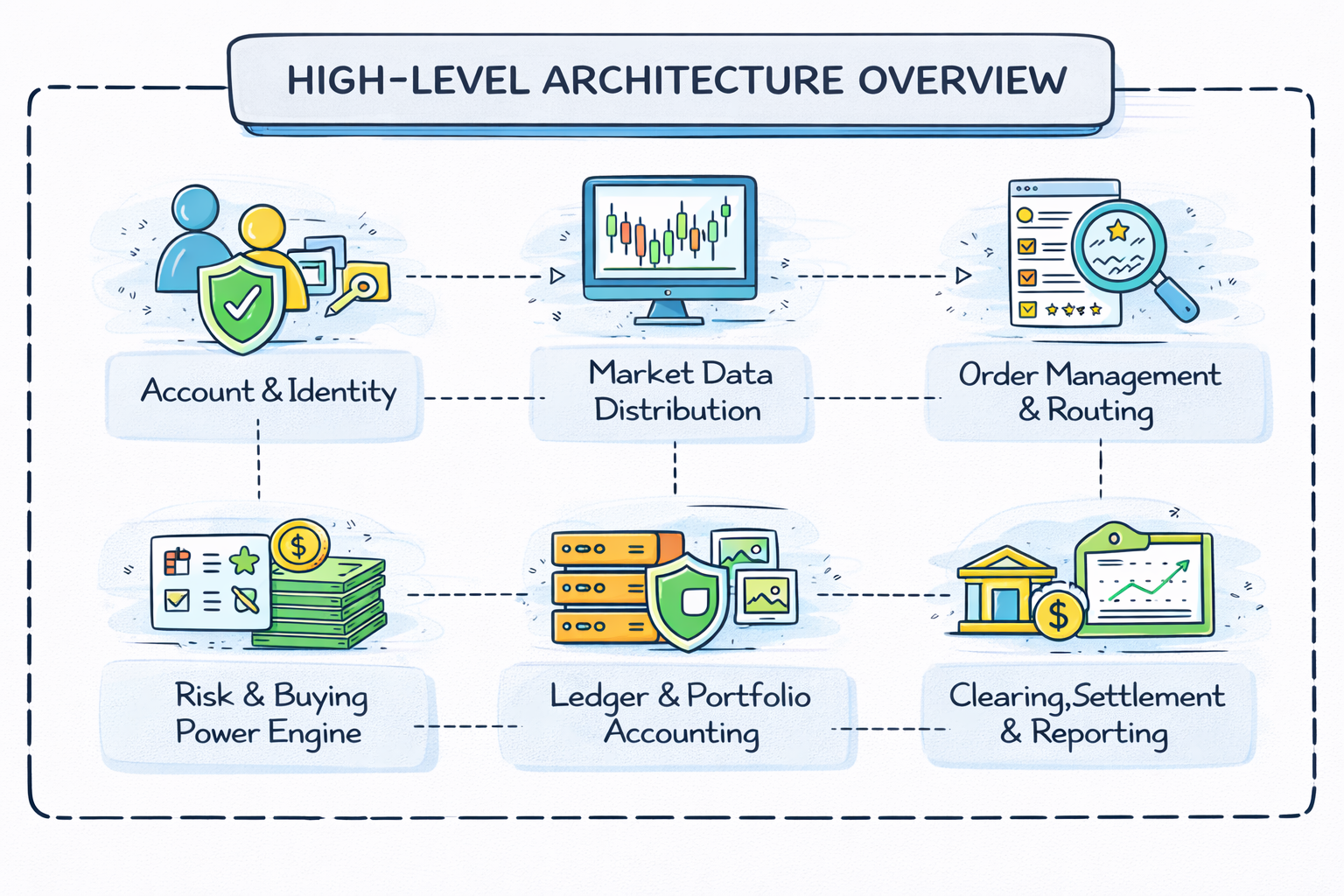
At a high level, Robinhood can be decomposed into several major subsystems:
A user account and identity system
A market data ingestion and distribution layer
An order management and routing system
A risk and buying power engine
A ledger and portfolio accounting system
A clearing, settlement, and reporting layer
Each subsystem has different performance and consistency requirements. Separating them allows Robinhood to prioritize correctness where needed and responsiveness where possible.
Scalability & System Design for Developers

As you progress in your career as a developer, you'll be increasingly expected to think about software architecture. Can you design systems and make trade-offs at scale? Developing that skill is a great way to set yourself apart from the pack. In this Skill Path, you'll cover everything you need to know to design scalable systems for enterprise-level software.
Account Management and Identity#
Everything begins with the user account.
Robinhood must verify user identity through KYC processes before allowing trading. This involves asynchronous checks with third-party providers and internal compliance systems.
Account state directly affects what actions a user can take. A partially verified user may view markets but not trade. A fully verified user may trade but still face limits based on funding status.
This identity state becomes a core input into authorization and risk decisions across the platform.
Market Data Ingestion and Distribution#
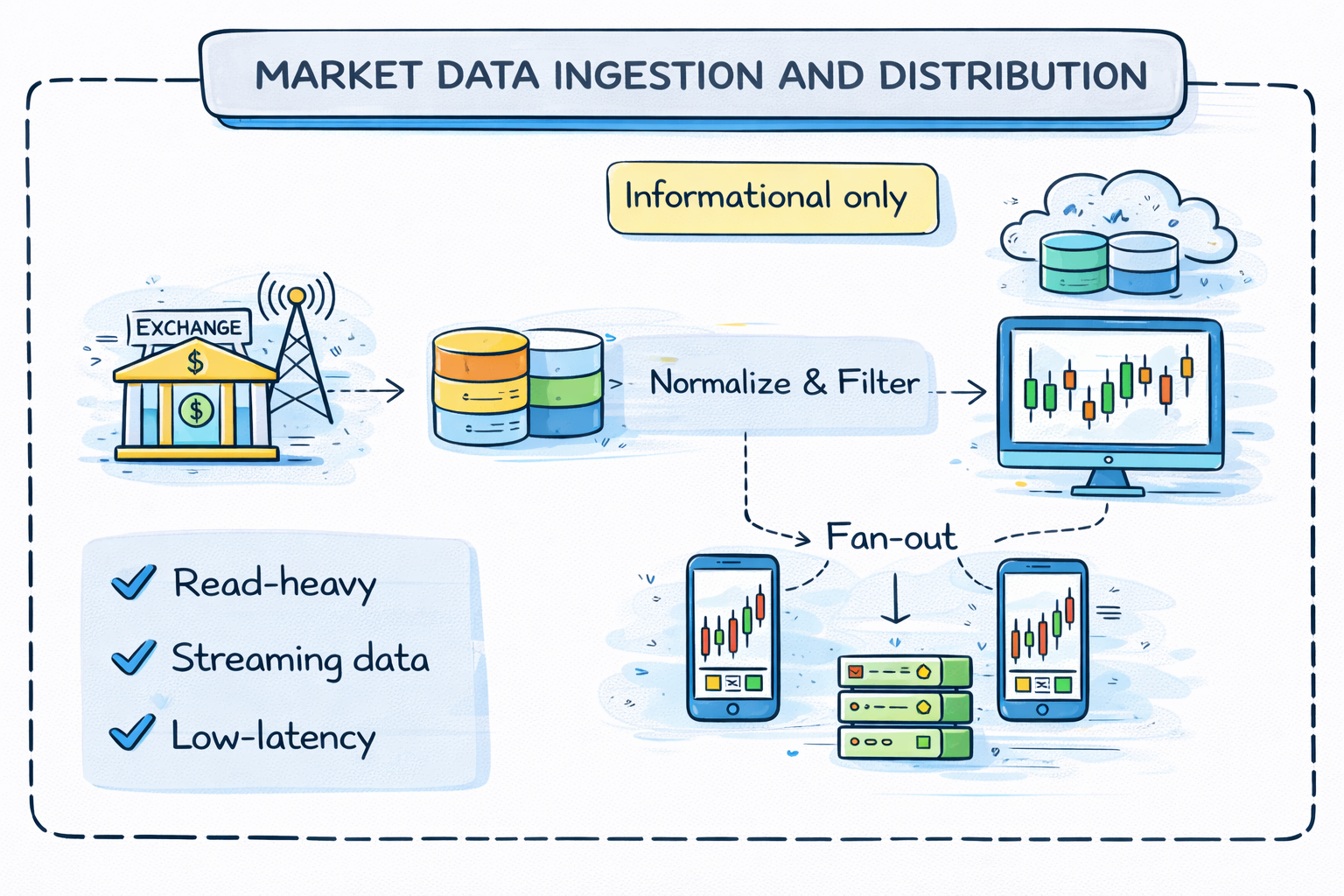
Market data is the most visible part of the system.
Robinhood ingests real-time price feeds from exchanges and market data providers. This data must be normalized, filtered, and distributed to millions of clients with minimal latency.
Because market data is read-heavy and changes rapidly, it is handled separately from transactional systems. The platform often uses in-memory caches, streaming systems, and fan-out mechanisms to distribute updates efficiently.
Importantly, market data is informational, not authoritative. It must be fast, but it does not directly affect account balances.
Order Placement and Validation#
When a user places an order, the system enters a critical path.
The order must be validated against multiple constraints before acceptance:
Validation check | Purpose |
Account authorization | Permission |
Buying power | Financial safety |
Regulatory rules | Compliance |
If validation fails, the order is rejected immediately with a clear explanation. This prevents invalid orders from propagating downstream.
Order Management and Routing#
Once validated, orders flow into the order management system.
This system tracks the lifecycle of every order: submitted, routed, partially filled, filled, canceled, or rejected. Orders are routed to market makers or exchanges based on asset type and routing logic.
Order routing is latency-sensitive, but correctness is critical. Duplicate orders, lost acknowledgments, or out-of-order updates can lead to serious financial discrepancies.
As a result, the system uses idempotent operations, unique order IDs, and durable state storage to maintain consistency.
Buying Power and Risk Controls#
Buying power is one of the most complex aspects of Robinhood System Design.
Input | Used for |
Cash balance | Base funding |
Unsettled trades | Temporary exposure |
Margin rules | Leverage control |
Risk limits | Loss prevention |
Unlike traditional brokers, Robinhood often allows instant access to funds before bank transfers fully settle. This introduces credit risk that must be tightly controlled.
The system continuously calculates buying power based on cash balances, unsettled trades, margin requirements, and risk rules. This calculation must be fast and accurate, because it directly gates user actions.
Risk control needs:
Buying power must be updated in real time
Risk limits must be enforced consistently
Violations must block further trading
This risk engine often acts as a gatekeeper for the entire trading flow.
Portfolio Accounting and Internal Ledger#
The ledger is the source of truth for user assets.
Robinhood maintains an internal accounting system that tracks cash, securities, and unsettled positions. Like other financial platforms, balances are derived from immutable ledger entries, not updated directly.
Every trade, fee, dividend, or adjustment results in ledger entries. This ensures auditability and makes reconciliation possible even after failures.
The ledger prioritizes strong consistency and durability over speed. Other systems read from it but do not modify it directly.
Clearing and Settlement#
Trade execution is not the end of the story.
In traditional markets, trades settle days later through clearinghouses. Robinhood must integrate with these systems to ensure that executed trades are properly settled and recorded.
This process is asynchronous and involves multiple external entities. The system tracks settlement state separately from execution state and reconciles discrepancies over time.
Users see immediate portfolio updates, but the system internally distinguishes between settled and unsettled positions.
Handling Market Volatility and Spikes#
Market volatility is a defining challenge.
During events like earnings announcements or social-media-driven rallies, traffic can spike dramatically. Millions of users may attempt to trade simultaneously.
Robinhood System Design must protect itself under these conditions. Rate limiting, queueing, and temporary restrictions may be applied to preserve system stability and regulatory compliance.
Scenario | Mitigation |
Traffic spikes | Rate limiting |
Liquidity stress | Trade restrictions |
External outages | Queueing |
Regulatory events | Trading halts |
These decisions are difficult but necessary. The system is designed to fail loudly and predictably, not silently or inconsistently.
Notifications and User Feedback#
Communication is critical in trading systems.
Users must be informed when orders are placed, filled, canceled, or rejected. Delays or inconsistencies here erode trust quickly.
Notifications are handled asynchronously and are always driven by authoritative system state. The platform avoids optimistic messages that might later be contradicted by backend reality.
Clear, timely feedback is part of the system’s reliability contract with users.
Security and Fraud Prevention#
Security permeates every layer of Robinhood System Design.
Account access is protected through authentication, device verification, and anomaly detection. Trades and withdrawals are monitored for suspicious patterns.
Fraud detection systems operate continuously in the background, flagging or blocking activity when needed. These systems are decoupled from the trading path to avoid latency but can intervene quickly when required.
Failure Handling and Recovery#
Failures are inevitable in systems of this complexity.
Network partitions, exchange outages, and internal bugs can occur. Robinhood System Design assumes these failures and builds recovery into workflows.
Idempotent operations prevent duplicate processing. A durable state allows replay and reconciliation. Manual intervention tools exist for rare edge cases.
The primary goal is that no failure results in incorrect balances or untracked trades.
Scaling Across Regions and Markets#
Robinhood serves users across regions and asset classes.
Service type | Scope |
Market data | Global |
Compliance | Regional |
Settlement | Market-specific |
Some services are global, such as market data ingestion. Others are region-specific due to regulatory constraints. The system isolates these concerns to avoid global coupling.
This allows Robinhood to adapt to new markets and products without destabilizing the core platform.
Data Integrity and User Trust#
Trust is the foundation of Robinhood.
Users trust that prices are accurate, trades execute fairly, and balances are correct. This trust is earned through conservative design, transparency, and predictable behavior.
Robinhood System Design often sacrifices convenience or features to preserve this trust, especially during high-stress market events.
How Interviewers Evaluate Robinhood System Design#
Interviewers use Robinhood to assess your ability to design consumer-facing financial systems.
They look for strong reasoning around order lifecycle management, risk controls, ledgers, and failure handling. They care less about trading strategies and more about system fundamentals.
Being explicit about trade-offs between latency, availability, and correctness is usually a strong signal.
Final Thoughts#
Robinhood System Design shows how difficult it is to make complex financial systems feel simple.
A strong design emphasizes clear separation of concerns, conservative risk management, immutable ledgers, and graceful degradation under load. If you can clearly explain how a trade flows from tap to execution, and how the system protects itself and users along the way, you demonstrate the system-level judgment required to build real-world trading platforms.
