Salesforce System Design Interview
Ready to ace the Salesforce System Design interview? Master multi-tenant architecture, metadata-driven design, workflow automation, API scalability, and enterprise reliability. Learn to build secure, customizable SaaS platforms at a global scale.
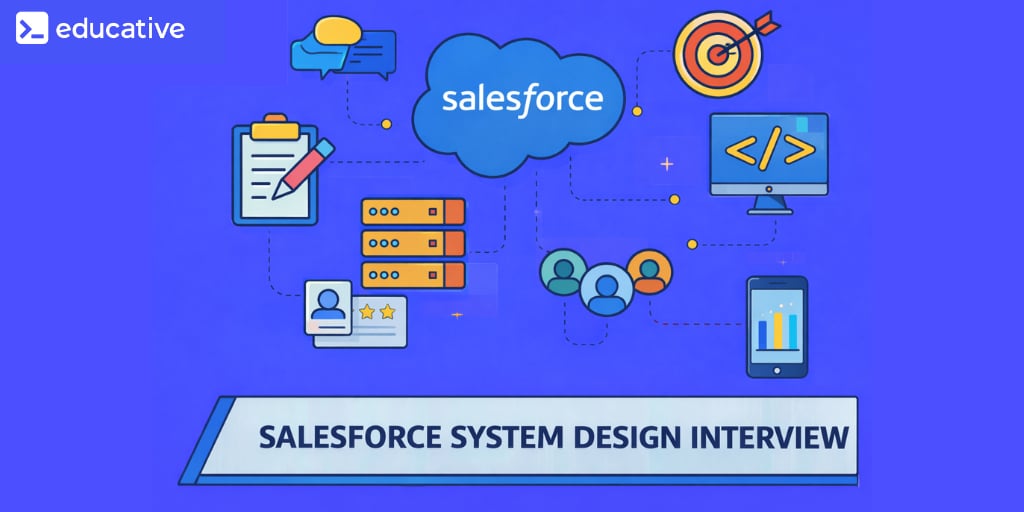
Preparing for the Salesforce System Design interview means understanding how to design one of the most complex categories of software systems in modern engineering: large-scale, multi-tenant, metadata-driven enterprise SaaS platforms.
Salesforce is not a simple CRUD application layered over a database. It is a highly extensible ecosystem that supports CRM workflows, automation engines, analytics, search, integrations, APIs, mobile clients, AI features such as Einstein, and millions of tenant organizations with deep customization capabilities.
Unlike traditional tech interviews that focus on scaling consumer-facing applications, the Salesforce System Design interview questions emphasize multi-tenancy, metadata abstraction, customization frameworks, governance, data integrity, automation orchestration, and enterprise-grade reliability. Salesforce powers mission-critical business processes for some of the world’s largest enterprises. Reliability, correctness, flexibility, and security are not optional. They are foundational.
Grokking Modern System Design Interview
For a decade, when developers talked about how to prepare for System Design Interviews, the answer was always Grokking Modern System Design Interview. This is that course — updated for the current tech landscape. As AI handles more of the routine work, engineers at every level are expected to operate with the architectural fluency that used to belong to Staff engineers. That's why System Design Interviews still determine starting level and compensation, and the bar keeps rising. I built this course from my experience building global-scale distributed systems at Microsoft and Meta — and from interviewing hundreds of candidates at both companies. The failure pattern I kept seeing wasn't a lack of technical knowledge. Even strong coders would hit a wall, because System Design Interviews don't test what you can build; they test whether you can reason through an ambiguous problem, communicate ideas clearly, and defend trade-offs in real time (all skills that matter more than ever now in the AI era). RESHADED is the framework I developed to fix that: a repeatable 45-minute roadmap through any open-ended System Design problem. The course covers the distributed systems fundamentals that appear in every interview – databases, caches, load balancers, CDNs, messaging queues, and more – then applies them across 13+ real-world case studies: YouTube, WhatsApp, Uber, Twitter, Google Maps, and modern systems like ChatGPT and AI/ML infrastructure. Then put your knowledge to the test with AI Mock Interviews designed to simulate the real interview experience. Hundreds of thousands of candidates have already used this course to land SWE, TPM, and EM roles at top companies. If you're serious about acing your next System Design Interview, this is the best place to start.
This blog breaks down what the Salesforce System Design interview evaluates, the types of problems you are likely to encounter, and how to structure a strong, enterprise-grade answer.
Why Salesforce System Design is different#
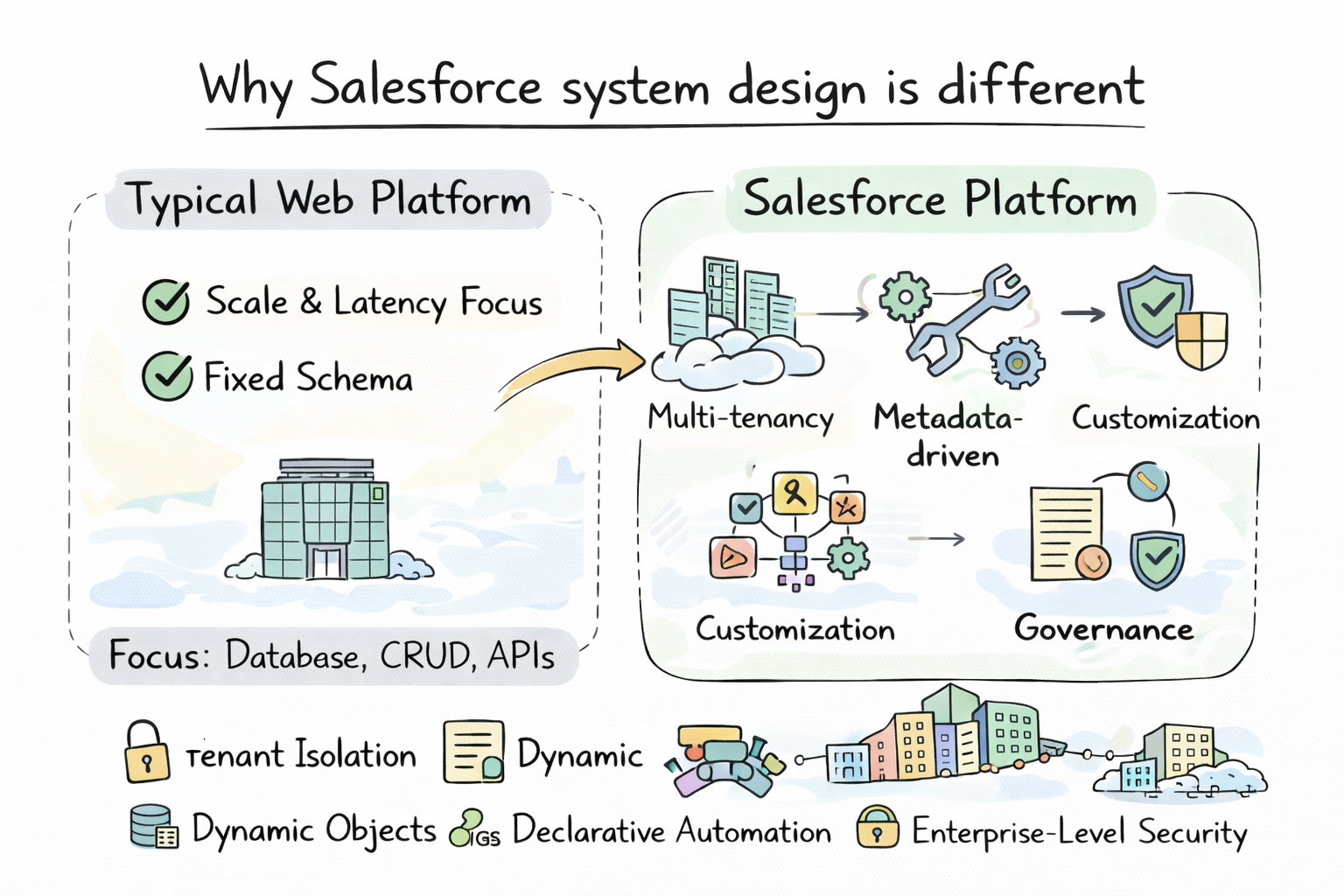
Salesforce’s architecture differs fundamentally from most consumer internet systems. While many web platforms optimize primarily for scale and latency, Salesforce must also optimize for tenant isolation, metadata-driven customization, compliance, and enterprise governance.
Each Salesforce customer, often called an “org,” can define custom objects, fields, workflows, validation rules, and automations. These customizations must execute dynamically without degrading the performance of other tenants sharing the same infrastructure.
The table below illustrates how Salesforce differs from typical web applications.
Dimension | Typical Web Platform | Salesforce Platform |
Tenancy model | Single tenant or lightweight multi-tenant | Massive shared multi-tenant |
Schema | Fixed schema | Dynamic, metadata-driven schema |
Customization | Limited | Deep declarative customization |
Automation | App-level logic | Tenant-defined workflow engines |
Compliance | Basic | Enterprise-grade (SOC, HIPAA, etc.) |
Data sensitivity | Moderate | Mission-critical business data |
Salesforce System Design revolves around enabling flexibility at scale without sacrificing performance or isolation.
Scalability & System Design for Developers
As you progress in your career as a developer, you'll be increasingly expected to think about software architecture. Can you design systems and make trade-offs at scale? Developing that skill is a great way to set yourself apart from the pack. In this Skill Path, you'll cover everything you need to know to design scalable systems for enterprise-level software.
What the Salesforce System Design interview evaluates#
Salesforce interviewers evaluate whether you can build scalable systems that support customization, automation, APIs, search, and analytics in a multi-tenant environment.
The following table summarizes the primary areas of evaluation.
Evaluation Area | What You Must Demonstrate |
Multi-tenancy | Tenant isolation and fairness |
Metadata-driven design | Dynamic schema and runtime configuration |
Workflow automation | Reliable event-driven orchestration |
API scalability | Secure, throttled, global APIs |
Search and analytics | Multi-tenant query performance |
Availability and resilience | Active-active global architecture |
A strong answer demonstrates a deep understanding of these enterprise constraints.
System Design Deep Dive: Real-World Distributed Systems

Modern software systems are expected to operate at a massive scale while meeting strict reliability and latency requirements. Whether it’s a feed refresh, a payment request, or a real-time analytics query, users expect systems to respond instantly and consistently. That expectation has raised the bar for engineers today, understanding that System Design isn’t optional. It’s a core skill for building and evaluating production-grade systems. I built this course from my experience working on large-scale distributed systems at Microsoft (Azure) and Meta (Scuba), and from interviewing hundreds of candidates across both companies. The pattern I kept seeing was this: candidates understood individual components, but struggled to combine them into a coherent system. They knew what a cache or load balancer was, but not when or why to use it. This course is designed to bridge that gap. We start with the foundational building blocks of System Design, including databases, caching layers, load balancing, and messaging systems, and focus on how they interact under real-world constraints. From there, we analyze systems built by companies like Google, Facebook, and Amazon, breaking them down to understand the trade-offs behind each design decision. The goal is not just to learn concepts, but to develop the ability to reason through them in practice. This approach has helped a large number of engineers build stronger intuition for System Design and perform better in interviews. If you want to understand how real systems are designed and be able to design them yourself, this course gives you a clear, practical path forward.
Multi-tenant SaaS architecture#
Multi-tenancy is the central theme in Salesforce System Design. Millions of tenants share infrastructure while expecting logical isolation, predictable performance, and security guarantees.
There are multiple approaches to tenant storage. A shared schema with tenant identifiers provides resource efficiency but requires strict row-level isolation and indexing strategies. Per-tenant schemas offer stronger isolation but introduce operational complexity.
The following table outlines common multi-tenant storage approaches.
Approach | Advantages | Trade-offs |
Shared schema with tenant ID | Efficient resource pooling | Requires strong isolation logic |
Schema-per-tenant | Strong logical separation | Operational complexity |
Hybrid sharded model | Balances performance and isolation | More complex routing |
Interviewers expect you to discuss tenant-aware indexing, throttling mechanisms, and resource fairness.
Metadata-driven architecture#
Salesforce’s most defining architectural feature is metadata-driven design. Tenants can define custom objects, fields, validation rules, page layouts, and automations without modifying core code.
This requires a metadata abstraction layer that stores object definitions separately from data. At runtime, the system evaluates metadata to interpret tenant-specific schemas dynamically.
The table below summarizes metadata responsibilities.
Metadata Component | Function |
Object definitions | Define custom entities |
Field configurations | Define attributes and validation |
Workflow definitions | Specify automation logic |
Access policies | Define tenant-level security |
Layout metadata | Control UI rendering |
A strong candidate explains how metadata is versioned, cached, and evaluated efficiently at runtime.
Workflow automation and orchestration#
Salesforce supports extensive automation through flows, triggers, and rule engines. Workflow automation is often event-driven. A record update may trigger downstream actions such as sending notifications, updating related records, or invoking external APIs.
Designing a workflow engine requires reliable event ingestion, asynchronous processing, state management, and guaranteed execution semantics.
The following table outlines workflow engine components.
Component | Responsibility |
Event router | Routes object changes |
Workflow interpreter | Executes tenant-defined rules |
Async executor | Handles background tasks |
Retry logic | Manages transient failures |
Dead-letter queue | Captures failed workflows |
Reliability and correctness are more important than raw throughput in enterprise automation systems.
API scalability and enterprise integration#
Salesforce exposes APIs used by thousands of enterprise applications. These APIs must support authentication, throttling, tenant isolation, and global distribution.
Rate limiting ensures that no single tenant monopolizes shared infrastructure. OAuth-based authentication enforces secure access. Versioned APIs maintain backward compatibility.
The following table highlights API priorities.
API Concern | Architectural Strategy |
High QPS | Horizontal scaling |
Tenant isolation | Rate limiting and quotas |
Authentication | OAuth / JWT |
Versioning | Backward-compatible endpoints |
Monitoring | Centralized logging |
Interviewers often expect you to reason about API gateways and traffic shaping.
Search, reporting, and analytics#
Salesforce platforms support complex reporting and querying across massive datasets. These queries must remain tenant-aware.
Search systems often rely on full-text indexing engines. Reporting engines may use distributed query execution with materialized views for performance optimization.
The table below summarizes analytics strategies.
Strategy | Purpose |
Materialized views | Speed up repeated queries |
Indexing | Accelerate object search |
Tenant query quotas | Prevent abuse |
Precomputed aggregates | Improve reporting latency |
Multi-tenant reporting is a major architectural challenge because large tenants can generate expensive queries that impact shared resources.
Availability, resilience, and failover#
Salesforce guarantees high availability across global regions. Multi-region active-active architectures allow failover during outages.
Data replication strategies must balance consistency and latency. Background job retries and circuit breakers improve resilience. Observability systems monitor workflow failures and API latency spikes.
A mature answer describes region-level redundancy and automated recovery processes.
Structuring your answer effectively#
A high-scoring Salesforce System Design answer follows a structured progression.
First, clarify requirements. Confirm whether the system must support multi-tenancy, deep customization, reporting, automation, or API exposure. Ask about service-level agreements and data consistency guarantees.
Second, define non-functional requirements. These include high availability, tenant isolation, scalability across millions of orgs, metadata flexibility, and compliance requirements.
Third, estimate scale. Provide realistic assumptions such as millions of tenants, billions of records, tens of millions of workflow events per day, and thousands of API requests per second.
Fourth, present a high-level architecture. A Salesforce-grade architecture includes an API gateway, authentication layer, tenant resolution service, metadata storage service, multi-tenant object store, workflow engine, search and analytics engine, event streaming layer, cache layer, background workers, and multi-region replication.
Deep dive into key components#
Multi-tenant storage#
The storage layer must enforce row-level isolation using tenant identifiers. Tenant-aware indexing ensures efficient lookups. Sharding strategies distribute large tenants across partitions to avoid hotspots.
Metadata service#
The metadata service stores versioned object definitions. Metadata caching reduces runtime evaluation cost. A metadata abstraction layer interprets declarative configurations dynamically.
Workflow engine#
The workflow engine interprets metadata-defined rules, triggers asynchronous actions, and ensures retries with idempotent execution. Versioning supports backward compatibility.
Reporting engine#
The reporting engine uses distributed query planning and materialized views. Tenant-level query limits prevent resource abuse. Indexing strategies optimize full-text search.
Event streaming#
Event streaming enables publish-subscribe patterns for record updates. Durable logs support replay. Per-tenant isolation ensures secure subscription channels.
Handling failures gracefully#
Failure handling is central to enterprise systems.
If a region fails, traffic should fail over to secondary regions. If metadata becomes corrupted, version rollback mechanisms must exist. If workflows hang, dead-letter queues capture failed jobs for reprocessing. If APIs are overloaded, tenant-level throttling protects shared infrastructure.
Enterprise-grade reliability requires layered recovery strategies.
Trade-offs in Salesforce System Design#
Trade-offs demonstrate engineering maturity.
Strict tenant isolation improves security but reduces resource pooling efficiency. Dynamic metadata evaluation increases flexibility but adds runtime overhead. Strong consistency ensures correctness but may increase latency in global deployments. Precomputed analytics improve speed but reduce freshness.
Explicitly articulating these trade-offs strengthens your answer.
Example: Multi-tenant Salesforce-style CRM system#
Consider designing a CRM system supporting millions of tenants.
A request hits the API gateway. The authentication layer resolves the tenant. The metadata service retrieves object definitions. The multi-tenant store fetches records using tenant-aware indexes. The workflow engine triggers automations. The event bus publishes updates. The reporting engine aggregates metrics. Cache invalidation strategies maintain performance. All components replicate across regions for availability.
This design reflects Salesforce’s architectural principles: metadata-driven flexibility, tenant isolation, automation reliability, and global scalability.
Final thoughts on the Salesforce System Design interview#
The Salesforce System Design interview tests your ability to architect multi-tenant, metadata-driven, enterprise-grade SaaS platforms that support customization, automation, analytics, APIs, and global reliability.
Strong answers emphasize tenant isolation, metadata abstraction, reliable workflows, API robustness, search scalability, and graceful failure handling. Simply scaling a database is not enough.
If you structure your response clearly, anchor decisions in enterprise SaaS constraints, dive deep into metadata and automation systems, justify trade-offs thoughtfully, and demonstrate production-level reliability thinking, you will stand out as a candidate capable of building complex, mission-critical SaaS platforms.