Senior Software Engineer System Design Interview Questions
Senior System Design interviews test leadership, judgment, and real-world ownership, not just diagrams. Learn how interviewers evaluate senior candidates, avoid common pitfalls, and present production-ready thinking with confidence.
Senior System Design interviews evaluate far more than technical correctness — hiring panels assess architectural leadership, operational maturity, and the ability to navigate ambiguity the way a production engineer would. Candidates are expected to frame problems, justify trade-offs, and demonstrate ownership over how systems behave long after launch.
Core principles
- Ambiguity handling: Strong candidates ask clarifying questions, surface constraints early, and structure the problem before proposing any solution.
- Trade-off justification: Every architectural choice should be backed by production-level reasoning, not generic answers about why a technology is popular.
- Operational foresight: Designs must account for failure recovery, monitoring, alerting, rollout strategies, and long-term scale evolution, not just initial functionality.
- Collaborative communication: Senior engineers lead the design conversation by inviting alignment, confirming assumptions, and adjusting direction without defensiveness when prompted.
- Incident ownership: Discussing past failures with root-cause clarity, personal accountability, and a focus on systemic prevention signals the maturity hiring panels look for at this level.
Senior System Design interviews represent one of the most important stages in a software engineering hiring process. For senior and staff-level roles, companies expect more than technical accuracy. They expect architectural leadership, communication maturity, incident ownership, and decision-making grounded in real-world production experience.
This guide explains how senior System Design interview questions work, what interviewers truly assess, how the format differs from mid-level interviews, and the specific skills that hiring panels look for when deciding whether a candidate is ready to operate at a senior level.
Grokking Modern System Design Interview

For a decade, when developers talked about how to prepare for System Design Interviews, the answer was always Grokking System Design. This is that course — updated for the current tech landscape. As AI handles more of the routine work, engineers at every level are expected to operate with the architectural fluency that used to belong to Staff engineers. That's why System Design Interviews still determine starting level and compensation, and the bar keeps rising. I built this course from my experience building global-scale distributed systems at Microsoft and Meta — and from interviewing hundreds of candidates at both companies. The failure pattern I kept seeing wasn't a lack of technical knowledge. Even strong coders would hit a wall, because System Design Interviews don't test what you can build; they test whether you can reason through an ambiguous problem, communicate ideas clearly, and defend trade-offs in real time (all skills that matter more than ever now in the AI era). RESHADED is the framework I developed to fix that: a repeatable 45-minute roadmap through any open-ended System Design problem. The course covers the distributed systems fundamentals that appear in every interview – databases, caches, load balancers, CDNs, messaging queues, and more – then applies them across 13+ real-world case studies: YouTube, WhatsApp, Uber, Twitter, Google Maps, and modern systems like ChatGPT and AI/ML infrastructure. Then put your knowledge to the test with AI Mock Interviews designed to simulate the real interview experience. Hundreds of thousands of candidates have already used this course to land SWE, TPM, and EM roles at top companies. If you're serious about acing your next System Design Interview, this is the best place to start.
What Senior System Design Interviews Actually Assess#
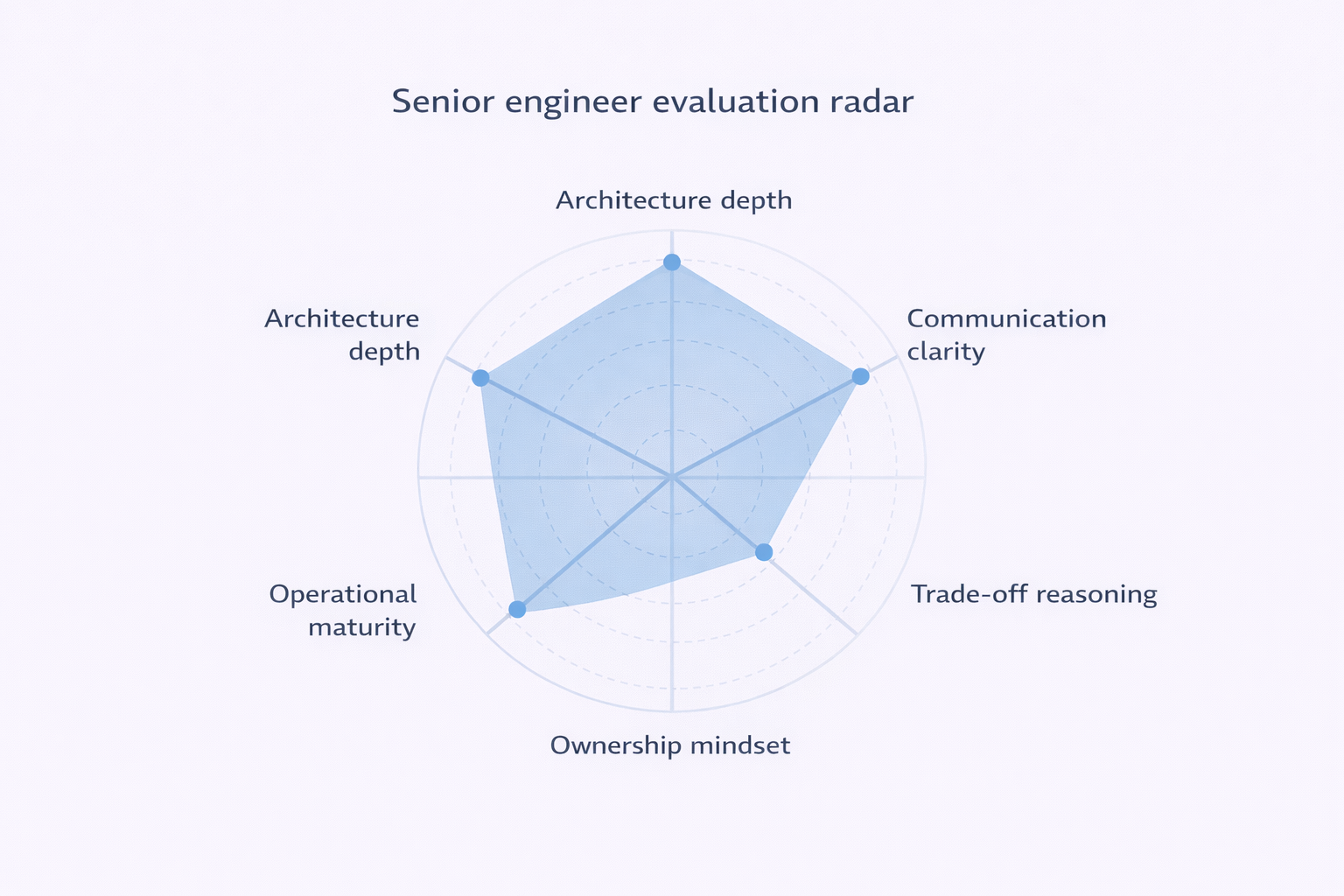
A senior System Design interview examines how you approach ambiguity. Real production systems rarely come with perfectly defined requirements. Interviewers want to see whether you can ask the right clarifying questions, identify constraints early, and structure the problem before diving into solutions. This ability to frame problems is a key leadership signal.
Evaluation area | What interviewers are looking for |
Architectural reasoning | Clear justification of design choices based on constraints, scale, and long-term behavior |
Real-world complexity | Understanding of caching, data modeling, messaging, consistency, and operational cost |
Ownership and foresight | Ability to anticipate failures, rollout risks, monitoring needs, and future scale |
Technical leadership | Structuring the conversation, guiding decisions, and maintaining clarity |
Cross-functional thinking | Awareness of product impact, user experience, and engineering trade-offs |
Interviewers also evaluate how well you understand real-world complexity. Senior engineers are expected to have working intuition around caching strategies, data modeling trade-offs, messaging patterns, and consistency models. More importantly, they expect you to understand the operational cost of each choice. Every database, queue, or microservice introduces ongoing maintenance and failure risks.
Ownership and foresight play a central role. Senior candidates should naturally think about rollout strategies, backward compatibility, monitoring, alerting, and failure recovery. Designing a system that works on paper is not enough. You must demonstrate how the system stays healthy after launch.
Finally, senior System Design interviews test technical leadership. This shows up in how you guide the conversation, summarize decisions, and maintain structure without dominating. Strong candidates create clarity for the interviewer, just as they would for a real engineering team.
Grokking the Frontend System Design Interview

Frontend System Design interviews have become standard for senior frontend and full-stack roles at major tech companies. The expectation is that you can take a broad prompt, “design the frontend for a chat application” or “architect a video streaming interface”, and walk through the full system, including component architecture, state management, API design, performance optimization, and tradeoffs. When I was building production systems at Microsoft and Meta, many of the hardest engineering decisions happened at the frontend layer. Questions like how to manage state across complex UIs, how to keep things responsive under load, and how to structure components so a growing team could work on them without stepping on each other. Those are exactly the kinds of decisions this course prepares you to make and articulate. In this course, you’ll start with foundational concepts, such as browser rendering, CSS positioning, DOM manipulation, state management, and non-functional requirements like performance, accessibility, and localization. From there, the course moves into optimization techniques, API architecture styles, design patterns (component-driven design, micro-frontends), and frontend security. The course’s backbone is the REDCAAP framework. This is a structured approach for breaking down any frontend System Design problem into manageable steps. You’ll apply it to three real-world systems: a newsfeed, a video streaming platform, and a chat application. Each design walks through requirements, architecture decisions, component structure, and performance considerations- all the same progression you'd follow in an actual interview.
Dimension | Mid-level interview | Senior interview |
Primary focus | Correctness and completeness | Judgment, trade-offs, and leadership |
Depth | Component-level explanations | Deep dives into data, scale, and failure modes |
Risk handling | Reacts when prompted | Proactively identifies risks |
Decision-making | Uses standard patterns | Justifies choices with real-world reasoning |
Communication | Answers questions | Structures and leads the discussion |
Failure awareness | Limited | Expected and explicit |
Senior-level interviews evaluate maturity: How do you lead the design conversation? How do you manage ambiguity? How do you navigate trade-offs? Do you identify edge cases without prompting?
Key differences include:
Depth vs. breadth#
Mid-level candidates may outline components. Senior candidates are expected to dive deeper into areas like data partitioning, rate limiting, consistency models, load balancing strategies, failure recovery, and performance tuning.
Proactive risk identification#
Seniors should surface bottlenecks, data risks, and operational challenges before being asked.
Decision justification#
Senior engineers justify trade-offs with production-level reasoning, not generic textbook answers.
Communication leadership#
Seniors structure the conversation, summarize, realign the problem, and bring clarity without being dominating.
Incident awareness#
Senior engineers are evaluated on how they would prevent, detect, and resolve issues.
A strong senior design interview showcases fluency with distributed systems and confidence in navigating ambiguity.
What Formats to Expect for Senior Software Engineer System Design Interviews#
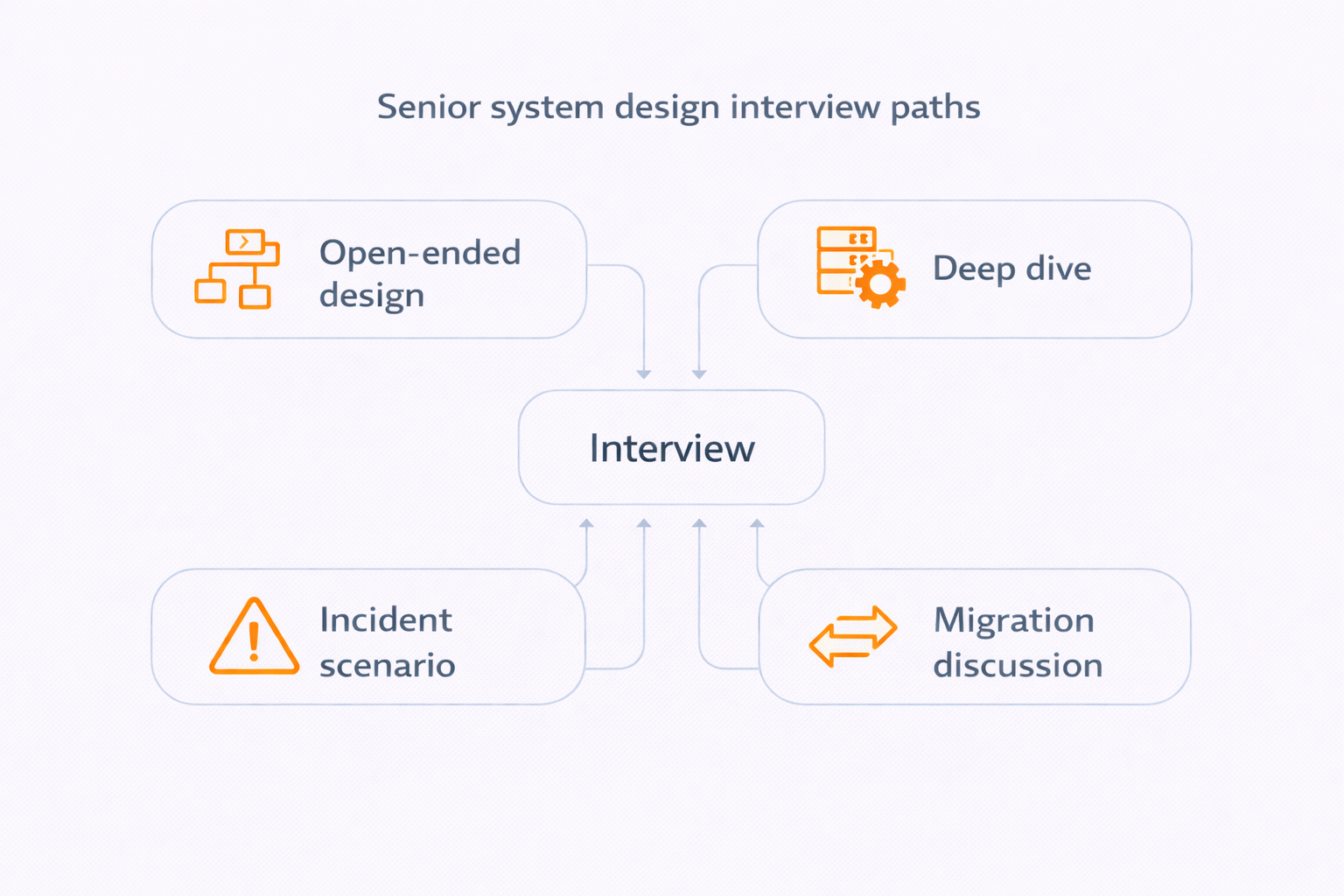
While formats differ across companies, senior System Design interviews typically fall into one or more of these categories:
Open-ended architecture design#
You design a large-scale system such as a messaging platform, a log aggregation pipeline, a search engine, or an event-driven analytics system.
Deep-dive component design#
You zoom in on a smaller but complex subsystem such as a rate limiter, a lock service, a scheduler, or a distributed cache.
Scenario-based or operational design questions#
Examples include handling a sudden traffic spike, managing data corruption, migrating a monolith to microservices, or redesigning a legacy component.
Cross-functional alignment questions#
Interviewers may ask how you would collaborate with product managers, SRE teams, or other engineering groups.
Failure-mode analysis#
You may be asked how you would detect or resolve outages, manage rollbacks, or harden system reliability.
Senior candidates should be prepared for conversations that go beyond architecture diagrams and into system behavior under stress, operational trade-offs, and long-term maintainability.
Which Non-Technical Signals Matter Most in Senior System Design Interviews#
Non-technical signals that influence senior hiring decisions
Signal | How it shows up in the interview |
Structured communication | Clear sequencing, summaries, and alignment checks |
Pragmatism | Avoiding unnecessary complexity |
Leadership without dominance | Driving clarity without bulldozing |
Calm decision-making | Composure under ambiguity or time pressure |
Learning mindset | Acknowledging unknowns and explaining how to resolve them |
Technical strength is essential, but senior engineers are evaluated on non-technical qualities as well.
The most important non-technical signals include:
Structured communication#
Interviewers expect clarity, logical sequencing, and an ability to guide the discussion.
Leadership without dominance#
You should drive the conversation, but not bulldoze it.
Pragmatism#
Senior engineers avoid over-engineering and choose solutions aligned with constraints and business needs.
Collaboration instincts#
Great senior candidates invite alignment, ask clarifying questions, and confirm trade-offs before making decisions.
Calm decision-making#
Senior engineers handle ambiguity, time pressure, and technical uncertainty without becoming reactive.
Learning mindset#
Senior engineers acknowledge unknowns and demonstrate a method for finding answers, rather than pretending to know everything.
Hiring panels pay close attention to how you communicate as much as what you communicate.
How to Talk About Failures or Incidents in a Senior System Design Interview#

Discussing failures is a key part of senior-level interviewing because it reflects your operational maturity. Companies want to know how you respond when systems break, not just when everything is functioning properly.
When discussing incidents, focus on:
Root-cause clarity: Explain what actually failed and why.
Ownership: Take responsibility for your contribution without blaming others.
Diagnosis and mitigation: Describe how you debugged the issue, which tools you used, and what you prioritized.
Long-term prevention: Highlight the steps taken to ensure the issue does not recur, such as architectural improvements, monitoring additions, or process changes.
Trade-offs learned: A mature senior engineer connects incidents to improved judgment and architectural insight.
The goal is not to avoid discussing failures. It is to demonstrate that you understand them deeply and use them to build better systems.
Common Pitfalls to Avoid During Senior System Design Interviews#
Even strong engineers lose points by falling into predictable traps. Avoid these senior-level pitfalls:
Jumping into solutions without clarifying the scope#
Senior interviews expect strong framing and alignment before designing.
Overcomplicating early steps#
Adding sharding, queues, and microservices too early signals poor judgment.
Name-dropping technologies without justification#
Senior engineers explain why they choose a particular database, cache, or pattern.
Ignoring operational realities#
Failing to discuss failure detection, monitoring, alerting, and observability is a red flag.
Not considering scale evolution#
Senior engineers think about how the system will behave over time, not just at initial launch.
Lack of trade-off reasoning#
A senior-level candidate must articulate pros and cons, not present single-path solutions.
Avoiding these common mistakes signals maturity, clarity, and readiness for senior ownership.
How Interviewers Evaluate Collaboration During a Senior System Design Interview#
Collaboration is a key evaluation criterion at the senior level. System Design is inherently cross-functional, and the interviewer wants to know whether you can lead collaborative discussions in real engineering environments.
Interviewers assess collaboration through signals such as:
How you engage with clarifying questions: Do you listen, incorporate feedback, and redirect appropriately?
Whether you invite alignment rather than assume it: Strong senior engineers check that constraints and assumptions match the interviewer’s expectations.
Your ability to communicate trade-offs with diplomacy: Collaboration requires explaining choices in a way that respects different stakeholders.
Responsiveness to hints or prompts: Good collaborators adjust direction without defensiveness.
Your handling of ambiguity and disagreement: Senior engineers navigate differing opinions professionally and logically.
Collaboration is not about being agreeable. It is about driving clarity, alignment, and shared understanding.
Final Thoughts#
Senior Software Engineer System Design interview questions reflect far more than architectural skill. They test your ability to lead design discussions, evaluate trade-offs, manage failures, and collaborate across functions. Strong senior candidates demonstrate a balance of depth, clarity, pragmatism, and ownership. If you can show that you think like someone who designs, scales, and maintains real systems, you will stand out in any hiring process.