The Strava System Design Explained
Designing Strava isn’t about tracking workouts; it’s about building scalable pipelines for real-time GPS data, analytics, and social feeds. Master this system design and show interviewers you can reason about real-world scale.
Strava is often introduced as a fitness tracking application, but that label dramatically understates what the system actually does. At scale, Strava is a distributed real-time data ingestion platform, a time-series analytics engine, and a social network built on top of high-frequency GPS data. Every run, ride, or hike uploaded to Strava represents thousands of data points flowing through a complex backend that must process, store, analyze, and share that information reliably.
This is why the Strava system design has become such a popular System Design interview question. It forces you to think beyond simple CRUD APIs and confront real-world challenges such as continuous data streams, asynchronous processing, massive write throughput, and privacy-sensitive data handling. Interviewers are less interested in whether you can name the “right” technologies and more interested in whether you can reason about scale, trade-offs, and system evolution.
Grokking Modern System Design Interview

For a decade, when developers talked about how to prepare for System Design Interviews, the answer was always Grokking System Design. This is that course — updated for the current tech landscape. As AI handles more of the routine work, engineers at every level are expected to operate with the architectural fluency that used to belong to Staff engineers. That's why System Design Interviews still determine starting level and compensation, and the bar keeps rising. I built this course from my experience building global-scale distributed systems at Microsoft and Meta — and from interviewing hundreds of candidates at both companies. The failure pattern I kept seeing wasn't a lack of technical knowledge. Even strong coders would hit a wall, because System Design Interviews don't test what you can build; they test whether you can reason through an ambiguous problem, communicate ideas clearly, and defend trade-offs in real time (all skills that matter ore than never now in the AI era). RESHADED is the framework I developed to fix that: a repeatable 45-minute roadmap through any open-ended System Design problem. The course covers the distributed systems fundamentals that appear in every interview – databases, caches, load balancers, CDNs, messaging queues, and more – then applies them across 13+ real-world case studies: YouTube, WhatsApp, Uber, Twitter, Google Maps, and modern systems like ChatGPT and AI/ML infrastructure. Then put your knowledge to the test with AI Mock Interviews designed to simulate the real interview experience. Hundreds of thousands of candidates have already used this course to land SWE, TPM, and EM roles at top companies. If you're serious about acing your next System Design Interview, this is the best place to start.
In this guide, we will walk through the design of a Strava-like system step by step. Instead of chasing a fictional perfect architecture, the focus is on explaining why each design decision makes sense and how those decisions align with real production constraints.
Reframing What Strava Really Is#
Before designing any system, it is essential to correctly define the problem. Many candidates make the mistake of thinking about Strava as an application where users upload workouts and view summaries. While that is the visible surface, the underlying system behaves very differently.
At its core, Strava is a data pipeline. It continuously ingests raw sensor data from millions of devices across the world. That data arrives in the form of GPS coordinates, timestamps, elevation readings, heart rate samples, and device metadata. The system must validate this data, store it durably, process it into meaningful metrics, compare it against historical records, and finally distribute the results socially.
This pipeline-oriented view immediately changes the design discussion. The system is no longer just about serving requests. It must handle streams of time-ordered data, tolerate network failures, process information asynchronously, and scale independently across multiple dimensions. This reframing is often the moment when interviewers see whether a candidate understands real-world systems.
Clarifying the Core Requirements#
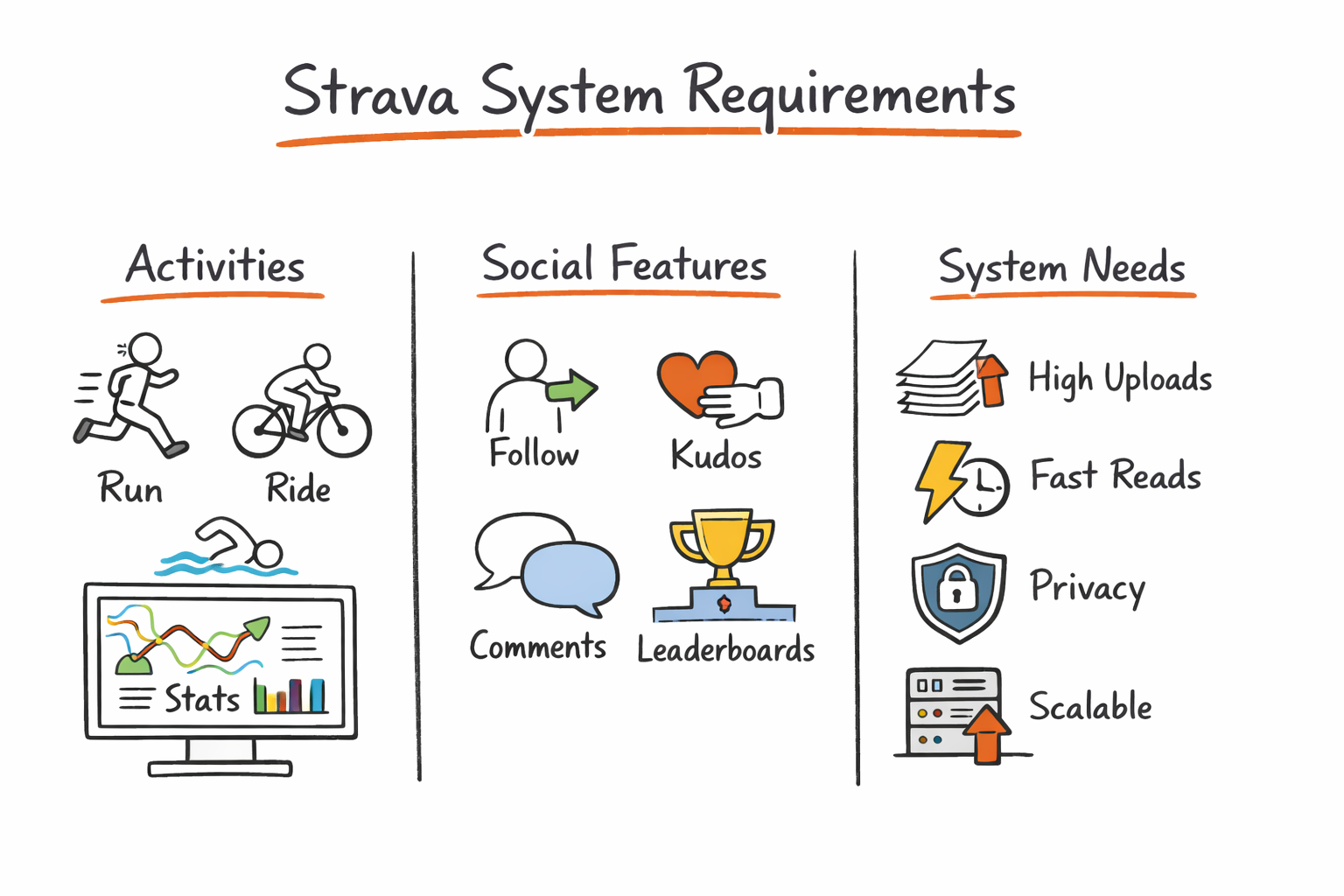
A strong Strava system design begins with clearly articulated requirements. These requirements guide architectural decisions and help prioritize trade-offs when constraints conflict.
From a functional perspective, the system must support user account creation, authentication, and profile management. Users should be able to record activities such as running, cycling, or swimming, and upload those activities to the backend. Once uploaded, activities must be displayed with maps, statistics, and historical comparisons.
On top of this foundation, Strava introduces social functionality. Users can follow other athletes, give kudos, leave comments, participate in challenges, and compete on segment leaderboards. These features transform isolated workouts into shared experiences and significantly increase system complexity.
The non-functional requirements are where the design becomes truly interesting. Activity uploads create extremely high write throughput, often arriving in bursts when users finish workouts around similar times. Read latency must be low for feeds, profiles, and dashboards to feel responsive. Data accuracy is critical because incorrect distances or rankings erode trust. Privacy requirements are strict because location data can expose sensitive personal information. Finally, the system must scale continuously as both the user base and historical data grow year after year.
The table below summarizes how these requirements shape the system design:
Requirement Type | Implication for System Design |
High write volume | Asynchronous ingestion and buffering |
Low read latency | Caching and read-optimized storage |
Accuracy | Deterministic processing pipelines |
Privacy | Fine-grained access control |
Scalability | Horizontally scalable services |
High-Level Architectural Overview#
At scale, a monolithic architecture would struggle to meet Strava’s diverse workload requirements. A more appropriate approach is a loosely coupled, service-oriented architecture that allows different components to scale independently.
Client applications on mobile and web platforms communicate with the backend through an API gateway. This gateway handles authentication, request routing, rate limiting, and basic validation. Behind it, the system is composed of multiple services, each responsible for a specific domain.
One service manages activity ingestion, another handles activity processing and analytics, while separate services manage user profiles, social graphs, feeds, leaderboards, and notifications. This separation is not purely conceptual. It allows the write-heavy ingestion pipeline to scale without being affected by read-heavy workloads such as feeds and profiles.
The architecture also encourages resilience. A slowdown in leaderboard computation should not prevent users from uploading new activities. By isolating responsibilities, the system remains responsive even when individual components are under stress.
System Design Deep Dive: Real-World Distributed Systems

Modern software systems are expected to operate at a massive scale while meeting strict reliability and latency requirements. Whether it’s a feed refresh, a payment request, or a real-time analytics query, users expect systems to respond instantly and consistently. That expectation has raised the bar for engineers today, understanding that System Design isn’t optional. It’s a core skill for building and evaluating production-grade systems. I built this course from my experience working on large-scale distributed systems at Microsoft (Azure) and Meta (Scuba), and from interviewing hundreds of candidates across both companies. The pattern I kept seeing was this: candidates understood individual components, but struggled to combine them into a coherent system. They knew what a cache or load balancer was, but not when or why to use it. This course is designed to bridge that gap. We start with the foundational building blocks of System Design, including databases, caching layers, load balancing, and messaging systems, and focus on how they interact under real-world constraints. From there, we analyze systems built by companies like Google, Facebook, and Amazon, breaking them down to understand the trade-offs behind each design decision. The goal is not just to learn concepts, but to develop the ability to reason through them in practice. This approach has helped a large number of engineers build stronger intuition for System Design and perform better in interviews. If you want to understand how real systems are designed and be able to design them yourself, this course gives you a clear, practical path forward.
Designing the Activity Upload and Ingestion Flow#
The activity upload flow is one of the most critical paths in the Strava system design. When a user finishes a workout, their device uploads a payload containing raw GPS traces and metadata. The user experience expectation is simple: the upload should be fast and reliable.
From a system perspective, this path must prioritize durability over computation. Performing complex calculations synchronously would increase latency and create failure points. Instead, the backend validates the request, stores the raw data safely, and quickly acknowledges the upload.
At this stage, the system hands off the activity to an asynchronous processing pipeline using a message queue. This queue acts as a buffer between ingestion and processing. It smooths traffic spikes, absorbs bursts of uploads, and decouples user-facing latency from backend computation.
This design ensures that even if downstream services are temporarily slow or unavailable, users can still upload activities without frustration. Reliability at this stage is more important than immediate completeness of analytics.
Handling GPS and Time-Series Data at Scale#
GPS data presents unique challenges that differ from traditional relational records. Each activity may contain thousands of ordered points sampled at regular intervals. Querying and storing this data efficiently requires careful consideration.
A common and effective strategy is to separate raw data from derived data. Raw GPS traces and sensor readings are stored in object storage systems optimized for large binary blobs. These systems provide durability and low cost for infrequently accessed data.
Processed metrics such as total distance, duration, elevation gain, average speed, and calories burned are stored in structured databases optimized for fast queries. These metrics are what power feeds, profiles, and dashboards.
This separation has two major benefits. First, it keeps frequently accessed queries lightweight and fast. Second, it allows the system to recompute metrics in the future if algorithms improve, without requiring users to re-upload their activities.
The following table illustrates this separation:
Data Type | Storage Strategy | Access Pattern |
Raw GPS traces | Object storage | Rare, batch access |
Activity metrics | Structured database | Frequent, low-latency |
Aggregated stats | Cache or analytics store | Extremely frequent |
Asynchronous Processing and Insight Generation#
Once an activity enters the processing pipeline, the system begins transforming raw data into meaningful insights. GPS points are analyzed to calculate distance and pace. Elevation data is processed to compute climbs and descents. Sensor data is normalized and validated for anomalies.
This processing is CPU-intensive and highly parallelizable. Worker nodes consume activities from the queue and perform computations independently. Because the pipeline is asynchronous, it does not block the user experience.
Users may see their activity appear almost immediately with basic information, while more advanced analytics and segment results are filled in moments later. This eventual consistency is an intentional trade-off. It prioritizes responsiveness while still delivering accurate results.
In interviews, explicitly acknowledging this trade-off demonstrates an understanding of how large-scale systems balance user experience with computational constraints.
Segment Matching and Leaderboard Computation#
Segments are one of Strava’s defining features, and they introduce a distinct set of challenges. A segment represents a fixed stretch of road or trail. For each activity, the system must determine whether the GPS trace overlaps with any segments closely enough to count as a valid attempt.
At scale, naively comparing every activity against every segment would be computationally infeasible. Instead, systems rely on spatial indexing techniques to narrow the search space. By identifying only the segments geographically relevant to a given activity, the system reduces unnecessary computation.
Leaderboard updates must also be handled carefully. Multiple users may attempt the same segment simultaneously, creating contention for rankings. Most designs accept eventual consistency here. Leaderboards may update with a short delay, but they remain accurate and fair over time.
This approach avoids locking critical paths and keeps the system scalable even as the number of segments and users grows.
Designing the Social Feed#
The social feed transforms individual activities into shared experiences. Designing this feed requires careful thought because it sits at the intersection of scalability, freshness, and cost.
When a user uploads an activity, it may appear in the feeds of hundreds or thousands of followers. One approach is to push updates to follower feeds immediately by writing feed entries for each follower. Another approach is to generate feeds dynamically when users open the app.
In practice, many systems adopt a hybrid strategy. Active users receive precomputed feed entries for fast access, while less active users’ feeds are generated on demand. This balances performance with storage and computation costs.
Caching recent feed items plays a crucial role in reducing latency. Since most users check recent activities far more often than older ones, caching provides significant efficiency gains.
Privacy and Visibility Controls#
Privacy is not an optional feature in the Strava system design. Location data can reveal where users live, work, and train. As a result, privacy controls must be enforced consistently across all system components.
Users may choose to hide the start and end points of activities, restrict visibility to followers, or keep activities completely private. These rules must be applied when generating feeds, rendering maps, computing leaderboards, and serving APIs.
This requires access control logic at multiple layers. It is not sufficient to secure the database alone. Application-level checks must ensure that only authorized users can access specific data. In interviews, thoughtful handling of privacy is often seen as a strong signal of production experience.
Notifications and User Engagement#
Strava maintains engagement through notifications for kudos, comments, challenge milestones, and leaderboard achievements. These notifications are generated by various services and delivered asynchronously.
Decoupling notifications from core services prevents spikes in social activity from affecting critical paths such as activity uploads. It also allows the system to support multiple delivery channels, including push notifications and email, without increasing coupling.
This event-driven approach makes the system more resilient and easier to evolve as new engagement features are added.
Scaling, Reliability, and Failure Handling#
As Strava grows, scaling strategies become essential. Activities and users can be partitioned by user ID to distribute load evenly. Read-heavy and write-heavy workloads are isolated to prevent interference.
Caching is used aggressively for frequently accessed data such as recent activities and profile summaries. Idempotent APIs ensure that retries do not create duplicate activities. Processing pipelines are designed to handle partial failures gracefully, ensuring correctness even when components fail.
Acknowledging these realities in a system design discussion demonstrates maturity and an understanding of how systems behave under real-world conditions.
What Interviewers Look for in Strava System Design#
When interviewers ask about the Strava system design, they are not expecting a perfect or exhaustive blueprint. They want to see how you approach ambiguity, make reasonable assumptions, and evolve your design as new constraints emerge.
Clear communication, structured thinking, and thoughtful trade-offs matter far more than naming specific technologies. Showing that you understand why a design works is more valuable than memorizing architectural patterns.
Final Thoughts#
Strava system design is a powerful interview problem because it mirrors real engineering challenges. It combines continuous data ingestion, asynchronous processing, social features, and privacy concerns into a single coherent system.
If you approach the problem as a journey rather than a checklist, you demonstrate the mindset of a strong system designer. Start with user needs, evolve through architecture, and refine with trade-offs. That is exactly how real production systems are built.