Test-driven development in 2026: What are the pros and cons?
Learn test-driven development (TDD) with real examples and practical insights. Master the red-green-refactor cycle, improve code quality, reduce bugs, and build maintainable software with a hands-on, interview-ready approach.
Test-driven development (TDD) is a software development technique where you write a failing test before writing the production code needed to make it pass. Popularized by Kent Beck through extreme programming, TDD follows a red-green-refactor cycle that builds testing directly into development and aims to reduce defect rates while producing cleaner, more maintainable code.
Key takeaways
Write the test first: TDD flips the typical workflow by requiring a failing test case before any production code is written, ensuring every line of code exists to satisfy a specific requirement.
Red-green-refactor cycle: The process follows five iterative steps where you write a failing test, write the minimum code to pass it, refactor for simplicity, and repeat for each new feature.
Advantages in practice: Teams using TDD commonly report fewer production defects, more flexible and extensible code, and reduced effort in later project phases despite higher upfront costs.
Common pitfalls: Developers may write too many tests at once or neglect test maintenance, and TDD can struggle with large legacy codebases or systems under strict performance constraints.
Related approaches and test strategy: TDD has inspired offshoots like ATDD (focused on acceptance criteria) and BDD (tied to business outcomes), and teams should balance unit, integration, and end-to-end tests using the test pyramid model.
You probably know the importance of software testing if you’ve been a developer for any length of time. Simply put, effective testing catches defects. While testing can’t prevent all bugs, it can help reduce their number.
But exactly how should you go about testing your code? This question has led to a number of methodologies and practices. One popular approach is test-driven development (or TDD). At a basic level, TDD is an approach to testing/software development that involves writing tests before coding.
Today, we’ll cover an overview of TDD and the advantages and disadvantages of using this approach.
Get hands-on with testing today.#
Try one of our 300+ courses and learning paths: Unit Testing Java Applications using JUnit 5.
Test-driven development: An overview#
TDD is related to principles of extreme programming, but it has also gained popularity in different contexts. Extreme programming is a type of agile software development intended to improve software quality and responsiveness to changing requirements. Kent Beck, who developed extreme programming in the late 1990s, says he rediscovered the test-first approach from an old programming manual. He later wrote his own book on TDD: Test-Driven Development: By Example.
To provide a definition, TDD is a technique in which you first write a test case, then develop the smallest portion of code needed to pass that test. This is contrary to typical development models in which feature development precedes test case creation. One notable feature of TDD is that it builds testing directly and prominently into the software development process, ensuring that the smallest portions of code within a piece of software work as expected.
Prerequisites for learning test-driven development#
Before diving deeper into test-driven development, it helps to have a basic understanding of a few core concepts. While TDD itself is not tied to a specific language or framework, your ability to apply it effectively depends on your familiarity with development fundamentals.
You should be comfortable writing basic code in at least one programming language, such as Java, Python, or JavaScript. Since TDD revolves around writing tests, some exposure to testing frameworks like JUnit, pytest, or similar tools will also make the learning process smoother. Even a basic understanding of how assertions work and how tests are executed is enough to get started.
It’s also helpful to have a general understanding of functions, classes, and modular code design. TDD encourages writing small, testable units of code, so familiarity with these concepts will make it easier to follow the workflow.
If you’re new to testing altogether, don’t worry. This guide introduces the core ideas step by step, and you can build deeper expertise as you practice.
The 5 steps of TDD: From test cases to refactoring#
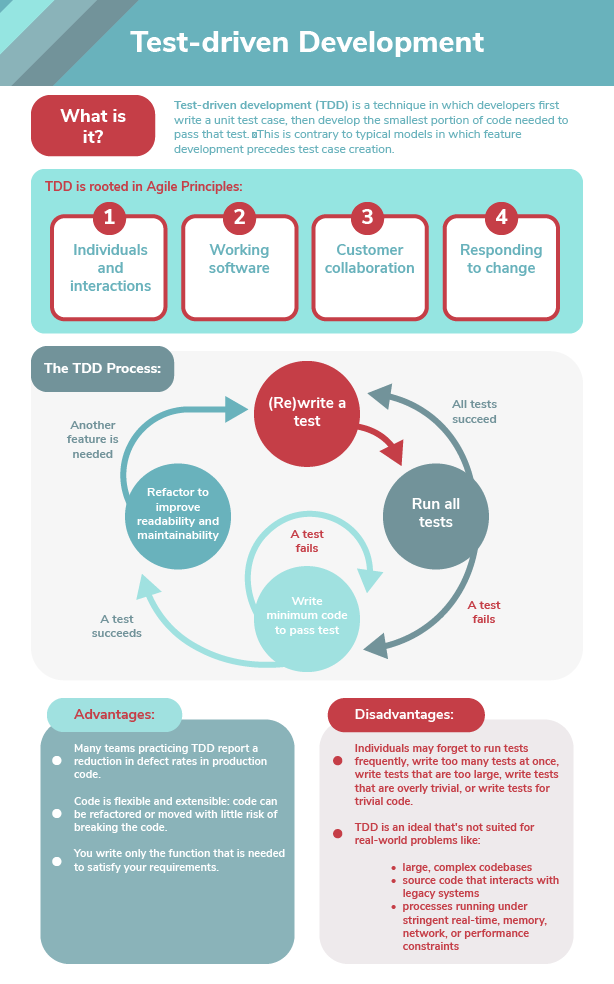
We can view TDD as an iterative cycle with five steps:
A developer writes a test for a new feature based on specifications.
The developer runs all existing tests. The newly created test should fail because the code for its feature hasn’t been written yet. This validates that the test was needed.
The developer writes the simplest code needed to get the test to pass.
The developer refactors the new code to improve the code’s readability and maintainability.
The developer repeats the process, eventually collecting new tests for every intended feature of the code.
Code Example: TDD in Practice (Java/Python)#
A concrete example helps solidify how TDD works end-to-end.
Java Example (JUnit + basic calculator)
Python Example (pytest)
This clearly shows the red → green → refactor flow. You can refer to this section when explaining pros/cons or pitfalls.
Build a simple feature using TDD: a mini-project you can try today#
Reading about test-driven development is useful, but the real understanding comes when you apply it yourself. If you’ve never fully followed the TDD cycle end-to-end, a small hands-on exercise can completely change how you think about writing code.
Let’s walk through a simple mini-project that you can implement in under an hour.
Imagine you’re building a basic “to-do list” feature. The goal is simple: users should be able to add tasks, mark them as complete, and retrieve a list of pending tasks. Instead of jumping straight into implementation, you’ll follow the TDD cycle from the start.
You begin by writing a failing test. For example, you might write a test that verifies whether a new task can be added to the list. At this stage, the functionality doesn’t exist yet, so the test should fail. This is expected; it confirms that your test is meaningful and that you’re driving development through requirements.
Next, you write the smallest possible amount of code needed to make that test pass. You’re not building a full-featured system yet. You’re simply implementing just enough logic to satisfy the test case. This keeps your code focused and avoids unnecessary complexity.
Once the test passes, you refactor the code. This step is often overlooked, but it’s where TDD really shines. You clean up your implementation, improve naming, and remove duplication while ensuring that all tests still pass.
You then repeat the process by adding new tests. For example, you might test marking a task as complete, filtering completed tasks, or handling edge cases like empty inputs. Each new test drives a small, controlled addition to your codebase.
By the end of this exercise, you’ll have a working feature built entirely through TDD. More importantly, you’ll have experienced the discipline of writing tests first, validating behavior, and iterating in small steps. This is exactly the mindset that experienced engineers bring into production systems.
Refactoring and other TDD principles#
Refactoring is a key step in TDD. It involves improving the internal structure of source code while preserving its functionality. Note that in the TDD cycle, refactoring occurs after a test passes. A failing test would require rewriting the code to pass the test. Refactoring shouldn’t be confused with fixing bugs, simply rewriting code, or improving observable aspects of software like the UI.
According to TDD, refactoring should continue until the source code conforms to the simplicity criteria. Developed by Beck, these criteria are intended to determine whether some amount of source code is “simple enough.” These criteria are also known as the rules of simple design and are listed in order of priority:
The source code is verified by automated tests, and all such tests pass.
The code contains no duplication.
The code expresses separately each distinct idea or responsibility.
The code is composed of the minimum number of components (e.g., classes, methods, lines of code) compatible with the first three criteria.
Beck is far from the only person to contribute to TDD conventions. The software engineer Robert C. Martin has distilled the approach further, summarizing his ideas in the three rules of TDD:
“You are not allowed to write any production code unless it is to make a failing unit test pass.”
“You are not allowed to write any more of a unit test than is sufficient to fail,” and failures include both compilation and runtime failures.
“You are not allowed to write any more production code than is sufficient to pass the one failing unit test.”
These rules are designed to ensure all production code is written in response to test cases. It seems simple enough, but TDD has critics as well as supporters. Next, we’ll look at the advantages and disadvantages of the test-first approach.
TDD advantages#
If the point of software testing is to reduce bugs, TDD should be good at this, right? According to the Agile Alliance, a nonprofit focused on the Agile Manifesto for Software Development, many teams practicing TDD do report a reduction in defect rates in production code. Of course, this reduction comes with some overhead costs for the initial development effort. But these same teams say the overhead costs are offset by reduced effort in the final phases of projects.
In addition, veterans of TDD say the emphasis on refactoring leads to better design quality in source code and a higher degree of internal or technical quality. That said, empirical research hasn’t backed up this claim.
IBM identifies other advantages of TDD:
Because the resulting code is robust, TDD can enable faster innovation and continuous delivery.
Code is flexible and extensible. This means code can be refactored or moved with little risk of breaking the code.
Tests themselves are tested, with developers verifying that each new test fails as part of the TDD process.
The resulting code is easy to test.
There’s little to no wasted effort because you only write code for the feature needed to satisfy your requirements.
IBM has also shared a TDD anecdote on its website about an experiment one of its development teams conducted. Some of the team members used TDD, while the rest wrote their tests after completing their code. When the developers in the second group were done with their code, they were surprised to see that the TDD coders had finished earlier and had what they considered more robust code. It’s just one example, but it certainly seems to support the benefits of TDD.
TDD disadvantages#
The test-first approach doesn’t work for everybody. The Agile Alliance identifies some common pitfalls.
Individuals may:
Forget to run tests frequently
Write too many tests at once
Write tests that are too large
Write tests that are overly trivial
Write tests for trivial code
Teams may:
Use TDD inconsistently
Fail to maintain suites of tests, leading to overly long run times
Abandon TDD test suites due to overly long run times or team turnover
These pitfalls may be more the result of not following TDD best practices rather than flaws in the approach. But search the web and you’ll find other criticisms of TDD. One is that TDD can lead to disregarding large- or medium-scale design because software design is so focused on the feature level.
In addition, detractors often say that TDD is an ideal that’s not suited for real-world problems in software development. These problems might include:
Large, complex codebases
Code that must interact with legacy systems
Processes running under stringent real-time, memory, network, or performance constraints
Test Doubles & Isolation: Mocks, Stubs, Fakes, Spies#
One of the real challenges in test-driven development is isolating units from dependencies (databases, HTTP, file I/O). That’s where test doubles come in:
Stub: returns canned responses; used for read-only dependencies.
Mock: records interactions (calls, counts), used to assert how a dependency is used.
Fake: simplified, working implementation (e.g., in-memory DB).
Spy: wraps a real object but spies on calls (records, intercepts).
Use test doubles judiciously:
Avoid over-mocking (brittle tests).
Prefer fakes or in-memory replacements for simplicity.
Mock only the behavior you observe, not the internal implementation.
Mention this in your disadvantages section to show you understand the complexity around writing good tests with TDD.
Get hands-on with unit testing today.#
Try one of our 300+ courses and learning paths: Unit Testing Java Applications using JUnit 5.
Related development approaches#
While popular in its own right, test-driven development has inspired offshoots that aim to further improve upon the software development process. We’ll look at two of these.
Acceptance test-driven development (ATDD)#
ATDD is analogous to TDD, but with a focus on the acceptance testing process. Acceptance tests are formal descriptions of how finished software products should behave. These usually take the form of examples or usage scenarios. In ATDD, team members involved in acceptance testing represent three stakeholders: customers, developers, and testers.
One benefit of ATDD is that acceptance tests represent the end user’s point of view. Additionally, ATDD tests serve as clear requirements that describe how programs will function. And they also ensure that programs function as expected.
Behavior-driven development (BDD)#
BDD combines and refines practices of TDD and ATDD, with a focus on making sure products serve business objectives. This approach scrutinizes proposed user stories to ensure that a test’s purpose is clearly related to business outcomes.
BDD may offer several benefits. It can minimize waste by implementing only the product behaviors that contribute to desired business outcomes. Additionally, BDD describes behaviors in a single notation accessible to domain experts, developers, and testers, and this simplification can improve communication. BDD also offers more guidance than TDD on organizing communication between domain experts, developers, and testers.
One caveat for BDD: it’s considered best for teams already using TDD or ATDD because it requires familiarity with a wider range of concepts.
Test Pyramid & Test Maintenance Strategies#
Writing many unit tests is good, but you need to balance. Use the Test Pyramid model:
Unit tests (bottom): fast, many, isolated.
Service/integration tests (middle): involve multiple components (DB, backend).
End-to-end/UI tests (top): slowest, fewest, but validate system flows.
Best practices for test maintenance:
Keep tests fast: long-running tests kill momentum.
Avoid highly brittle tests (flaky assertions, timing dependencies).
Organize test suite: group by module, mirror code structure.
Refactor tests too: remove duplication, use helper methods.
Coverage as guidance, not goal: 100% coverage isn’t necessary; focus on critical paths.
When someone interviews you on “test-driven development,” mentioning the test pyramid shows depth beyond naive unit tests.
Frequently asked questions about test-driven development#
What is test-driven development in simple terms?#
Test-driven development is a software development approach where you write tests before writing the actual code. The idea is to define expected behavior first, then implement the smallest amount of code needed to make the test pass. This process helps ensure that your code is correct, maintainable, and aligned with requirements from the start.
Is test-driven development used in real-world projects?#
Yes, many engineering teams use TDD in real-world projects, especially in environments that prioritize code quality and maintainability. While not every team follows TDD strictly, its principles, such as writing testable code and validating behavior early, are widely adopted in modern development practices.
Does test-driven development slow down development?#
At first, TDD can feel slower because you are writing tests before implementing features. However, over time, it often speeds up development by reducing debugging effort, minimizing defects, and making code easier to maintain. Many teams find that the initial overhead is offset by fewer issues later in the development cycle.
What are the main benefits of test-driven development?#
TDD helps improve code quality, reduces bugs, and encourages better design. It also makes refactoring safer because tests act as a safety net. Additionally, it promotes writing smaller, more focused functions, which improves readability and maintainability.
What is the difference between TDD and traditional testing?#
In traditional development, code is written first, and tests are added later. In TDD, the process is reversed. Tests are written before the code, and development is driven by making those tests pass. This shift in approach leads to more intentional design and better test coverage.
Can beginners learn test-driven development easily?#
Yes, beginners can learn TDD, especially if they already have a basic understanding of programming. Starting with simple examples and gradually applying TDD to small projects is an effective way to build confidence and develop good testing habits.
Wrapping up and next steps#
At this point, you should feel comfortable with the principles of test-driven development, its advantages, and its disadvantages. Where you go from here likely depends on your role. If you’re an individual contributor, you may find implementing TDD difficult without support from your team or organization. If you’re an engineering leader, you may be in a better position to put TDD into practice if you find it compelling.
Wherever you land on TDD, it’s important to ensure you incorporate robust testing into your development practices. Whether it’s unit testing or regression testing, it will help make sure your code functions properly, meets specifications, and doesn’t introduce defects at the production level. If you decide to try TDD, it certainly offers advantages, and to do it well, it helps to master writing tests.
If you work with Java and want to improve your unit testing skills, you might consider learning JUnit. To help you master this topic, we have developed the course Unit Testing Java Applications Using JUnit 5. It covers the fundamentals of unit testing and JUnit 5, as well as core concepts like assertions and assumptions, and advanced concepts of the JUnit framework.
Happy learning!