What is a Kafka Cluster?
Struggling to understand Kafka clusters? This guide breaks down how they work, why they matter, and how they power real-time systems. If you're building scalable data pipelines or preparing for system design, this is a must-read.
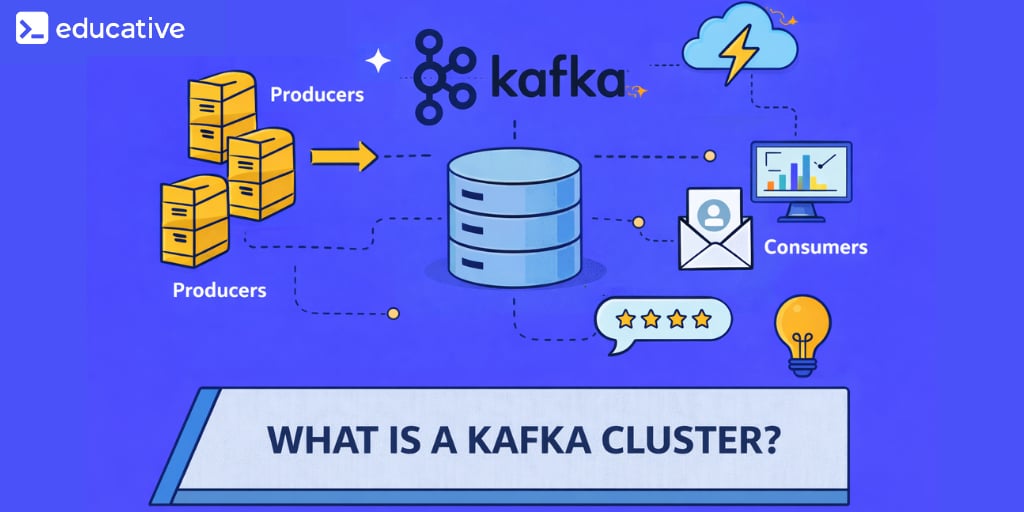
Modern applications generate enormous volumes of data from user interactions, backend services, IoT devices, logs, and analytics pipelines. As systems grow in scale, traditional messaging solutions often struggle to process data reliably and efficiently. Because of this challenge, many developers and data engineers begin exploring distributed messaging systems and eventually ask what is a Kafka cluster when learning about event-driven architectures.
Apache Kafka has become one of the most widely used platforms for building real-time data pipelines and event-driven systems. It allows services to communicate through streams of events rather than tightly coupled APIs. This design helps large systems process high-throughput data while maintaining reliability and scalability.
Building Scalable Data Pipelines with Kafka

If you’re interested in Big Data, then Apache Kafka is a must-know tool. What started as an internal LinkedIn project to streamline data transmission and propagation among services has quickly grown to become a mainstay platform for building highly scalable data pipelines. Meet Apache Kafka - the ubiquitous tool to build pipelines for diverse use cases ranging from chronologically tracking user-activity on a website to implementing publish-subscribe feeds. This course introduces you to Kafka theory and provides you with a hands-on interactive browser-terminal to execute Kafka commands against a running Kafka broker.
Understanding Kafka clusters is essential for backend engineers and data engineers who design distributed systems. A Kafka cluster allows multiple servers to work together to store and distribute event streams across many applications. This architecture enables organizations to process large datasets in real time while maintaining fault tolerance and high availability.
This guide explains how Kafka works, what its core components are, and how clusters enable scalable distributed messaging systems.
What is Apache Kafka?#

Apache Kafka is an open-source distributed streaming platform designed to handle real-time data pipelines and event-driven applications. It enables applications to publish, store, process, and subscribe to streams of records efficiently.
Kafka operates as a distributed commit log where events are written sequentially and stored for a configurable period of time. This approach allows multiple consumers to read the same data independently without interfering with each other.
Unlike traditional message queues that delete messages once they are consumed, Kafka retains event streams so that applications can replay historical data when needed. This capability is particularly useful in analytics pipelines, monitoring systems, and machine learning workflows.
Kafka is designed for high throughput and fault tolerance, allowing it to process millions of events per second while distributing workloads across multiple servers.
Mastering Apache Kafka

Apache Kafka is a distributed streaming platform designed to handle real-time data streaming and processing in a distributed and fault-tolerant manner. This course can be taken by software developers and data engineers wanting to learn Kafka to build data-intensive applications. You will begin with an introduction to the Kafka architecture, client libraries, and its project ecosystem. Next, you will learn to use the Kafka Client APIs along with key configurations. Then, you will learn to develop stream processing applications using Kafka Streams. You will also explore the Kafka Connect Source and Sink connectors. You will finish by learning to make Kafka-related projects in addition to the core ecosystem. After completing this course, you will be comfortable with developing data-intensive applications. The course will prove helpful for anyone who wants to learn Kafka using a practical, hands-on approach for building real-time data streaming, event-driven architecture, microservices, and log aggregation.
Understanding what a Kafka cluster is#
A Kafka cluster is a group of Kafka servers, known as brokers, that work together to manage and distribute streams of data across multiple machines. Instead of relying on a single server, Kafka distributes data across several brokers to ensure scalability, reliability, and availability.
When developers ask what is a Kafka cluster, they are typically referring to the infrastructure that allows Kafka to operate as a distributed messaging platform. By spreading data across multiple brokers, Kafka clusters can process extremely large volumes of events without overwhelming individual servers.
Clustering also enables fault tolerance. If one broker fails, other brokers in the cluster can continue serving data without interrupting the system. Data replication ensures that copies of messages exist on multiple brokers, which protects against data loss.
This distributed design makes Kafka particularly suitable for high-scale data streaming applications used by modern microservices architectures.
Kafka cluster overview#
Component | Description |
Broker | A Kafka server that stores and serves data |
Topic | A category used to organize messages |
Partition | A division of a topic that enables parallel processing |
Producer | Application that sends data to Kafka |
Consumer | Application that reads data from Kafka |
Each component plays a specific role in how data flows through a Kafka cluster.
A broker is a Kafka server responsible for storing messages and serving them to consumers. A cluster typically contains multiple brokers that share workloads.
A topic is a logical category used to organize messages. Applications publish messages to topics, and consumers subscribe to topics to receive data.
A partition divides a topic into smaller segments. Partitions enable parallel processing because multiple consumers can read from different partitions simultaneously.
A producer is an application or service that sends messages to Kafka topics. Producers may include web services, IoT devices, or backend applications generating events.
A consumer is an application that reads messages from topics. Consumers process these events for tasks such as analytics, data transformation, or system monitoring.
Key components of a Kafka cluster#
Several core components work together to enable the functionality of a Kafka cluster.
Brokers are Kafka servers responsible for storing data and handling requests from producers and consumers. Each broker manages a subset of topic partitions and participates in replication to ensure reliability.
Topics act as logical channels where messages are published. Applications write messages to topics, and consumers subscribe to them in order to process incoming data streams.
Partitions divide topics into smaller units that allow data to be distributed across multiple brokers. This partitioning mechanism enables Kafka to process large amounts of data in parallel.
Producers are applications or services that publish messages to Kafka topics. These messages often represent events such as user activity, transactions, or system logs.
Consumers subscribe to Kafka topics and process the messages they receive. Multiple consumers can read from the same topic without interfering with each other, which allows Kafka to support multiple downstream applications.
Together, these components form the foundation of Kafka’s distributed messaging architecture.
How a Kafka cluster works#
Understanding the workflow of a Kafka system helps clarify how distributed messaging operates in practice.
1. Producers send messages to a Kafka topic#
Applications generate events and send them to Kafka topics through producers. Each message typically represents a single event, such as a user action, a system log entry, or a transaction record.
2. Messages are stored in partitions across brokers#
Kafka stores incoming messages within partitions that are distributed across brokers in the cluster. This distribution allows the system to scale horizontally as data volume increases.
3. Consumers subscribe to topics and read messages#
Consumers subscribe to topics and retrieve messages from partitions. Because partitions can be read independently, multiple consumers can process data simultaneously.
4. Kafka ensures data replication and fault tolerance#
Kafka replicates partitions across multiple brokers to protect against failures. Each partition has a leader broker and one or more replica brokers. If the leader fails, a replica can automatically take over, ensuring continued availability.
This architecture enables Kafka to maintain high throughput while protecting against data loss.
Why Kafka clusters are important for distributed systems#
Kafka clusters provide several advantages that make them valuable in modern distributed architectures.
High-throughput data streaming
Kafka is designed to process large volumes of messages efficiently, making it suitable for applications that generate millions of events per second.
Because Kafka distributes partitions across multiple brokers, clusters can scale horizontally by adding more servers. This capability allows systems to grow as data volumes increase.
Fault tolerance and replication
Replication ensures that data is copied across multiple brokers, which protects against server failures and improves system reliability.
Decoupling of system components
Kafka allows services to communicate through event streams rather than direct API calls. This decoupling enables microservices to evolve independently without tightly coupling system components.
These benefits make Kafka clusters a core infrastructure component in many large-scale distributed systems.
Real-world use cases of Kafka clusters#
Kafka clusters are used in many real-world systems that require reliable and scalable data streaming. One common use case involves real-time analytics pipelines, where event streams from applications are processed immediately to generate insights and dashboards.
Kafka is also widely used for log aggregation systems. Organizations collect logs from servers and applications, then stream them into centralized monitoring platforms. Another common use case involves event-driven microservices architectures, where services communicate through events rather than direct service calls.
Kafka also supports streaming data platforms used in industries such as finance, e-commerce, and telecommunications. These platforms process large volumes of data continuously to support real-time decision making.
These examples illustrate why many organizations rely on Kafka clusters for large-scale data processing.
FAQ#
What is the difference between a Kafka broker and a Kafka cluster?#
A Kafka broker is a single server that stores and manages data within the Kafka system. A Kafka cluster consists of multiple brokers working together to distribute workloads and ensure system reliability.
Why does Kafka use partitions?#
Partitions allow Kafka to distribute data across multiple brokers and enable parallel processing. By dividing topics into partitions, Kafka can scale horizontally and handle large volumes of events efficiently.
Is Kafka suitable for real-time data processing?#
Yes, Kafka is designed specifically for high-throughput data streaming and real-time processing. Many organizations use it to power analytics pipelines, monitoring systems, and event-driven applications.
Do Kafka clusters require many servers?#
Kafka clusters can run on a small number of servers for development environments, but production deployments often use multiple brokers to ensure scalability, redundancy, and fault tolerance.
Conclusion#
Apache Kafka provides a powerful platform for building scalable and reliable data streaming systems. Its distributed architecture allows organizations to process large volumes of events while maintaining high availability and fault tolerance.
Understanding what is a Kafka cluster helps developers design event-driven applications and data pipelines that can scale with growing workloads. By distributing data across multiple brokers and supporting replication, Kafka clusters enable modern systems to process real-time data efficiently while maintaining resilience in distributed environments.