X System Design Interview
Ready to ace the X System Design interview? Master real-time fan-out, timeline ranking, social graph scaling, and trending analytics. Learn to design low-latency systems that handle global spikes and stand out as a top distributed systems engineer.
Preparing for the X System Design interview means preparing to design systems that operate under extreme scale, real-time constraints, and constant global visibility. X, formerly Twitter, functions as a public conversation layer for the internet. Millions of posts are created every hour. Billions of timeline reads occur daily. Conversations unfold in real time across continents.
This is not a typical CRUD-based backend interview. The X System Design interview questions whether you can architect systems that support high-velocity writes, massive fan-out patterns, real-time ranking, safety enforcement, and low-latency delivery.
Grokking Modern System Design Interview

For a decade, when developers talked about how to prepare for System Design Interviews, the answer was always Grokking System Design. This is that course — updated for the current tech landscape. As AI handles more of the routine work, engineers at every level are expected to operate with the architectural fluency that used to belong to Staff engineers. That's why System Design Interviews still determine starting level and compensation, and the bar keeps rising. I built this course from my experience building global-scale distributed systems at Microsoft and Meta — and from interviewing hundreds of candidates at both companies. The failure pattern I kept seeing wasn't a lack of technical knowledge. Even strong coders would hit a wall, because System Design Interviews don't test what you can build; they test whether you can reason through an ambiguous problem, communicate ideas clearly, and defend trade-offs in real time (all skills that matter ore than never now in the AI era). RESHADED is the framework I developed to fix that: a repeatable 45-minute roadmap through any open-ended System Design problem. The course covers the distributed systems fundamentals that appear in every interview – databases, caches, load balancers, CDNs, messaging queues, and more – then applies them across 13+ real-world case studies: YouTube, WhatsApp, Uber, Twitter, Google Maps, and modern systems like ChatGPT and AI/ML infrastructure. Then put your knowledge to the test with AI Mock Interviews designed to simulate the real interview experience. Hundreds of thousands of candidates have already used this course to land SWE, TPM, and EM roles at top companies. If you're serious about acing your next System Design Interview, this is the best place to start.
The architecture behind X demands resilience, scalability, intelligent feed ranking, abuse mitigation, and strict performance guarantees. In this blog, we break down what X evaluates, the most common interview questions, and a structured framework you can use to deliver a clear, high-impact System Design answer.
Why X System Design is different#
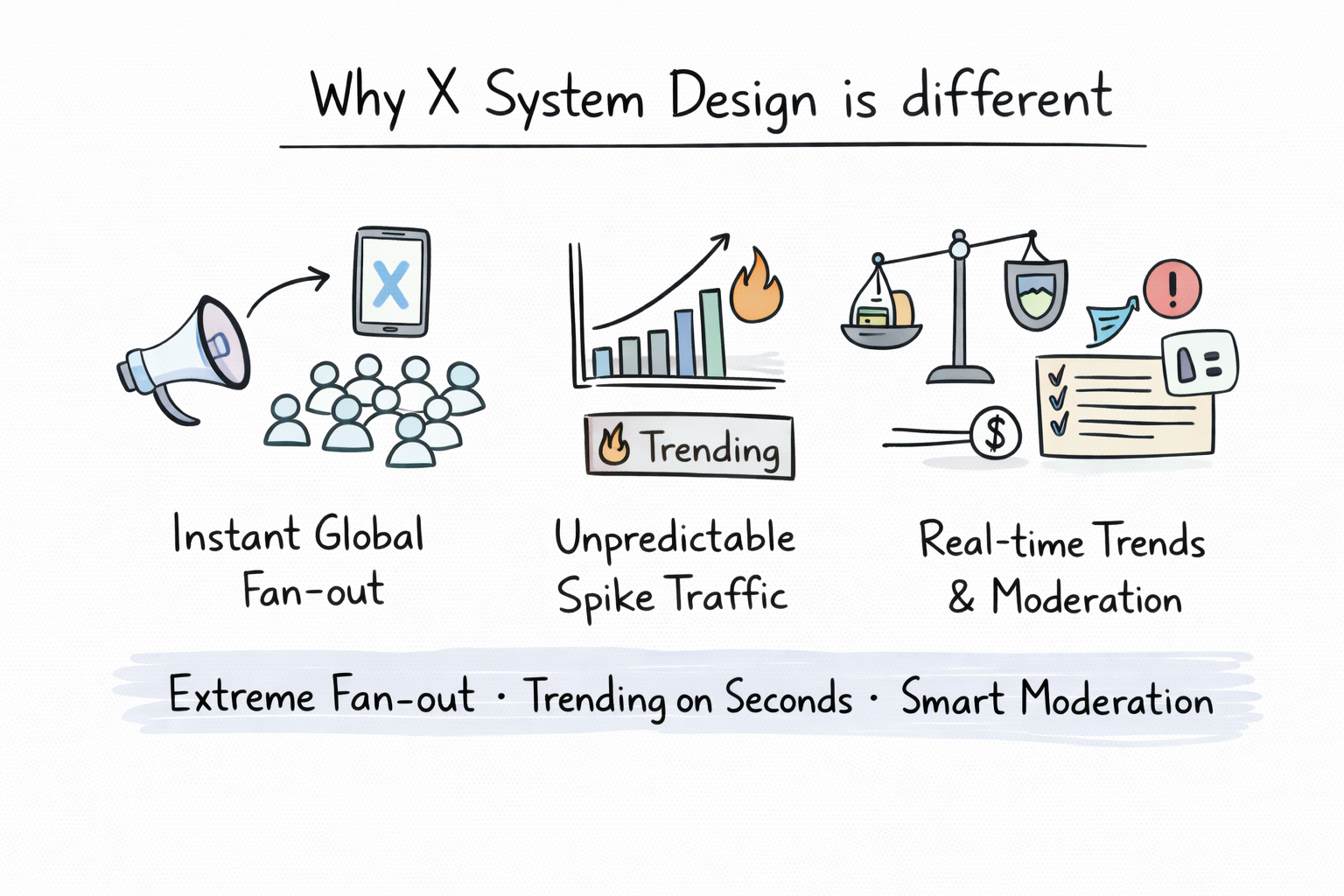
X operates at a unique intersection of real-time communication and global-scale distribution. Unlike many applications where write traffic is moderate and reads dominate quietly, X must process an intense and continuous stream of user-generated content.
When a user posts, that content may need to propagate to hundreds, thousands, or millions of followers instantly. When a global event occurs, traffic spikes unpredictably. Trending topics must update in near real time. Ranking systems must balance recency with relevance. Moderation systems must react immediately to abuse patterns.
The table below highlights how X differs from conventional web systems.
Dimension | Typical Web App | X Platform |
Write pattern | Moderate | High velocity, bursty |
Fan-out complexity | Limited | Extreme skew (celebrities) |
Latency target | Sub-second | Often sub-100 ms |
Personalization | Moderate | Deep ranking pipelines |
Abuse surface | Limited | Massive, global |
Designing for X requires understanding high-fan-out systems, distributed ranking, and real-time stream processing.
System Design Deep Dive: Real-World Distributed Systems

Modern software systems are expected to operate at a massive scale while meeting strict reliability and latency requirements. Whether it’s a feed refresh, a payment request, or a real-time analytics query, users expect systems to respond instantly and consistently. That expectation has raised the bar for engineers today, understanding that System Design isn’t optional. It’s a core skill for building and evaluating production-grade systems. I built this course from my experience working on large-scale distributed systems at Microsoft (Azure) and Meta (Scuba), and from interviewing hundreds of candidates across both companies. The pattern I kept seeing was this: candidates understood individual components, but struggled to combine them into a coherent system. They knew what a cache or load balancer was, but not when or why to use it. This course is designed to bridge that gap. We start with the foundational building blocks of System Design, including databases, caching layers, load balancing, and messaging systems, and focus on how they interact under real-world constraints. From there, we analyze systems built by companies like Google, Facebook, and Amazon, breaking them down to understand the trade-offs behind each design decision. The goal is not just to learn concepts, but to develop the ability to reason through them in practice. This approach has helped a large number of engineers build stronger intuition for System Design and perform better in interviews. If you want to understand how real systems are designed and be able to design them yourself, this course gives you a clear, practical path forward.
What the X System Design interview evaluates#
Interviewers at X look for engineers who can design systems that handle billions of timeline reads, high-volume writes, and dynamic ranking pipelines without sacrificing safety or performance.
They focus on real-time ingestion, feed generation, graph modeling, read performance, analytics pipelines, and abuse mitigation.
The following table summarizes key evaluation domains.
Evaluation Area | What You Must Demonstrate | Why It Matters |
Content ingestion | High-throughput write pipelines | Posts arrive constantly |
Timeline ranking | Efficient, personalized feed logic | Timeline is the core product |
Social graph | Scalable follower modeling | Fan-out complexity |
Read systems | Caching and low-latency design | Reads dominate traffic |
Real-time analytics | Stream aggregation | Trends and virality |
Safety engineering | Abuse detection | Platform integrity |
Strong candidates connect these components into a cohesive system rather than describing them independently.
Scalability & System Design for Developers
As you progress in your career as a developer, you'll be increasingly expected to think about software architecture. Can you design systems and make trade-offs at scale? Developing that skill is a great way to set yourself apart from the pack. In this Skill Path, you'll cover everything you need to know to design scalable systems for enterprise-level software.
Real-time content ingestion and fan-out#
X handles tweets, replies, reposts, likes, media uploads, and notifications in real time. The ingestion system must handle distributed write pipelines capable of processing millions of posts per hour.
Fan-out patterns are central to X’s design. When a user posts, the content must appear in followers’ timelines. The core trade-off is between fan-out-on-write and fan-out-on-read.
Fan-out-on-write pushes posts to follower timelines at creation time, increasing write cost but improving read latency. Fan-out-on-read stores posts centrally and computes timelines dynamically, reducing write cost but increasing read complexity.
The table below compares these strategies.
Strategy | Advantage | Trade-off |
Fan-out-on-write | Faster reads | Expensive for high-follower users |
Fan-out-on-read | Lower write cost | Slower timeline assembly |
Hybrid approach | Balanced | More system complexity |
Most realistic designs at X use hybrid strategies depending on account size.
Timeline generation and ranking#
The timeline is the heart of X. It combines posts from followed users with ranked content, replies, reposts, and promoted material.
Timeline ranking involves multi-stage pipelines. The first stage retrieves candidate tweets from storage or precomputed timelines. The second stage applies ranking models based on recency, engagement, graph proximity, and personalization signals.
Ranking must execute within tight latency budgets. Caching plays a critical role in accelerating frequently accessed timelines.
A strong X System Design answer clearly separates candidate retrieval from ranking logic and explains how personalization is layered without violating performance constraints.
Social graph modeling at scale#
The social graph is massive and skewed. Some users have a few followers. Others have tens of millions. Designing adjacency storage and partitioning strategies is critical.
Follower lists are typically sharded by user ID. Highly followed accounts require hot-key mitigation strategies, including caching and partition spreading. Influence propagation must avoid overwhelming downstream systems during celebrity posts.
The table below illustrates graph challenges.
Graph Challenge | Architectural Response |
High skew | Partitioning and hot-key caching |
Massive adjacency lists | Sharded storage |
Frequent follow changes | Event-driven updates |
Graph consistency | Eventual consistency with reconciliation |
Handling skew is one of the most important design discussions in the X interview.
Low-latency read systems#
Most X requests are reads: timelines, profiles, search results, and trending topics. The read path must be optimized aggressively.
Distributed caching layers such as Redis reduce repeated database hits. Read replicas ensure horizontal scaling. Query routing directs traffic to regionally optimal clusters.
The table below summarizes read optimization layers.
Layer | Purpose |
CDN | Static media delivery |
In-memory cache | Fast timeline retrieval |
Read replicas | Horizontal scaling |
Search index | Efficient text queries |
Sub-100 ms response times are often expected for major endpoints.
Trending topics and real-time analytics#
Trending topics require continuous stream aggregation. As tweets flow into the system, stream processing engines compute sliding-window metrics to detect spikes in activity.
Trending pipelines must account for spam suppression, anomaly detection, and ranking adjustments. Aggregation windows may span five minutes, one hour, or longer intervals, depending on the use case.
Stream processing frameworks such as Kafka-based pipelines or similar distributed log systems enable scalable aggregation.
Safety, moderation, and rate limiting#
X faces constant abuse attempts. Moderation systems must analyze content in real time and apply enforcement policies quickly.
Abusive content scoring, rate limiting, user reporting workflows, and shadow-banning mechanisms operate alongside feed ranking systems. These safety systems must integrate without degrading performance.
Designing safety as a modular pipeline ensures adaptability as policies evolve.
Format of the X System Design interview#
A typical X System Design interview lasts between 45 and 60 minutes. You begin by clarifying requirements and constraints. You propose a high-level architecture. You then deep dive into components such as timeline services, graph modeling, or ranking pipelines.
You must explain scaling strategies, storage decisions, and failure handling clearly. Structured communication is essential.
Structuring your answer for maximum impact#
Success in the X System Design interview depends on clarity and structured reasoning.
Step 1: Clarify requirements#
You should ask about latency targets, ranking consistency, multimedia support, and global deployment expectations. Clarifying trade-offs between availability and consistency demonstrates maturity.
Step 2: Define non-functional requirements#
For X, non-functional requirements often include high write throughput, low read latency, horizontal scalability, eventual consistency for fan-out, strong consistency for critical metadata, and global availability.
The table below summarizes common priorities.
Non-Functional Requirement | Priority |
Write scalability | High |
Read latency | Critical |
Fault tolerance | High |
Abuse resistance | Critical |
Global replication | High |
Anchoring your architecture to these requirements signals alignment with real-world constraints.
High-level architecture for X#
A strong design includes an API Gateway, Tweet Service, Social Graph Service, Timeline Service, Ranking Engine, Media Service, Notification Service, and Trending Analytics pipeline. Event streaming platforms handle propagation. Distributed caches accelerate reads. Databases such as Cassandra or DynamoDB handle large-scale storage. Search indexing services power discovery.
Each component must support skew and bursty traffic patterns.
Deep dive into critical components#
Timeline service#
Precomputed timelines accelerate reads for active users. A hybrid fan-out model manages celebrity skew. Ranking pipelines merge recency, engagement, and personalization signals.
Social graph service#
Graph edges are partitioned by user ID. Hot accounts are cached aggressively. Follow events propagate asynchronously to update timeline storage.
Tweet storage#
Unique ID generation ensures ordering. Writes are sharded across storage partitions. Media content is stored separately and served via CDN.
Trending analytics#
Stream processing engines compute sliding-window aggregations. Spam signals adjust trend scores. Results are cached and refreshed at defined intervals.
Failure handling and graceful degradation#
Systems must handle cache invalidation issues, delayed propagation, ranking pipeline outages, and celebrity-induced traffic spikes.
Graceful degradation may include temporarily reducing personalization depth, serving cached timelines, or throttling abusive accounts.
Trade-offs in X System Design#
Trade-offs define senior-level answers. Fan-out-on-write improves read latency, but increases write amplification. Strong consistency improves reliability but adds latency overhead. Aggressive caching improves speed but complicates invalidation. Local ranking models improve personalization but increase computational cost.
Explicit trade-off reasoning demonstrates System Design maturity.
Example: High-level X home timeline design#
A user posts a tweet. The Tweet Service stores the content and publishes an event to the streaming platform. A hybrid fan-out strategy distributes the tweet to follower timelines. The Timeline Service caches updated timelines in Redis. The Ranking Engine merges signals, including recency, engagement, and graph proximity. The read path retrieves cached results with fallback recomputation. Trends update asynchronously.
This architecture balances scalability, speed, and personalization.
Final thoughts on the X System Design interview#
The X System Design interview evaluates your ability to build real-time, large-scale, fault-tolerant distributed systems that power global conversation. These are not theoretical problems. They reflect real engineering challenges involving skewed graphs, high-fan-out writes, ranking pipelines, and abuse mitigation.
If you structure your answers clearly, emphasize latency and scalability, articulate trade-offs thoughtfully, and demonstrate product awareness, you will stand out as a strong candidate ready to build systems that operate at internet scale.
