Yelp System Design Explained
Discover how Yelp powers local discovery at a massive scale. This deep dive covers search, ranking, caching, reviews, and trust systems behind one of the most read-heavy platforms on the web.
Yelp feels simple when you use it. You search for a restaurant, scroll through reviews, glance at ratings, and decide where to eat. Everything feels fast, intuitive, and grounded in community opinion. But behind that experience is a highly complex System Designed to handle massive read traffic, user-generated content, ranking logic, fraud prevention, and location-based discovery.
Yelp System Design is a classic and powerful System Design interview problem. It tests whether you can design a system that is read-heavy, trust-sensitive, and ranking-driven, while supporting millions of users, businesses, and reviews. Unlike pure transactional systems, Yelp must balance performance with credibility because showing the “wrong” results can be just as damaging as showing slow ones.
Grokking Modern System Design Interview
For a decade, when developers talked about how to prepare for System Design Interviews, the answer was always Grokking System Design. This is that course — updated for the current tech landscape. As AI handles more of the routine work, engineers at every level are expected to operate with the architectural fluency that used to belong to Staff engineers. That's why System Design Interviews still determine starting level and compensation, and the bar keeps rising. I built this course from my experience building global-scale distributed systems at Microsoft and Meta — and from interviewing hundreds of candidates at both companies. The failure pattern I kept seeing wasn't a lack of technical knowledge. Even strong coders would hit a wall, because System Design Interviews don't test what you can build; they test whether you can reason through an ambiguous problem, communicate ideas clearly, and defend trade-offs in real time (all skills that matter ore than never now in the AI era). RESHADED is the framework I developed to fix that: a repeatable 45-minute roadmap through any open-ended System Design problem. The course covers the distributed systems fundamentals that appear in every interview – databases, caches, load balancers, CDNs, messaging queues, and more – then applies them across 13+ real-world case studies: YouTube, WhatsApp, Uber, Twitter, Google Maps, and modern systems like ChatGPT and AI/ML infrastructure. Then put your knowledge to the test with AI Mock Interviews designed to simulate the real interview experience. Hundreds of thousands of candidates have already used this course to land SWE, TPM, and EM roles at top companies. If you're serious about acing your next System Design Interview, this is the best place to start.
In this blog, we’ll walk through how a Yelp-like system can be designed, focusing on architecture, data flow, and real-world trade-offs rather than UI or front-end concerns.
Understanding the Core Problem#
At its core, Yelp is a local business discovery and review platform. It connects users with nearby businesses and helps them make decisions based on community-generated reviews, ratings, photos, and metadata.
Unlike e-commerce or delivery platforms, Yelp is not primarily transactional. Most interactions are exploratory and read-heavy. A single business page may be viewed thousands of times per day, while new reviews are written far less frequently.
The system must continuously answer a few fundamental questions. Which businesses are relevant to this user’s location and query? Which reviews should be shown, and in what order? How do we ensure the content is trustworthy? How do we serve this information quickly on a global scale?
These questions define the heart of Yelp System Design.
Core Functional Requirements#
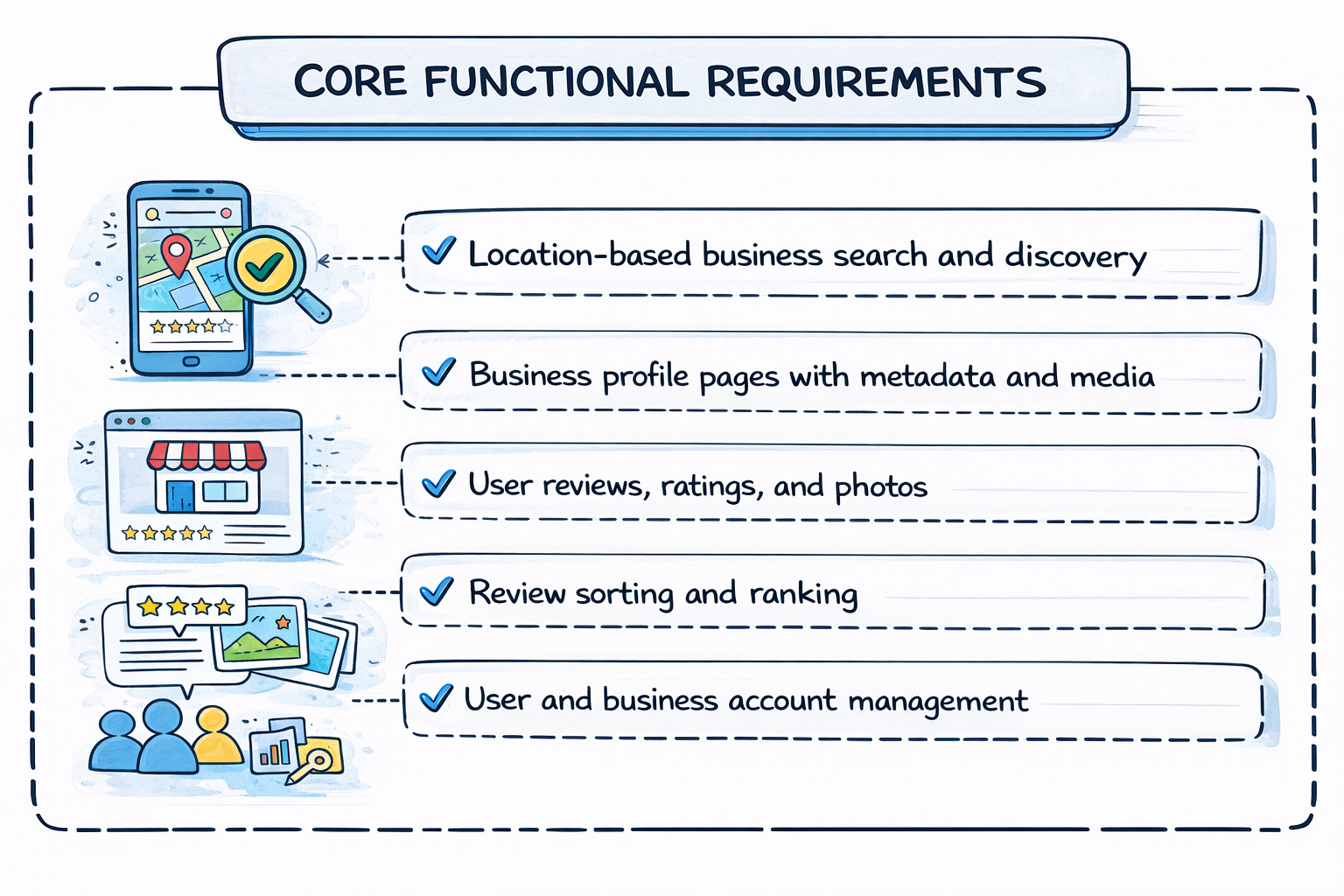
To ground the design, we start with what the system must do, which are the core requirements.
From a user’s perspective, Yelp must allow users to search for businesses, view business profiles, read reviews, write reviews, upload photos, and interact with other users. From a business perspective, Yelp must allow owners to manage profiles, respond to reviews, and view analytics.
More concretely, the system must support:
Location-based business search and discovery
Business profile pages with metadata and media
User reviews, ratings, and photos
Review sorting and ranking
User and business account management
What makes Yelp challenging is that content quality and ranking matter as much as correctness. Showing irrelevant or low-trust reviews undermines the platform’s value.
Non-Functional Requirements That Shape the Design#
Yelp System Design is heavily shaped by non-functional requirements.
The platform must handle extremely high read traffic, especially in dense urban areas and during peak hours. Latency matters because search and scrolling are interactive experiences. At the same time, Yelp must maintain trust by preventing spam, fake reviews, and manipulation.
Different features tolerate different guarantees:
Requirement | Search & discovery | Reviews & moderation |
Latency | Very low | Moderate |
Consistency | Eventual | Stronger |
Availability | Critical | Critical |
Error tolerance | Low | Very low |
Scalability and trust are the two dominant forces shaping the system.
System Design Deep Dive: Real-World Distributed Systems

Modern software systems are expected to operate at a massive scale while meeting strict reliability and latency requirements. Whether it’s a feed refresh, a payment request, or a real-time analytics query, users expect systems to respond instantly and consistently. That expectation has raised the bar for engineers today, understanding that System Design isn’t optional. It’s a core skill for building and evaluating production-grade systems. I built this course from my experience working on large-scale distributed systems at Microsoft (Azure) and Meta (Scuba), and from interviewing hundreds of candidates across both companies. The pattern I kept seeing was this: candidates understood individual components, but struggled to combine them into a coherent system. They knew what a cache or load balancer was, but not when or why to use it. This course is designed to bridge that gap. We start with the foundational building blocks of System Design, including databases, caching layers, load balancing, and messaging systems, and focus on how they interact under real-world constraints. From there, we analyze systems built by companies like Google, Facebook, and Amazon, breaking them down to understand the trade-offs behind each design decision. The goal is not just to learn concepts, but to develop the ability to reason through them in practice. This approach has helped a large number of engineers build stronger intuition for System Design and perform better in interviews. If you want to understand how real systems are designed and be able to design them yourself, this course gives you a clear, practical path forward.
High-Level Architecture Overview#

At a high level, Yelp can be decomposed into several major subsystems:
A business data and location indexing system
A search and ranking service
A review and rating management system
A user and business account system
A media storage and delivery layer
A fraud detection and trust system
Each subsystem has distinct data access patterns and scaling needs. Separating them allows Yelp to optimize read performance without compromising review integrity.
Business Data and Location Indexing#
Business data is the foundation of Yelp.
Each business has a profile that includes name, category, location, hours, attributes, and photos. This data changes infrequently compared to how often it is read.
To support fast location-based search, Yelp indexes businesses using geospatial data structures. This allows the system to efficiently answer queries such as “restaurants near me” or “coffee shops within 2 miles.”
Because business metadata is relatively static, it is heavily cached and replicated. Updates propagate asynchronously, favoring availability and performance over immediate consistency.
Search and Discovery Flow#
Search is the primary entry point for most users.
When a user performs a search, the system must combine text matching, location filtering, category relevance, and ranking signals. This is a read-heavy operation that must return results quickly, even under high load.
Ranking is where Yelp differentiates itself. Results are not sorted purely by rating. Factors such as review quality, recency, reviewer credibility, and engagement signals all influence ordering.
Ranking signal | Purpose |
Query relevance | Match intent |
Location proximity | Practical usefulness |
Review quality & recency | Freshness |
Reviewer credibility | Trust |
Engagement signals | Popularity |
The ranking system is continuously tuned, often through experimentation, to balance fairness, relevance, and user satisfaction.
Business Profile Pages#
Once a user selects a business, they land on a profile page.
This page aggregates data from multiple systems: business metadata, reviews, photos, ratings, and user interactions. Because this page is viewed frequently, it must be optimized aggressively for read performance.
Profile pages are often assembled using cached components. Reviews and ratings may be fetched separately from business metadata. This modular approach allows the system to update individual components without invalidating the entire page.
The goal is to keep page load times low while ensuring consistency across displayed data.
Review Submission and Storage#
Review submission is a write-heavy but lower-volume workflow.
When a user submits a review, the system must validate the input, associate it with the correct business and user, and store it durably. Reviews are immutable once published, though users may update them later through controlled workflows.
Review writes require stronger consistency guarantees than reads. A submitted review must not be lost or duplicated. At the same time, it does not need to appear immediately in all search results.
Aspect | Requirement |
Durability | Mandatory |
Duplication | Prevented |
Visibility | Eventual |
Edit policy | Controlled |
This leads to a design where reviews are written synchronously but propagated asynchronously to search indexes and caches.
Ratings Aggregation#
Ratings appear simple, but they require careful handling.
A business’s overall rating is derived from many individual reviews. Recomputing this value on every read would be expensive, so Yelp typically maintains precomputed aggregates.
When a new review is added, the system updates aggregate ratings asynchronously. Temporary inconsistencies, such as a new review appearing before the rating updates, are acceptable, as long as they resolve quickly.
This trade-off favors performance and scalability over strict real-time accuracy.
Review Ranking and Filtering#
Not all reviews are equal.
Yelp places significant emphasis on showing the most helpful and trustworthy reviews first. This requires ranking reviews within a business page, based on factors such as reviewer history, engagement, and content quality.
Filtering concerns:
Spam and low-quality reviews must be suppressed
High-trust reviewers should be prioritized
Ranking must adapt over time
This system is closely tied to Yelp’s trust and fraud detection mechanisms.
Trust, Fraud, and Spam Detection#
Trust is the backbone of Yelp.
Signal | Used for |
Reviewer history | Credibility |
Review patterns | Fraud detection |
Network behavior | Collusion detection |
Engagement anomalies | Abuse prevention |
Fake reviews, coordinated manipulation, and spam can destroy the platform’s credibility. As a result, Yelp invests heavily in automated and manual review moderation systems.
Fraud detection systems analyze patterns such as reviewer behavior, review timing, and network signals. Suspicious reviews may be filtered out automatically or flagged for human review.
Importantly, moderation decisions often affect visibility rather than deletion. This allows Yelp to reduce spam impact without creating adversarial feedback loops.
Media Storage and Delivery#
Photos are a key part of Yelp’s user experience.
User-uploaded photos and business images are large binary objects that must be stored efficiently and served quickly. Yelp typically uses object storage combined with a CDN to deliver media with low latency.
Media uploads are validated asynchronously, and processing such as resizing or compression happens off the critical path. This ensures that photo-heavy pages load quickly without overloading backend services.
Caching and Performance Optimization#
Yelp is an extremely read-heavy system.
To scale efficiently, the platform relies heavily on caching at multiple layers. Business metadata, search results, and review lists are cached aggressively, with different TTLs based on update frequency.
Cache invalidation is handled conservatively. It is often better to show slightly stale data than to miss cache hits and overload databases.
This philosophy underpins much of Yelp System Design.
Notifications and User Engagement#
Yelp also includes social and engagement features.
Users receive notifications when their reviews receive reactions or when businesses respond. Business owners receive alerts for new reviews or messages.
Notifications are handled asynchronously and are always derived from authoritative state. Delays are acceptable; incorrect notifications are not.
Failure Handling and Recovery#
Failures are inevitable in a system of this scale.
Nodes crash, caches evict data, and network partitions occur. Yelp System Design assumes these failures and builds resilience into every layer.
Graceful degradation is key. If search ranking services are unavailable, the system may fall back to simpler ordering. If media services fail, text content still loads.
The system is designed so that core discovery functionality remains available even during partial outages.
Scaling Across Regions and Cities#
Yelp operates globally, but usage patterns vary by region.
Dense cities generate heavy traffic and frequent updates. Smaller towns see fewer writes but still expect fast reads. The system isolates regional data where appropriate while sharing global infrastructure for efficiency.
This hybrid approach allows Yelp to scale without central bottlenecks.
Data Integrity and User Trust#
Ultimately, Yelp’s success depends on trust.
Users trust that reviews reflect real experiences. Businesses trust that rankings are fair. Yelp System Design prioritizes transparency, consistency, and conservative changes to preserve this trust.
Performance optimizations are always weighed against their impact on credibility.
How Interviewers Evaluate Yelp System Design#
Signal | What it demonstrates |
Read-heavy optimization | Scale awareness |
Ranking reasoning | Product thinking |
Trust modeling | Platform maturity |
Trade-off clarity | Senior judgment |
Interviewers use Yelp to assess your ability to design read-heavy, ranking-driven platforms.
They look for strong reasoning around search, caching, ranking, and trust systems. They care less about CRUD mechanics and more about how you handle scale, relevance, and abuse.
Clear articulation of trade-offs, especially between performance and trust, is usually a strong signal.
Final Thoughts#
Yelp System Design demonstrates that scalable systems are not just about throughput; they’re about judgment.
A strong design emphasizes fast discovery, thoughtful ranking, robust caching, and deep trust mechanisms. If you can clearly explain how Yelp surfaces relevant businesses while protecting the integrity of reviews, you demonstrate the system-level thinking required to build durable, user-centric platforms.
