Yes, Java is excellent for coding interviews. It’s a popular and widely used programming language in the industry and effectively supports core data structures and algorithms. Java’s strong typing and object-oriented features help write clear, maintainable code, making it a solid choice for technical interviews.
Updated today
Save this course
Grokking the Coding Interview Patterns
Grokking the Coding Interview saves you countless hours of grinding LeetCode. Master the 28 coding patterns behind most coding interview problems. Developed by and for MAANG engineers.
Select your Language
Select your Language
Created by Fahim ul Haq

What's included
- 1125 lessons across 41 modules
- 579 quizzes with instant feedback
- with scoring rubrics
- on every lesson
- Ace MAANG Coding InterviewsSolve unseen problems under pressure in timed technical loops.
- Crack Unfamiliar Problems FastMap any new question to a proven strategy within minutes.
- Optimize Code in ProductionSpot slow paths and choose leaner algorithms in code reviews.
- Defend Your Solution ChoicesExplain complexity and trade-offs clearly to interviewers and peers.
Fahim ul Haq
Software Engineer, Distributed Storage at Meta and Microsoft, Educative (Co-founder & CEO)
Fahim ul Haq is the co-founder and CEO of Educative, a hands-on learning platform for software engineers. He spent nearly a decade as a software engineer at Microsoft and Meta, where he gained deep experience building large-scale distributed systems. His work spanned Project Red Dog at Microsoft, which evolved into Microsoft Azure, and Scuba, Meta's real-time data analytics engine. In 2015, Fahim co-founded Educative to help developers get hands-on with new skills. Fahim's courses have helped hundreds of thousands of engineers learn System Design and prepare for technical interviews. Fahim earned his M.S. in Computer Science from the University of Washington in 2015.
Join 3.1 million developers at
Join 3.1 million developers at
What you'll learn
- Identify and apply coding interview patterns to solve algorithmic problems effectively
- Utilize data structures such as arrays, linked lists, stacks, and queues in coding challenges
- Implement sorting and searching algorithms to optimize problem-solving efficiency
- Analyze and apply dynamic programming techniques to tackle complex problems
- Employ graph algorithms to solve connectivity and traversal challenges
- Develop proficiency in string manipulation and pattern recognition for coding interviews
Learning Roadmap
1.
The Two Pointers pattern uses two coordinated pointers or iterators to traverse data efficiently.
2.
The Fast and Slow Pointers pattern uses two pointers that traverse a data structure at different speeds.
3.
Uses a window, either fixed or dynamic, to optimize the analysis of sequential data (substring or subarray) through iterative processing, minimizing the need for nested loops.
4.
The Intervals pattern is a powerful algorithmic technique for solving problems involving ranges of values, such as time spans or numeric ranges.
5.
In-place manipulation of a linked list refers to modifying the linked list directly by changing the pointers between existing nodes, without creating a new linked list or using extra data structures.
6.
A heap is a specific data structure with a fixed ordering (min or max), while a priority queue is an abstract data type that handles custom priority requirements for elements.
7.
The K-Way Merge pattern is an algorithmic strategy used to efficiently combine multiple sorted sequences into a single sorted result.
8.
The Top K Elements pattern focuses on efficiently identifying the k largest, smallest, or most frequent elements in a dataset.
9.
It applies a binary search technique with variations to efficiently solve problems like finding specific targets, peaks (first/last occurrence), or rotated array elements by reducing the search space.
10.
The Subsets pattern is an algorithmic strategy used to generate all possible combinations or subsets of a given set of elements.
11.
Makes locally optimal choices at each step, aiming for a globally optimal solution in problem-solving scenarios, often without reassessment.
12.
Systematically explores all possibilities to find solutions, often used in problems with multiple decision points, exploring, and undoing choices.
13.
Solves complex problems by breaking them into smaller overlapping subproblems and storing results to avoid redundant computations, optimizing time and space.
14.
Sorts an array of integers from 1 to n in place by repeatedly swapping the elements until each is placed in its correct position.
15.
Determines a valid linear ordering of nodes in a directed acyclic graph that has dependencies on each other, crucial in tasks like scheduling or dependency resolution.
16.
Combines sorting and searching techniques to effectively process and retrieve data, often using sorting algorithms and binary search to optimize problem-solving in datasets that can be ordered.
17.
Organizes data in a two-dimensional grid format, where each element is accessed by its row and column, enabling structured manipulation and traversal of the data.
18.
Operates on a last-in, first-out principle, where elements are added and removed from the same end, facilitating ordered data processing and retrieval.
19.
Represents a set of connected nodes or vertices, allowing for traversal and analysis of relationships or connections between data points.
20.
Traverses a tree by exploring as deeply as possible along each branch before backtracking, which is useful for tasks like traversal, pathfinding, or search operations.
21.
Explores nodes of a tree level by level, ensuring each level is processed before moving to the next, often using a queue to manage traversal.
22.
Organizes data in a tree structure where each node represents a character, enabling efficient insertion, deletion, and search operations for words.
23.
Utilizes a data structure that maps keys to values, enabling efficient insertion, deletion, and retrieval operations for associative arrays.
24.
The Knowing What to Track pattern focuses on identifying and maintaining only the key variables or states necessary to solve a problem efficiently, such as counts, indices, or states.
25.
Maintains disjoint sets, supporting operations to determine the set to which an element belongs (find) and merge two sets (union).
26.
Designs specialized structures tailored to specific problem requirements, optimizing data representation and operations for efficient solutions.
27.
It uses binary operations to efficiently perform calculations, comparisons, or transformations directly on bits, optimizing for low-level data control.
28.
Applies mathematical concepts and geometric properties to solve problems efficiently, often involving calculations, number properties, coordinate geometry, or transformations.
29.
Test your understanding of various coding challenges focusing on algorithm efficiency.
30.
The Monotonic Stack pattern uses a stack that maintains elements in increasing or decreasing order to efficiently find the next or previous greater or smaller element.
31.
The Prefix Sum pattern uses a running total of array elements to efficiently calculate the sum of any contiguous subarray, often without repeatedly summing its elements.
32.
The Ordered Set pattern uses a data structure that maintains elements in sorted order to efficiently search, insert, remove, and retrieve elements by value or position.
33.
The Segment Tree pattern uses a tree-based data structure to efficiently query and update ranges of an array, typically in logarithmic time.
34.
The Binary Indexed Tree (Fenwick Tree) pattern uses a tree-based data structure to efficiently calculate prefix sums and update individual elements in an array, typically in logarithmic time.
35.
The Graph DFS pattern uses recursive traversal or a stack to explore a graph as deeply as possible along each path before backtracking, solving problems involving connectivity, paths, and cycles.
36.
The Graph BFS pattern uses a queue to explore a graph level by level, efficiently finding shortest paths in unweighted graphs and solving problems involving connectivity and traversal.
37.
The State-Space BFS pattern uses a queue to explore possible states level by level, efficiently finding the shortest sequence of moves or transformations needed to reach a target state.
38.
The Grid as a Graph pattern treats grid cells as graph nodes and valid moves between neighboring cells as edges.
39.
The Weighted Shortest Paths pattern uses algorithms like Dijkstra's to find the minimum-cost paths between nodes in a weighted graph.
40.
The Minimum Spanning Tree pattern connects all nodes in a weighted graph with the minimum total edge weight and no cycles.
41.
The Advanced Graph Algorithms pattern uses specialized techniques to solve complex graph problems involving connectivity, cycles, strongly connected components, and network flow.
Course Author:
About this course
WHY I WROTE THIS COURSE
I created Grokking the Coding Interview because I watched too many talented engineers fail interviews they should have passed. At Microsoft and Meta, I saw firsthand what separated the candidates who succeeded from the ones who didn't. It wasn't how many LeetCode problems they'd solved. It was whether they could look at an unfamiliar problem and know how to approach it the right way.
That's what this course teaches. Rather than throwing hundreds of disconnected problems at you, we organize the entire coding interview around 28 fundamental patterns. Each pattern is a reusable strategy. Once you understand two pointers, for example, you can apply them to dozens of problems you've never seen before.
The course walks you through each pattern step by step, starting with the intuition behind it, then building through increasingly complex applications. As with every course on Educative, you will practice in a hands-on way with 500+ challenges, 17 mock interviews, and detailed explanations for every solution.
The course is available in Python, Java, JavaScript, Go, C++, and C#, so you can prep in the language you'll actually use in your interview. Whether you're preparing for your first FAANG loop or brushing up after a few years away from interviewing, this course will give you a repeatable framework for cracking the coding interview.
ABOUT THE AUTHOR
Fahim ul Haq
Software Engineer, Distributed Storage at Meta and Microsoft, Educative (Co-founder & CEO)
Trusted by 3.1 million developers working at companies
V
Vlad
Software Developer
H
Hari Govind S
Software Developer
A
Abayomi O
Software Developer
V
VJ
Software Developer
J
John Tang
Software Developer
A
Anant Rao
Software Developer
M
Md. A. Barik
Software Developer
Frequently Asked Questions
Is Java good for coding interviews?
How to crack Java coding interviews?
How can I prepare for a Java interview fast?
What are the coding patterns?
Which coding platform is best for interviews?
Is Grokking the Coding Interview still relevant in 2026?
Is it worth practicing coding interview questions in 2026?
Built for 10x Developers
No Passive Learning
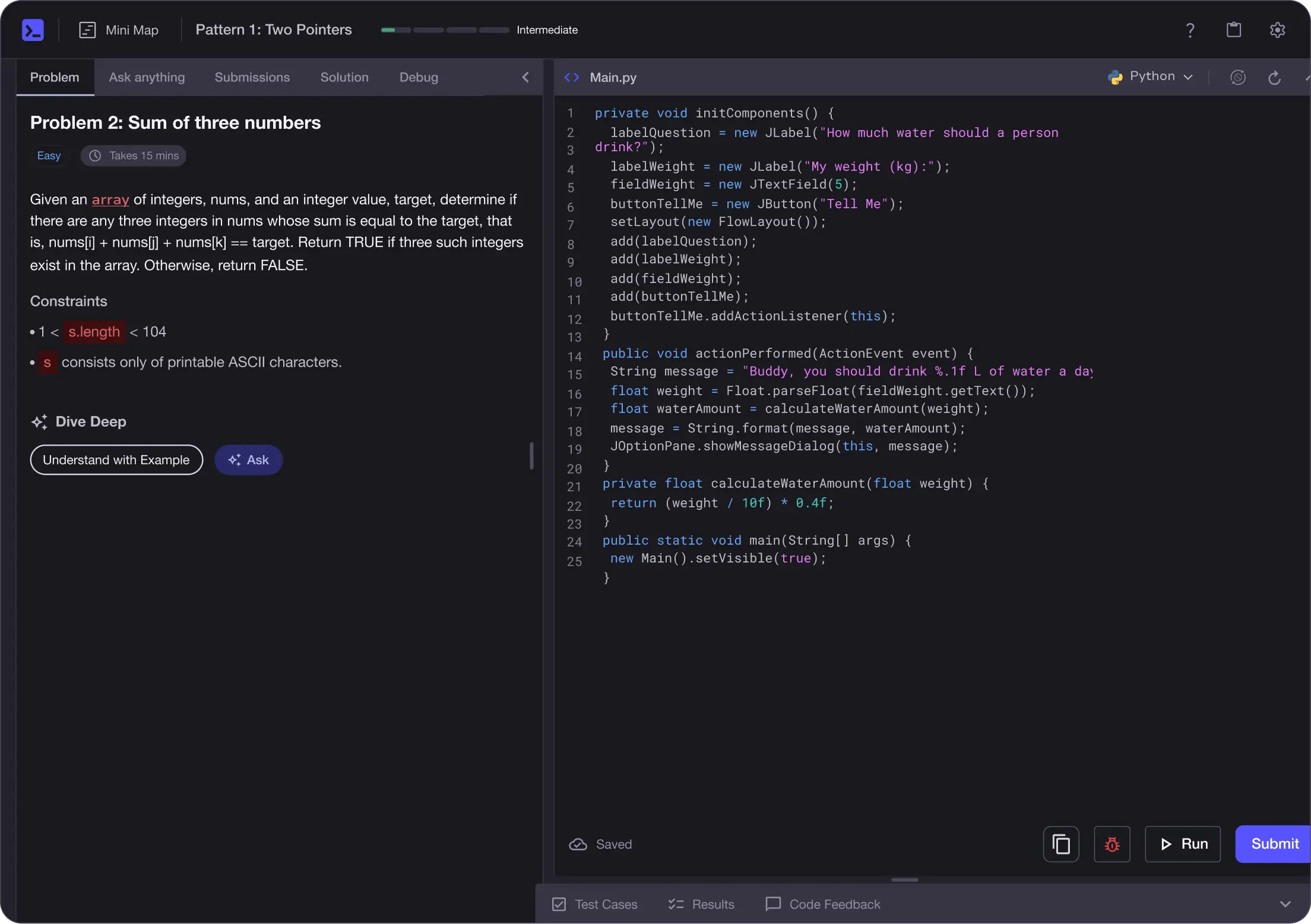
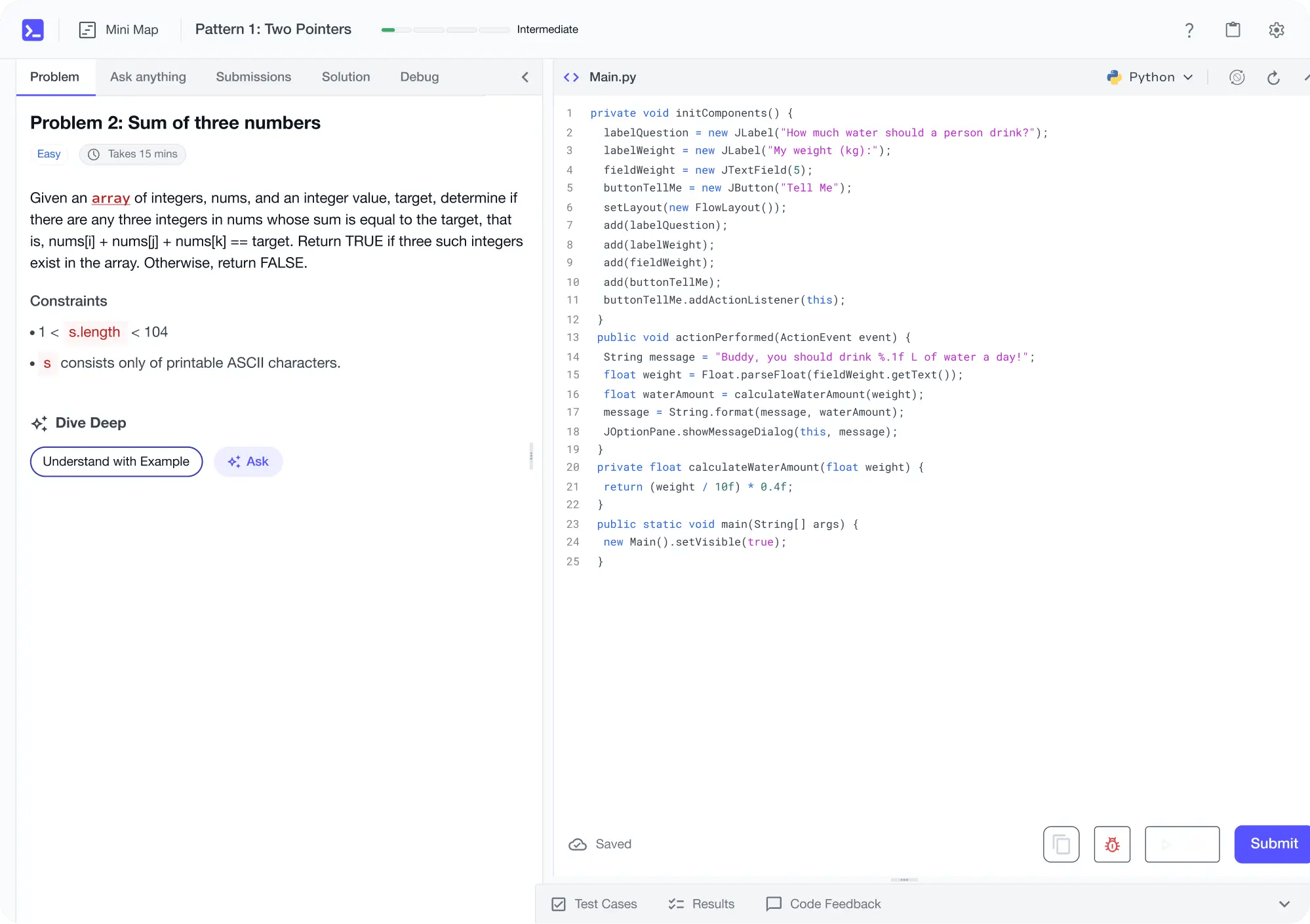
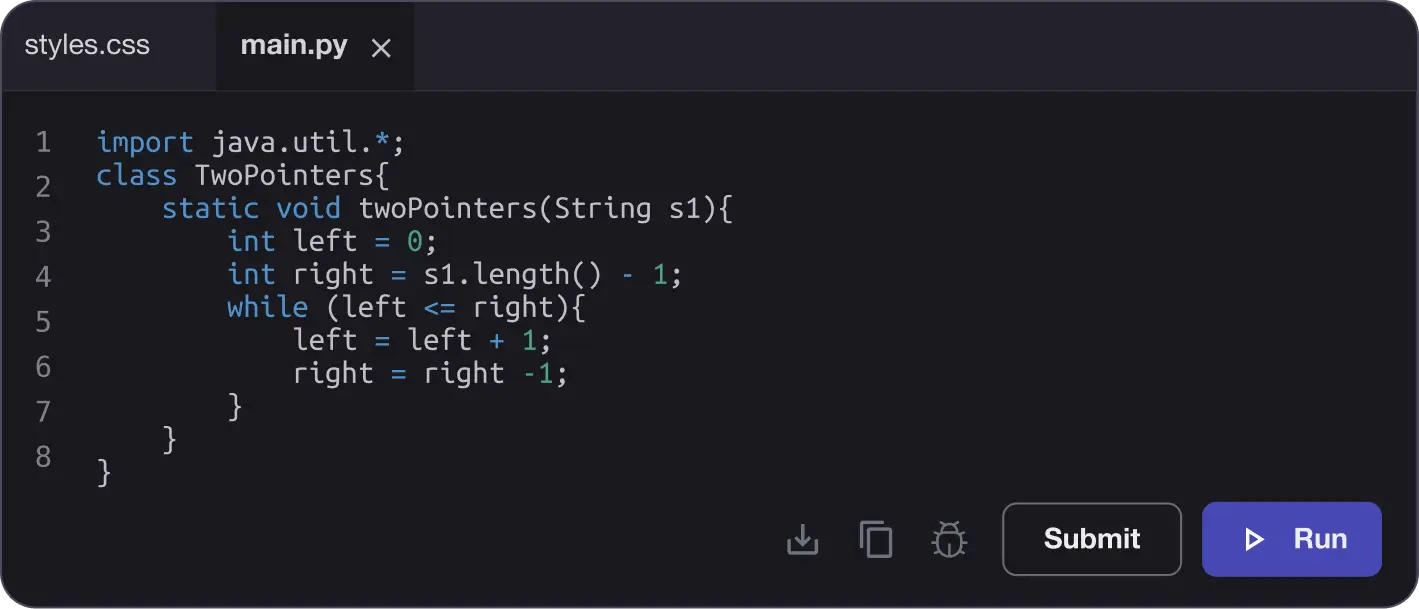
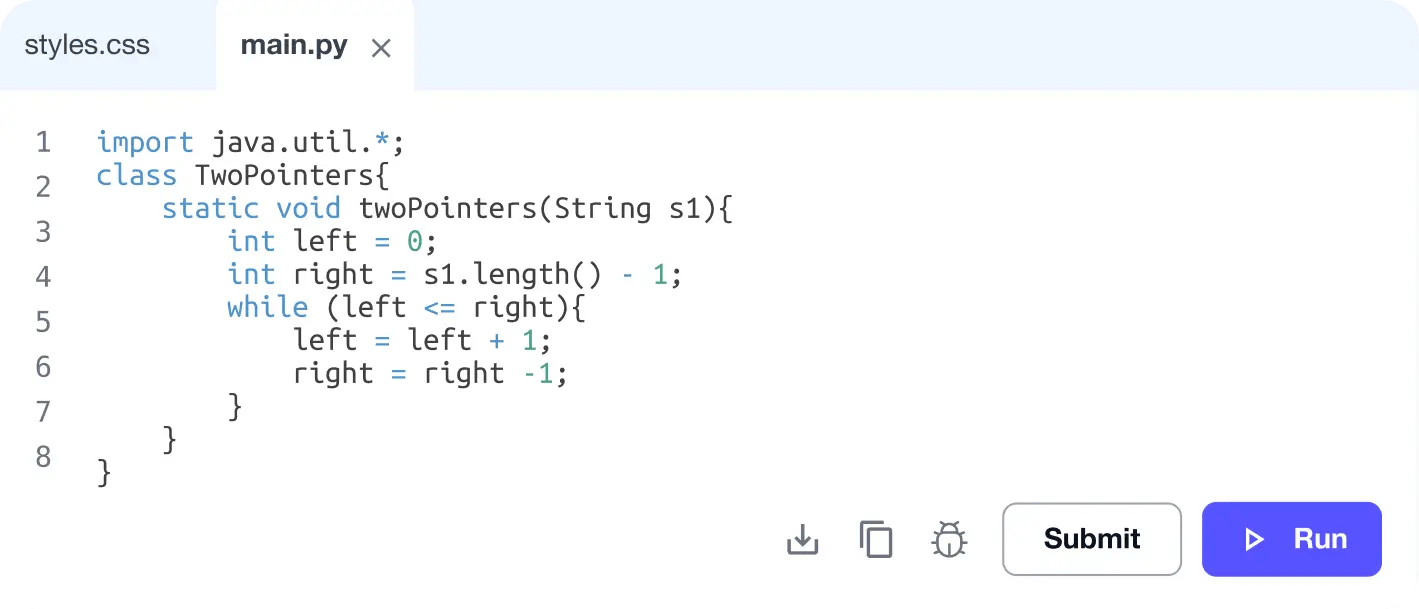
Learn by building with project-based lessons and in-browser code editor
Personalized Roadmaps
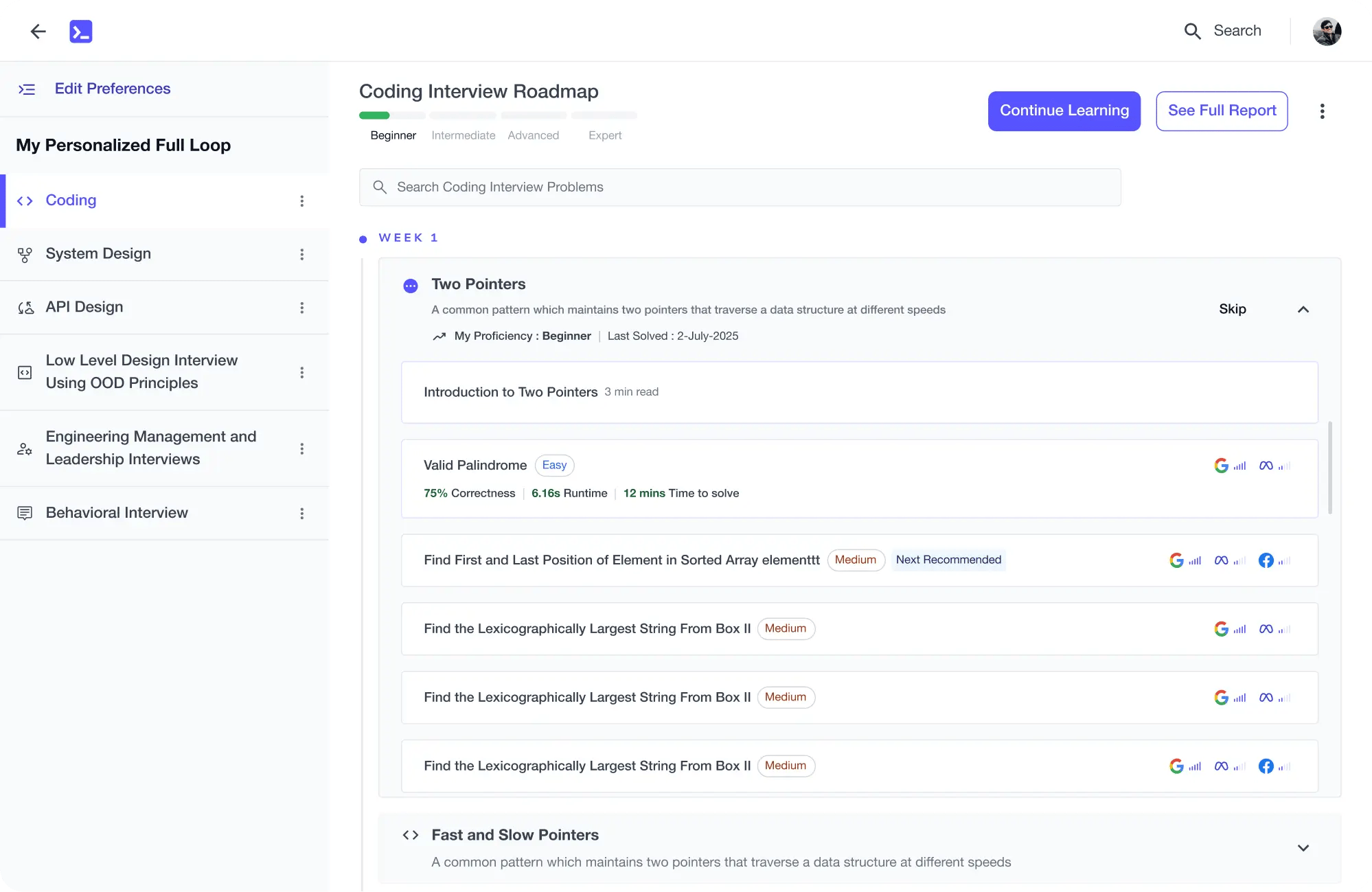
The platform adapts to your strengths & skills gaps as you go

Future-proof Your Career
Get hands-on with in-demand skills
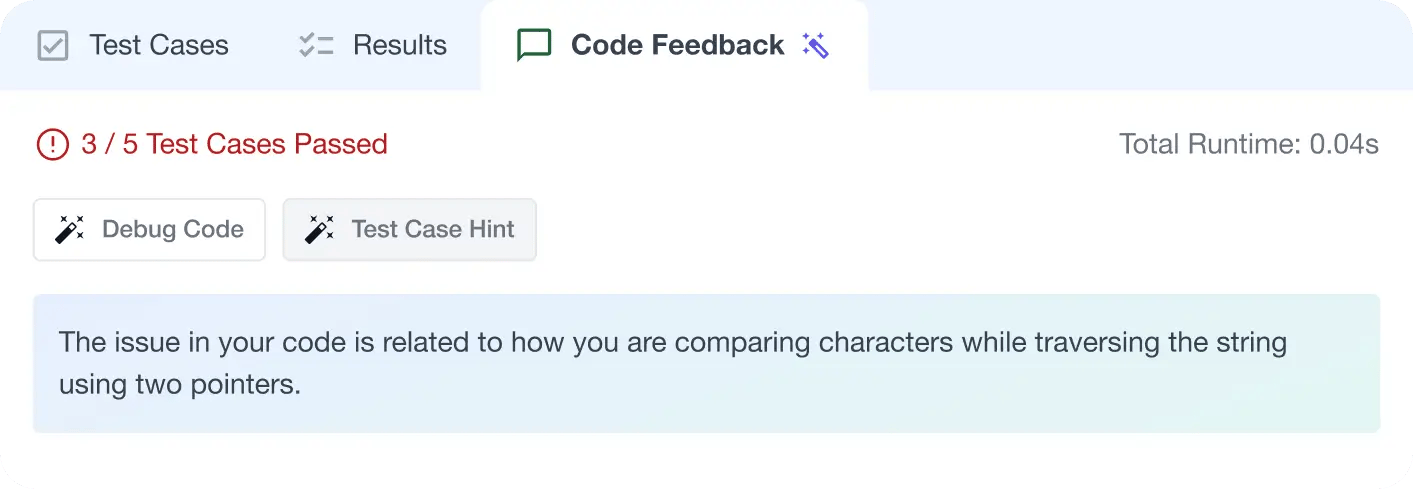
AI Code Mentor
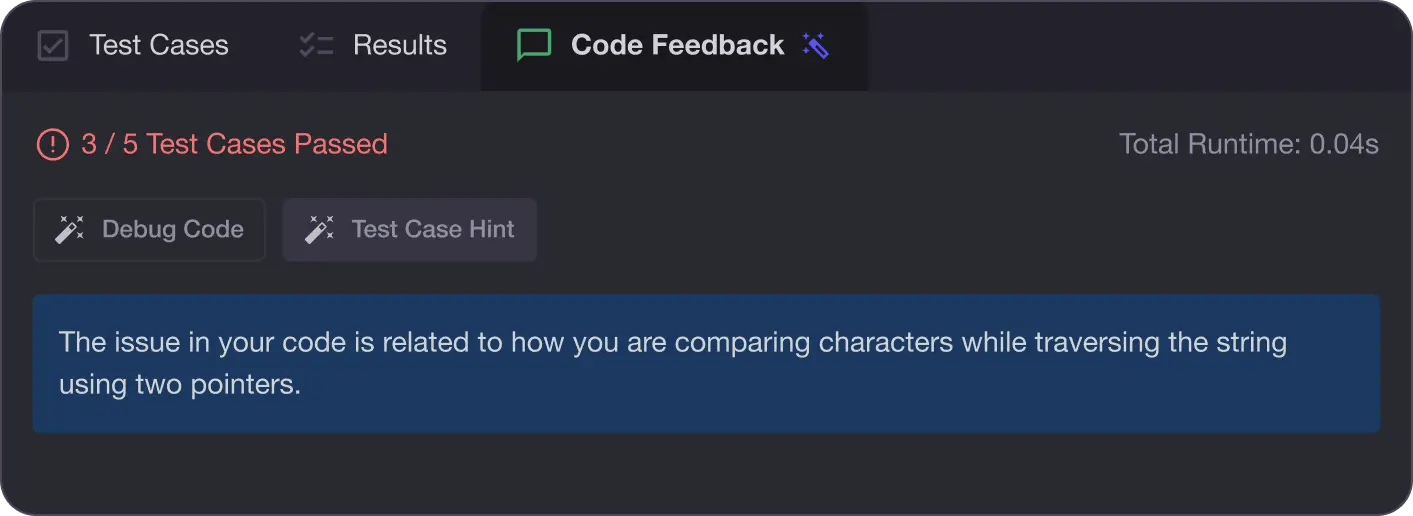
Write better code with AI feedback, smart debugging, and "Ask AI"
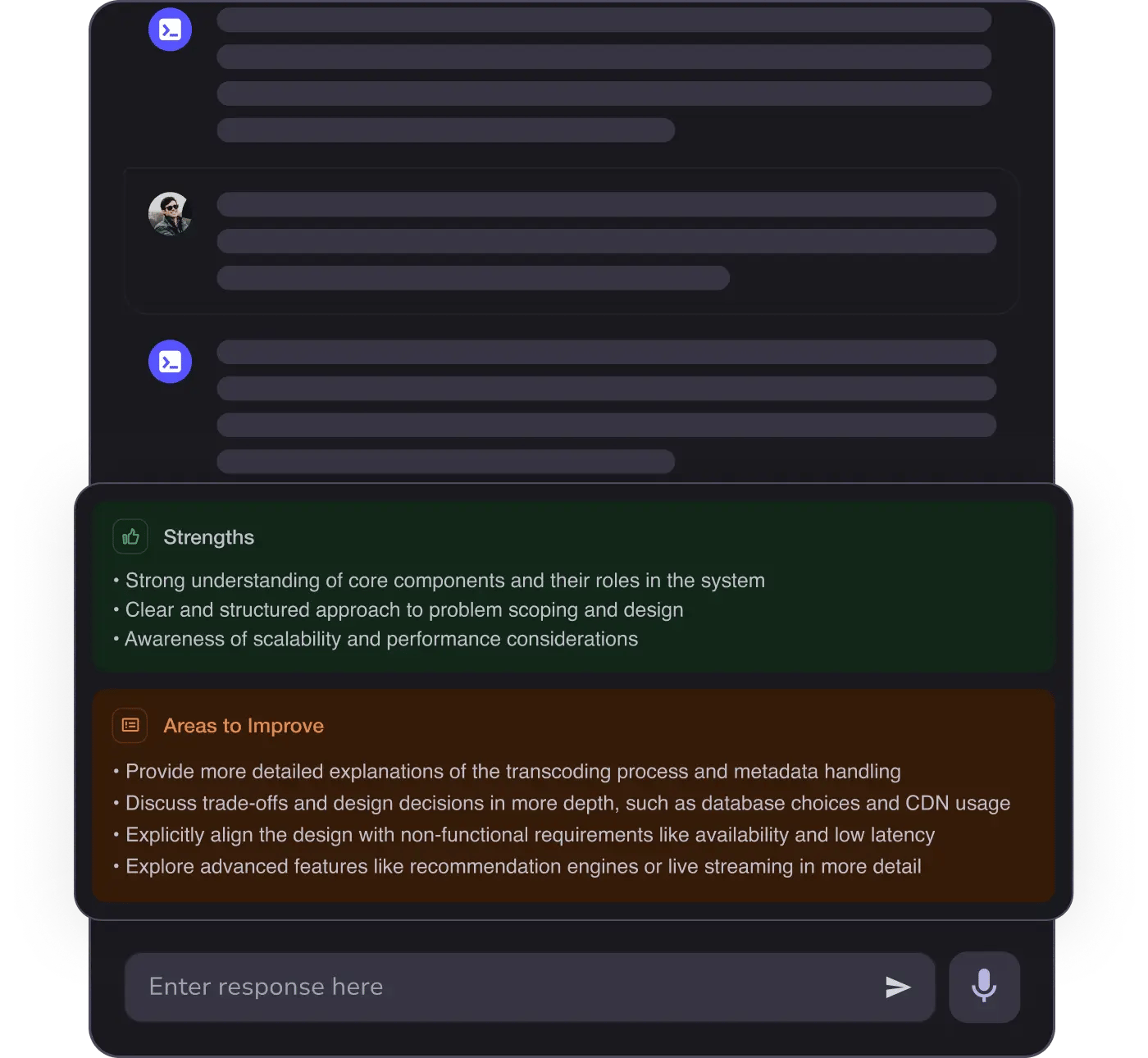
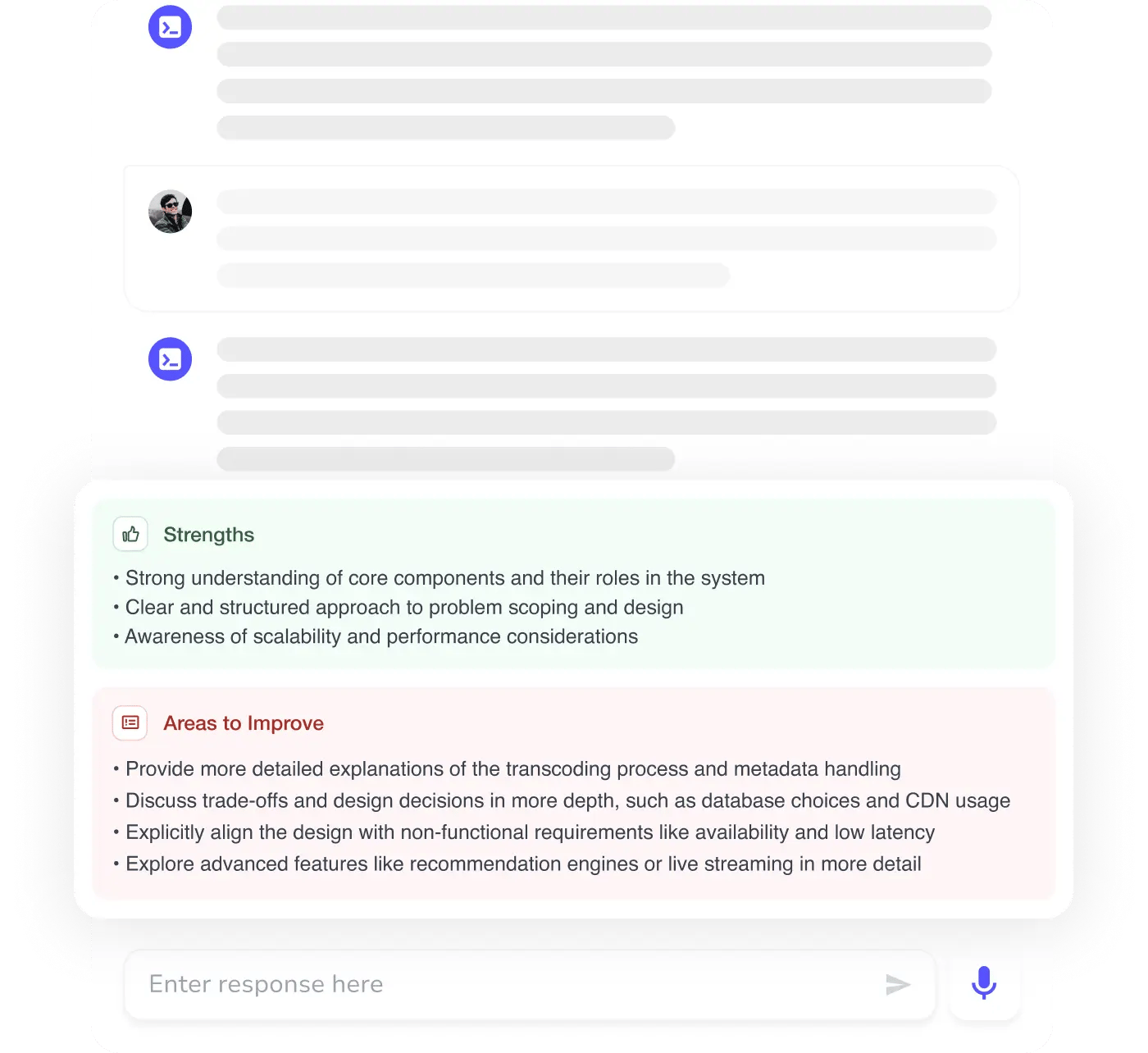
MAANG+ Interview Prep
AI Mock Interviews simulate every technical loop at top companies
Free Resources
cheatsheet
cheatsheet