15 Common Anthropic Interview Questions (With Sample Answers)
Practice these common Anthropic interview questions before your next interview to strengthen your coding, System Design, behavioral, and AI engineering skills. Better preparation leads to more confident interviews and stronger performance.
Preparing for Anthropic interviews involves much more than solving algorithm problems. Whether you're applying for a software engineering, infrastructure, machine learning, or research role, interviewers evaluate how you solve problems, communicate technical ideas, and make thoughtful engineering decisions.
Many candidates spend weeks practicing coding challenges, but neglect the broader range of Anthropic interview questions that appear throughout the hiring process. Alongside technical exercises, you'll likely discuss previous projects, design distributed systems, explain engineering tradeoffs, and answer behavioral questions that reveal how you collaborate with others.
This blog covers 15 common Anthropic interview questions, explains why interviewers ask them, and provides sample answers that demonstrate the kind of thinking hiring teams typically look for.
What Makes Anthropic Interviews Different?#
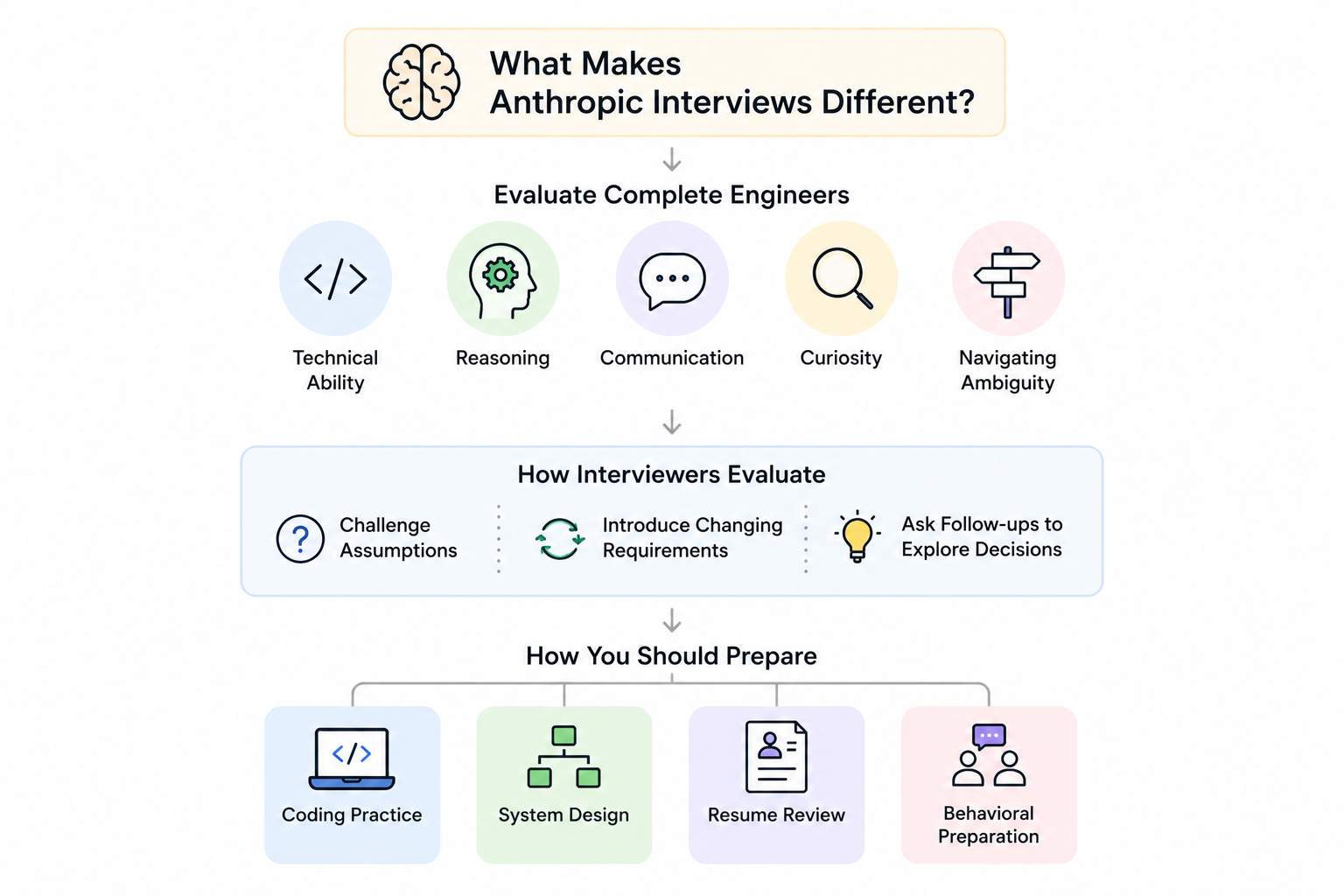
Anthropic interviews are designed to evaluate complete engineers rather than candidates who excel in only one area. Strong technical ability is essential, but interviewers also pay close attention to reasoning, communication, curiosity, and your ability to navigate ambiguity.
Instead of looking for memorized answers, interviewers generally want to understand your thought process. They may challenge assumptions, introduce changing requirements, or ask follow-up questions that explore why you made particular engineering decisions.
Because of this, preparing for Anthropic interview questions should include coding practice, System Design, resume review, and behavioral preparation.
Categories of Anthropic Interview Questions#
Although every role differs slightly, most candidates encounter questions from several broad categories.
Interview Category | Typical Topics |
Coding | Algorithms and data structures |
System Design | Distributed systems and scalability |
Resume Deep Dive | Previous engineering projects |
Behavioral | Collaboration and communication |
AI Fundamentals | Machine learning and LLM concepts |
Engineering Judgment | Tradeoffs and decision-making |
Understanding these categories helps you build a balanced preparation plan rather than focusing on only one interview area.
Coding Interview Questions#
1. How would you solve this coding problem?#
Coding questions remain one of the most common Anthropic interview questions. Rather than expecting an immediate solution, interviewers usually want candidates to explain assumptions, compare multiple approaches, and gradually improve their implementation.
Sample Answer#
Start by clarifying the problem and identifying edge cases before writing code. Explain an initial solution, discuss its time and space complexity, and then refine it into a more efficient implementation while continuing to communicate your reasoning throughout the exercise.
2. Can you optimize your solution?#
Many coding interviews include follow-up questions after an initial solution. Interviewers often want to see whether you recognize opportunities to reduce complexity or improve scalability.
Sample Answer#
After presenting a working solution, discuss possible optimizations such as replacing nested loops with hash maps, reducing unnecessary memory usage, or improving the algorithm from quadratic to linear or logarithmic complexity where appropriate. Explain the tradeoffs rather than assuming optimization is always beneficial.
3. How would you test this implementation?#
Writing correct code is only part of the evaluation. Interviewers frequently ask how you would verify your solution before deploying it.
Sample Answer#
Describe several categories of tests, including normal inputs, boundary conditions, empty collections, duplicate values, invalid inputs, and large datasets. Demonstrating a structured testing strategy shows engineering maturity beyond simply writing code.
Grokking the Coding Interview Patterns

I created Grokking the Coding Interview because I watched too many talented engineers fail interviews they should have passed. At Microsoft and Meta, I saw firsthand what separated the candidates who succeeded from the ones who didn't. It wasn't how many LeetCode problems they'd solved. It was whether they could look at an unfamiliar problem and know how to approach it the right way. That's what this course teaches. Rather than throwing hundreds of disconnected problems at you, we organize the entire coding interview around 28 fundamental patterns. Each pattern is a reusable strategy. Once you understand two pointers, for example, you can apply them to dozens of problems you've never seen before. The course walks you through each pattern step by step, starting with the intuition behind it, then building through increasingly complex applications. As with every course on Educative, you will practice in a hands-on way with 500+ challenges, 17 mock interviews, and detailed explanations for every solution. The course is available in Python, Java, JavaScript, Go, C++, and C#, so you can prep in the language you'll actually use in your interview. Whether you're preparing for your first FAANG loop or brushing up after a few years away from interviewing, this course will give you a repeatable framework for cracking the coding interview.
System Design Interview Questions#
4. Design a scalable chat application.#
This is one of the most frequently discussed Anthropic interview questions for experienced backend engineers because it evaluates architecture, scalability, and communication simultaneously.
Sample Answer#
Begin by clarifying functional and non-functional requirements before proposing a high-level architecture. Discuss API gateways, load balancers, WebSocket connections, databases, caching, message queues, and monitoring while explaining how each component contributes to scalability and reliability.
5. How would you design an API serving millions of users?#
Interviewers want to understand how you think about scaling production systems under heavy traffic.
Sample Answer#
Start with a simple architecture and then discuss horizontal scaling, caching layers, database replication, rate limiting, load balancing, observability, and fault tolerance. Explain how each design decision addresses a particular scalability challenge instead of presenting every component at once.
6. How would you improve system reliability?#
Reliability is particularly important for AI infrastructure, making this one of the more valuable Anthropic interview questions to prepare for.
Sample Answer#
Discuss redundancy, graceful degradation, health checks, retries with exponential backoff, circuit breakers, monitoring, alerting, and disaster recovery. Emphasize preventing failures before discussing how to recover from them.
Grokking Modern System Design Interview

For a decade, when developers talked about how to prepare for System Design Interviews, the answer was always Grokking System Design. This is that course — updated for the current tech landscape. As AI handles more of the routine work, engineers at every level are expected to operate with the architectural fluency that used to belong to Staff engineers. That's why System Design Interviews still determine starting level and compensation, and the bar keeps rising. I built this course from my experience building global-scale distributed systems at Microsoft and Meta — and from interviewing hundreds of candidates at both companies. The failure pattern I kept seeing wasn't a lack of technical knowledge. Even strong coders would hit a wall, because System Design Interviews don't test what you can build; they test whether you can reason through an ambiguous problem, communicate ideas clearly, and defend trade-offs in real time (all skills that matter more than ever now in the AI era). RESHADED is the framework I developed to fix that: a repeatable 45-minute roadmap through any open-ended System Design problem. The course covers the distributed systems fundamentals that appear in every interview – databases, caches, load balancers, CDNs, messaging queues, and more – then applies them across 13+ real-world case studies: YouTube, WhatsApp, Uber, Twitter, Google Maps, and modern systems like ChatGPT and AI/ML infrastructure. Then put your knowledge to the test with AI Mock Interviews designed to simulate the real interview experience. Hundreds of thousands of candidates have already used this course to land SWE, TPM, and EM roles at top companies. If you're serious about acing your next System Design Interview, this is the best place to start.
Resume and Technical Deep Dive Questions#
7. Tell me about your most technically challenging project.#
Interviewers frequently select projects directly from your resume and spend considerable time exploring implementation details.
Sample Answer#
Choose a project where your contribution was substantial and clearly explain the problem, architecture, technical challenges, tradeoffs, implementation decisions, and measurable outcomes. Be prepared for several follow-up questions that explore individual design decisions.
8. If you rebuilt this project today, what would you change?#
This question evaluates reflection and continuous learning rather than whether your original implementation was perfect.
Sample Answer#
Identify specific architectural improvements, performance optimizations, or operational enhancements you would make with the benefit of hindsight. Demonstrating thoughtful self-evaluation often creates a stronger impression than insisting the original design was flawless.
9. Describe a difficult production incident.#
Production engineering experience provides valuable evidence of technical judgment and ownership.
Sample Answer#
Explain the root cause, how you investigated the issue, the mitigation strategy, long-term improvements, and the lessons learned. Interviewers generally appreciate structured incident analysis over dramatic storytelling.
Grokking the Product Architecture Interview
I created Grokking Product Architecture after noticing a growing gap in how engineers prepare for the modern product architecture interview. While traditional System Design focuses heavily on backend scalability, many candidates struggle when asked to think from the client’s perspective, like how real users interact with products, how APIs are designed, and how those interactions translate into seamless experiences. Having worked on product-facing systems, I’ve seen that strong candidates understand the full lifecycle of a request. They can trace how a client call flows through APIs, interacts with services, and ultimately delivers a fast, reliable experience. That’s a very different skill set, and one that isn’t taught well in most System Design resources. That’s why I built this course. In Grokking Product Architecture, you’ll learn how to approach product architecture interview problems with a structured, practical mindset. Instead of treating APIs as an afterthought, we place them at the center of design. You’ll explore how to translate product requirements into clean, efficient APIs and how to design systems that minimize client-visible latency. We anchor these concepts in real-world scenarios. You’ll design products like YouTube, Stripe, and Zoom, breaking them down from the client’s perspective and understanding how each component works together. Along the way, you’ll use a reference backend implementation to see exactly how API calls flow through a system. By the end, you’ll be able to design it confidently, communicate it clearly, and stand out in your next product architecture interview.
Behavioral Interview Questions#
10. Tell me about a disagreement with a teammate.#
Behavioral Anthropic interview questions often explore collaboration because engineering work depends heavily on effective communication.
Sample Answer#
Describe the disagreement objectively, explain how different perspectives were considered, discuss how the final decision was reached, and highlight what you learned from the experience. Focus on collaboration rather than proving you were correct.
11. Describe a time you made a mistake.#
Interviewers want to understand accountability and learning rather than perfection.
Sample Answer#
Choose an example where you accepted responsibility, addressed the issue quickly, communicated transparently with stakeholders, and implemented changes that prevented similar problems from occurring again.
12. How do you prioritize competing tasks?#
Engineering teams frequently balance technical debt, feature development, and production issues simultaneously.
Sample Answer#
Explain how you evaluate customer impact, business priorities, technical risk, dependencies, and deadlines before deciding where to focus. Demonstrating structured prioritization often matters more than any specific framework.
Grokking the Behavioral Interview

Behavioral interviews have become a decisive part of the hiring process across roles. Whether you’re a software engineer, product manager, or engineering leader, strong technical skills alone are no longer enough. Companies are evaluating how you think, communicate, and operate in real-world situations. That’s why preparing specifically for behavioral interviews is critical. This is why I built this course around a common gap: candidates often underestimate behavioral interviews or prepare for them too late. As a result, even strong candidates struggle to clearly articulate their experiences, decisions, and impact. The goal here is to give you a structured way to approach behavioral questions with clarity and confidence. You’ll learn how to break down common behavioral interview questions, structure your answers, and communicate your experiences effectively. The course also includes a video recording feature, allowing you to practice your responses, review them, and improve over time. By the end, you’ll have a repeatable approach to behavioral interviews, one that helps you present your experiences clearly and perform with confidence in any interview setting.
AI and Engineering Judgment Questions#
13. Why are you interested in Anthropic?#
Among all Anthropic interview questions, this is one of the first you may encounter during recruiter and hiring manager conversations.
Sample Answer#
Discuss your interest in building reliable AI systems, solving technically challenging problems, and contributing to products that responsibly advance artificial intelligence. Avoid generic statements that could apply equally to every technology company.
14. What challenges do large language models introduce for engineering teams?#
Candidates interviewing for AI-related positions may encounter questions that explore their understanding of modern AI systems.
Sample Answer#
Discuss challenges such as latency, inference costs, hallucinations, evaluation, monitoring, prompt engineering, retrieval systems, model deployment, and responsible AI practices. Connect these technical challenges to production engineering rather than discussing research alone.
15. How do you approach technical decisions with incomplete information?#
Engineering rarely provides perfect information, making this one of the most insightful Anthropic interview questions.
Sample Answer#
Explain that you begin by gathering available evidence, identifying assumptions, evaluating tradeoffs, and choosing an approach that balances risk with available information. You should also emphasize monitoring results after implementation and remaining willing to revise decisions as new information becomes available.
Ace the AI Engineer Interviews
This course prepares candidates to confidently tackle AI interviews by covering the most relevant and in-demand topics. You’ll explore neural network training (gradient descent, transfer learning, and model compression), language processing (tokenization, embeddings, and decoding), and transformer attention mechanisms (self-attention, cross-attention, and flash attention). You’ll gain a solid understanding of evaluation metrics like perplexity, BLEU, and ROUGE, and dive into modern AI challenges, including hallucinations, jailbreaks, and interpretability. You’ll also learn cutting-edge methods such as RAG, few-shot learning, and chain-of-thought prompting. You’ll explore efficiency, scalability, Mixture of Experts, vector databases, and agentic AI behaviors.
Tips for Answering Anthropic Interview Questions#
Preparing effective answers requires more than memorizing scripts. Interviewers generally prefer candidates who communicate naturally while adapting their responses to the discussion.
When preparing for Anthropic interview questions, focus on understanding the reasoning behind your answers instead of rehearsing exact wording. Practicing aloud with mock interviews often produces greater improvements than silently reading solutions because it develops both technical communication and confidence.
For behavioral questions, using a structured framework helps keep your answers organized. For technical questions, explain your assumptions before proposing solutions and continue discussing tradeoffs as the conversation evolves.
Common Mistakes Candidates Make#
Many candidates spend all of their preparation time solving coding problems while overlooking resume discussions and behavioral interviews. Since Anthropic evaluates multiple dimensions of engineering ability, this narrow approach can leave significant gaps during the interview process.
Another common mistake is rushing toward answers without clarifying requirements. Whether discussing algorithms or distributed systems, interviewers usually appreciate candidates who ask thoughtful questions before proposing solutions and who explain their reasoning throughout the conversation.
Final Thoughts#
Preparing for Anthropic interview questions requires a balanced approach that combines technical knowledge with strong communication and engineering judgment. While coding and System Design remain important, your ability to explain decisions, reflect on previous projects, and collaborate effectively often plays an equally significant role in the hiring process.
By practicing these common Anthropic interview questions, reviewing your previous engineering work, and developing clear, structured answers, you'll be much better prepared to navigate every stage of the interview process with confidence.
Table: Quick Review of the 15 Questions#
# | Question | Interview Focus |
1 | Solve a coding problem | Algorithms |
2 | Optimize your solution | Complexity analysis |
3 | How would you test it? | Code quality |
4 | Design a chat application | System Design |
5 | Design a scalable API | Scalability |
6 | Improve system reliability | Distributed systems |
7 | Most challenging project | Resume deep dive |
8 | What would you change today? | Engineering judgment |
9 | Describe a production incident | Ownership |
10 | Disagreement with a teammate | Collaboration |
11 | Tell me about a mistake | Accountability |
12 | Prioritizing competing work | Decision making |
13 | Why Anthropic? | Motivation |
14 | LLM engineering challenges | AI knowledge |
15 | Making decisions with uncertainty | Technical judgment |
