Beginner-friendly roadmap to learn data engineering with Python
Ready to start your data engineering journey with Python? Follow this beginner-friendly roadmap covering Python, SQL, ETL, cloud tools, and real-world projects to build scalable data pipelines confidently.
If you are thinking about becoming a data engineer, you are aiming at one of the most in-demand roles in modern technology. Data engineering sits behind every analytics dashboard, machine learning model, and business intelligence report. It is the discipline that ensures data is collected, transformed, stored, and made accessible reliably.
You might already know some Python. You might have worked with data analysis or even basic scripting. But data engineering requires a broader systems mindset. It combines programming, databases, distributed systems, and cloud infrastructure.
Data Engineering Foundations in Python
Data engineering is currently one of the most in-demand fields in data and technology. It intersects software engineering, DataOps, data architecture, data management, and security. Data engineers, such as analysts and data scientists, lay the foundation to serve data for consumers. In this course, you will learn the foundation of data engineering, covering different parts of the entire data life cycle: data warehouse, ingestion, transformation, orchestration, etc. You will also gain hands-on experience building data pipelines using different techniques such as Python, Kafka, PySpark, Airflow, dbt, and more. By the end of this course, you will have a holistic understanding of data engineering and be able to build your data pipelines to serve data for various consumers.
The good news is that Python is one of the most widely used languages in data engineering. It is versatile, powerful, and supported by a rich ecosystem of libraries. What you need is a clear and beginner-friendly roadmap that prevents overwhelm and builds skill step by step.
This blog will walk you through exactly that.
Understanding what data engineering really involves#
Before diving into tools and technologies, it is important to understand what data engineering actually means.
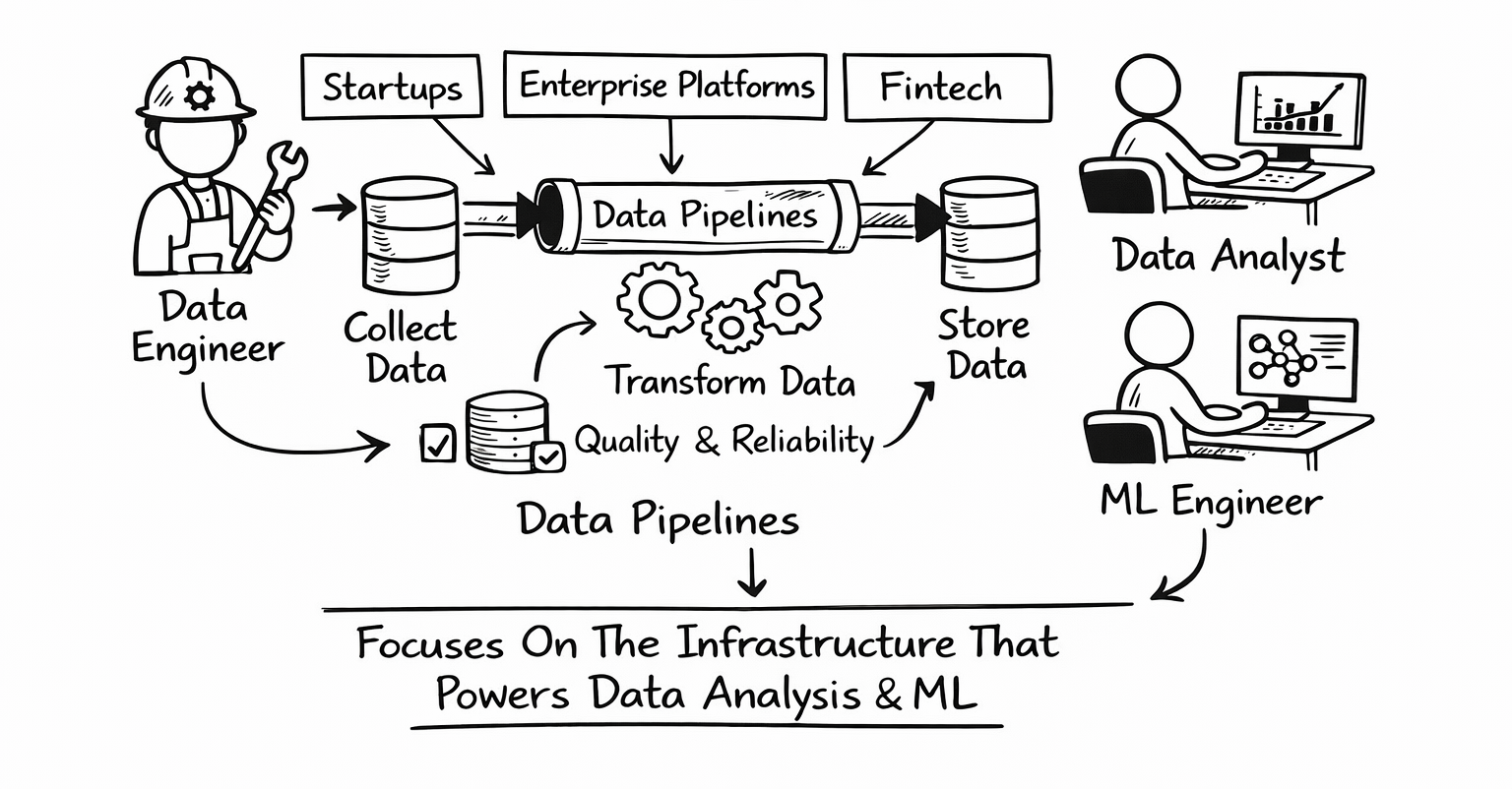
Data engineers design and build systems that collect raw data, transform it into usable formats, and store it efficiently. They create data pipelines that move data between services. They ensure data quality, scalability, and reliability.
Unlike data analysts, who primarily analyze and visualize data, data engineers focus on infrastructure and pipelines. Unlike machine learning engineers, who build predictive models, data engineers focus on feeding those models clean and structured data.
This distinction matters because it shapes your learning path.
Learn Data Engineering
As organizations scale their use of data, the bottleneck is infrastructure. Data engineering has become the backbone of modern data systems, enabling reliable pipelines, scalable storage, and real-time processing. Yet many professionals struggle to learn data engineering beyond isolated tools. This course is designed to give you a systems-level understanding of data engineering, so you can build and reason about data platforms with confidence. I built this course from my experience working with data-intensive systems and teaching how complex architectures evolve under real-world constraints. A consistent pattern I observed was that learners could write queries or use frameworks, but lacked a clear mental model of how data flows through systems end-to-end. This course addresses that gap by focusing on how to learn data engineering as a cohesive discipline, not just a collection of technologies. You’ll start by understanding how data moves across systems and how to work with structured data using SQL and Python. From there, you’ll handle semi-structured and unstructured data with NoSQL systems like MongoDB. The course then moves into designing scalable architectures using data warehouses and lakehouses, followed by working with big data technologies such as Hadoop, Spark, and Kafka, all framed through practical system design patterns. If you want to learn data engineering in a way that prepares you to build reliable, scalable data systems, this course provides a clear and structured path forward.
Phase 1: Strengthen your Python fundamentals#
Your journey begins with Python.
Becoming a data engineer requires more than basic scripting. You need to be comfortable with writing clean, modular code. You should understand functions, classes, error handling, and file operations deeply.
You should also master working with structured data. Libraries such as pandas and NumPy are foundational. They allow you to clean and transform datasets before they enter production pipelines.
Here is how core Python skills connect to data engineering tasks:
Python Skill | Data Engineering Application |
File handling | Processing CSV, JSON, and log files |
Pandas | Transforming structured datasets |
Exception handling | Building reliable pipelines |
Logging | Monitoring data flows |
Virtual environments | Managing dependencies |
Without strong Python fundamentals, advanced tools will feel unnecessarily complex.
Learn Python
Python has become the foundation for everything from data science and automation to modern AI workflows. Yet many beginners struggle to learn Python because they spend too much time watching and not enough time building. This course is designed for a different kind of learner, one who wants to learn Python by doing, not just observing, and to build skills that remain relevant in an AI-driven development landscape. I built this course from my experience teaching and designing interactive learning systems at Educative. Across classrooms and platforms, I saw the same pattern: learners could follow tutorials, but struggled to apply concepts independently. The problem was the approach. This course is built on a simple principle: you learn Python best when you write, test, and refine code continuously. You’ll start with core fundamentals, variables, control flow, functions, and data structures, through hands-on exercises that reinforce real understanding. As you progress, you’ll build practical projects like a chatbot and an expense tracker. The course also introduces how to learn Python alongside AI tools, including prompting, debugging, and validating generated code in real workflows. If your goal is to learn Python in a way that prepares you to build real applications and work effectively with AI, this course gives you that foundation from day one.
Phase 2: Learn SQL and database fundamentals#
Data engineering revolves around databases.
You must learn SQL thoroughly. Understanding how to write SELECT queries is not enough. You should be comfortable with joins, aggregations, indexing, and query optimization.
You also need to understand relational database concepts such as normalization, primary keys, foreign keys, and transactions. Data engineering often requires designing schemas that balance performance and flexibility.
Here is a conceptual breakdown:
Concept | Why It Matters |
Joins | Combining datasets from multiple tables |
Indexing | Improving query performance |
Normalization | Reducing redundancy |
Transactions | Ensuring data consistency |
Query optimization | Handling large-scale data efficiently |
SQL mastery is non-negotiable for data engineers.
Phase 3: Understand ETL and data pipelines#
ETL stands for Extract, Transform, and Load. It is the core workflow of data engineering.
You extract data from sources such as APIs or databases. You transform it into a usable format. You load it into storage systems or data warehouses.
In Python, you can implement simple ETL pipelines using libraries like pandas. You might extract data from an API, clean it, and store it in a database.
Understanding the ETL conceptually prepares you for more advanced tools later.
Phase 4: Learn about data warehouses and storage systems#
As you progress, you need to understand where data lives.
Data warehouses are designed for analytical workloads. They differ from transactional databases. Concepts such as star schemas, fact tables, and dimension tables become important.
You should also learn about file formats used in big data environments, such as Parquet and ORC. These formats optimize storage and query performance.
Understanding storage systems expands your perspective beyond simple database tables.
Phase 5: Explore workflow orchestration tools#
Real-world data pipelines require automation.
Tools such as Apache Airflow orchestrate complex workflows. They schedule tasks, manage dependencies, and monitor failures.
In Python, you define workflows programmatically. Learning how tasks are scheduled and monitored introduces you to production-grade systems.
Orchestration tools transform isolated scripts into reliable systems.
Phase 6: Understand distributed data processing#
As data volume grows, single-machine processing becomes insufficient.
Frameworks such as Apache Spark allow distributed data processing. Python integrates with Spark through PySpark.
You do not need to master distributed systems immediately, but understanding concepts such as parallel processing and cluster computing is important.
Here is a simplified comparison:
Processing Type | Best For |
Single-machine Python | Small to medium datasets |
PySpark | Large-scale distributed data |
SQL engines | Structured data querying |
Distributed thinking prepares you for scalable systems.
Phase 7: Learn cloud fundamentals#
Modern data engineering often happens in the cloud.
Platforms such as AWS, Google Cloud, and Azure offer data storage, processing, and orchestration services. Understanding cloud storage, object storage, and managed databases is critical.
You should learn how to deploy Python-based pipelines in cloud environments. Familiarity with cloud services increases your employability significantly.
Cloud knowledge bridges local experimentation and production deployment.
Building projects to integrate everything#
Projects are essential.
Instead of learning tools in isolation, build end-to-end pipelines. For example, you might create a system that extracts data from a public API, transforms it, stores it in a database, and schedules updates automatically.
Projects expose integration challenges. You learn about debugging failures, monitoring logs, and handling unexpected data formats.
Here is how learning approaches compare:
Learning Mode | Skill Depth |
Watching tutorials | Low |
Completing exercises | Moderate |
Building full pipelines | High |
Projects transform knowledge into experience.
Avoiding common beginner mistakes#
Many beginners try to learn every big data tool immediately. This leads to confusion.
Focus first on Python and SQL. Build simple ETL pipelines locally before exploring distributed frameworks. Avoid skipping foundational concepts.
Another mistake is ignoring data quality. Clean data is the backbone of reliable systems.
Patience and structured progression are key.
Suggested beginner roadmap timeline#
You can structure your journey in phases:
Stage | Focus Area |
Months 1–2 | Python and pandas mastery |
Months 3–4 | SQL and database design |
Months 5–6 | ETL pipelines and workflow tools |
Months 7–8 | Distributed systems basics |
Months 9–10 | Cloud services and deployment |
Timelines vary, but progression matters more than speed.
Final thoughts#
So, can I recommend a beginner-friendly roadmap to learn data engineering with Python? Absolutely.
Start with strong Python fundamentals. Master SQL. Understand ETL pipelines. Learn about data warehouses. Explore orchestration tools. Gradually introduce distributed systems and cloud platforms. Build projects consistently.
Data engineering is not mastered overnight. It is built through layered learning and practical application.
If you approach the journey intentionally, you will move from writing simple scripts to designing reliable, scalable data systems that power modern technology.