Updated November 20, 2026. We review this list every week and update it whenever a resource changes.
An AI agent is a model running in a loop: it calls a tool, reads what comes back, and decides what to do next. Getting one to work reliably takes more than a good prompt, and much of what you need to learn changed over the last year. The Model Context Protocol has a new version, OpenAI, Anthropic, and Google each ship their own agent SDK, and evaluating agents has become a subject of its own.
The fastest way in is short: Read two free essays that define the vocabulary, take one hands-on course, and pick one framework. Then build a small agent with a few test cases before you go deeper. This guide covers the books, courses, essays, framework docs, papers, and newsletters for each of those steps, with every entry checked against its own source.
What changed in 2026#
Agent tooling changes faster than most "best of" lists get updated, so here are the dated changes first.
The Model Context Protocol has a newer spec. The current revision is 2026-07-28, and the one before it was 2025-11-25, so check which version a tutorial targets before you copy its code.
The most-cited agent essay now carries a warning. Anthropic published Building effective agents on December 19, 2024. It now opens with a note that much of the tooling it describes has changed since then, and it points readers to Anthropic's newer Managed Agents material. Its advice on when to skip agents altogether is still the best short read on the subject.
Evaluation got its own reading list. Anthropic published Demystifying evals for AI agents on January 9, 2026, and the Hugging Face Agents Course now has a bonus unit on agent observability and evaluation.
Frameworks went multi-language. Google's Agent Development Kit now ships in Python, TypeScript, Go, Java, and Kotlin, and Microsoft's free beginner course builds its code samples on Microsoft Agent Framework.

Books#
Agent books age quickly, so we kept only three whose core material still applies. Two are about building the application, and one is about the model underneath it.
AI Engineering by Chip Huyen (O'Reilly, 2025) covers building applications on foundation models end to end, including evaluation, prompting, finetuning, and a chapter on RAG and agents. It suits engineers who want the whole system around an agent, and it is more than you need for a first weekend project.
AI Agents in Action by Micheal Lanham (Manning, February 2025, 344 pages) works through building, orchestrating, and deploying multi-agent systems. Read it if you learn best from one long build. Framework details in any 2025 book will lag the current docs, so pair it with the framework section below.
Build a Large Language Model (From Scratch) by Sebastian Raschka (Manning, 2024) has you implement a ChatGPT-like model in PyTorch, step by step. You can build agents without it. Read it if you want to know what the model inside your agent is doing when it runs out of context or ignores an instruction.
Courses#
A course gives you a fixed order and exercises that make you write the loop yourself. The free courses come from the teams behind the frameworks. The interactive ones go deeper on agent design and on specific tools.
Free courses#
Hugging Face AI Agents Course takes you from agent concepts to hands-on units in smolagents, LlamaIndex, and LangGraph, then an agentic RAG use case and a final project you can submit for a certificate. Bonus units cover finetuning a model for function calling, and agent observability and evaluation. It suits people who want to try several frameworks before committing to one.
Introduction to LangGraph from LangChain Academy has 55 lessons and about 6 hours of video on state and memory, human-in-the-loop, and building and deploying an assistant. Take it once you have chosen LangGraph.
AI Agents for Beginners from Microsoft is an MIT-licensed course of 18 lessons on GitHub. Its code samples use Microsoft Agent Framework and Foundry Agent Service, and most of them need an Azure account, so it fits best if your team already builds on Azure.
Interactive courses#
Agentic System Design has 45 lessons across 13 modules, 8 quizzes, a project, an AI mock interview, and 2 breakout sessions with a virtual coach. It starts with agent components, memory, orchestration patterns, and guardrails, then works through case studies such as a multi-agent conversational recommender, Nvidia's Eureka reward-learning agent, and a multimodal web agent, and implements two of them with Google's ADK. It suits engineers preparing for agentic System Design interviews, or anyone who wants to reason about the architecture before writing code.
Master Agentic Design Patterns covers the core building blocks that agentic systems are assembled from, in 14 lessons and about 4 hours.
LangGraph: From LangChain User to Agent Builder teaches stateful LangGraph workflows with memory, loops, and routing, in 22 lessons and about 7 hours.
Build AI Agents Using Google ADK covers agent anatomy, multi-agent collaboration, and sequential, parallel, and loop workflows, in 17 lessons and about 3 hours.
MCP Fundamentals for Building AI Agents walks you through building MCP servers and clients, in 12 lessons and about 2 hours.
LLM Evaluation: Building Reliable AI Systems at Scale covers traces, synthetic data, and testing for agents and RAG systems, in 16 lessons and about 2 hours.
Agentic System Design
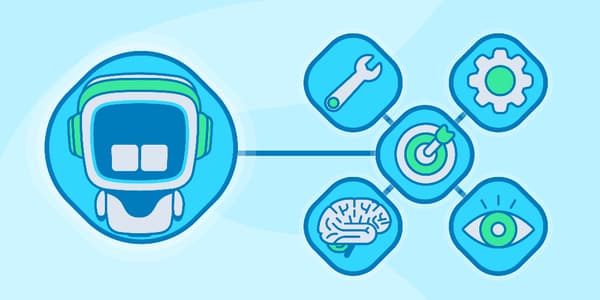
Agentic system design is rapidly redefining how modern AI systems are built, moving from single-model interactions to autonomous, multi-step systems that can reason, plan, and act. As large language models evolve, the real challenge is no longer just using them, but orchestrating them into reliable, goal-driven agents that operate safely and effectively in real-world environments. I built this course from my work in adaptive AI and intelligent systems, where designing autonomous behavior requires more than model accuracy. It demands structured reasoning, control, and safety. A recurring pattern I observed was that teams could experiment with LLMs, but struggled to design cohesive agentic systems that could handle ambiguity, coordinate tasks, and remain aligned with user intent. This course is designed to bring that structure. You will study real-world examples, including the Multi-Agent Conversational Recommender System (MACRS), NVIDIA’s Eureka for reward generation, and advanced agents navigating live websites and creating complex images. Drawing on insights from industry deployments and cutting-edge research, you will gain the foundational knowledge to confidently start designing your agent-based systems. Engineers and researchers are already using these patterns to build next-generation AI systems. If you want to design agents that go beyond prompts and into action, this is where to begin.
LangGraph: From LangChain User to Agent Builder

As AI applications transition from prototypes to production systems, the limitations of linear chaining become apparent. Real-world agents require memory, branching logic, retry mechanisms, and human-in-the-loop control. These requirements exceed the capabilities of basic LangChain workflows. LangGraph is designed to support the development of stateful, controllable AI systems. To transition from experimental agents to reliable, production-ready architectures, understanding graph-based orchestration is essential. I built this course based on my research and work in intelligent systems, as well as my work on adaptive AI and service-oriented architectures. One consistent gap I’ve seen is that developers can assemble simple chains but face challenges when systems require state, control flow, and resilience. This course presents a structured approach to designing agents, treating them not as sequences of calls, but as systems with state, decision logic, and feedback loops. You’ll learn how to model AI workflows as graphs using LangGraph, starting from simple nodes and shared state, then progressively adding routing, tool usage, memory, and interrupts. The course is built around a single evolving project: a research assistant agent that grows in complexity as you move forward. Instead of isolated examples, each concept is introduced as part of a larger system, with LangSmith used for debugging, tracing, and evaluation throughout. Developers are rapidly adopting graph-based approaches to build more reliable AI agents across industries. If you’re ready to go beyond basic chaining and build systems that behave predictably under real conditions, this course gives you the exact framework and hands-on experience to get there.
Courses at a glance#
Course | Format | Size | Frameworks used | Practice | Access |
AI Agents Course (Hugging Face) | Text with hands-on units | 4 units plus 3 bonus units | smolagents, LlamaIndex, LangGraph | Final project, student leaderboard, certificate | Free |
Introduction to LangGraph (LangChain Academy) | Video | 55 lessons, about 6 hours | LangGraph | Not listed | Free |
AI Agents for Beginners (Microsoft) | Lessons and code on GitHub | 18 lessons | Microsoft Agent Framework, Foundry Agent Service | Code samples (Azure account needed) | Free, MIT license |
Agentic System Design (Educative) | Text, interactive | 45 lessons across 13 modules | Google ADK in two case studies | 1 project, 1 AI mock interview, 8 quizzes, 2 breakout sessions | Subscription |
Free guides and essays#
Most of the useful writing on agents is free, short, and written by people who build them.
Building effective agents from Anthropic (December 2024) draws the distinction most teams now use. In workflows, models and tools follow predefined code paths, and in agents, the model directs its own process and tool use. Across the dozens of teams Anthropic worked with, the most successful implementations used simple, composable patterns instead of complex frameworks. Read the note at the top about what has changed since.
LLM Powered Autonomous Agents by Lilian Weng (June 2023) is the standard overview of planning, memory, and tool use, the three components most agent designs still map onto, with case studies. It takes about half an hour to read.
Demystifying evals for AI agents from Anthropic (January 2026) covers how an evaluation is structured, how to evaluate agents specifically, and a roadmap for going from no evals to good ones, with an appendix of eval frameworks.
12-Factor Agents from HumanLayer sets out principles for building LLM software that is good enough to put in front of production customers. It has about 27,000 stars on GitHub.
Simon Willison's ai-agents tag collects more than 100 posts on what agents can and can't do. His working definition, "LLMs calling tools in a loop to achieve a goal," is the most useful one-line definition we know.

Framework and protocol docs#
Pick one framework and read its docs end to end before you compare it with others. These five are the most common starting points.
OpenAI Agents SDK keeps a very small set of primitives, which are agents with instructions and tools, handoffs between agents, and guardrails on inputs and outputs. OpenAI calls it a production-ready upgrade of its earlier Swarm experiment.
LangGraph is a low-level orchestration framework and runtime for long-running, stateful agents, with durable execution, streaming, and human-in-the-loop support. Choose it when you need to mix fixed steps and model-driven steps in one graph.
Google Agent Development Kit is open source and available in Python, TypeScript, Go, Java, and Kotlin. Version 2.0 of the TypeScript release added graph workflows.
Claude Agent SDK gives you the same tools, agent loop, and context management that power Claude Code, programmable in Python and TypeScript.
Model Context Protocol is the open protocol for connecting agents to tools and data. Hosts, clients, and servers exchange JSON-RPC 2.0 messages, and servers can offer resources, prompts, and tools. Learn plain tool calling first, and add MCP when you need the same tools across several apps.

Papers#
The frameworks above mostly package ideas from a handful of papers. These are the ones whose vocabulary you will meet in every set of docs and in most interviews.
ReAct (Yao and colleagues, 2022) interleaves reasoning with actions, and it is the source of the reason, act, and observe loop behind many agent frameworks.
Toolformer (Schick and colleagues, 2023) showed that a language model can teach itself when and how to call external tools.
Reflexion (Shinn and colleagues, 2023) has agents improve through written feedback on their own attempts instead of weight updates, which is the idea behind the reflection pattern.
Generative Agents (Park and colleagues, 2023) gave a small town of twenty-five simulated characters memory, reflection, and planning, and it is still the clearest worked example of agent memory.
SWE-bench (Jimenez and colleagues, 2023) tests whether models can resolve real GitHub issues, and τ-bench (Yao and colleagues, 2024) tests agents that use tools while talking to users in realistic domains. Reading how they score agents is the fastest way to design your own evals.

Practice#
Reading about agents teaches you far less than building one and watching where it goes wrong, so start with something small.
Build one agent with one or two tools. A research agent that searches, cites what it found, and asks for approval before any action with side effects exercises the whole loop. Write a handful of test cases for it so you can tell when a change breaks something.
Educative AI Mock Interviews include a 45-minute Agentic System Design interview, in which you design and refine a production AI agent with an AI interviewer. Premium includes 3 mock interviews a month and Premium Plus includes 7.
The Hugging Face course's final project puts your agent on a student leaderboard, which gives you an outside benchmark at no cost.

Newsletters, podcasts, and videos#
The docs above will change again before the year is out, so these are for keeping up after the course.
Latent Space is a publication, podcast, and community for people turning AI research into working software. It publishes original essays, a daily AI News briefing, and long conversations with engineers, researchers, and founders.
Import AI is Anthropic co-founder Jack Clark's weekly newsletter on AI research and policy.
Ahead of AI is Sebastian Raschka's newsletter on LLM research, with long explainers on model architectures and reasoning models.
Interconnects is Nathan Lambert's newsletter and podcast on post-training, open models, and the AI industry.
Practical AI is a long-running podcast on making AI practical, from building agents to running models in production.
AI Engineer is the YouTube channel of the AI Engineer conferences, with talks from builders at the major labs and startups, including the 2026 World's Fair in San Francisco.
Educative's AI Newsletter covers new models and agent tooling, with explainers such as one on Google's Agent2Agent protocol and one on agentic RAG.

How we choose and update this list#
Everything here is something we have seen recommended repeatedly by engineers who build agents, in framework communities, and in the answers AI assistants give when asked where to learn agentic AI. We then checked each resource against its own page in November 2026 for format, size, price, and date, and noted where a free resource does the job. Every week we re-check each entry against its source, add new resources that have earned a place, and update or remove anything that has changed or gone stale.
FAQ#
Do I need to pay for anything? No. The Hugging Face course, LangChain Academy, Microsoft's course, the Anthropic essays, the papers, and the framework docs are all free. What you pay for is structured practice, certificates, and the model API calls your agent makes.
Which framework should I learn first? Start with the one your team or target employer already uses. If there is no such framework, write the agent loop in plain Python first, and then try one framework from the list above so you can see what it does for you.
What is the difference between generative AI and agentic AI? Generative AI produces content from a prompt. An agent wraps a model in a loop where it calls tools, reads the results, and decides what to do next. Anthropic's essay adds a useful middle category, workflows, where your code fixes the steps and the model fills them in.
Do I need MCP? You need it when you want one set of tools to work across several agents or apps. For a single agent with two tools, plain function calling is enough, and you can add MCP later.
How does agentic AI come up in interviews? Mock interview platforms now include agentic System Design rounds, among them Educative's 45-minute Agentic System Design mock. Be ready to design an agent's tools, memory, orchestration, and guardrails for a scenario, and to explain how you would evaluate it. For the wider round, see the best System Design resources for 2026.
Do you have lists like this for other topics? Yes. The best cloud computing resources follow the same format, and we keep them current the same way.
