The system design interview is the round that sets your level and your offer — and it’s the one most engineers are typically the least prepared for. Not for lack of material: there’s actually too much of it, and most of it was written for loops that stopped running years ago. The useful question is not which system design resources exist. It is where to spend the thirty to forty hours you actually have.
We have a specific vantage point on that. Educative has taught System Design to more than three million developers since 2015. Our founders ran hundreds of these interviews at Microsoft and Meta before writing the courses. And we have read or used everything on this list, including the resources that compete with ours. Our own course appears once, in its place, and where a competitor is the better fit for a particular need, we say so.
Here’s the short answer: read one book, work through one structured course, then spend most of your time on free primary sources — the System Design Primer, company engineering blogs, and a handful of foundational papers. Below is the full list, with what each resource is good for and who it is not for.
Everything below is something we have seen recommended repeatedly in Reddit and Blind threads, in the GitHub lists, and by candidates and interviewers we work with, and that we have read or used ourselves. Where a resource is ours, we say so. Where a competitor's resource is the better fit for a particular need, we say that too. And where a resource has not kept pace with what interviews now ask, we name the gap specifically rather than leaving you to discover it in the room.
Let's start with the best books available.
Books#
Two of these are about the interview and two are about the systems underneath it. If you only have time for one, take the first.
System Design Interview – An Insider's Guide, Vol. 1 and 2 — Alex Xu (Vol. 2 with Sahn Lam). The most-recommended interview books: each chapter walks one classic problem (rate limiter, key-value store, news feed, chat) through a four-step framework. Best for: anyone with an interview in the next one to three months. Not for: learning distributed systems from first principles, or for AI-era systems, which postdate both volumes.
Designing Data-Intensive Applications — Martin Kleppmann. The reference text on replication, partitioning, transactions, consensus and stream processing. Best for: understanding why the interview answers work. Not for: a two-week cram.
Understanding Distributed Systems — Roberto Vitillo. Shorter and gentler than DDIA; a good first book if you have never built a distributed system.
Grokking System Design in 2026: The Only Way To Master Your System Design Interview — Fahim ul Haq (Educative). A short read, 42 pages, on how the interview has changed and what to prepare for in the version being run now. Best for: a first read before the longer books, or the week before the loop.
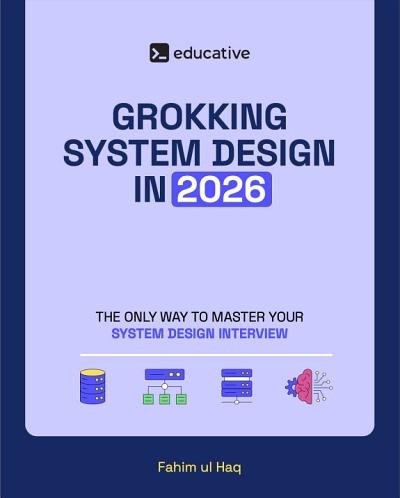
The newest entry on the list, and the shortest: Grokking System Design in 2026 (Educative, November 2025).
Courses#
A course buys you a fixed sequence and a place to practice out loud. The four below differ mostly in depth and in how far they reach into AI-era systems, which the table after the list makes explicit.
System Design for Beginners — NeetCode. Text with diagrams, 21 lessons on the fundamentals (networking, caching, load balancing, databases, replication, queues); approachable and pairs well with NeetCode's coding roadmap if you are doing both tracks. Best for: a first pass if you have never studied this. Not for: problem practice; it stops before the worked designs.
Grokking Modern System Design Interview — Educative (that's us). Text-based and interactive, 206 lessons: building blocks first (load balancers, key-value stores, CDNs, sequencers, distributed caches, rate limiters), then the classic case studies (YouTube, Uber, Twitter, WhatsApp, Google Maps, a payment system) and four AI-era ones (a ChatGPT-style system, data infrastructure for AI/ML, an LLM-powered support bot, an AI code assistant), plus 8 AI mock interviews. Best for: people who prefer reading over video and want to practice out loud. Not for: people who want video lectures.
System Design in a Hurry — Hello Interview. A free, written, deliberately short guide (core concepts, key technologies, common patterns, then about 25 problem breakdowns), with paid human mocks and an AI guided-practice mode alongside. It has kept up: the breakdowns include a ChatGPT design and a vector-databases explainer (some behind the premium tier), and there is a separate ML system design guide. Best for: a week-out refresh.
ByteByteGo System Design Interview course — Alex Xu's course companion to the books: the book chapters plus additional problems, 30 in all, with the diagrams the newsletter is known for. No AI-era systems in the chapter list. Best for: readers of the books who want the same material with more visuals.
Courses at a glance#
Course | Format | Size | AI-era systems | Mock interviews | Access |
System Design for Beginners (NeetCode) | Text with diagrams | 21 lessons | None | Not listed | Free lessons, then Pro |
Grokking Modern System Design Interview (Educative) | Text, interactive | 206 lessons, about 26 hours | ChatGPT-style system, AI/ML data infrastructure, LLM support bot, AI code assistant | 8 AI mock interviews | Subscription |
System Design in a Hurry (Hello Interview) | Text guide | 7 sections, about 25 breakdowns | ChatGPT, vector databases (some premium), separate ML guide | Paid human mocks, AI guided practice | Free core, premium tier |
ByteByteGo System Design Interview | Text with diagrams | 30 chapters | None in the chapter list | Not listed | Subscription |
Free guides and primers#
Most of your hours should go here. These are free, they are what the paid courses are summarizing, and the System Design Primer alone covers the fundamentals.
Ultimate System Design Interview Guide for 2026 — Fahim ul Haq. A long-form guide to the interview itself: what interviewers score, the RESHADED approach, and how to structure the 45 minutes. (Fahim is Educative's co-founder.)
The System Design Primer — Donne Martin. The most-starred system design repository on GitHub: a study guide, topic index, back-of-the-envelope tables and worked solutions, with Anki decks. Start here if you start anywhere.
Awesome System Design Resources — AlgoMaster's curated list of concept explainers, interview problems by difficulty, engineering articles and papers.
System Design 101 — ByteByteGo's visual explainers of common systems and protocols, one diagram per topic.
Top 30 System Design Interview Questions — our own deep dive into the questions that come up most, with requirement sketches for each, including the ChatGPT-style service and AI-powered support platform questions that have entered recent loops.

Engineering blogs, papers and real systems#
The interview is a proxy for having read how real systems are built. These are the sources the courses above are summarizing.
High Scalability — two decades of architecture write-ups, including the classics (WhatsApp, Instagram, Stack Overflow).
Netflix Tech Blog, Uber Engineering, Engineering at Meta, Cloudflare Blog, Discord Engineering, Slack Engineering — the company blogs interviewers actually read. If a question says "design Discord," read how Discord stores trillions of messages first.
Dynamo: Amazon's Highly Available Key-value Store and In Search of an Understandable Consensus Algorithm (Raft) — the two papers most worth reading in full. Consistent hashing, vector clocks, quorums and leader election all come from here.
Google SRE Book — free online; the chapters on SLOs, monitoring and handling overload are what "non-functional requirements" means in practice.
Numbers Every Programmer Should Know By Year — the latency table behind every back-of-the-envelope estimate.

Practice and mock interviews#
Nothing in the reading substitutes for saying a design out loud to someone who pushes back. Start mocks by week four, not after you feel ready.
interviewing.io — anonymous mock interviews with engineers from large tech companies; the closest thing to the real room.
Exponent — peer-to-peer mock interviews (Exponent absorbed Pramp), free to schedule.
Hello Interview mock interviews — system-design-specific mocks with written feedback.
Educative AI mock interviews — unlimited practice runs with an AI interviewer, scored against a rubric; useful between human mocks.

Newsletters and YouTube#
For keeping current after the loop, and for watching which systems are turning into standard questions. Two of these are ours, and we say so.
ByteByteGo Newsletter — Alex Xu's weekly illustrated explainer; the widest-read system design newsletter.
The Pragmatic Engineer — Gergely Orosz; deep dives on how real engineering organizations build and ship.
Future Stack — Fahim ul Haq's LinkedIn newsletter on where the engineering stack and engineering careers are heading. The interview-relevant half is which systems are turning into standard questions. (Fahim is Educative's co-founder.)
Grokking Weekly — Educative's LinkedIn newsletter, Tuesdays: one system design or interview concept a week, from a different practitioner each time, with a worked example.
Jordan has no life, Gaurav Sen, Hussein Nasser — three very different YouTube styles: exhaustive problem walk-throughs, classic interview explainers, and backend fundamentals respectively.

A note on what's different about 2026 loops#
The classic problem set has not gone away. You should still be able to design a URL shortener, a news feed, and a ride-matching service on a whiteboard. But a growing share of loops now add a question the older material never anticipated: design a ChatGPT-style service, a retrieval pipeline over a vector store, an LLM-backed support bot, or the data infrastructure that trains and serves a model. The trade-offs are familiar (latency, consistency, cost) but the components are new, and a resource that stops at 2019 will leave you improvising. Where a resource above has kept up, we said so, and where it has not, we named the gap.

FAQ#
Do I need to pay for everything? No. Fahim ul Haq’s Ultimate System Design Interview Guide is free to read on Medium. The System Design Primer, Hello Interview's written guide, the engineering blogs, the SRE book, and the two papers are also all free. Books and courses buy structure and time.
How long should I prepare? With a software engineering background, four to eight weeks of a few hours a week is typical: one to two weeks of fundamentals (primer, DDIA chapters on replication and partitioning), then two to four weeks of problems and mocks. Laid out, it looks like this.

The plan above, as a timeline. The only rule that matters is the last one: mocks start before you feel ready.
Books or courses? Books for depth and for owning the material; courses for structure, a fixed problem sequence and practice. Most people who pass used one of each, then spent the remaining time on mocks.
Do I need to prepare AI-era systems specifically? If the role touches AI at all, yes. Be ready to design an LLM-serving path (prompt in, tokens out, with caching and rate limiting), a retrieval layer over a vector store, and the offline data pipeline behind a model. The building blocks are the ones you already know; the interviewer wants to see you place them in the new shape.
What about low-level / object-oriented design? That is a different interview. Start with Head First Design Patterns, then a dedicated course such as Grokking the Low Level Design Interview or Hello Interview's LLD material.
