



Prepare across software engineering fundamentals, coding, LLM application development, prompt design, evaluations, retrieval, tool use, System Design, reliability, and AI safety. The exact balance should follow the job description because positions closer to models or infrastructure can require considerably deeper machine learning or systems knowledge.
Table of Contents
Anthropic Generative AI Engineer interview: 2026 prep guide
Prepare for the Anthropic Generative AI Engineer interview with focused practice in coding, LLM applications, evaluations, prompting, System Design, and AI safety. Learn what to study, which technical skills matter, and how to approach each interview.
14 mins read
Aug 27, 2026
Share
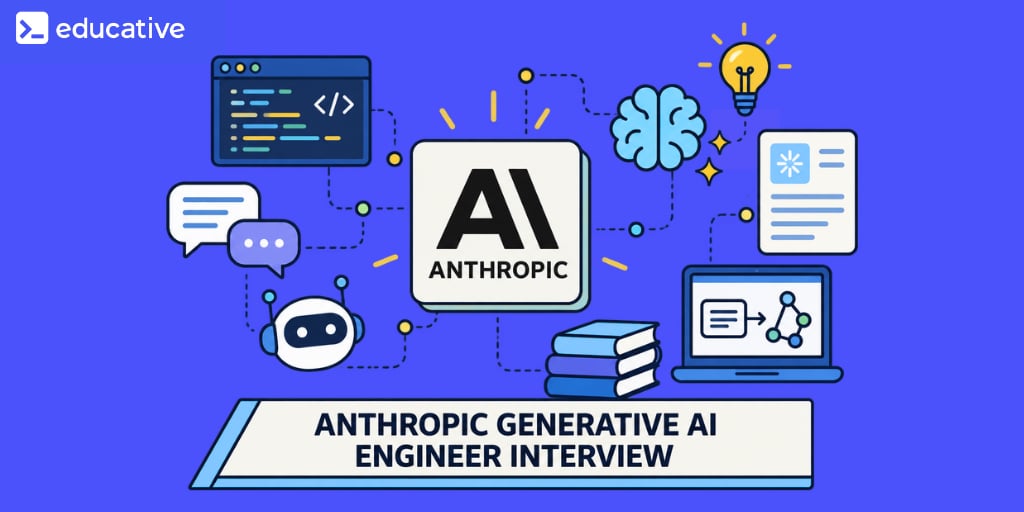
Generative AI engineering sits in an unusual space between traditional software engineering, machine learning, and product development. If you are preparing for an Anthropic Generative AI Engineer interview, you should expect to demonstrate more than your ability to call a model API because the harder engineering problems begin when you need to make an AI-powered system reliable, measurable, safe, and genuinely useful.
This guide breaks down the technical areas worth preparing for the Anthropic Generative AI Engineer interview and shows how those skills fit together. The exact interview process can vary by team and seniority, so use your recruiter guidance and the requirements of the position as the final authority on the interviews you will encounter.
Generative AI Essentials
Generative AI Essentials
Generative AI is rapidly reshaping how software is built, how decisions are made, and how humans interact with machines. From large language models to multimodal systems, understanding generative AI is becoming a foundational skill. This course focuses on generative AI essentials, giving you the conceptual clarity and practical perspective needed to navigate this fast-moving space with confidence. I built this course from my work in adaptive AI systems, intelligent tutoring platforms, and teaching complex machine learning concepts at scale. A recurring challenge I observed was that learners could use generative AI tools, but lacked a clear mental model of how these systems actually work. This course addresses that gap by breaking generative AI down into its core principles and connecting them to real-world applications. You’ll begin with the fundamentals of generative AI, including its evolution, key architectures, and language representations. From there, you’ll explore foundation models, pretraining, fine-tuning, and optimization strategies that power modern systems. The course also covers large language models, multimodal AI (vision and audio), and how context is constructed within neural systems. Throughout, you’ll develop the ability to interpret, guide, and effectively interact with AI systems. If you want to master generative AI essentials and build a strong foundation for working with modern AI systems, this course provides a clear, structured path to get there.
What is the Anthropic Generative AI Engineer interview?#
The Anthropic Generative AI Engineer interview evaluates whether you can take the capabilities of modern language models and turn them into dependable systems that solve real problems. That can require traditional software engineering alongside experimentation, model evaluation, prompt design, retrieval, tool integration, safety thinking, and careful measurement of behavior that is inherently probabilistic.
This distinction is important because building a generative AI model is different from integrating a deterministic API. Model outputs can vary between requests, quality can degrade on unexpected inputs, prompts can become part of your application logic, and improvements often require experimentation rather than a conventional debugging workflow.
The exact process depends on the role, but you can organize your preparation around several broad competencies.
Interview area | What you should prepare to demonstrate |
Coding and problem solving | Clean implementation, algorithms, debugging, and reasoning |
Generative AI engineering | Prompting, context management, tool use, retrieval, structured outputs |
Evaluation | Test-set design, metrics, error analysis, regression detection |
System Design | Reliable and scalable architectures for AI applications |
AI safety and reliability | Failure modes, safeguards, adversarial inputs, monitoring |
Behavioral discussions | Ownership, experimentation, collaboration, and judgment |
For a specialized position, expect the emphasis to shift considerably. An engineer building developer-facing AI products may encounter different technical depth from someone working closer to model behavior, infrastructure, or applied research.
Generative AI Handbook
Generative AI Handbook
Since the rise of generative AI, the landscape of content creation and intelligent systems has profoundly transformed with large language models (LLMs). This free generative AI course will guide you through the fascinating evolution of generative AI, exploring how these models power everything from text generation to advanced multimodal capabilities. You’ll begin with the basics of content creation. You’ll explore what generative AI is and how does generative AI works. You’ll learn how LLMs and diffusion models are used to generate everything from text to images. You’ll get familiar with LangChain and vector databases in managing AI-generated content. You’ll also cover RAG and the evolving role of AI agents and smart chatbots. From fine-tuning LLMs for specialized tasks to creating multimodal AI experiences with AI-powered images and speech recognition, you’ll unlock the full potential of generative AI with this free course and navigate the future challenges of this dynamic field.
What skills should you prepare for the Anthropic Generative AI Engineer interview?#
The strongest preparation starts with software engineering fundamentals and then adds the skills required to work effectively with probabilistic models. Generative AI does not eliminate conventional engineering problems because applications still need APIs, databases, authentication, monitoring, testing, deployment, and reliable failure handling.
What changes is that you now have another complex component whose behavior cannot always be expressed through simple deterministic tests. You should be able to reason about the model as one component within a larger software system rather than treating it as the entire application.
Programming and problem solving#
Strong coding skills remain fundamental because generative AI engineers spend significant time building the systems surrounding models. You should be comfortable taking an ambiguous requirement, defining expected behavior, implementing a clean solution, testing it, and explaining how your approach behaves under different constraints.
Review common data structures and algorithms, but do not restrict preparation to traditional interview puzzles. Practice manipulating structured data, calling APIs, processing asynchronous workloads, implementing retries, parsing model responses, debugging unfamiliar code, and designing maintainable abstractions.
Python is particularly useful throughout the AI ecosystem, although the appropriate language depends on the position. Whatever language you use, prioritize readable code, explicit error handling, thoughtful interfaces, and tests that demonstrate correctness.
Understand how LLM applications actually work#
Knowing how to send text to an LLM is only the starting point. You should understand the major pieces involved in taking user input, assembling context, making a model request, validating the result, invoking external capabilities when necessary, and returning a useful response.
Study tokens, context windows, system instructions, sampling, structured outputs, streaming, tool use, embeddings, retrieval, caching, and conversation state. More importantly, understand the trade-offs created by each technique rather than memorizing terminology.
For example, adding more context can sometimes improve an answer but also increase latency and cost while introducing irrelevant information. Strong generative AI engineering involves recognizing these trade-offs and testing whether a proposed change actually improves the application.
Prompt engineering beyond clever wording#
Prompting should be treated as engineering rather than finding a magical sentence that produces a good demonstration. A production prompt needs clear instructions, appropriate context, predictable output requirements, and a way to measure whether changes improve or damage behavior.
During an Anthropic Generative AI Engineer interview, you should be prepared to diagnose why a model is producing an undesirable result. Your first response should not automatically be "rewrite the prompt" because the failure might instead require better context, structured output constraints, retrieval, a tool, a different workflow, or changes to the surrounding application.
All You Need to Know About Prompt Engineering
All You Need to Know About Prompt Engineering
As generative AI becomes embedded in everyday workflows, the ability to guide models effectively is emerging as a core skill. Prompt engineering is foundational to how we build reliable, controllable AI systems. Yet most practitioners struggle to learn prompt engineering in a structured way, often relying on trial and error. This course focuses on turning prompt design into a disciplined, repeatable process. I built this course from my work in intelligent systems and adaptive AI, where controlling model behavior has always been as important as building the model itself. A pattern I observed across teams was that even strong engineers treated prompts as ad hoc inputs rather than system components. This led to instability, inconsistency, and hidden failure modes. This course addresses that gap by framing prompt engineering as a structured design problem. You’ll learn how to design prompts with clear objectives, defined roles, and controlled ambiguity to improve output quality. The course covers techniques such as few-shot prompting, schema-based outputs, reasoning strategies, and parameter tuning. You’ll also explore grounding, long-context handling, and defenses against prompt injection. Finally, you’ll integrate evaluation, monitoring, and safety practices to maintain prompt reliability in production systems. If you want to learn prompt engineering in a way that prepares you to build stable, trustworthy AI systems, this course provides a clear and practical foundation.
Example prompt-design question#
Imagine you are building an AI assistant that summarizes customer-support tickets into a fixed schema containing the issue, urgency, attempted fixes, and recommended next step. The model performs well on ordinary tickets but occasionally invents attempted fixes that were never mentioned by the customer.
A good discussion would begin by defining the failure precisely and creating examples that reproduce it. You could then explore stronger instructions, explicit evidence requirements, structured output validation, an "unknown" state for missing information, and evaluations that measure unsupported claims before deciding whether the change is successful.
Evaluations should be central to your preparation#
One of the most important differences between conventional application development and generative AI engineering is how you test quality. A function can often be tested against an exact expected value, while an LLM may produce several different responses that are all acceptable.
You should understand how to create evaluation datasets, define success criteria, establish baselines, categorize failures, and compare model or prompt changes. Evaluation can include deterministic checks, human review, model-based grading, task-specific metrics, and combinations of these approaches.
How would you build an evaluation set?#
Start with examples that represent the actual distribution of user requests rather than a collection of convenient demonstrations. Then add difficult edge cases, previously observed failures, adversarial inputs, ambiguous requests, and examples representing outcomes that would be particularly costly if the system handled them incorrectly.
The evaluation set should evolve alongside the product because production failures provide valuable new test cases. This creates a feedback loop where real-world problems become regression tests instead of disappearing after the immediate bug is fixed.
Retrieval-augmented generation#
Retrieval-augmented generation, or RAG, is useful when a model needs information that is too large, too private, or too frequently updated to depend on model knowledge alone. A production RAG system involves considerably more engineering than embedding documents and selecting the nearest chunks.
You should understand document ingestion, chunking, embeddings, indexing, metadata filtering, query transformation, ranking, context assembly, and evaluation. You should also be able to distinguish retrieval failures from generation failures because changing the prompt will not fix a system that consistently retrieves the wrong information.
Fundamentals of Retrieval-Augmented Generation with LangChain
Fundamentals of Retrieval-Augmented Generation with LangChain
Retrieval-augmented generation (RAG) is rapidly becoming the standard for building reliable, production-ready LLM applications. As generative models face limitations around hallucination and stale knowledge, RAG provides a structured way to ground outputs in real data, making it essential for any system that requires accuracy, context, and trust. I built this course from my work in intelligent systems and adaptive AI, where combining retrieval with generation is critical for building systems that reason over dynamic information. A recurring pattern I observed was that developers could build LLM demos, but struggled to make them dependable in real-world scenarios. The missing piece was almost always retrieval. This course is designed to make RAG practical and approachable. You’ll learn RAG fundamentals through its architecture and workflows, then implement end-to-end pipelines using LangChain. You’ll build a working RAG application and extend it with a Streamlit frontend, focusing on how to structure data, queries, and responses effectively. Developers are already using RAG to power search, assistants, and enterprise AI systems. If you want to build LLM applications that are accurate and production-ready, this is where you start.
Example RAG interview question#
Suppose you build an internal assistant over company documentation and employees complain that it confidently provides outdated answers. An interviewer may ask how you would determine whether the problem comes from retrieval, source freshness, ranking, or generation.
A strong answer separates the pipeline into measurable stages and inspects what documents were available, what was retrieved, what context reached the model, and whether the final answer was supported by that context. Only after identifying the failing stage should you propose changes such as freshness-aware ranking, metadata filters, better chunking, or stricter evidence requirements.
Tool use and agentic systems#
Language models become considerably more useful when they can interact with external systems rather than generating text alone. Tool use allows a model to search databases, execute application functions, retrieve live information, manipulate files, or trigger controlled actions.
You should understand how to define tools clearly, validate arguments, control permissions, manage failures, and decide when the model should be allowed to perform an action. For multi-step systems, you also need to reason about state, loops, stopping conditions, retries, observability, and the possibility that an incorrect intermediate decision propagates through the workflow.
When should you use an agent?#
Not every AI feature needs an autonomous loop because additional autonomy increases both capability and failure surface. A deterministic workflow with a few model-assisted decisions can often be easier to test, cheaper to operate, and more predictable than a general-purpose agent.
In an interview, explain why the task actually requires dynamic planning or tool selection before proposing an agentic architecture. Showing that you know when not to use an agent can demonstrate stronger engineering judgment than automatically applying the most complex AI pattern available.
System Design for generative AI applications#
Anthropic System Design interview questions can combine conventional distributed systems with constraints unique to AI applications. You may need to consider model latency, token usage, streaming, context management, rate limits, fallbacks, expensive requests, safety checks, and quality monitoring alongside databases, queues, caches, APIs, and observability.
Start by clarifying what the application needs to accomplish and what failures matter most. Then design the simplest architecture capable of satisfying those requirements before introducing optimizations or additional model-powered components.
Grokking the Generative AI System Design
Grokking the Generative AI System Design
GenAI System Design is emerging as its own interview category at top tech companies, distinct from traditional ML System Design. The questions are different, the architectures are different, and the scale considerations (GPU compute, parallelism, inference optimization) require their own mental models. Having spent years researching adaptive AI systems and neural networks, and now leading the creation of learning content at Educative, I designed this course to bridge that gap between understanding generative AI conceptually and being able to architect these gen AI systems end-to-end. You'll learn the SCALED framework, which is a 6-step methodology for breaking down any GenAI System Design problem, then apply it across five real-world systems spanning text, image, speech, and video generation. Each case study walks through training architecture, deployment design, and the specific tradeoffs involved in that modality. Before diving into the case studies, the course covers the foundational concepts you'll need: neural networks, transformers, tokenization, embeddings, parallelism strategies, inference optimization, RAG, and fine-tuning. You'll also learn how to do back-of-the-envelope calculations for LLM training and deployment. A bonus: if you have a GenAI or ML System Design interview coming up, this will give you both the framework and the depth to handle whatever systems are asked to design.
Example System Design prompt: Design an enterprise AI assistant#
Imagine you are asked to design an AI assistant that lets employees ask questions about internal company information. It needs to retrieve private documents, respect existing permissions, cite supporting material, maintain conversational context, stream responses, and serve thousands of employees.
A high-level architecture might contain authentication, permission-aware retrieval, document ingestion and indexing, model orchestration, conversation storage, streaming infrastructure, evaluation, and monitoring. The deeper conversation should explore permission enforcement, prompt injection, stale documents, retrieval quality, latency, model failures, and how you determine whether users are receiving accurate answers.
Reliability in probabilistic systems#
Traditional software reliability often asks whether a request succeeded or failed, while AI applications can return technically successful responses that are still wrong or unhelpful. This means reliability needs to include both operational health and output quality.
Monitor conventional metrics such as latency, availability, error rate, throughput, and resource utilization alongside AI-specific signals such as task success, refusal rates, retrieval quality, tool-call failures, output validation, and user feedback. The exact metrics should reflect the application's purpose instead of creating a generic dashboard simply because the system uses an LLM.
AI safety should be part of the architecture#
Safety should not be treated as a final filter added after an application is complete. Generative AI systems can encounter adversarial prompts, sensitive information, unsafe requests, unexpected tool calls, prompt injection, and failures that emerge only when multiple individually reasonable components interact.
During the Anthropic Generative AI Engineer interview, be prepared to discuss layered safeguards appropriate to the application's risk. These can include input validation, permission boundaries, constrained tools, output checks, human approval for consequential actions, monitoring, red-team testing, and carefully designed failure behavior.
Prompt injection and tool security#
Prompt injection becomes particularly important when a model processes untrusted external content while also having access to tools or private data. An attacker may place instructions inside a document or webpage that attempt to override the application's intended behavior.
A robust design does not rely solely on telling the model to ignore malicious instructions. Tool permissions, data access controls, argument validation, isolation, explicit approval boundaries, and architecture that minimizes unnecessary privileges provide stronger layers of protection.
Coding questions worth practicing#
Your coding preparation should combine traditional computer science fundamentals with practical AI application engineering. Being able to solve algorithm problems remains useful, but you should also be comfortable manipulating real data, handling asynchronous operations, and designing robust interfaces around unreliable dependencies.
Area | What to practice |
Data structures | Arrays, strings, maps, trees, graphs, heaps |
Algorithms | Search, traversal, sorting, dynamic programming |
Python | Data manipulation, async code, typing, testing |
API engineering | Validation, pagination, retries, error handling |
Data processing | Parsing, transformation, batching, pipelines |
AI integration | Streaming, structured outputs, tool calls |
Reliability | Timeouts, backoff, idempotency, fallbacks |
For every coding problem, practice explaining assumptions before implementation and testing edge cases afterward. Interviewers gain considerably more information from your reasoning process when you make the decisions behind your code visible.
Grokking the Coding Interview Patterns
Grokking the Coding Interview Patterns
I created Grokking the Coding Interview because I watched too many talented engineers fail interviews they should have passed. At Microsoft and Meta, I saw firsthand what separated the candidates who succeeded from the ones who didn't. It wasn't how many LeetCode problems they'd solved. It was whether they could look at an unfamiliar problem and know how to approach it the right way. That's what this course teaches. Rather than throwing hundreds of disconnected problems at you, we organize the entire coding interview around 28 fundamental patterns. Each pattern is a reusable strategy. Once you understand two pointers, for example, you can apply them to dozens of problems you've never seen before. The course walks you through each pattern step by step, starting with the intuition behind it, then building through increasingly complex applications. As with every course on Educative, you will practice in a hands-on way with 500+ challenges, 17 mock interviews, and detailed explanations for every solution. The course is available in Python, Java, JavaScript, Go, C++, and C#, so you can prep in the language you'll actually use in your interview. Whether you're preparing for your first FAANG loop or brushing up after a few years away from interviewing, this course will give you a repeatable framework for cracking the coding interview.
A practical AI debugging framework#
One of the most valuable skills for a generative AI engineer is diagnosing why a feature performs poorly. Randomly adjusting prompts can create the illusion of progress while making it impossible to know which change actually improved the system.
A useful approach is to reproduce the failure, categorize it, inspect the relevant traces, identify which stage introduced the problem, implement the smallest plausible fix, and run evaluations before deploying. This creates a disciplined debugging loop even when the underlying model remains probabilistic.
Diagnose before choosing the solution#
Suppose an assistant repeatedly answers questions using outdated information. The solution could be better retrieval, fresher data, metadata filtering, a tool that accesses live information, or clearer instructions about when the model should admit uncertainty.
Choosing between those options requires identifying the underlying failure first. This ability to connect a diagnosed problem to the simplest appropriate capability is worth practicing extensively before the interview.
Behavioral preparation#
Behavioral interviews help determine how you work when the technical path is unclear, which is particularly relevant in a rapidly evolving field. Prepare stories involving ambiguous projects, difficult technical decisions, experiments that failed, production incidents, disagreements, rapid learning, and situations where evidence changed your original approach.
Focus on your individual contribution without presenting complex projects as solo accomplishments. Strong answers explain how you collaborated, what trade-offs you considered, what evidence guided your decisions, and how the experience changed the way you approached later work.
Show comfort with experimentation#
Generative AI engineering frequently involves hypotheses rather than obvious solutions. You may believe a retrieval change or new prompting strategy will improve the system, but the result needs to be measured before that belief becomes an engineering conclusion.
Prepare examples where you used experimentation or data to challenge an assumption. Demonstrating that you can change direction when evidence disagrees with your initial idea is particularly valuable for work involving rapidly changing models and techniques.
Why do you want to work at Anthropic?#
Avoid building your answer entirely around the popularity of generative AI because that does little to explain why Anthropic specifically interests you. Research the role and connect your motivation to technical problems, products, research directions, or approaches to building reliable AI systems that genuinely match your interests.
Then connect those interests to your own experience. If you have worked on developer tools, distributed systems, ML infrastructure, evaluations, AI products, or reliability, explain how that background could help you contribute while continuing to develop skills relevant to the position.
A five-week Anthropic Generative AI Engineer interview preparation plan#
A balanced preparation plan should include software engineering fundamentals without allowing traditional coding practice to consume all of your available time. The exact balance depends on the position, but a five-week structure provides a useful starting point.
Week | Primary focus | Preparation goal |
Week 1 | Coding and software engineering | Refresh problem solving, Python, APIs, and testing |
Week 2 | LLM fundamentals and prompting | Understand model behavior and reliable application patterns |
Week 3 | RAG, tools, and evaluations | Build and measure complete AI workflows |
Week 4 | System Design, reliability, and safety | Design production-ready generative AI systems |
Week 5 | Mock interviews and behavioral preparation | Practice explaining decisions under realistic constraints |
During the first weeks, build small systems rather than studying every concept theoretically. A compact RAG application or tool-using assistant gives you practical opportunities to think about retrieval, prompting, validation, evaluations, latency, and failures within the same project.
During the final weeks, deliberately break the systems you design and explain how you would diagnose them. Introduce stale retrieval, malformed model output, unavailable tools, high latency, prompt injection, or sudden traffic growth and practice adapting the architecture.
Common mistakes candidates make#
Generative AI changes quickly, which can make interview preparation feel like an endless attempt to learn every new framework and technique. Strong preparation is usually less about knowing every tool and more about understanding the underlying engineering problems those tools are attempting to solve.
Treating prompting as the entire job#
Prompt engineering matters, but a reliable AI product also requires data, evaluations, application architecture, observability, security, and conventional software engineering. If every failure leads you to rewrite the prompt, you are likely overlooking problems elsewhere in the system.
Practice separating model failures from retrieval, orchestration, data, tool, and application failures. That diagnostic discipline gives you a much stronger foundation for unfamiliar interview scenarios.
Building without evaluations#
A model output looking better after a change does not demonstrate that the system improved overall. Without a representative evaluation set, you may fix one example while quietly making dozens of others worse.
Make evaluation part of every AI system you practice designing. Explain what success means, how you would measure it, which failures deserve special attention, and how you would detect regressions after deployment.
Using agents when deterministic workflows are enough#
Agentic systems can be powerful, but unnecessary autonomy increases latency, cost, debugging difficulty, and security risk. Start with the simplest workflow capable of solving the problem and add model-driven decision making only where flexibility creates meaningful value.
This approach also makes your interview answers easier to defend. Every additional autonomous step should have a reason to exist and a strategy for detecting when it goes wrong.
Ignoring safety until the end#
Safety decisions affect tool permissions, data access, architecture, evaluation, and user experience, so they are difficult to bolt onto a finished system. Think about misuse and failure modes while defining requirements rather than after drawing the architecture.
You do not need to claim that every application requires the same safeguards. Instead, demonstrate that you can evaluate risk proportionally and introduce stronger controls as the consequences of incorrect behavior increase.
What to do during the final week#
The final week should focus on connecting the areas you have studied rather than collecting more isolated concepts. Practice complete scenarios where you receive an ambiguous AI product problem, clarify requirements, design the architecture, identify likely failures, define evaluations, and explain how you would operate the feature after launch.
Review the job description again and prioritize anything explicitly required by the position that you still cannot discuss comfortably. Complete several coding and AI System Design mock interviews, rehearse your strongest behavioral examples, and give yourself enough time to arrive at the interview rested rather than trying to learn one more framework the night before.
Final thoughts#
The Anthropic Generative AI Engineer interview is best approached as a software engineering interview for systems whose most important component behaves probabilistically. Strong candidates can write reliable code, understand modern LLM capabilities, design useful AI workflows, evaluate their quality, diagnose failures, and think carefully about safety and production reliability.
Instead of trying to memorize every new generative AI technique, build a framework for deciding when each technique is appropriate. If you can move from requirements to implementation, from failures to diagnosis, and from proposed improvements to measurable evaluations, you will be developing the engineering judgment that matters far beyond a single interview.
Frequently Asked Questions
What should I prepare for an Anthropic Generative AI Engineer interview?
What should I prepare for an Anthropic Generative AI Engineer interview?
How much machine learning knowledge do I need for the Anthropic Generative AI Engineer interview?
How much machine learning knowledge do I need for the Anthropic Generative AI Engineer interview?
Should I prepare RAG and agent questions?
Should I prepare RAG and agent questions?
How important are evaluations in a Generative AI Engineer interview?
How important are evaluations in a Generative AI Engineer interview?
How long should I prepare for the Anthropic Generative AI Engineer interview?
How long should I prepare for the Anthropic Generative AI Engineer interview?
Written By:
Mishayl Hanan