TL;DR#
Fenzo is an AI learning agent from the team behind Educative. It turns a question, a topic, or your own notes into a personal learning experience in less than a minute. Educative built it because AI tools have made answers close to free, but almost none are built to make understanding stick.
Who it's for. Working professionals learning to use AI in their role, and students preparing for exams, from the SAT through graduate and professional admissions tests.
What's in a course. Short readings that build on each other, worked examples, practice questions with immediate feedback, and a tutor that knows where you are in the material.
How it relates to Educative. Same team, separate product. Educative goes deep on system design, interview prep, and building with AI, while Fenzo covers any subject.
Cost. Fenzo is free to start.
Overview#
If you work in tech, you probably already know that Educative is an interactive learning platform built to get software developers hands-on with the skills that decide careers: system design, interview preparation, and, increasingly, building with AI. Since 2015, more than three million developers have used it to master new skills and land roles at companies like Meta, Google, Amazon, Netflix, and Stripe.
This approach has not changed in ten years. Courses are written by practitioners, including co-founder and CEO Fahim ul Haq, who ran hundreds of system design interviews at Microsoft and Meta before starting the company. Nothing is watched; everything is done. Code runs in the browser, problems are worked rather than read, and the flagship course, Grokking Modern System Design Interview, now walks through AI-era systems alongside the classics and includes AI mock interviews for practice. Across the platform, developers have completed more than 18,000 of those mock interviews.
That record is the reason the rest of this post exists.
Somewhere in a decade of watching what actually makes an engineer's understanding stick, one lesson kept surfacing, and it turned out not to be about engineering at all.
The next challenge started with a homework problem#
Fahim was helping his daughter with algebra one evening. The quadratic formula. They were both stuck, so he did what most of us would do: opened an AI chat tool and asked.
The answer came back instantly. Clear, confident, correct.
They were still stuck. Neither of them could apply the concept they had just read. The answer was right, and it did not help.

That evening stayed with him, and a little later it got a name. A joint study from Carnegie Mellon and Microsoft found that knowledge workers who leaned more heavily on AI scored lower on critical-thinking assessments than their peers, and were less aware of the gap. What he had watched at his kitchen table was a measurable pattern.
AI tools have made answers close to free. Getting one takes a sentence. But an answer is not the same as understanding, and the more of the thinking you hand off, the less of the muscle you keep. Most tools are built to deliver the answer. Almost none are built to make sure it sticks.
Software engineers understand this intuitively. You cannot learn to code by reading about code. Ten years of Educative's own data say the same thing in numbers: learners in active formats are about 1.5 times more likely to succeed than those in passive ones, and producing an answer builds more durable understanding than recognizing one. What became clear that evening is that the rule was never about code. Nobody learns the quadratic formula by reading about it either.
So we built Fenzo#
Fenzo is a learning agent that turns a question, a topic, or your own uploaded notes into a structured interactive course — in less than a minute.

Its courses offer personal learning experiences that include short lessons, worked examples, practice questions with immediate feedback, and a tutor that answers in the context of where you are in the material rather than in the abstract.
It serves two groups today:
Working professionals learning to use AI in their specific role, across HR, marketing, sales, analytics, finance, operations, and project management.
And students preparing for exams, from the SAT through graduate and professional admissions tests. Upload a practice test, mark the questions you missed, and Fenzo builds a course around exactly those gaps.
The science underneath it#

The generation is not the hard part. Language models can produce text on any topic, which is precisely why "ask the chatbot" is not a learning strategy.
The hard part is structure: what to teach in what order, how to test understanding rather than recall, when to offer help and when to let someone struggle productively, and how to keep a person moving through to the end. That is what carried over from Educative to Fenzo, along with the people who worked it out: instructional designers, researchers, and educators, many with PhDs, who have spent years on one question, which is what actually makes learning stick.
Retrieval practice. Every lesson asks you to produce an answer, not select one.
Active engagement. There is no point in a Fenzo course where you are only reading. Sandboxes, challenges, and quizzes are built into the structure.
Completability. Most people never finish self-directed courses, and the usual explanation, motivation, is mostly wrong. The format fails them. Fenzo courses are built in units short enough to keep momentum and structured enough that finishing means something.
Contextual tutoring. The tutor knows where you are in the course, what you have covered, and what is next. It is the difference between asking a stranger for directions and asking a guide who has been walking with you.
Fenzo generates the course. It does not generate the understanding. That still gets built the way it always has, by doing the work. Mastery is built, not generated, on either platform.
Why a separate product#
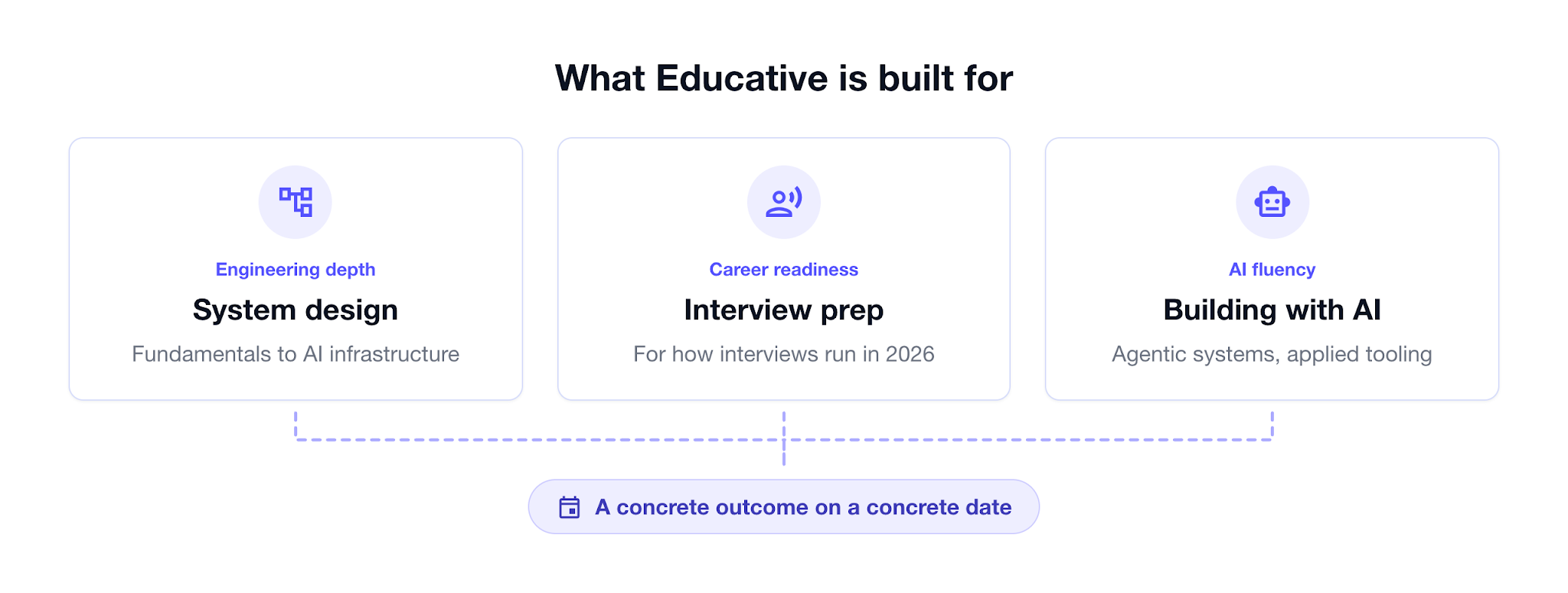
Educative has a specific job. The people who come to it are engineers with a concrete outcome on a concrete date: an interview next month, a system design round, a role that now expects them to build with AI. The depth, the practitioner authorship, and the focus on those three areas are the whole point. Adding algebra homework and HR training to that catalog would make it worse at its job, not better.
The homework problem is a different job. It belongs to anyone, on any subject, at any pace, and it wants breadth and speed. So it got its own product, with its own name, on its own domain.
Fenzo casts wide. Educative goes deep. Both rest on the same conviction about how people learn.
Where to go from here#
If you are preparing for an engineering interview, going deeper on system design, or building the AI skills that are showing up in job descriptions right now, that is what Educative is built for. Start with the interview preparation catalog or our flagship Grokking the Modern System Design course.
If you want a structured course on something else entirely, a subject for work, a topic for school, a chapter that is just not clicking, that is Fenzo — and it is free to start.
Same team. Same conviction about how people learn. Two different platforms.
Frequently asked questions#
What is Fenzo?#
Fenzo is an AI learning agent from the team behind Educative. It turns a question, a topic, or your own notes into a personal learning experience in less than a minute. Its courses include worked examples, practice questions with immediate feedback, and a tutor that knows where you are in the material.
Is Fenzo part of Educative?#
Fenzo is built by the team behind Educative, the interactive learning platform for software engineers founded in 2015. It is a separate product with its own name and its own site, fenzo.ai. Educative stays focused on software engineering, and Fenzo covers any subject modern professionals need help with.
Who is Fenzo for?#
Fenzo serves two groups today. Working professionals use it to learn AI for their specific role, across HR, marketing, sales, analytics, finance, operations, and project management. Students use it to prepare for exams, from the SAT through graduate and professional admissions tests.
How is Fenzo different from ChatGPT and other AI chat tools?#
An AI chat tool answers the question you ask. Fenzo builds a structured course around it, so you practice producing answers instead of only reading them. Lessons build on each other, practice questions give immediate feedback, and the tutor answers in the context of where you are in the course.
Can I turn my own notes or study materials into a course?#
Yes. You can upload a PDF, Word document, slide deck, text file, or an image, and Fenzo builds the course around that material. Students can upload a practice test, mark the questions they missed, and get a course built around exactly those gaps.
Is Fenzo free?#
Fenzo is free to start, with no card required and no trial clock.
Can teams use Fenzo together?#
Yes. Fenzo for Business puts a whole team on one plan, with shared seats, courses you can assign, and reporting on who has finished what.
Should I use Educative or Fenzo?#
Use Educative if you are preparing for a technical interview, going deeper on system design, or building the AI skills that are showing up in engineering job descriptions. Use Fenzo for personal learning experiences and structured courses on anything else, such as a subject for work or a topic for school.
