Grokking Modern System Design Interview Just Got A Massive Update
We recently updated our flagship Grokking Modern System Design Interview for System Design in the AI era. The course now has more than 20 real-world AI features built into 13 classic design problems, a new seven-lesson AI Building Blocks chapter, and two new lessons on how AI has changed system design interviews. Every problem you already know is still there, with the same lesson flow and the same lesson titles.
This post walks through the update the way you'll meet it in the course. Stops 1 and 3 start with lessons you can open right now, for free, without an account.
Stop 1. Read how AI changed the interview#
Start with How AI Reshaped System Design and Interviews, one of the two new lessons in the System Design Interviews chapter. It opens with a prompt you've probably practiced, a customer support chat system. You draw the usual client, API gateway, cache, app servers, queue and sharded database, and then the interviewer asks how the system finds the right policy documents, how a model call fits in the response-time budget, and how you know a generated answer is backed by evidence.
The lesson answers those questions by putting the two request paths side by side:
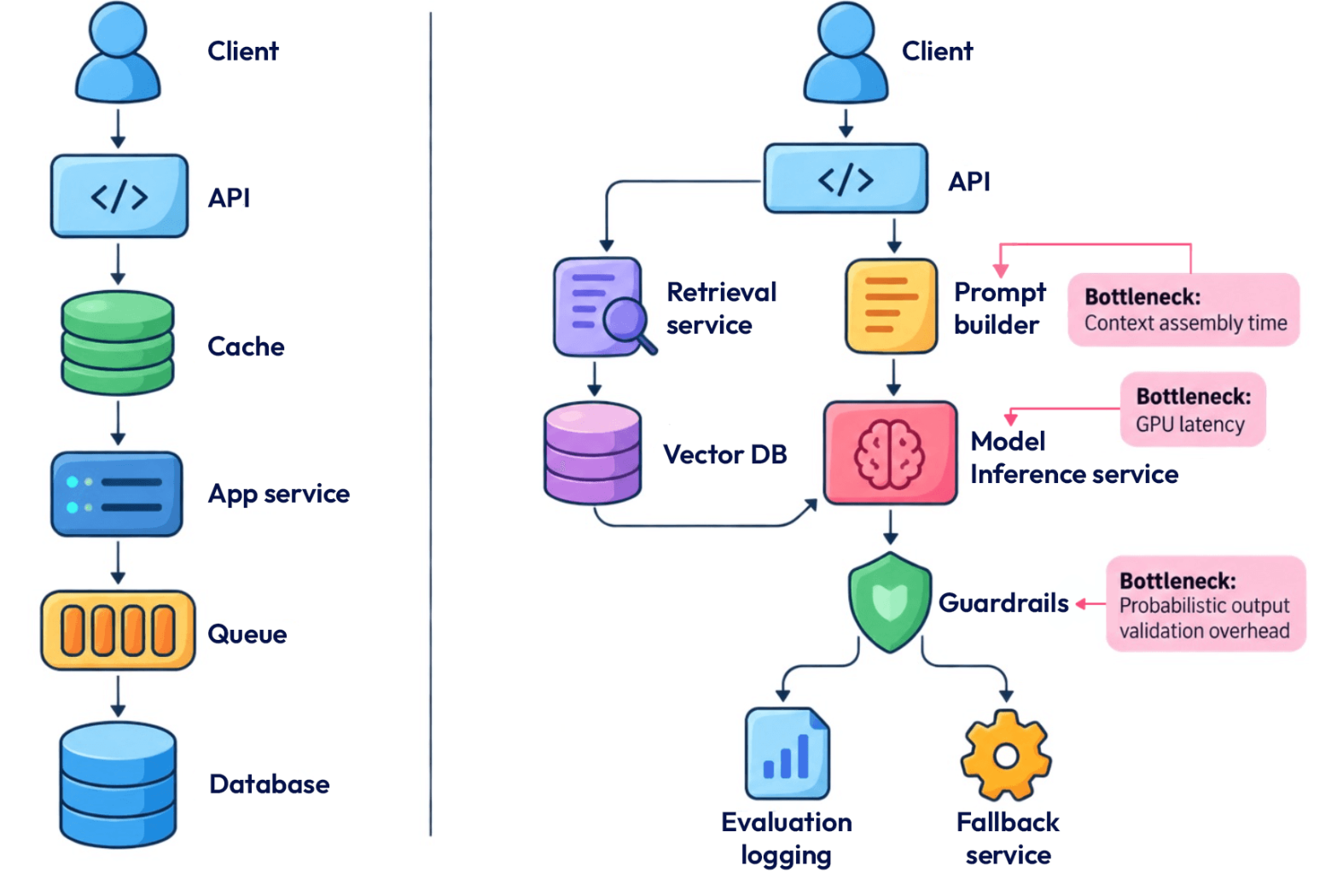
From there it covers the components AI adds (retrieval, vector databases, model inference, guardrails, evaluation and fallbacks), the classic assumptions that stop holding once inference is on the request path, and the levers that keep cost and latency in check. The idea the rest of the course builds on is short enough to remember in an interview. "AI design decisions trade among cost, latency, and output quality."
The second new lesson, How Roles and Tools Reshaped the System Design Interview, shows how interviewers score the same AI design question at different levels. It's the table to study before your next loop.

Stop 2. Learn the seven AI building blocks once#
The course teaches 16 distributed-systems building blocks before the design problems, from DNS and load balancers to sharded counters. The new AI Building Blocks for System Design chapter sits right after them and adds seven more.
Models as Components in a System
Ranking, Prediction, and Classification Pipelines
Tokens, Context Windows, and Generation
Embeddings and Retrieval
Retrieval-Augmented Generation, which also covers agents
Serving Models within Latency and Cost Budgets
Evaluating and Protecting AI Features
You learn each concept once. When a later design problem needs embeddings or retrieval, it links back to this chapter instead of teaching the idea again. The chapter also defines the key metrics for evaluating AI features.
Stop 3. Design Uber, now with its arrival-time models#
The first lesson of the Uber chapter, System Design: Uber, is free. Before you read any design, an AI-powered exercise asks you to list three functional and three non-functional requirements for Uber and explain why each one matters. You type your answer, the AI evaluates it, and you get three attempts, a hint and the reference answer if you need them.

The chapter has six parts (requirements, high-level design, detailed design, payment service and fraud detection, evaluation, and a quiz). What's new is the AI inside the design. You still build the routing and ETA services yourself, and the lesson then shows where Uber's own models fit. DeepETA is the deep learning model Uber uses to correct the routing engine's arrival-time estimate, and DeepETT, which Uber described in May 2026, forecasts travel time for each road segment. The design question the lesson makes you answer is what happens when the model is down, and the answer is that the system falls back to the routing estimate.
The chapter ends with an AI mock interview on Uber Eats system design, a Premium feature, so you can practice the same reasoning out loud.
Stop 4. Ask YouTube, the pattern the other problems reuse#
The Design YouTube chapter has a new lesson on Ask YouTube, AI-powered conversational video discovery. It's based on the real feature, which YouTube made available to U.S. viewers on October 12, 2026. In the lesson you design it as retrieval-augmented generation grounded in video transcripts. That design is the reference pattern the other problems reuse, including the retrieval-based features in Google Docs and Yelp.
Stop 5. The other 11 problems#
Each of the remaining problems keeps its original design and gains an AI feature modeled on one the real company ships, linked inside the lesson to the company's own source. Seven of the 13 problems pair a predictive model, such as a ranker or a classifier, with a smaller generative piece.
Design problem | The AI feature you add | The trade-off you defend |
Home timeline ranking and AI summaries of trending topics, as on X | Retrieving candidates and then ranking them at scale, and generating a summary once to serve it many times | |
Newsfeed | AI ranking during feed construction, and language models that help the system understand posts | Ranking at write time or read time, cold start, and the latency budget |
Explore recommendations and generated alt text for photos | Embedding retrieval, staged ranking and accessibility | |
Typeahead | AI ranking of suggestions | Why the gap between keystrokes is too short for a large language model call on each one, and where generative AI fits instead |
Web crawler | Spam filtering before indexing, and robots.txt rules for AI crawlers | Running classification asynchronously, off the fetch path |
Payment system | Fraud scoring, plus an LLM that helps fraud analysts, modeled on Stripe Radar | Thresholds, false positives against false negatives, and labels that arrive late |
Private summaries of unread messages | Summarizing on the server without giving up the privacy of end-to-end encrypted chats | |
Google Docs | AI writing help grounded in your documents, as in Gemini in Docs | Retrieving only what the user is allowed to see, and applying AI edits safely while others are editing |
Google Maps | AI trip planning for electric vehicles, and Ask Maps | A model estimates energy use and a planner decides, with battery reserve as the safety margin |
Quora | Duplicate-question detection | Similarity against true equivalence, precision over coverage, and merges you can undo |
Yelp | An assistant that recommends places and takes actions such as booking a table or joining a waitlist | Location as a hard constraint, plus confirmation, idempotency and async tasks for every action |
Several lessons also show where the better answer is a predictive model, or no AI at all. Typeahead ranks with a predictive model and keeps generation away from the keystroke path, and Uber's arrival times stay predictive, with the routing estimate as the fallback.
Stop 6. Practice until it holds up in an interview#
Reading the design is half the work. The course gives you several ways to check yourself.
147 quizzes with instant feedback, including end-of-chapter quizzes on many of the design problems.
AI-powered exercises like the Uber one above. The free lesson Let AI Evaluate Your System Design Interview Preparation has two, one on requirements for a video streaming service and one on the clarifying questions you'd ask to scope it.
An AI Tutor on every lesson, for the questions you'd normally save for a study partner.
10 AI mock interviews built into the course, each with a scoring rubric. The mock interview lesson now includes a section on practicing AI-era interviews.
What stayed the same#
Every design problem still follows the same arc of requirements, estimation, high-level design, detailed design and evaluation, built on the RESHADED approach for open-ended problems. Nothing was removed. If you took the course before, the AI material sits inside the lessons you already finished, as one more requirement, one more design section and one more evaluation point, with the AI component highlighted in the diagram you've already seen.
The course today#
Grokking Modern System Design Interview has 220 lessons across 52 modules, 20 case studies and 10 AI mock interviews, about 26 hours in total, and 77 lessons are free to read.
Educative created the Grokking series in 2018, and Grokking System Design evolved into this course, which still lives at its original address. Fahim ul Haq, Educative's co-founder and CEO, built it from nearly a decade of work on large-scale distributed systems at Microsoft and Meta, and the Educative course team keeps it current.
Where to start#
If you've taken the course before, read the two new interview lessons, then the AI Building Blocks chapter, then revisit a problem you know well, such as Uber or YouTube.
If you're new to system design, start at the beginning. The AI Building Blocks chapter builds on the 16 distributed-systems building blocks that come before it.
If you want to try it before you commit, open the Course Structure lesson, which maps where all the AI material lives.
Frequently asked questions#
Is Grokking Modern System Design Interview updated for 2026?
We updated it on October 29, 2026, with more than 20 real-world AI features across 13 classic design problems, a seven-lesson AI Building Blocks chapter, and two new lessons on how AI changed system design interviews.
Do I need a machine learning background?
You don't. The lessons teach design trade-offs such as latency, fallbacks, privacy and evaluation, and they leave model internals out.
Was anything removed?
Nothing was removed. Every original problem, lesson flow and lesson title is still in the course.
Is this the same course as Grokking the System Design Interview?
Grokking Modern System Design Interview is the current edition of Educative's original Grokking system design course. Educative created the Grokking series in 2018, and Grokking System Design evolved into this course, which still lives at educative.io/courses/grokking-the-system-design-interview.
