The best practices for using React and Python together
Struggling to connect React and Python effectively? Learn how frontend and backend truly interact, avoid common pitfalls, and build scalable, production-ready applications with confidence. Master full-stack development the right way.
You’ve probably experienced this transition firsthand. You’ve built a React app that looks great, or a Python backend that handles data efficiently, and now you want to bring them together into a full-stack application. On the surface, this sounds like a natural next step. After all, React handles the UI, Python handles the backend, how hard could it be?
But the moment you try to connect them, things become more complex than expected. You’re no longer just writing components or API routes. You’re dealing with asynchronous communication, data consistency, error handling, and system boundaries. Small decisions, like how you structure an endpoint or where you store state, suddenly have ripple effects across the entire application.
This is where the real question emerges: What are the best practices for using React and Python together? The answer isn’t a simple checklist. It requires understanding how frontend and backend systems interact, how data flows across layers, and how to design an architecture that remains maintainable as your application grows.
Learn React 19: The Complete Guide to Modern Web Apps
React remains one of the most widely used libraries for building modern web applications. This course focuses on modern React (React 18+ and emerging React 19 capabilities), covering improvements in rendering, concurrency, and application architecture that help developers build faster and more scalable user interfaces. This course takes you beyond the fundamentals and focuses on building production-ready React applications. You'll learn how to structure large React codebases using feature-based architecture, state ownership principles, context segmentation, reducer patterns, and headless or compound components. You'll also explore React’s rendering internals, including the Fiber architecture, render and commit phases, and modern concurrent rendering patterns using transitions and Suspense, along with performance optimization strategies such as memoization and component profiling. The course then moves into modern async UI patterns, teaching you how to build responsive interfaces using Suspense, server-side and streaming rendering concepts, lazy loading, and error boundaries, along with an introduction to React Server Components (RSC). You'll learn how to manage server data effectively using TanStack Query (formerly React Query), including caching, dependent queries, optimistic updates, and query invalidation. The course also introduces real-time-inspired and offline-first UI strategies, background synchronization, and performance techniques such as using Web Workers for off-main-thread computation. Beyond architecture and data management, you'll learn how to build complex forms, scalable workflows, and accessible user interfaces, along with practical testing strategies using React Testing Library. The course concludes with production-focused topics including accessibility architecture, internationalization (i18n), design systems, security considerations, and deployment practices. You'll be able to design, optimize, and deploy scalable React applications using modern architectural and performance patterns. Throughout the course, you'll apply what you learn through two hands-on projects: Task Manager Dashboard: Build a complete React dashboard that manages tasks, routing, state, and API interactions. Product Launch Readiness Board: Build a modern collaboration tool featuring optimistic updates, offline-capable editing, simulated real-time collaboration (UI-level), Suspense-based lazy loading, and a themeable, internationalized UI.
Understanding the separation between frontend and backend#
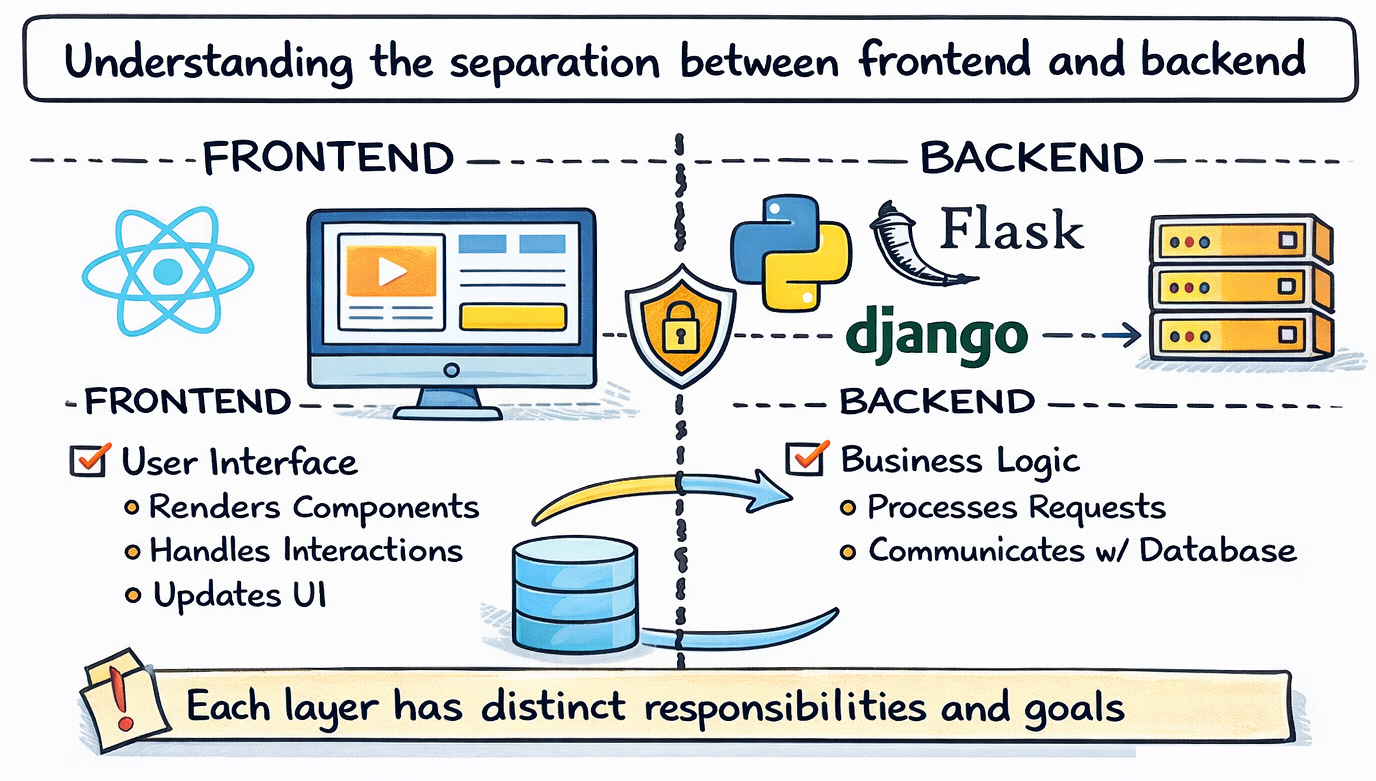
To combine React and Python effectively, you need to start with a clear separation of responsibilities. React is responsible for the user interface—it renders components, handles user interactions, and updates the UI dynamically. Python, through frameworks like Flask or Django, handles business logic, processes requests, and communicates with databases. Each layer serves a distinct purpose, and confusing these roles is where many problems begin.
Modern web applications are intentionally designed around this separation. The frontend should not directly manipulate database logic, and the backend should not concern itself with how the UI is rendered. This boundary allows each layer to evolve independently, which is critical for scalability and maintainability. When you respect this separation, your system becomes easier to reason about and extend over time.
Imagine a user clicking a “Load Orders” button in your React app. That action triggers a request to the backend, where Python processes the request, queries the database, and returns the result. React then takes that data and updates the UI. This flow may seem simple, but it illustrates a key principle: each layer does its job and communicates through a well-defined interface.
React for Front-End Developers
Backed by Facebook and widely adopted by companies of all sizes, React has become one of the most popular front-end libraries in modern web development. As a result, React developers are in high demand. If you already know JavaScript, learning React is a smart step toward advancing your front-end career. In this path, you’ll start with a quick refresher of essential JavaScript and modern ES6+ features used in React development. You’ll then explore React fundamentals, including JSX, components, props, state, and how React renders dynamic user interfaces. As you progress, you’ll learn how to manage state and side effects using React Hooks and build reusable logic with custom hooks. You’ll also explore routing and navigation, modern React improvements, advanced hooks, and techniques for building smooth, responsive user experiences. The path covers handling forms, integrating APIs, and managing asynchronous data in real-world applications. Finally, you’ll extend your skills by integrating Firebase for authentication and databases, and by building strongly typed React applications using TypeScript. By the end, you’ll be able to build modern, scalable, and production-ready React applications with confidence.
How React and Python communicate#
The bridge between React and Python is built through APIs. These APIs define how the frontend and backend exchange data, acting as a contract between the two systems. Without a clear API layer, communication becomes inconsistent, and your application quickly becomes difficult to manage.
In most cases, this communication follows a RESTful pattern. React sends HTTP requests to Python endpoints, and the backend responds with JSON data. This format is lightweight, predictable, and widely supported, making it the standard choice for modern applications. Understanding this interaction is crucial because it shapes how your application behaves at runtime.
For example, when a user submits a form, React gathers the input and sends it to a Python endpoint. The backend validates the data, processes it, and returns a response indicating success or failure. React then updates the UI accordingly. This request-response cycle is the foundation of full-stack applications, and every feature you build will rely on it.
Learn Python 3 - Free Interactive Course
Python has become the foundation for everything from data science and automation to modern AI workflows. Yet many beginners struggle to learn Python because they spend too much time watching and not enough time building. This course is designed for a different kind of learner, one who wants to learn Python by doing, not just observing, and to build skills that remain relevant in an AI-driven development landscape. I built this course from my experience teaching and designing interactive learning systems at Educative. Across classrooms and platforms, I saw the same pattern: learners could follow tutorials, but struggled to apply concepts independently. The problem was the approach. This course is built on a simple principle: you learn Python best when you write, test, and refine code continuously. You’ll start with core fundamentals, variables, control flow, functions, and data structures, through hands-on exercises that reinforce real understanding. As you progress, you’ll build practical projects like a chatbot and an expense tracker. The course also introduces how to learn Python alongside AI tools, including prompting, debugging, and validating generated code in real workflows. If your goal is to learn Python in a way that prepares you to build real applications and work effectively with AI, this course gives you that foundation from day one.
What are the best practices for using React and Python together?#
When you ask What are the best practices for using React and Python together?, you’re really asking how to design a system that behaves predictably under real-world conditions. These practices are not isolated rules—they emerge from understanding how systems interact and how architectural decisions affect long-term outcomes.
Combining React and Python requires you to think beyond individual features. You need to consider how data flows through the system, how components depend on each other, and how changes in one layer affect the other. This means making deliberate decisions about architecture, communication patterns, and scalability from the very beginning.
The rest of this article builds on this idea. Instead of presenting a list of rules, we explore how different parts of the system interact and how thoughtful design leads to better outcomes. This approach helps you develop intuition, which is far more valuable than memorizing best practices.
Designing a clean API layer#
The API layer is the foundation of your full-stack application. It defines how the frontend interacts with the backend and how data is structured and delivered. A well-designed API simplifies frontend development, while a poorly designed one introduces unnecessary complexity.
Consistency is one of the most important aspects of API design. Endpoints should follow predictable naming conventions, and responses should have a uniform structure. This allows React components to consume data without needing complex transformations or special handling for different endpoints.
For instance, if all your endpoints return data in a consistent format, your frontend logic becomes much simpler. You don’t need to write custom parsing logic for each response, and your components can focus on rendering data rather than interpreting it. This not only improves developer experience but also reduces the likelihood of bugs.
Managing state and data flow in the frontend#
State management is where many full-stack applications become complex. In React, state determines what is displayed and how the UI behaves. When you introduce backend data, state becomes dynamic and asynchronous, requiring careful coordination.
When React fetches data from a Python backend, it must handle multiple states: loading, success, and error. This means your UI needs to reflect these states appropriately, ensuring a smooth user experience. If you ignore this, users may see inconsistent or confusing behavior.
Consider a dashboard that loads user data. Initially, React shows a loading indicator. Once the data arrives, the state updates, and the UI re-renders. If the request fails, an error message is displayed. This flow may seem straightforward, but as your application grows, managing these transitions becomes increasingly complex and requires a structured approach.
Handling authentication and security#
Authentication is one of the most critical aspects of combining React and Python. It ensures that users are properly identified and that sensitive data is protected. This process requires coordination between both layers of your application.
A common approach is token-based authentication. When a user logs in, the Python backend generates a token and sends it to the React frontend. React stores this token and includes it in subsequent requests, allowing the backend to verify the user’s identity. This approach is scalable and works well in distributed systems.
Security, however, goes beyond authentication. You need to validate inputs, secure communication channels, and handle sensitive data carefully. These considerations are essential for building applications that are not only functional but also trustworthy in real-world environments.
Comparison of integration approaches#
Approach | Description | Strengths | Limitations |
Direct API integration | React communicates directly with Python APIs | Simple and flexible | Can lead to tight coupling |
Monolithic setup | Frontend and backend are part of the same system | Easier to manage initially | Harder to scale |
Decoupled architecture | Frontend and backend are independent systems | Highly scalable and maintainable | Requires careful design |
Each approach represents a different way of structuring your application. Direct API integration is often the starting point for many developers because it is straightforward and easy to implement. However, as your application grows, this approach can lead to tight coupling between frontend and backend.
Monolithic setups simplify development in the early stages but can become difficult to maintain as complexity increases. Decoupled architectures, while more complex to design, offer the greatest flexibility and scalability. They allow teams to work independently and make it easier to evolve the system over time.
Structuring the project for scalability#
As your application grows, organization becomes critical. You need a structure that separates concerns while allowing different parts of the system to work together seamlessly. This often means maintaining separate codebases for React and Python, each with its own responsibilities.
On the frontend, components should be modular and organized logically. On the backend, routes, services, and models should be clearly defined. This separation ensures that your application remains manageable as it grows in complexity.
Scalability is not just about handling more users—it’s about maintaining clarity and control over your system. A well-structured project allows you to add features, debug issues, and collaborate effectively, ensuring long-term success.
Common mistakes when combining React and Python#
Many developers fall into the trap of tightly coupling their frontend and backend. This makes the system fragile, as changes in one layer can break the other. Maintaining a clear separation between layers helps avoid this issue and keeps your application flexible.
Another common mistake is poor API design. Inconsistent endpoints and unpredictable responses create unnecessary complexity on the frontend. This often leads to duplicated logic and makes the system harder to maintain over time.
Ignoring error handling is also a frequent issue. Real-world systems encounter failures, and your application must handle them gracefully. Without proper error handling, even small issues can lead to poor user experiences and difficult debugging.
Moving from small projects to production systems#
As your application evolves, your architecture must adapt. What works for a small project may not scale to a production system. This transition involves thinking about deployment, performance, and scalability.
For example, a simple application might run both frontend and backend on a single server. As traffic increases, you may need to separate them, introduce load balancing, and optimize performance. These changes require a deeper understanding of system design.
This evolution is a natural part of development. You start with simple solutions and refine them as your needs grow. Understanding this process helps you build systems that can adapt and scale effectively.
Conclusion#
So, What are the best practices for using React and Python together?
They are not about specific tools or shortcuts. They are about understanding how systems are designed, how different layers interact, and how to build applications that are scalable and maintainable. When you approach development with this mindset, you move beyond simply connecting technologies.
Instead, you begin to design systems that can grow, adapt, and handle real-world complexity. And that is what ultimately defines effective full-stack development.
Happy learning!