Best Python cheat sheets for beginners
Ready to speed up your Python learning? Discover the best beginner-friendly Python cheat sheets, compare top options, and learn how to use them strategically so you build real coding confidence instead of memorizing syntax blindly.
If you are learning Python for the first time, you already know that the hardest part is not understanding concepts, but remembering them. You might understand how a for loop works in the morning and completely blank out when you try to write one at night. That is exactly where Python cheat sheets become powerful.
The best Python cheat sheets for beginners do not replace learning. They reinforce it. They help you recall syntax, structure your thinking, and reduce friction while practicing. When used correctly, they act like scaffolding for your coding journey, especially during those early weeks when everything feels overwhelming.
In this blog, you will discover what makes a cheat sheet truly useful, how to choose one based on your goals, and which beginner-friendly Python cheat sheets are genuinely worth your time. By the end, you will know exactly which resource fits your learning style and how to use it strategically instead of passively collecting PDFs you never open.
Learn Python 3 - Free Interactive Course
Python has become the foundation for everything from data science and automation to modern AI workflows. Yet many beginners struggle to learn Python because they spend too much time watching and not enough time building. This course is designed for a different kind of learner, one who wants to learn Python by doing, not just observing, and to build skills that remain relevant in an AI-driven development landscape. I built this course from my experience teaching and designing interactive learning systems at Educative. Across classrooms and platforms, I saw the same pattern: learners could follow tutorials, but struggled to apply concepts independently. The problem was the approach. This course is built on a simple principle: you learn Python best when you write, test, and refine code continuously. You’ll start with core fundamentals, variables, control flow, functions, and data structures, through hands-on exercises that reinforce real understanding. As you progress, you’ll build practical projects like a chatbot and an expense tracker. The course also introduces how to learn Python alongside AI tools, including prompting, debugging, and validating generated code in real workflows. If your goal is to learn Python in a way that prepares you to build real applications and work effectively with AI, this course gives you that foundation from day one.
Why Python Cheat Sheets Matter More Than You Think#
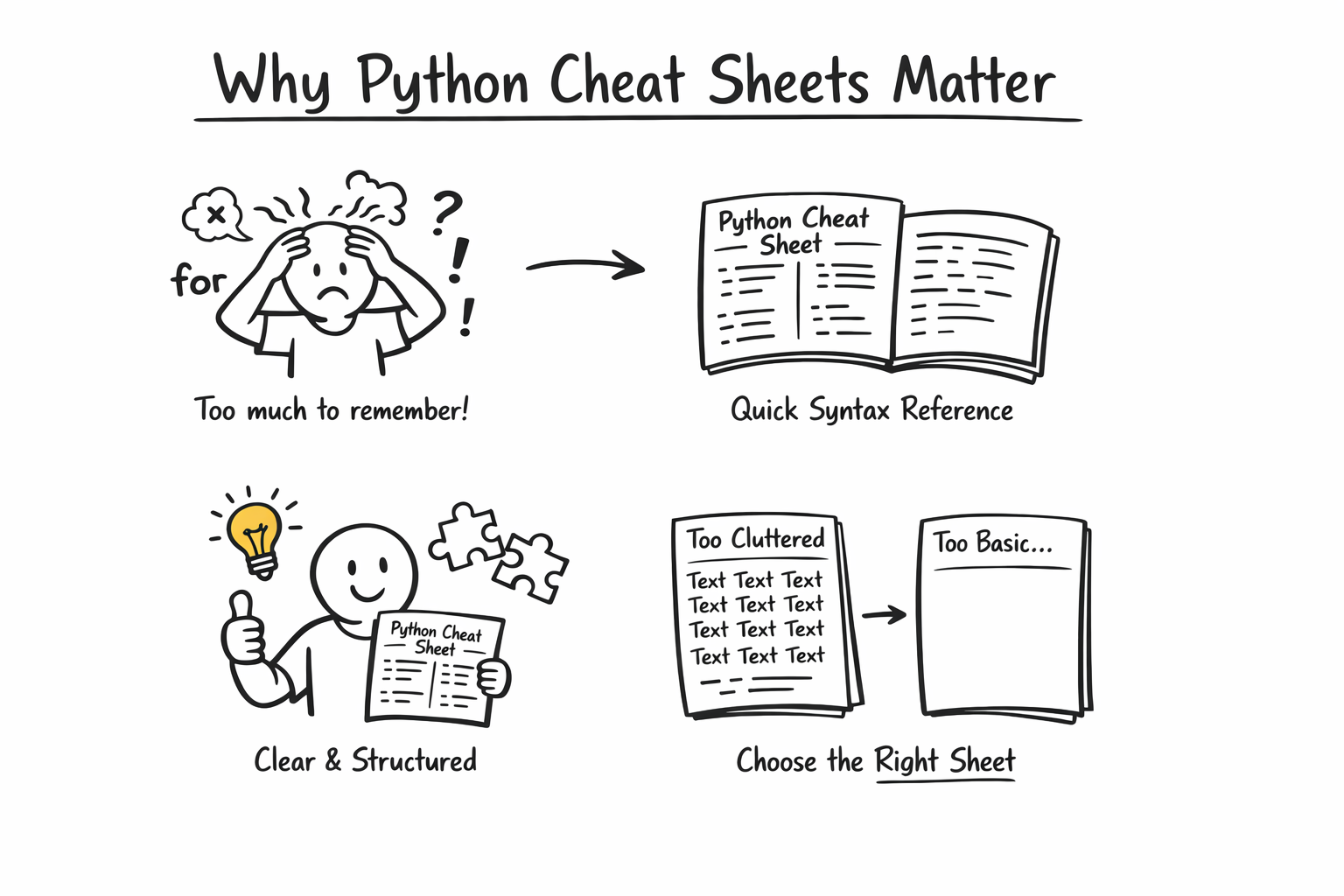
When you are starting out with Python, your brain is juggling too many new ideas at once. Variables, data types, loops, conditionals, functions, indentation rules, error handling, and built-in methods all compete for mental space. That cognitive load slows you down, and it can make you feel like you are not progressing fast enough.
A well-designed Python cheat sheet reduces that load. Instead of trying to memorize every detail, you focus on understanding concepts while using the cheat sheet as a quick reference for syntax. This is how professional developers work as well. They do not memorize everything. They reference documentation constantly.
The difference between struggling beginners and confident beginners is often not intelligence but tooling. A cheat sheet gives you a sense of structure. It shows you how pieces connect, and it provides clarity when you hit a roadblock during practice.
However, not all cheat sheets are created equal. Some are dense walls of text that overwhelm you. Others are too minimal and leave out critical context. Choosing the right one depends on your learning stage and goals.
Python for Programmers
Python is one of the favorite programming languages among developers and data scientists due to its intuitive syntax and advanced functionality. These properties arguably also make Python the most in-demand programming language in the world today. Python libraries make things easier and help reduce the time and effort required to solve big problems. This path will help you use your programming experience to quickly adapt Python to your programming requirements. You'll also go through a few brain teasers to test your understanding. By the end, you'll have advanced knowledge to confidently use Python in your next project.
What Makes a Python Cheat Sheet Beginner-Friendly?#
Before diving into specific Python resources, you should understand what separates a high-quality beginner cheat sheet from a generic summary page.
A beginner-friendly Python cheat sheet should focus on clarity over completeness. It should include core syntax, short examples, and readable formatting. It should avoid advanced topics like decorators, metaclasses, or complex comprehensions unless clearly labeled.
It should also reflect modern Python practices. Python evolves, and outdated syntax can cause confusion. For example, print statements from Python 2 still appear in older cheat sheets. You want resources that reflect Python 3 standards.
Most importantly, the best cheat sheets guide your thinking rather than just listing commands. They show patterns. They demonstrate how loops interact with lists, how conditionals combine with user input, and how functions encapsulate logic. When a cheat sheet reinforces structure, it becomes a learning accelerator rather than a crutch.
Clean Code in Python
Writing high quality code is one of the highly desirable traits of software engineers in the industry. This course is useful for anyone interested in creating scalable and maintainable software design in Python. It is assumed that the learner is already familiar with the principles of object-oriented software design and has experience writing code in Python. In this course, you’ll go through the content in an increasing order of complexity, starting from the basics of Python. The course covers some advanced topics in Python as well, including decorators, descriptors, and an introduction to asynchronous programming. It'll help you discover more about Python because some of the cases are analyzed from the internals of the language itself. After taking this course, you are expected to be equipped with sound hands-on experience and working knowledge of advanced topics in Python. You will be able to demonstrate how to write highly readable and maintainable clean code using the software engineering principles.
Categories of Python Cheat Sheets for Beginners#
Not all Python cheat sheets serve the same purpose. Some focus on core language fundamentals. Others focus on specific domains like data science, web development, or automation.
Below is a comparison of common categories to help you understand where each fits in your journey.
Category | Best For | Topics Covered | Beginner Suitability |
Core Syntax Cheat Sheets | Absolute beginners | Variables, loops, functions, data types | Excellent |
Python Standard Library Sheets | Early intermediate learners | Built-in functions, modules | Good with basics |
Data Science Cheat Sheets | Aspiring analysts | NumPy, Pandas, Matplotlib | Good after fundamentals |
Web Development Sheets | Future backend developers | Flask, Django basics | Moderate |
Interview Prep Sheets | Job seekers | Common patterns, edge cases | Best after practice |
If you are just starting, you should begin with core syntax cheat sheets. Expanding too quickly into specialized cheat sheets can create confusion rather than clarity.
The Best Python Cheat Sheets for Beginners in 2026#
Now, let’s explore the most useful and widely respected Python cheat sheets that genuinely support beginner learning. These are not random downloads but structured references that complement real practice.
1. Official Python Documentation Quick Reference#
It might surprise you, but one of the best beginner cheat sheets is the official Python documentation itself. While it may not look like a traditional cheat sheet, the quick reference sections are extremely reliable and up to date.
When you use official documentation early, you develop a habit that professional developers rely on daily. It builds confidence because you know the information is accurate. It also teaches you how to navigate documentation effectively, which is a skill that becomes essential later in your career.
The official reference is especially strong in explaining built-in functions and data types. It may not always feel beginner-friendly in tone, but it is precise and structured. If you pair it with a more visual cheat sheet, it becomes incredibly powerful.
2. Educative’s Python Syntax Reference Sheets#
Interactive platforms often provide structured Python cheat sheets integrated with guided exercises. Educative-style cheat sheets are particularly effective because they combine explanation with code execution environments.
Instead of simply reading syntax, you see it in context. That reduces passive learning. You are not just scanning keywords. You are applying them. This approach works especially well if you struggle with retention.
For beginners, structured cheat sheets that align with lessons feel less intimidating. They follow a logical progression from variables to control flow to functions, helping you internalize structure instead of memorizing fragments.
3. Real Python Cheat Sheet#
Real Python is known for high-quality educational content, and their cheat sheets reflect that reputation. Their Python cheat sheet provides clean formatting, clear examples, and beginner-friendly explanations.
The layout is visually approachable, which matters more than you might think. When a cheat sheet feels cluttered, your brain resists using it. Clean formatting increases usability.
This cheat sheet is particularly strong in covering common data structures and built-in methods. It does not dive too deeply into advanced material, making it ideal for learners in their first three months of Python practice.
4. DataCamp Python Cheat Sheet for Beginners#
DataCamp provides a concise yet structured cheat sheet that focuses on beginner syntax. It emphasizes common patterns such as loops over lists, dictionary usage, and conditional logic.
If you are someone who learns best by seeing examples, this cheat sheet works well. It is example-driven rather than definition-heavy. That helps you connect syntax with real usage.
However, it is best used as a supplement. It may not provide deep conceptual explanations, so pairing it with active coding practice is essential.
5. GitHub Community Python Cheat Sheets#
Many open-source contributors publish Python cheat sheets on GitHub. These often combine core syntax with practical tips and common pitfalls.
The quality varies, so you need to evaluate formatting and update frequency. Some GitHub cheat sheets are exceptional because they reflect real-world developer experience.
If you choose this route, prioritize repositories with consistent updates and community engagement. That usually signals accuracy and relevance.
Comparing Top Beginner Python Cheat Sheets#
To help you make a practical decision, here is a comparison of major options.
Cheat Sheet | Format | Strength | Weakness | Ideal For |
Official Python Docs | Web reference | Accurate, comprehensive | Can feel dense | Structured learners |
Educative-style Sheets | Interactive | Applied learning | Platform-based | Hands-on learners |
Real Python | Downloadable PDF | Clean and beginner-friendly | Limited advanced topics | Early beginners |
DataCamp | Visual PDF | Example-rich | Less depth | Visual learners |
GitHub Community | Markdown/PDF | Real-world focus | Inconsistent quality | Explorers |
Each option serves a slightly different type of learner. Your choice should reflect how you process information.
How to Actually Use a Python Cheat Sheet Effectively#
Simply downloading a cheat sheet will not improve your skills. The real value comes from how you integrate it into your workflow.
When you practice coding, keep your cheat sheet open beside your editor. Try solving problems from memory first. If you get stuck, reference the cheat sheet. Then close it and attempt again. This strengthens recall rather than replacing it.
You should also annotate your cheat sheet. Add notes. Highlight confusing sections. Rewrite small examples in your own words. When you personalize a cheat sheet, it becomes part of your mental model.
Over time, you will notice that you rely on it less frequently. That is a good sign. It means concepts are becoming internalized.
Common Mistakes Beginners Make With Cheat Sheets#
One major mistake is using cheat sheets as a substitute for practice. Reading syntax repeatedly does not build coding fluency. Writing code does.
Another mistake is collecting too many cheat sheets. When you have five different references open, you create confusion instead of clarity. Choose one primary reference and one backup resource.
You should also avoid jumping into advanced cheat sheets too early. It can create unnecessary cognitive overload and make you feel like you are falling behind.
When to Move Beyond Beginner Cheat Sheets#
At some point, you will notice that you rarely consult your beginner cheat sheet. That is a sign of growth.
As you transition into intermediate topics like object-oriented programming, file handling, and libraries, your cheat sheet needs will change. You may shift from syntax-focused references to concept-focused documentation.
This is a natural evolution. The goal of a beginner's cheat sheet is not permanent dependency. It is accelerated confidence-building.
Building Your Own Python Cheat Sheet#
One of the most powerful strategies you can adopt is creating your own cheat sheet. When you rewrite concepts in your own language, you deepen understanding.
Start by summarizing variables, loops, functions, and data structures on a single page. Include small code snippets that reflect problems you have personally solved.
Over time, this document becomes uniquely tailored to your learning gaps. It evolves with you. That is far more effective than relying exclusively on static PDFs.
Final Thoughts#
The best Python cheat sheet for beginners is not the one with the most pages. It is the one you actually use consistently.
If you prefer structured accuracy, lean toward official documentation. If you thrive on guided examples, choose an interactive platform reference. If you want something clean and printable, Real Python and DataCamp offer strong options.
Your goal should not be to memorize everything. It should be to reduce friction while practicing. When your mental energy shifts from remembering syntax to solving problems, you begin thinking like a developer.
That transformation is the real purpose of a cheat sheet.
