Geometric visualization of the binomial theorem
A
Now that we know what a binomial expression is, let's multiply a binomial expression with itself to get powers of the binomial term. These powers can be expanded using the binomial theorem.
A general expression for binomial theorem goes as follows:
A power of
Let’s look at a simple binomial expression with the first few powers:
In the following section, we'll give a visual explanation of some simple binomial expressions, without going into the algebraic manipulations.
Square of addition of the two terms#
We add the two terms
Geometric proof#
The above expression involves squares and multiplications. In geometry, the multiplication of two terms defines the area of a shape. The most commonly used areas are the areas of squares and rectangles.
The area of a square shape is simply the square of the length of its side.
The area of a rectangle is the multiplication of its length with its width.
In the equation above,
We see the square terms,
, , and . We may think of these as areas of squares with sides , , and . The term involving
can be seen as the area of a rectangle with sides and .
Let’s visualize it in the following figure:


We can see that the areas of the two regions in the image above are the same.
The side of the square with the length
By adding all these areas we get the area of the larger square that is
Equating the areas of the larger square to the sum of areas of the components, we get the binomial expansion of power


Square of subtraction of the two terms#
Let’s make a slight variation in the binomial terms. Instead of taking the sum, we take the difference
Let’s show it geometrically.
Geometric proof#
Visualizing it geometrically is not as simple as in the case of the sum of the binomial terms. Again, we see squares and multiplication terms, indicating we can visualize with squares and rectangles and compute their areas.
On the left-hand side of the equation, we see the difference of the two terms. We can think of it as the difference between the lengths of the sides of two squares. The larger square has the side of length


Let’s look at the right side of the figure now. We get a larger square with a side of length
It contains the smaller square of side
. Its area is . On top of this smaller square is a rectangle with sides
and , so its area is . The same rectangle is there, in the vertical position on the right side of the square with sides
and . The area of the rectangle is . We subtract areas of the rectangles from the larger square of the side
, and we get the area . It’s important to notice here that the two rectangles overlap with each other. The area of the intersection is
. When we subtract the rectangles, we subtract the area twice. We need to add it back once to get the correct measure. We get the area .
So the two areas are the same:


Difference of squares of the two terms#
Let’s look at another binomial expression:
This gives us a nice factored form when we have a difference of two squared terms. We can easily show it algebraically by simply multiplying the factors on the right-hand side of the equation. Let’s show it visually.
Geometric proof#
The left-hand side of the equation indicates the difference of areas of two squares


On the left side of the figure, we see the difference in the areas of the two squares. We get a figure whose upper-right corner is missing. Let’s see how an area of this shape equals the area of a rectangle with sides
On the right side, we see the blue rectangle has sides of lengths
and . It is positioned on top of the square with an area of . When we look at the rectangle and square together, we get a larger rectangle with a vertical side of length and a horizontal base with length . Below the square with area
, we get a smaller vertical rectangle with sides of and . Now, let’s rotate this rectangle and stack it horizontally under the larger white square, which has an area of .


The two rectangles and the square, when stacked on top of each other, form a larger rectangle with sides of lengths
So, we get the identity:
Higher powers#
Can we do it for higher powers? Let’s see for
We can validate it simply by multiplying the
Let’s visualize it geometrically.
Geometric proof#
We can think of

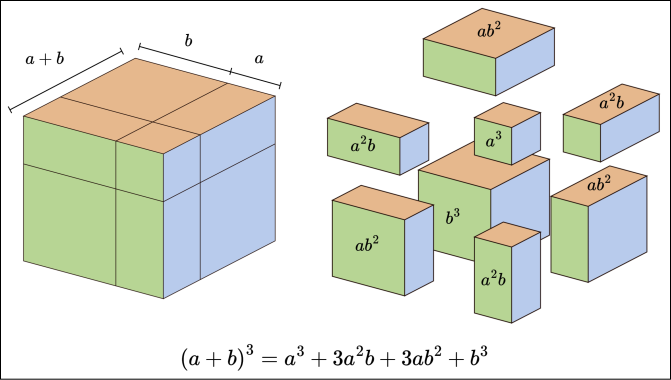
We get a number of cubes and cuboids. Let’s gather their volumes.
We see two cubes of volumes
and . There are three cuboids of volumes
. There are three cuboids of volumes
.
We get the total volume as follows:
Note: For higher powers it becomes hard to show it visually on a two dimensional plane.
Conclusion#
Geometry gives a beautiful way to understand the basic mathematical concepts. In this blog, we proved some basic binomial theorem expansions with the help of geometric shapes. Although it can be done algebraically, the geometric proofs give us a good insight into how the mathematical expressions are actually working.
Getting insights with geometric proofs may help to visualize many mathematical problems and analyses of algorithms.
Your next learning steps#
Problem solving skill is fundamental to computing. Visualizing a problem and its solution simplifies the problem solving approach, its explanation, and analysis. Educative offers some interesting courses to develop and enhance problem solving skills. Have a look at the following courses offered here at Educative: