BookMyShow is one of those System Design interview prompts that feels familiar the moment it’s mentioned. You’ve booked tickets, picked seats, stared at the timer during payment, and maybe lost a seat because someone else confirmed faster. That lived experience makes the problem approachable, which is exactly why it’s so useful as an interview filter: familiarity tempts you into oversimplifying the hardest parts.
From an interviewer’s point of view, BookMyShow isn’t a “movie app.” It’s a high-contention e-commerce system where a scarce resource (seats) is sold under time pressure, with real money involved, and with user trust on the line. The system has to stay correct when users refresh pages, retry requests, abandon checkout, and when payment providers respond late or twice. If you handle those realities calmly and coherently, you signal senior engineering judgment.
What the interviewer is actually testing:
Whether you can reason about correctness under concurrency, articulate trade-offs clearly, and design recovery paths when the happy path breaks.
This blog is a teaching guide. You’ll learn how to talk through the problem like a Staff engineer: you’ll build the design through user flows, state transitions, and decision points, and you’ll practice the exact failure scenarios interviewers use to stress-test your thinking.

For a decade, when developers talked about how to prepare for System Design Interviews, the answer was always Grokking System Design. This is that course — updated for the current tech landscape. As AI handles more of the routine work, engineers at every level are expected to operate with the architectural fluency that used to belong to Staff engineers. That's why System Design Interviews still determine starting level and compensation, and the bar keeps rising. I built this course from my experience building global-scale distributed systems at Microsoft and Meta — and from interviewing hundreds of candidates at both companies. The failure pattern I kept seeing wasn't a lack of technical knowledge. Even strong coders would hit a wall, because System Design Interviews don't test what you can build; they test whether you can reason through an ambiguous problem, communicate ideas clearly, and defend trade-offs in real time (all skills that matter ore than never now in the AI era). RESHADED is the framework I developed to fix that: a repeatable 45-minute roadmap through any open-ended System Design problem. The course covers the distributed systems fundamentals that appear in every interview – databases, caches, load balancers, CDNs, messaging queues, and more – then applies them across 13+ real-world case studies: YouTube, WhatsApp, Uber, Twitter, Google Maps, and modern systems like ChatGPT and AI/ML infrastructure. Then put your knowledge to the test with AI Mock Interviews designed to simulate the real interview experience. Hundreds of thousands of candidates have already used this course to land SWE, TPM, and EM roles at top companies. If you're serious about acing your next System Design Interview, this is the best place to start.
Start by framing the problem the way an interviewer frames it#
A strong answer doesn’t begin with “we’ll use microservices” or “we’ll use Redis.” It begins with framing: what are we building, what matters most, and what constraints define success. Interviewers are listening for whether you can shape ambiguity into a design problem with crisp boundaries.
Start by stating the minimum product: users browse movies and shows, select seats, pay, and receive confirmation. Then immediately tell the interviewer why those steps are not equal. Browsing is read-heavy, cache-friendly, and tolerant of staleness. Seat selection is write-heavy, contention-heavy, and intolerant of errors. Payment is external, slow, and failure-prone, and once money moves you need an audit trail.
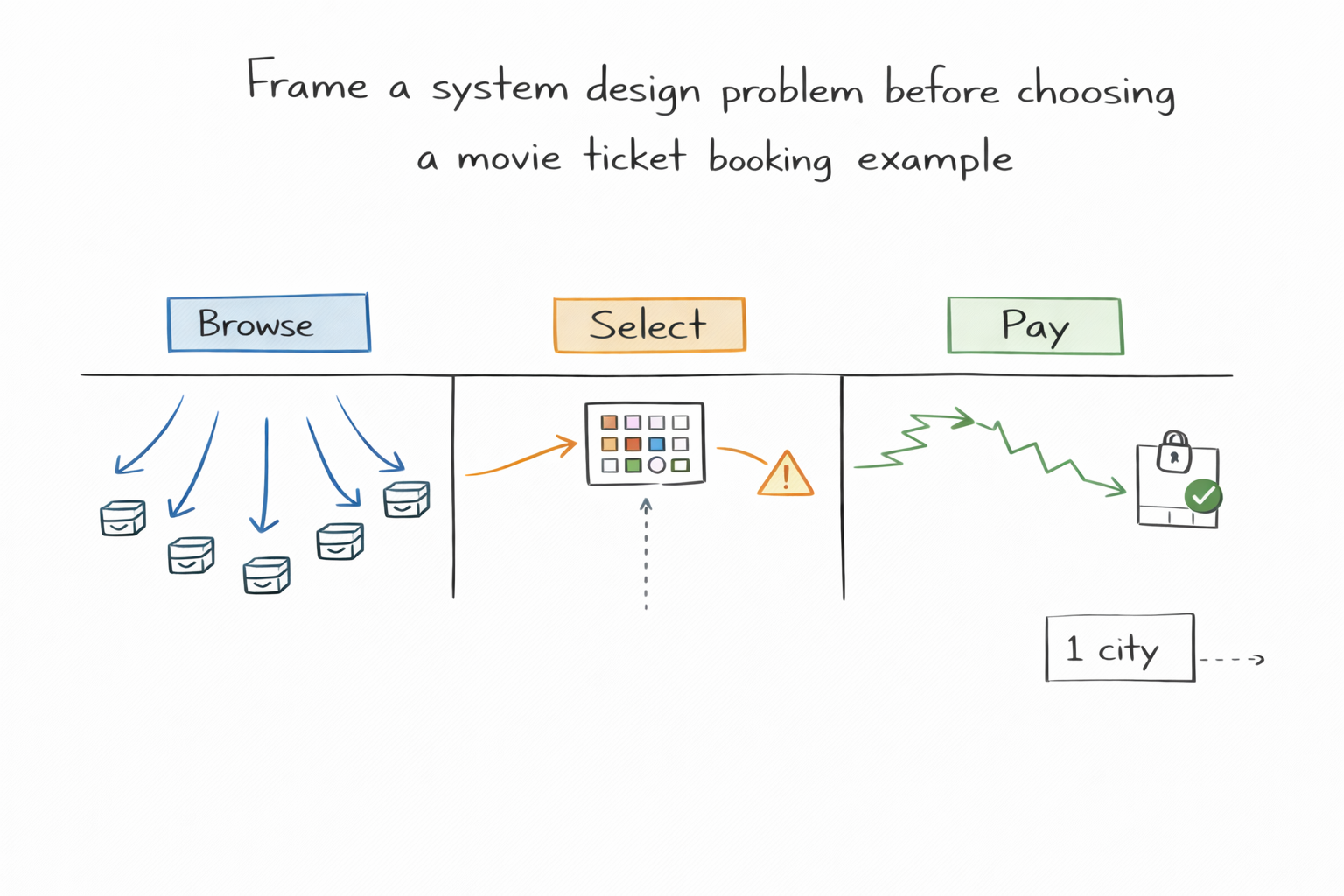
This framing is more than a polite introduction. It sets up the rest of your design. Once you’ve separated “discovery” from “reservation” from “confirmation,” you’ve essentially preempted a dozen follow-ups about consistency.
Interview signal:
You explicitly separate read-heavy, stale-tolerant workflows from write-heavy, correctness-critical workflows before naming any technology.
At this point, the interviewer often pushes on scope because scope reveals how you prioritize. Don’t dodge it. Choose a reasonable initial scope, say it confidently, and leave room to evolve.
If the interviewer pushes back…
“I’ll start with a single region and one city’s theaters so we can focus on the seat reservation mechanics. If you want multi-region, we can extend it once correctness is nailed down.”
That line does two things: it shows focus, and it makes it easy to expand later without rewriting your entire answer.
Think in flows first, because flows expose where systems break#
BookMyShow is best explained as a flow that changes character mid-way. The first half looks like a typical content platform. The second half looks like a stock-trading system for seats.
If you start by listing components, you risk building a “box museum” that doesn’t explain where contention happens. If you start with the user’s journey, the hard parts become unavoidable: “multiple users are looking at the same seat map at the same time” leads naturally to “how do we stop double booking?” and “what happens when payment is slow?”
Here’s the end-to-end flow you should keep returning to. Not because tables are the point, but because this table forces you to attach a consistency requirement to every step.
User action | System responsibility | Consistency need |
Browse city/movie list | Serve catalog and show listings quickly | Eventual consistency is fine |
Open a showtime | Render seat layout and pricing | Mostly available; mild staleness acceptable |
Select seats | Attempt to hold seats atomically | Strong consistency required |
Proceed to payment | Create a reservation record with expiry | Strong consistency required |
Pay | Interact with external gateway | Correctness + auditability |
Confirm booking | Transition held seats to booked and issue ticket | Durable, exactly-once semantics |
See tickets/order | Serve booking history and status | Durable reads, consistent status |
Why this matters in production:
Most customer-facing incidents happen at boundaries between steps (seat hold → payment, payment → confirmation), not inside a single service.
Notice what this table does for your interview. It gives you a rhythm. For each row, you can say: “Here’s what happens, here’s what could go wrong, here’s the guarantee we need.” That’s how senior candidates sound.
The core of the problem is state, not services#
You can describe BookMyShow with three responsibilities—discovery, reservation, confirmation—but the system becomes real only when you explain the state it manages. Interviews reward candidates who treat state as a first-class design object.
Seat availability is the most important state, and it’s where many candidates stumble. The naive mental model is “a seat is either available or not.” That model fails because availability changes rapidly, conflicts are inevitable, and the system must support time-bound holds.
In real systems, seat availability is not a static attribute of a seat. Seats are static entities attached to a screen. Availability is a per-show state attached to a seat. That distinction matters because the same physical seat can be available in one show and booked in another.
This is the point where the interviewer is watching whether you can shift from data storage thinking to data coordination thinking.
What the interviewer is actually testing:
Whether you can model rapidly changing shared state under contention, and whether your design preserves invariants.
An invariant is simply a property that must always be true. In BookMyShow, the big one is: a seat can be booked by at most one user for a given show. Your job is to preserve that invariant even when users retry, servers crash, and payment gateways respond late.
Seat state machine: the “invariant engine” of your design#
Once you say “seat availability is state,” you need to show you can manage state transitions explicitly. The cleanest way is a state machine. You’re not doing this for formality. You’re doing it because state machines make invariants enforceable.
Here’s the seat state machine that should anchor your explanation:
AVAILABLE | Seat is free for selection | → HELD |
HELD | Seat is temporarily reserved | → BOOKED, → RELEASED |
BOOKED | Seat is permanently booked | Terminal |
RELEASED | Hold expired or canceled | → AVAILABLE |
Interview signal:
You anchor correctness in explicit state transitions instead of vague “we’ll handle concurrency” statements.
Now comes the most important teaching moment: explain why the naive approach fails.
The naive approach is to let users select seats client-side, then “confirm” later. You might check availability at confirmation time and reject if taken. That sounds plausible until you see what users experience: they spend time selecting seats and entering payment details, only to be rejected at the end. Worse, under high contention, you create a stampede where thousands of users repeatedly attempt confirmation. The system stays busy rejecting people, and the user experience collapses.
A second naive approach is “we’ll lock rows in the database.” This often works in toy designs. In real high-traffic systems, long-running locks during payment are disastrous. Payment can take seconds or minutes. Holding database locks that long means you’ve converted seat selection into a database throughput problem. Under spikes, your database becomes the bottleneck and everything slows down, which increases timeouts, which causes retries, which increases load. That’s how you spiral into an outage.
Common pitfall:
Treating payment as a short, reliable step and holding locks “until payment completes.” Payment latency turns this into a scalability failure.
This is why HELD exists. It’s the system acknowledging that payment takes time and contention is real, while still preserving the “no double booking” invariant.
Deep seat locking: time-bound reservations and why they work#
The best interview designs use time-bound reservations: when a user selects seats, the system holds them for a fixed TTL (say, five minutes). During that window, no one else can take them. If the user pays in time, the seats transition to BOOKED. If not, the hold expires and the seats become available again.
This is not just a technical trick. It’s a product decision encoded into system behavior. You are balancing fairness, utilization, and frustration.
Fairness matters because users perceive the system as unfair if seats disappear randomly during payment. Utilization matters because holds waste inventory when users abandon checkout. Frustration matters because too-short TTLs cause legitimate users to lose seats mid-payment.
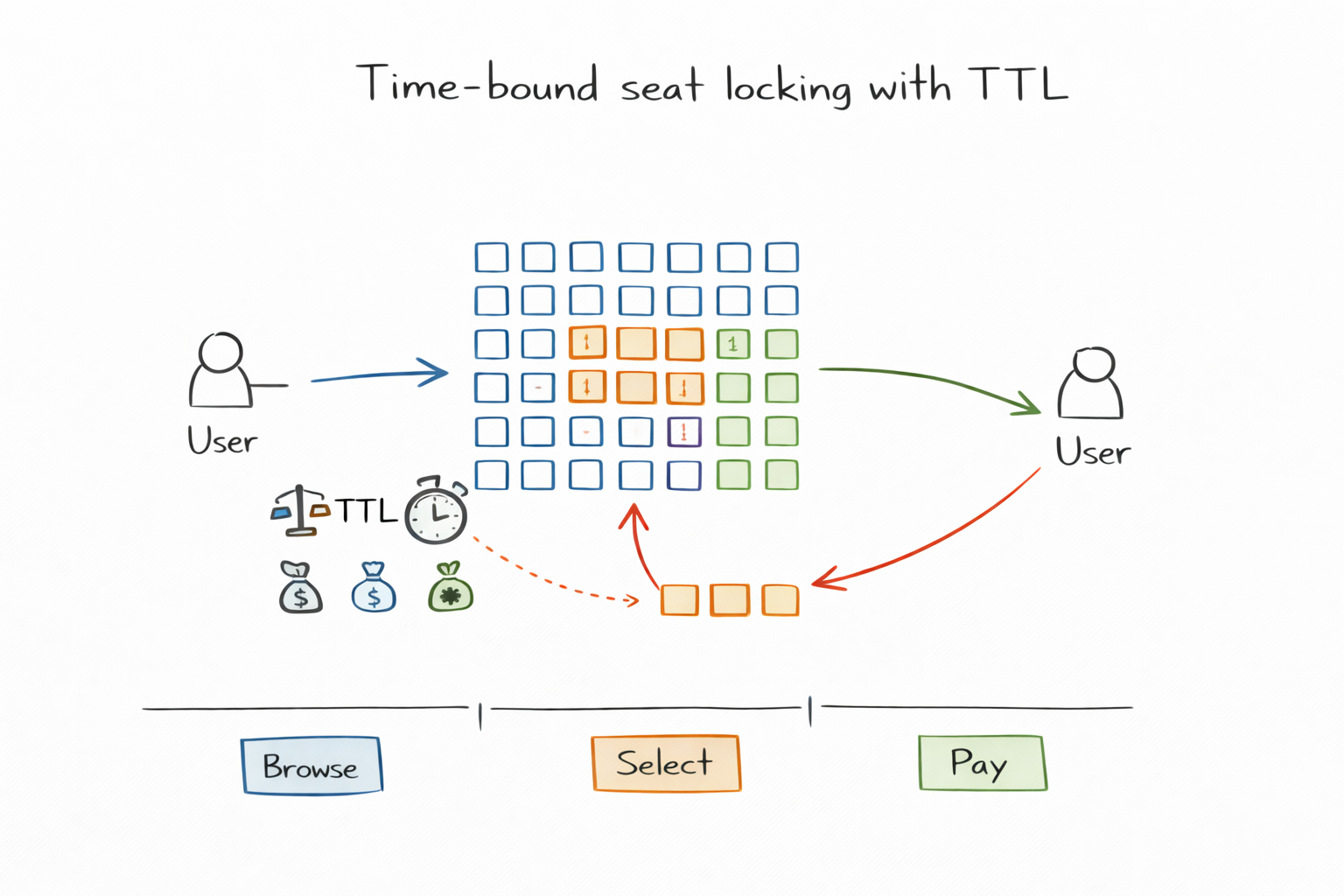
In an interview, you must explain how TTL solves abandoned cart behavior. Abandonment is not an edge case. It is normal. Many users browse, click, hesitate, and leave. If holds never expire, inventory becomes permanently locked. If holds expire, inventory recovers automatically.
Why this matters in production:
The hold TTL is a lever that directly controls revenue: too long wastes seats; too short causes users to fail payment and churn.
Now you need a locking strategy. There are multiple ways to implement holds, and interviewers expect you to compare them in terms of contention and failure handling, not in terms of “which tool is popular.”
DB row locks | Transaction locks seat rows | Simple mental model, strong correctness | Poor under spikes, lock contention, long payment times | Low traffic, small scope |
Redis TTL holds | Atomic set with expiry + store reservation data | Very fast, scales under contention, TTL expiry built-in | Must handle Redis failures, requires reconciliation to DB | Most interview-friendly choice |
Token reservation service | Reservation tokens per seat/show, validated on confirm | Strong correctness + fair ordering possible | More moving parts, needs token issuance/replay protection | Extreme contention and fairness requirements |
An interviewer doesn’t need you to pick the “perfect” choice. They need you to pick a reasonable choice and defend it under follow-ups. A common and practical choice is Redis TTL holds for the hot path, with a durable booking store as the system of record.
This is an important nuance: you can use an in-memory store for speed, but the moment money enters, your audit trail must be durable.
What the interviewer is actually testing:
Whether you understand which state can be ephemeral (holds) and which must be durable (bookings and payments).
A complete booking flow, narrated like you’re in the room#
Now you put it all together. The best way to do this in an interview is to narrate one complete booking and call out what gets written where and why.
The user starts by browsing movies in a city. This is discovery. You serve it from caches and read replicas. If your “now showing” list is a few seconds stale, the user won’t notice. Your job here is speed and availability.
The user picks a movie and showtime and loads the seat map. At this point, you show AVAILABLE seats, but you treat this view as informational, not authoritative. You can even include a subtle disclaimer in real products: “Seats are not confirmed until booked.” In interviews, you say it directly: the seat map is a read view; correctness is enforced at hold time.
The user selects seats A10 and A11 and clicks “Proceed.” Now the system must act. You send a request to the reservation workflow that attempts to transition those seats from AVAILABLE to HELD. This must be atomic. Either both seats are held for the user or none are. Partial holds create a confusing UX and complicate release logic.
The reservation system creates a reservation record with a reservation ID and an expiry timestamp. The seats are now HELD for that reservation. Other users see them as unavailable. The reservation ID is returned to the client, because it becomes the handle for the rest of the checkout.
The user proceeds to payment. Payment initiation creates a payment intent in your system that references the reservation ID. The gateway call includes an idempotency key so retries don’t create duplicate charges. Payment completes, but you still do not declare success until you confirm booking.
On confirmation, your booking system checks that the reservation is still valid and unexpired, then transitions seats from HELD to BOOKED and writes a durable booking record. That durable record becomes the ticket source of truth. Only now do you respond to the user with a confirmation and ticket details.
If any step fails after payment, you treat it as an exception path and reconcile, which is where senior designs really stand out.
Interview signal:
You define the exact “commit point” where the system considers a booking final, and you justify it.
Idempotency: the difference between “works once” and “works always”#
High-contention systems amplify retries. Users refresh seat maps. Mobile networks drop. Browsers resend POSTs. Load balancers retry on timeouts. If you don’t design for retries, you will create duplicate holds, duplicate bookings, and duplicate payment attempts.
Idempotency means the same request can be executed multiple times and produce the same result. In BookMyShow, idempotency is not optional. It is the only way to survive real client behavior.
The naive approach is to treat each request as unique. That creates duplicates immediately. A user clicks “Pay” twice, and you create two payment intents. A gateway retries a callback, and you record payment twice. The user refreshes confirmation, and you create two bookings.
The correct approach is to attach a stable idempotency key to each operation. The system stores the mapping from idempotency key to outcome, and repeated requests return the existing outcome instead of re-executing.
Create reservation (hold seats) |
| Duplicate holds, inconsistent seat states |
Start payment |
| Double charges, duplicate gateway requests |
Confirm booking |
| Duplicate bookings for same reservation |
Handle payment callback |
| Double-recorded payments, repeated transitions |
What the interviewer is actually testing:
Whether you design for real user behavior (retries and refreshes), not idealized happy paths.
Idempotency also changes how you talk about retries. Instead of “we retry a few times,” you say: “We retry safely because operations are idempotent.” That’s a big difference. Retrying without idempotency is how systems corrupt state.
Mini case studies: four failure scenarios you must be able to explain#
Interviewers almost always probe failures around the “money meets state” boundary. They’re looking for whether you can preserve invariants when the system is partially failing.
Case study 1: payment succeeds but booking confirmation fails#
This is the canonical distributed failure. The user’s payment goes through, but your booking service crashes before it can transition HELD → BOOKED and write the booking record.
The naive approach is to treat this as catastrophic and manually fix it. That’s not acceptable. The correct approach is to design for it up front.
Your system must record payment success durably and in a way that can be reconciled. When booking confirmation fails, you attempt to confirm again using idempotency keys. If confirmation cannot succeed because the reservation expired, you trigger a compensating action: refund or void, depending on your payment model. You also make this visible to the user as a “pending” or “failed, refund initiated” state, rather than leaving them in limbo.
Why this matters in production:
Nothing destroys trust faster than taking money without issuing tickets.
If the interviewer pushes back…
“This is why I separate ‘payment authorized’ from ‘booking confirmed’ and run reconciliation jobs to handle orphaned payments.”
Case study 2: booking confirmed but payment callback is delayed#
Payment gateways often call you back asynchronously. Sometimes the callback arrives late, after the user has been redirected. Sometimes it arrives twice. Sometimes the initial response times out even though the payment succeeded.
The naive approach is to assume synchronous payment success and lock seats until you hear back. That pushes latency into your hot path and causes contention to explode during spikes.
A better design treats the booking as dependent on durable payment state and allows a “pending payment” state if needed. If you confirm booking only after payment authorization is recorded, you can handle delayed callbacks by polling gateway status using the payment intent, or by accepting the callback later and transitioning the booking state exactly once using idempotency.
The point is not the exact mechanism. The point is that delayed callbacks are normal, and your system should converge correctly without duplicates.
Interview signal:
You acknowledge that payment is asynchronous and you design for eventual convergence, not perfect synchronicity.
Case study 3: the user retries checkout and causes duplicates#
Under load, the user clicks “Pay” twice. Or the client retries the “confirm booking” request after a timeout. Or the app relaunches and replays the request.
If you haven’t designed idempotency at reservation, payment, and booking confirmation boundaries, you will produce duplicates. If you have designed idempotency, repeated requests simply return the same reservation ID, the same payment intent, or the same booking ID.
This is where you should explicitly say how your APIs behave: repeated ConfirmBooking(booking_request_id) returns the existing booking if already created. Repeated StartPayment(payment_intent_id) does not start a new charge.
Common pitfall:
Saying “the client shouldn’t retry POST requests.” In real systems, clients retry because they have to.
Case study 4: reservation expires mid-payment#
This scenario is uncomfortable but realistic. The user holds seats for five minutes. Payment takes too long. The reservation expires at minute five. Then at minute six, the gateway reports success.
The naive approach is to extend holds automatically whenever payment is in progress. Under spikes, that is how you starve inventory and block legitimate buyers. It’s also how you turn “short-lived holds” into “indefinite locks.”
A better design treats expiry as final. If the reservation has expired, you do not confirm booking. You reconcile by refunding or voiding the payment. You also expose this to the user clearly: “Payment succeeded but seats could not be confirmed; refund initiated.” In interviews, you tie it back to correctness: you are protecting the seat allocation invariant.
If the interviewer pushes back…
“If we want to reduce this scenario, we can shorten the payment path by pre-authorizing earlier or by warning users before expiry, but we still don’t violate the ‘no double booking’ invariant.”
Consistency versus availability: make it a deliberate story#
Interviewers like candidates who can articulate when the system chooses availability and when it chooses consistency. BookMyShow makes this contrast sharp.
Browse catalog | Availability and speed | Perfect freshness | Users tolerate staleness |
View seat map | Availability-biased reads | Fully accurate live state | Correctness happens at hold |
Hold seats | Consistency | Some requests rejected | Prevent double booking |
Payment | Correctness and auditability | Low latency guarantees | Money reminder: be precise |
Confirm booking | Durability | Speed under failure | Trust depends on records |
This table helps you answer a common interviewer line: “What if the database is down?” You can respond with a nuanced answer: browsing can degrade gracefully; seat holds cannot.
What the interviewer is actually testing:
Whether you can protect correctness by reducing availability only where it’s necessary.
Failure scenarios candidates overlook#
The four case studies above are the classics, but strong candidates go one step further: they demonstrate that they can anticipate the failures that don’t show up in toy designs.
One overlooked scenario is split-brain visibility: the seat map page shows a seat as available because the client cached a layout or because reads are served from replicas, but the hold service rejects the hold because someone else already held it. This is not a correctness bug if you enforce correctness at hold time. It becomes a product problem if you don’t communicate it. In interviews, you say: “Seat maps are informational; holds are authoritative.”
Another overlooked scenario is double-release: the user cancels checkout, and your system also has a TTL expiry process. Without careful design, you might release the hold twice and corrupt counters. This is why release operations should be idempotent too, and why state transitions should be conditional: only HELD can move to RELEASED, and only if the reservation matches.
Why this matters in production:
Overlooked failure scenarios become “impossible bugs” that appear only during peak traffic.
How user behavior changes correctness#
High-contention systems are defined by user behavior as much as by code. Users refresh when they’re anxious. They open multiple tabs. They ask friends to book in parallel. They back out and come back. Your design must treat these behaviors as normal.
This is also why you avoid “client authority.” If the client tells you “these seats are mine,” you ignore it. The server is the arbiter. The client is a view.
It’s also why you design the confirmation experience carefully. If the user reaches a “processing” page and refreshes, your system should respond consistently. That usually means your booking confirmation endpoint returns the current status of the booking attempt keyed by an idempotency key. The user shouldn’t be able to create a new booking attempt accidentally just by refreshing.
Interview signal:
You design APIs around real user behavior: retries, refreshes, and duplicate actions.
How the design changes at extreme scale#
At moderate scale, Redis TTL holds plus a durable bookings database is often enough. At extreme scale—blockbuster openings, limited seat releases—the hot path becomes the bottleneck and you need more active traffic shaping.
The most common scale pressure is that a small number of shows become hotspots. That creates a thundering herd on the hold operation. If you simply “scale the service,” you may still bottleneck on the shared state store.
At that point, you introduce backpressure and admission control. You rate limit seat hold requests per user and per show. You may queue hold attempts for fairness. You can even “pre-filter” traffic by requiring users to enter a waiting room before they can access seat selection, which protects the core hold service from overload.
This is an interview moment: the interviewer asks “what breaks first?” A strong answer is not “we autoscale.” A strong answer is: “the contention point is the hold operation on a show; we protect it with admission control and degrade non-critical features.”
If the interviewer pushes back…
“I’m okay rejecting some hold attempts during spikes because correctness is more important than availability for seat allocation.”
A small recap that stays out of your way#
The goal of this recap is not to turn the article into notes. It’s to give you a few sentences you can carry into an interview.
After you’ve explained the flow, the state machine, the locking, and the failures, the only quick summary you need is:
BookMyShow is an e-commerce concurrency problem: seats are inventory, booking is checkout, and payment is external.
Correctness lives in explicit state transitions (AVAILABLE → HELD → BOOKED) with time-bound reservations and idempotent operations.
Reliability comes from designing for retries and reconciliation, especially when payment and booking diverge.
Final words: what “acing” this interview really means#
If you’re looking for the secret to doing well on BookMyShow, it’s not memorizing components. It’s learning to tell a coherent story under pressure. You frame the problem around flows and invariants. You explain why naive designs fail. You show how your design behaves when payment is slow, when requests retry, and when the system partially fails. You don’t sound defensive when challenged because your design has explicit commit points, idempotency keys, and reconciliation paths.
That’s what interviewers reward: clear thinking, confident trade-offs, and calm adaptability when the problem stops being ideal.
Happy learning!